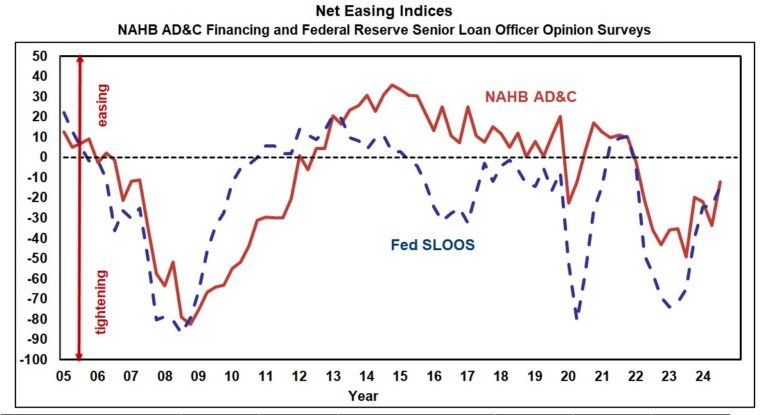
Credit conditions on loans for residential Land Acquisition, Development & Construction (AD&C) were still tightening in the third quarter of 2025, according to NAHB’s quarterly survey on AD&C Financing. The net easing index derived from the survey posted a reading of -11.0 (the negative number indicating that credit tightened since the previous quarter). This is in reasonably close agreement with the third quarter reading of -6.6 for the similar net easing index produced from the Federal Reserve’s survey of senior loan officers—marking fifteen consecutive quarters of tightening credit conditions reported by both builders and lenders.
More details from the Fed’s survey of lenders—including measures of demand and net easing for residential mortgages—appeared in a previous post.
According to the NAHB survey, the most common way lenders tightened in the third quarter was by lowering the maximum allowable loan-to-value or loan-to-cost ratio on the loans (cited by 60% of the builders and developers who reported tighter credit). Tied for second place were reducing the amount they are willing to lend, requiring out-of-pocket payment of interest or borrower funding of an interest reserve, and requiring personal guarantees (cited by 47% each).
Results on the cost of credit in the third quarter were mixed. The average contract rate increased from 7.82% to 7.95% on loans specifically for residential land acquisition—but declined on the other three categories of loans tracked in NAHB’s AD&C survey: from 8.04% to 7.68% on loans for land development, from 8.17% to 7.90% on loans for speculative single-family construction, and from 7.95% to 7.90% on loans for pre-sold single-family construction.
Meanwhile, the average initial points charged on the loans increased across the board: from 0.56% to 0.66% on loans for land acquisition, from 0.74% to 0.83% on loans for land development, from 0.72% to 0.74% on loans for speculative single-family construction, and from 0.58% to 0.67% on loans for pre-sold single-family construction.
Those combinations of quarter-to-quarter changes caused the effective interest rate (which takes both the contract rate and initial points into account) to increase from 9.95% to 10.15% on loans for land acquisition, but to decline from 11.77% to 10.92% on loans for land development and from 12.82% to 12.04% on loans for speculative single-family construction. The average effective rate on loans for pre-sold single-family construction remained essentially unchanged at 12.74%, compared to 12.73% in the second quarter.
Although results on the average effective interest rate were mixed on a quarter-to-quarter basis, the rate on each of the four types of AD&C loans has declined significantly since peaking somewhere in the period between 2023 Q3 and 2024 Q2.
Also in the NAHB AD&C survey, 37% of respondents who built single-family homes during the third quarter of 2025 reported financing some of the construction with a construction-to-permanent (one-time-close) loan made to the ultimate home buyer. On average, 63% of the homes these respondents built were financed this way.
More detail on credit conditions for residential builders and developers is available on NAHB’s AD&C Financing Survey web page.
This article was originally published by a eyeonhousing.org . Read the Original article here. .