Tag

Territory

Browsing


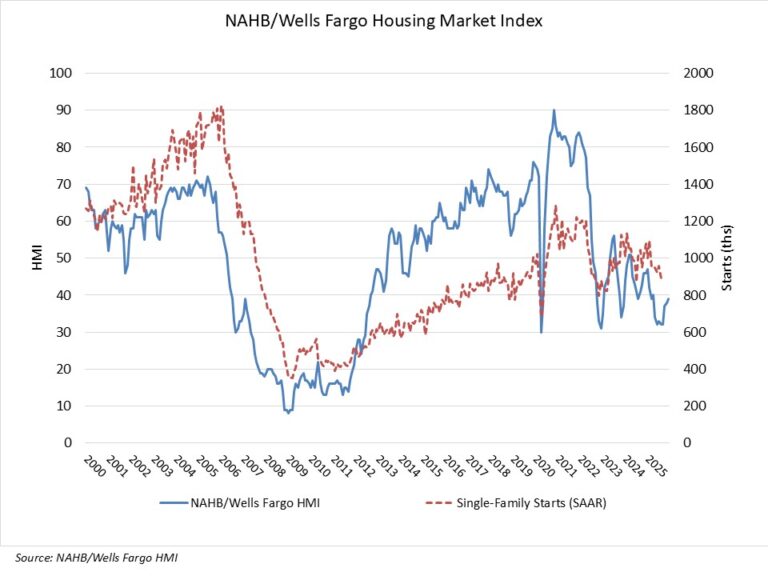
Builder confidence inched higher to end the year but still remains well into negative territory as builders continue to grapple with rising construction costs, tariff and economic uncertainty, and many potential buyers remaining on the sidelines due to affordability concerns.

Builder confidence in the market for newly built single-family homes rose one point to 39 in December, according to the National Association of Home Builders (NAHB)/Wells Fargo Housing Market Index (HMI). Sentiment levels were below the breakeven point of 50 every month in 2025 and ranged in the high 30s in the final quarter of the year.

Market conditions remain challenging with two-thirds of builders reporting they are offering incentives to move buyers off the fence.

In positive signs for the market, builders report that future sales expectations have been above the key breakeven level of 50 for the past three months and the recent easing of monetary policy should help builder loan conditions at the start of 2026. However, builders continue to face supply-side headwinds, as regulatory costs and material prices remain stubbornly high. Rising inventory also has increased competition for newly built homes.

In a further sign of ongoing challenges for the housing market, the latest HMI survey also revealed that 40% of builders reported cutting prices in December, marking the second consecutive month the share has been at 40% or higher since May 2020. It was 41% in November. Meanwhile, the average price reduction was 5% in December, down from the 6% rate in November. The use of sales incentives was 67% in December, the highest percentage in the post-Covid period.

Derived from a monthly survey that NAHB has been conducting for more than 40 years, the NAHB/Wells Fargo HMI gauges builder perceptions of current single-family home sales and sales expectations for the next six months as “good,” “fair” or “poor.” The survey also asks builders to rate traffic of prospective buyers as “high to very high,” “average” or “low to very low.” Scores for each component are then used to calculate a seasonally adjusted index where any number over 50 indicates that more builders view conditions as good than poor.

The HMI index gauging current sales conditions increased one point to 42, the index measuring future sales rose one point to 52 and the gauge charting traffic of prospective buyers held steady at 26.

Looking at the three-month moving averages for regional HMI scores, the Northeast fell one point to 47, the Midwest rose two points to 43, the South increased two points to 36 and the West gained four points to 34.

The HMI tables can be found at nahb.org/hmi.

Editor’s Note: With the official 2026 release schedule for the Survey of Construction still unavailable from the U.S. Census Bureau, NAHB confirms the HMI for January 2026 will be released on January 16.  A schedule for the rest of the year will be available as soon as possible.


This article was originally published by a eyeonhousing.org . Read the Original article here. .

Confidence in the market for new multifamily housing increased year-over-year in the third quarter, according to the Multifamily Market Survey (MMS) released today by the National Association of Home Builders (NAHB). The MMS produces two separate indices. The Multifamily Production Index (MPI) had a reading of 46, up six points year-over-year, while the Multifamily Occupancy Index (MOI) had a reading of 74, down one point year-over-year.

The MPI and MOI are giving a mixed picture, creating a bifurcation of the multifamily market.  While MPI is still in negative territory, developers of low-rise market-rate and subsidized rental properties express increased optimism, with both components above 50 for the quarter.  Weakness is concentrated in the mid-to-high-rise and condominium developments which tend to be common in high-density metro areas.  This is consistent with NAHB’s Home Building Geography Index where multifamily construction activity is growing in areas with low population densities but weakening in the larger metros. 

Even though MOI is in positive territory and existing apartment owners are positive about occupancy overall, this is the lowest reading since NAHB redesigned the survey starting in Q1 2023.  Sentiment for mid/high-rise apartment occupancy is noticeably weaker than it is for the other two rental market segments.

Multifamily Production Index (MPI)

The MMS asks multifamily developers to rate the current conditions as “good”, “fair”, or “poor” for multifamily starts in markets where they are active.  The index and all its components are scaled so that a number above 50 indicates that more respondents report conditions as good rather than poor. The MPI is a weighted average of four key market segments: three in the built-for-rent market (garden/low-rise, mid/high-rise, and subsidized) and the built-for-sale (or condominium) market.

All four components experienced year-over-year increases in the third quarter of 2025: both the components measuring mid/high rise and subsidized units jumped up nine points to 37 and 55, respectively, the component measuring built-to-sale units increased six points to 35, and the component measuring garden/low-rise units increased three points to 51.

Multifamily Occupancy Index (MOI)

The survey also asks multifamily property owners to rate the current conditions for occupancy of existing rental apartments, in markets where they are active, as “good”, “fair”, or “poor”.  Like the MPI, the MOI and all its components are scaled so that a number above 50 indicates more respondents report that occupancy is good than as poor.  The MOI is a weighted average of three built-for-rent market segments (garden/low-rise, mid/high-rise and subsidized). 

Two of the three MOI components experienced year-over-year decreases in the third quarter of 2025; the component measuring subsidized units fell by five points to 81 and the garden/low-rise component dipped one point to 76.  Meanwhile, the component measuring mid/high-rise units was unchanged at 66.  All three MOI components remain well above the break-even point of 50.

The MMS was re-designed in 2023 to produce results that are easier to interpret and consistent with the proven format of other NAHB industry sentiment surveys.  Until there is enough data to seasonally adjust the series, changes in the MMS indices should only be evaluated on a year-over-year basis.

Please visit NAHB’s MMS web page for the full report.

Discover more from Eye On Housing

Subscribe to get the latest posts sent to your email.


This article was originally published by a eyeonhousing.org . Read the Original article here. .
Pin It