As of 2024, one in five adults aged 25-34 lives with parents or in-laws. NAHB’s analysis of the latest American Community Survey (ACS) Public Use Microdata Sample (PUMS) evaluates a wide range of socioeconomic and demographic factors that shape young adults’ path to independence. While the long-run demographic trends toward delaying marriage and childbearing are highly consequential, housing market constraints remain a significant barrier to leaving parental homes.
The current share of 19.5% translates into approximately 9 million young adults living with parents or parents-in-law. This is a sharp increase from 2000, when fewer than 12% (4.6 million) did so. The share peaked at roughly 22% in 2017–2018, when the ACS recorded more than 9.7 million young adults in this living arrangement.
Demographic Characteristics
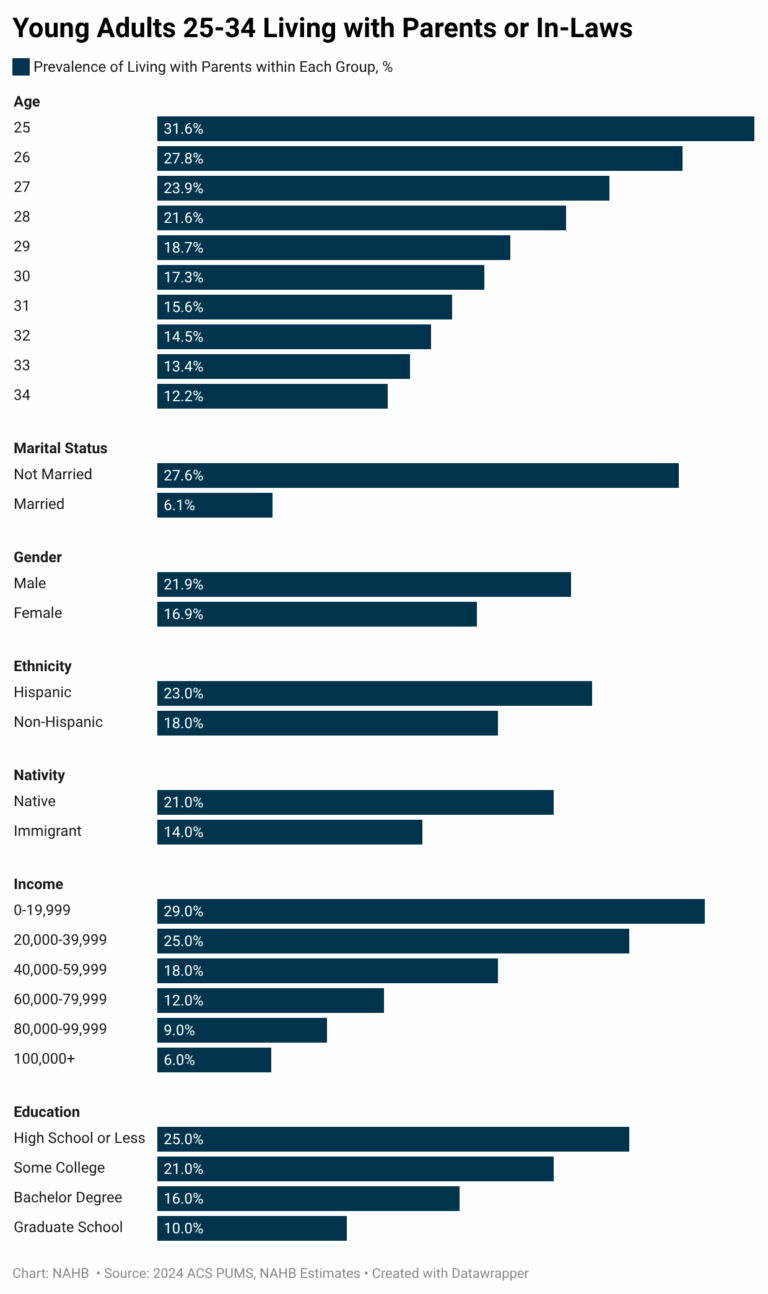
A range of demographic characteristics influences the likelihood of leaving the parental home. Marriage is most consequential: 28% of single young adults live with parents, compared to just 6% of their married counterparts. Age follows a predictable pattern: nearly one-quarter of 25-year-olds live at home, falling to 17% among 30-year-olds and 12% at the upper end of the cohort. Young men are more likely to live with parents than young women (22% versus 17%).
Ethnicity and nativity further shape these outcomes. Hispanic young adults are more likely to live with parents (23%) than non-Hispanic peers (18%), consistent with higher rates of multigenerational living. In contrast, foreign-born young adults are less likely to live with parents than their native-born counterparts (14% versus 21%), likely reflecting the fact that many immigrants in this age group arrive in the U.S. as independent adults without family present.
Economic Drivers
Income and employment are the primary economic drivers. More than a third (34%) of unemployed young adults reside with their parents. Among those with jobs, the share is 17%. Income reinforces this pattern. The share living at home declines steadily with earnings, from nearly 30% among those earning less than $30,000 annually to just 6% among those earning $100,000 or more.
Educational attainment follows a similar gradual-decline pattern. The share living with parents decreases from a quarter of young adults without education beyond high school down to 16% among those with a bachelor’s degree and 10% among graduate degree holders.
Estimating the Odds of Independent Living
The socioeconomic and demographic forces shaping young adults’ residential independence are deeply intertwined. Educational attainment, for example, rises with age because completing advanced degrees requires additional years of schooling. Education, in turn, improves labor market outcomes and earnings potential, both of which facilitate leaving the parental home. At the same time, women now attain college and graduate degrees at higher rates than men, which may contribute to earlier residential independence among young women. To disentangle these overlapping influences, we use a logistic model that isolates each variable’s independent contribution to the odds of living outside the parental home.
The model’s results confirm that marriage is by far the strongest predictor of leaving the parental home. Married young adults are more than four times as likely to live apart from parents as otherwise similar unmarried individuals. Age continues to play a powerful role, with each additional year increasing the odds of leaving the parent by roughly 8.5%.
The other demographic effects, except education, remain strong as well. For education, the model reveals an important nuance: while higher educational attainment generally implies greater residential independence, the effect is substantially weaker, once the model accounts for age and other factors. This finding most likely reflects the stalling effect of rising tuition costs and growing student debt burdens early in the career.
The income gradient holds after controlling for other characteristics. The model estimates that each $10,000 increase in personal income raises the odds of living independently by roughly 16%, while unemployment strongly predicts continued co-residence with parents.
The model also allows us to evaluate how housing market conditions affect young adults’ ability to leave their parents’ homes. To proxy for local affordability pressures, we estimate cost burdens (the share of renters and owners spending at least 30% of income on housing costs) for Public Use Microdata Areas (PUMAs), the smallest geographic units available in Census microdata (see the map below). The model shows that in markets with higher owner and renter-cost burdens, young adults are significantly less likely to establish residence outside the parental home, even after accounting for individual income, employment, and other factors. In other words, local housing market constraints directly inhibit young adults’ ability to leave their parents’ homes.
Overall, the model confirms that long-term demographic trends toward delaying marriage undoubtedly made living with parents more common. Nevertheless, while marriage, income, and age are the powerful drivers, housing market constraints significantly limit young adults’ ability to leave the parental home.
This article was originally published by a eyeonhousing.org . Read the Original article here. .