Tag

Student

Browsing


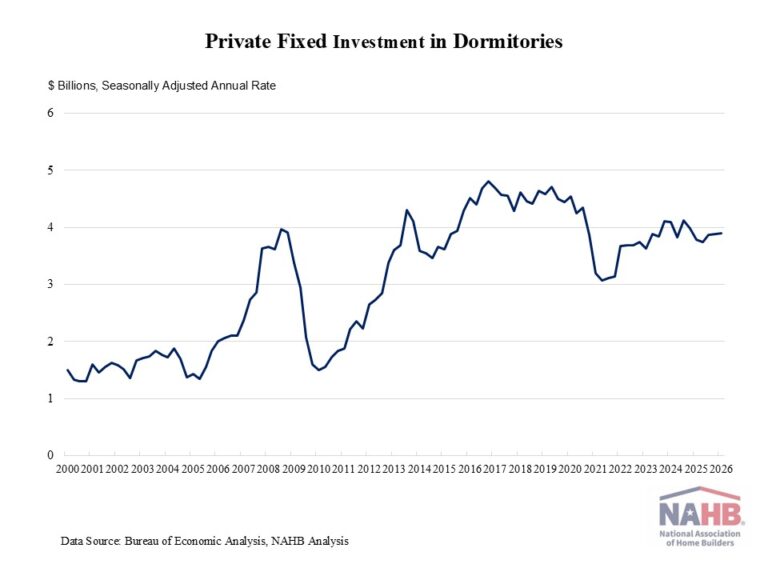
Private fixed investment in student dormitories edged up 0.1% in the first quarter of 2026, holding at a seasonally adjusted annual rate (SAAR) of $3.9 billion. This modest gain marked a third consecutive quarterly increase, despite continued pressures from elevated interest rates. However, on a year-over-year basis, investments in dorms remained almost unchanged.

Private fixed investment in student housing experienced a surge after the Great Recession, as college enrollment increased from 17.2 million in 2006 to 20.4 million in 2011. However, during the pandemic, private fixed investment in student housing declined drastically from $4.4 billion (SAAR) in the last quarter of 2019 to $3 billion in the second quarter of 2021. According to the National Student Clearinghouse Research Center, college enrollment fell by 3.6% in the fall of 2020 and by 3.1% in the fall of 2021.

Since then, private fixed investment in dorms has rebounded, as college enrollments show a gradual recovery from pandemic-driven declines. Effective in-person learning requires college students to return to campuses, boosting the student housing sector. Still, demographic trends are reshaping the outlook for student housing. The U.S. faces slower growth in the college-age population as birth rates declined following the Great Recession. As a result, total enrollment in postsecondary institutions is projected to only increase 8% from 2020 to 2030, according to the National Center for Education Statistics, well below the 37% increase between 2000 and 2010.

Despite recent fluctuations, student housing construction shows signs of recovery, and future growth is expected in response to increasing student enrollment projections.


This article was originally published by a eyeonhousing.org . Read the Original article here. .
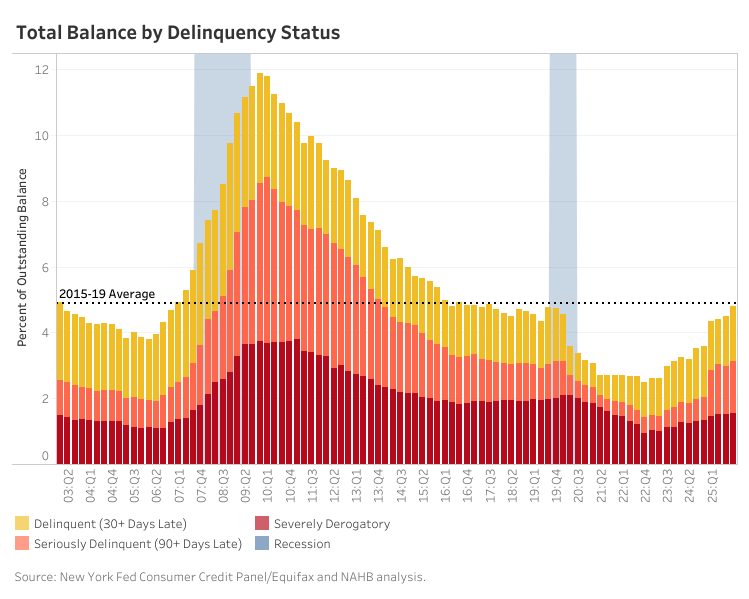

Delinquent consumer loans have steadily increased as pandemic distortions fade, returning broadly to pre-pandemic levels. According to the latest Quarterly Report on Household Debt and Credit from the Federal Reserve Bank of New York, 4.8% of outstanding household debt was delinquent at the end of 2025, 0.3 percentage points higher than the third quarter of 2025 and 1.2% higher from year-end 2024.

This increase reflects a normalization period coming out of the pandemic, when delinquency rates were suppressed by payment forbearance and fiscal support. As these government assistance programs ended and credit reporting normalized, delinquency rates rose steadily and are now on par with pre-pandemic levels.

While aggregate delinquency has normalized, transitions into serious delinquency (defined as 90+ days past due) show diverging patterns across loan types. Student loans and credit cards stand out as having significantly higher inflows into serious delinquency than before the pandemic, while mortgages, HELOC and auto loan transitions remain comparatively stable.

Late student loan payments saw a sharp rise in early 2025, and by the fourth quarter of 2025, 16.2% of student loan balances became seriously delinquent over the past year. This surge reflects the re-entering of delinquent balances into credit reports following a nearly 5-year pause due to the pandemic. Credit cards, on the other hand, show signs of deterioration with new seriously delinquent balances rapidly rising mid-2022 before moderating around 7% in recent years. In the fourth quarter of 2025, about 7.1% of credit card balances transitioned into serious delinquency over the past year, a rate comparable to levels observed during the early stages of the Great Recession.

Mortgage transitions into serious delinquency remain low at around 1.4% annually, despite edging higher in recent years and are currently slightly higher than pre-pandemic levels. In a further analysis on the credit report data from Equifax, the deterioration is concentrated among borrowers living in lower-income zip codes, where serious mortgage delinquency rates for this group of borrowers have reached roughly 3.0% by late 2025.

Comparing delinquency transitions with the overall balance of seriously delinquent loans provides a clearer understanding of current credit conditions. Credit cards display a concerning trend in which both transition rate and overall balance of seriously delinquent loan balances are rising. For example, the share of credit card balances 90+ days past due is only about one percentage point below its post-great recession peak in 2010 at 12.7%, which seems to suggest persistent issues in repayment by borrowers.

Mortgages show the opposite dynamic, whereby the balance of seriously delinquent mortgages has remained stable despite a steady increase in transitions into serious delinquency. This divergence indicates higher recovery rates or shorter delinquency periods, an implication that mortgage borrowers prioritize meeting their mortgage payments which would be rational if borrowers had locked in historic low mortgage rates and have built up sufficient home equity.

While it is too early to determine if elevated transition rates will translate into increasing seriously delinquent student loan balances, this rate remains high at 9.6% at the end of 2025. Furthermore, the credit scores of student loan borrowers that improved during the student loan payment pause, will now be affected and could weigh on borrowers’ demand or ability to access other forms of credit, especially in an environment of tighter labor markets.


This article was originally published by a eyeonhousing.org . Read the Original article here. .


Overall consumer credit continued to rise in 2025, but the pace of growth remains slow. Student loan balances also rose year-over-year as borrowers resumed payments following the end of pandemic-era relief. Meanwhile, credit card and auto loan debt both experienced their slowest annual growth rates in years. Despite historically high interest rates, credit card and auto loan rates have eased slightly, providing some relief for consumers facing elevated borrowing costs.

Total outstanding U.S. consumer credit reached $5.05 trillion for the second quarter of 2025, according to the Federal Reserve’s G.19 Consumer Credit Report. This is an increase of 2.32% at a seasonally adjusted annual rate (SAAR) compared to the previous quarter, and a 2.09% increase compared to last year. Both rates have increased from last quarter.

Nonrevolving Credit

Nonrevolving credit, largely driven by student and auto loans (the G.19 report excludes mortgage loans), reached $3.76 trillion (SA) in the second quarter of 2025. This marks a 2.90% increase (SAAR) from the previous quarter, and a 1.94% increase from last year.

Student loan debt stood at $1.81 trillion (NSA) for the second quarter of 2025, marking a 4.16% increase from a year ago. The end of the COVID-19 Emergency Relief—which allowed 0% interest and halted payments until September 1, 2023—led year-over-year growth to decline for four consecutive quarters, from Q3 2023 through Q2 2024 as borrowers resumed payments and took on less new debt. The past four quarters have shown a return to growth, nearly matching pre-pandemic growth rates.

Auto loans reached a level of $1.56 trillion (NSA), showing a year-over-year increase of only 0.31%, marking the slowest growth rate since 2010. The deceleration in growth can be attributed to several factors, including stricter lending standards, elevated interest rates, and overall inflation. Auto loan rates for a 60-month new car stood at 7.67% (NSA) for the second quarter of 2025, a historically elevated level. However, auto rates have slowed modestly, decreasing by 0.53 percentage points compared to a year ago.

Revolving Credit

Revolving credit, primarily made up of credit card debt, rose to $1.30 trillion (SA) in the second quarter of 2025. This represents a 0.66% increase (SAAR) from the previous quarter and a 2.54% increase year-over-year. Both measures reflect a notable slowdown, marking the weakest growth in revolving credit in several years. This deceleration comes as credit card interest rates remain elevated, with the average rate held by commercial banks (NSA) at 21.16%. Although rates have hovered near historic hi­ghs since Q4 2022, the past two quarters have shown modest year-over-year declines, reflecting the impact of rate cuts that began in 2024.

Discover more from Eye On Housing

Subscribe to get the latest posts sent to your email.


This article was originally published by a eyeonhousing.org . Read the Original article here. .
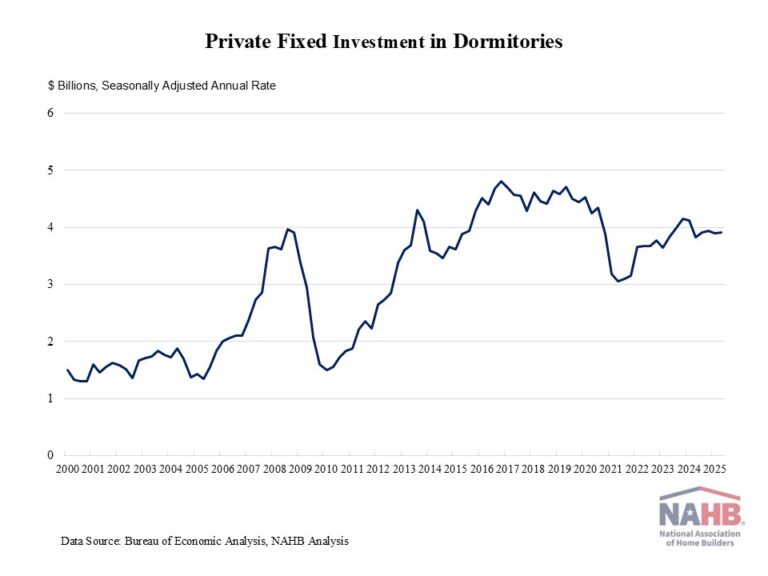

Private fixed investment in student dormitories inched up 0.3% in the second quarter of 2025, reaching a seasonally adjusted annual rate (SAAR) of $3.9 billion. This gain followed a 1.1% decrease in the previous quarter, as elevated interest rates placed a damper on student housing construction. Moreover, private fixed investment in dorms was 2.1% higher than a year ago 

Private fixed investment in student housing experienced a surge after the Great Recession, as college enrollment increased from 17.2 million in 2006 to 20.4 million in 2011. However, during the pandemic, private fixed investment in student housing declined drastically from $4.4 billion (SAAR) in the last quarter of 2019 to a lower annual pace of $3 billion in the second quarter of 2021, as COVID-19 interrupted normal on-campus learning. According to the National Student Clearinghouse Research Center, college enrollment fell by 3.6% in the fall of 2020 and by 3.1% in the fall of 2021.  

Since then, private fixed investment in dorms has rebounded, as college enrollments show a gradual recovery from pandemic driven declines. Effective in-person learning requires college students to return to campuses, boosting the student housing sector.  Still, demographic trends are reshaping the outlook for student housing. The U.S. faces slower growth in the college-age population as birth rates declined following the Great Recession. As a result, total enrollment in postsecondary institutions is projected to only increase 8% from 2020 to 2030, according to the National Center for Education Statistics, well below the 37% increase between 2000 and 2010. 

Despite recent fluctuations, the student housing construction shows signs of recovery and future growth is expected in response to increasing student enrollment projections. 

Discover more from Eye On Housing

Subscribe to get the latest posts sent to your email.


This article was originally published by a eyeonhousing.org . Read the Original article here. .
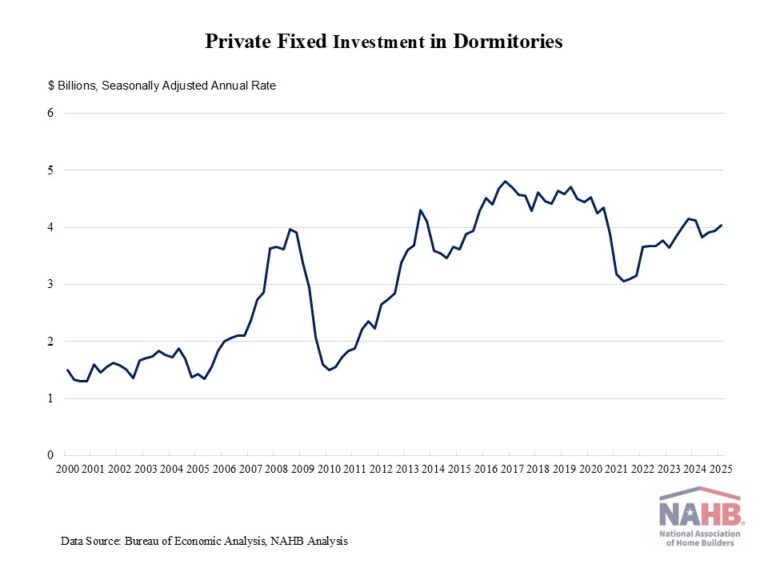

Private fixed investment in student dormitories increased by 2.3% in the first quarter of 2025, reaching a seasonally adjusted annual rate (SAAR) of $4.04 billion. This gain followed a 1.0% increase in the previous quarter. However, private fixed investment in dorms was 2% lower than a year ago, as elevated interest rates place a damper on student housing construction.  

Private fixed investment in student housing experienced a surge after the Great Recession, as college enrollment increased from 17.2 million in 2006 to 20.4 million in 2011. However, during the pandemic, private fixed investment in student housing declined drastically from $4.4 billion (SAAR) in the last quarter of 2019 to a lower annual pace of $3 billion in the second quarter of 2021, as COVID-19 interrupted normal on-campus learning. According to the National Student Clearinghouse Research Center, college enrollment fell by 3.6% in the fall of 2020 and by 3.1% in the fall of 2021.  

Since then, private fixed investment in dorms has rebounded, as college enrollments show a gradual recovery from pandemic driven declines. Effective in-person learning requires college students to return to campuses, boosting the student housing sector.  Still, demographic trends are reshaping the outlook for student housing. The U.S. faces slower growth in the college-age population as birth rates declined following the Great Recession. As a result, total enrollment in postsecondary institutions is projected to only increase 8% from 2020 to 2030, according to the National Center for Education Statistics, well below the 37% increase between 2000 and 2010. 

Despite recent fluctuations, the student housing construction shows signs of recovery and future growth is expected in response to increasing student enrollment projections. 

Discover more from Eye On Housing

Subscribe to get the latest posts sent to your email.


This article was originally published by a eyeonhousing.org . Read the Original article here. .
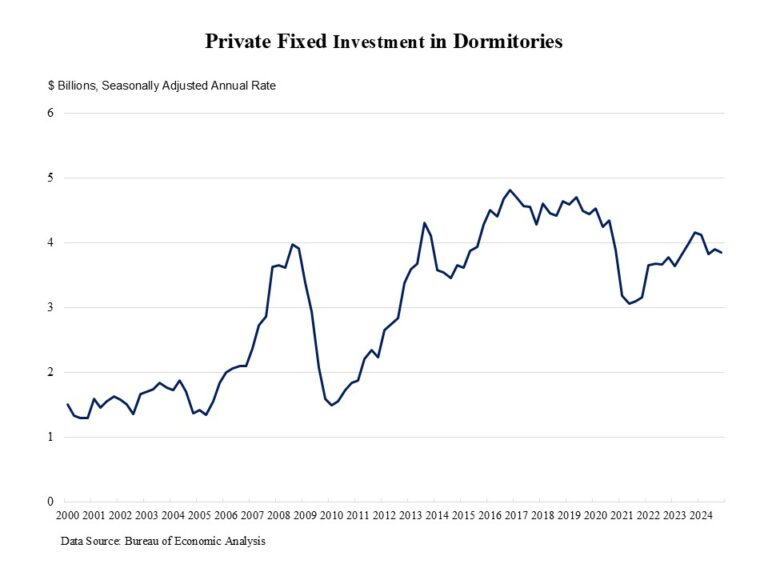

Private fixed investment in student dormitories edged down by 1.3% in the fourth quarter of 2024, reaching a seasonally adjusted annual rate (SAAR) of $3.86 billion. This decline follows a 1.9% increase in the prior quarter. However, private fixed investment in dorms was 7.2% lower than a year ago, as the elevated interest rates place a damper on student housing construction.  

Private fixed investment in student housing experienced a surge after the Great Recession, as college enrollment increased from 17.2 million in 2006 to 20.4 million in 2011. However, during the pandemic, private fixed investment in student housing declined drastically from $4.4 billion (SAAR) in the last quarter of 2019 to $3 billion in the second quarter of 2021, as COVID-19 interrupted normal on-campus learning. According to the National Student Clearinghouse Research Center, college enrollment fell by 3.6% in the fall of 2020 and by 3.1% in the fall of 2021.  

Since then, private fixed investment has rebounded, as college enrollments show a slow but stabilizing recovery from pandemic driven declines. Effective in-person learning requires college students to return to campuses, boosting the student housing sector. Furthermore, the demand for student housing is growing robustly, because total enrollment in postsecondary institutions is projected to increase 8% from 2020 to 2030, according to the National Center for Education Statistics. 

Despite recent fluctuations, the student housing construction shows signs of recovery and is expected to grow in response to increasing student enrollment projections. 

Discover more from Eye On Housing

Subscribe to get the latest posts sent to your email.


This article was originally published by a eyeonhousing.org . Read the Original article here. .


Private fixed investment in student dormitories increased by 2.2% to a seasonally adjusted annual rate (SAAR) of $3.9 billion in the third quarter of 2024. This rise follows a 7% decrease in the prior quarter. However, private fixed investment in dorms was 1.8% lower than a year ago, as the elevated interest rates place a damper on student housing construction.  

Private fixed investment in student housing experienced a surge after the Great Recession, as college enrollment increased from 17.2 million in 2006 to 20.4 million in 2011. However, during the pandemic, private fixed investment in student housing declined drastically from $4.4 billion (SAAR) in the last quarter of 2019 to a lower annual pace of $3 billion in the second quarter of 2021, as COVID-19 interrupted normal on-campus learning. According to the National Student Clearinghouse Research Center, college enrollment fell by 3.6% in the fall of 2020 and by 3.1% in the fall of 2021.  

Since then, private fixed investment has rebounded, as college enrollments show a slow but stabilizing recovery from pandemic driven declines. Effective in-person learning requires college students to return to campuses, boosting the student housing sector. Furthermore, the demand for student housing is growing robustly, because total enrollment in postsecondary institutions is projected to increase 8% from 2020 to 2030, according to the National Center for Education Statistics. 

Discover more from Eye On Housing

Subscribe to get the latest posts sent to your email.


This article was originally published by a eyeonhousing.org . Read the Original article here. .
Pin It