Tag

Start

Browsing


Residential building material prices rose at a slower rate in January, according to the latest Producer Price Index release from the Bureau of Labor Statistics. This was the first decline in the rate of price growth since April of last year. Metal products continue to experience price increases, while specific wood products are showing declines in prices.

The Producer Price Index for final demand increased 0.5% in January, after rising 0.4% in December. The January increase in final demand is linked directly to final demand services, which saw prices rise 0.8% in January. The index for final demand goods decreased 0.3% in January.

The price index for inputs to new residential construction rose 0.7% in January and was up 3.3% from last year. The price of goods used in new residential construction was up 0.9% over the month and 2.4% from last year. Meanwhile, the price for services was up 0.3% over the month and up 4.7% from last year.

Input Goods

The goods component has a larger importance to the inputs to residential construction price index, representing around 60%. On a monthly basis, the price of input goods to new residential construction was up 0.9% in January.

The input goods to residential construction index can be further broken down into two separate components, one measuring energy inputs with the other measuring remaining goods. The latter of these two components simply represents building materials used in residential construction, which makes up around 93% of the goods index.

Energy input prices fell 0.9% in January and were 10.3% lower than one year ago. Building material prices were up 1.0% in January and up 3.3% compared to one year ago, marking the lowest year-over-year price change since July of last year.

The largest year-over-year price increases continue to show in metal products. Topping the list in January was metal molding and trim, with prices up 48.3% from last year. One product that has seen rapid price growth acceleration over the past few months has been nonferrous metal and cable with prices up 19.7%. Price declines for materials over the year are concentrated among wood products with prices for particleboard and fiberboard down 24.4%, treated wood products down 5.0%, and softwood lumber down 3.3%.

Input Services

Prices for service inputs to residential construction reported an increase of 0.3% in January. On a year-over-year basis, service input prices were up 4.7%. The price index for service inputs to residential construction can be broken out into three separate components: a trade services component, a transportation and warehousing services component, and a services excluding trade, transportation, and warehousing component (other services).

The most significant component is trade services (around 60%), followed by other services (around 29%), and finally transportation and warehousing services (around 11%). The largest component, trade services, was up 7.1% from a year ago. The transportation and warehousing services rose 2.0%, while prices for other services were up 1.1% over the year.

Expanded Inputs to New Construction

Within the PPI that BLS publishes, new experimental data was recently published regarding inputs to new construction. The data expands existing inputs to industry indexes by incorporating import prices with prices for domestically produced goods and services. With this additional data, users can track how industry input costs are changing among domestically produced products and imported products. This data focuses on new construction, but the complete dataset includes indices across numerous industries that can be found here on BLS website. 

New construction input prices are primarily influenced by domestically produced goods and services, with domestic products accounting for 90% of the weight of the industry index for new construction. Imported goods make up the remaining 10% of the index.  

The latest available data, for November 2025, showed that domestically produced goods continue to have faster price growth compared to imported goods used in new construction. On a year-over-year basis, the index for domestic goods increased 3.0%, while prices for imported goods have fallen 3.0%.


This article was originally published by a eyeonhousing.org . Read the Original article here. .
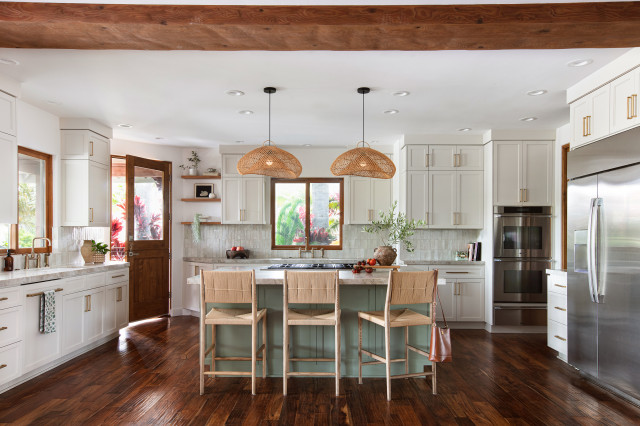


“After” photos by Avery Nicole Photography

Kitchen at a Glance
Who lives here: An empty-nest couple
Location: Martindale, Texas
Size: 250 square feet (23 square meters)
Designer: Amanda Buckley of Bauley Interiors
Cabinetmaker: Kleighton Westphall of Monarch Woodworks of Austin
Builder: Blanco River Construction

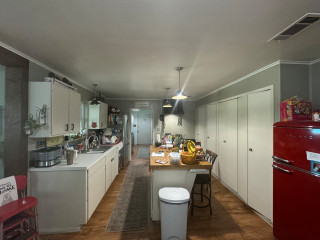
Before: Gray walls, short white cabinets and laminate counters gave the former kitchen a flat, utilitarian feel. Shallow upper cabinets flanking the sink window on the left offered little storage and blocked natural light. Ceilings in the small house were less than 8 feet high, Buckley says. “The window wasn’t that big and there wasn’t enough lighting overall. They also had a vinyl-style tile above the sink but that was their only backsplash.”

A long, narrow island with stools felt especially tight, squeezed by reach-in closets along the right wall. “That essentially was their pantry,” Buckley says. “Their small appliances and pots and pans were stacked up on each other in there.” A retro-style red refrigerator sat out in the open with no clear role, while the primary stainless steel refrigerator was tucked into the far back left corner. “The red refrigerator was sort of just there,” Buckley says. “They liked the look of it but didn’t use it much.”


This article was originally published by a www.houzz.com . Read the Original article here. .


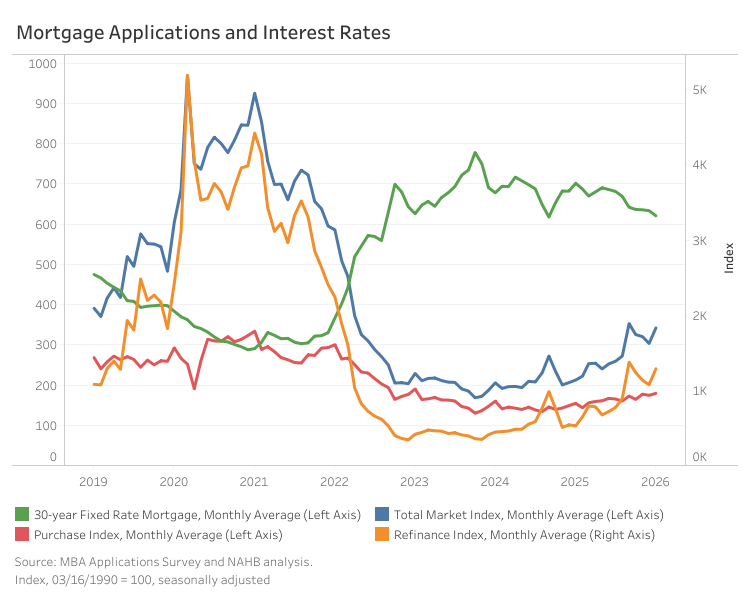
Mortgage application activity rose sharply in January, driven primarily by a surge in refinancing activity as mortgage rates declined to a new low. The Mortgage Bankers Association’s (MBA) Market Composite Index, a measure of total mortgage application volume, increased 12.9% from December on a seasonally adjusted basis and was 61.3% higher than a year earlier.

The average contract interest rate for 30-year fixed mortgages dropped 13 basis points (bps) to 6.2% following the announcement of $200 billion in mortgage-backed securities (MBS) buybacks by the GSEs. Compared with January 2025, the 30-year fixed mortgage rate was 81 bps lower. The decline in rates supported month-over-month gains in both purchase and refinance activity. Purchase applications increased 2.9%, while refinance applications surged 19.8%. Relative to January 2025, purchase activity increased 16.2%, while refinance applications jumped 143.8%.

By loan type, applications for fixed-rate mortgages (FRMs) and adjustable-rate mortgages (ARMs) increased 12.9% and 7.9% month-over-month, respectively. On a year-over-year basis, FRM applications were up 57.8%, while ARM applications more than doubled, rising 113.1%. As of January 2026, ARMs accounted for an average of 7.1% of total applications on a non-seasonally adjusted basis, down 0.4 percentage points from December but 1.7 percentage points higher than a year earlier.

For loan sizes, the average loan amount across the total market increased by 1.1% to $402,000. Average purchase loan sizes increased 2.5% to $435,400, while the refinance loan size increased modestly by 0.2% to $378,000. In contrast, the average ARM loan size continued to decline, falling 4.4% to $925,600.


This article was originally published by a eyeonhousing.org . Read the Original article here. .

Builder confidence moved lower to start the year as affordability concerns continue to weigh heavily with buyers, and builders continue to contend with rising construction costs.

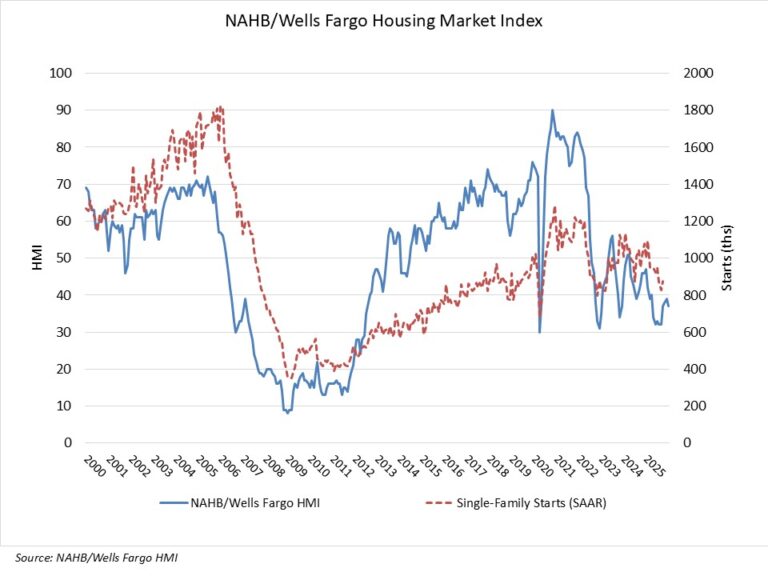
Builder confidence in the market for newly built single-family homes fell two points to 37 in January, according to the National Association of Home Builders (NAHB)/Wells Fargo Housing Market Index (HMI).

While the upper end of the housing market is holding steady, affordability conditions are taking a toll on the lower and mid-range sectors. Buyers are concerned about high home prices and mortgage rates, with downpayments particularly challenging given elevated price to income ratios.

In a positive development, Freddie Mac reported that the average mortgage rate fell to 6.06% as of Jan. 15, the lowest rate in three years and nearly 100 basis points below the same period last year.

Most responses to the January HMI survey were received prior to the announcement that Fannie Mae and Freddie Mac would be purchasing $200 billion in mortgage-backed securities in an effort to bring down mortgage interest rates. And while this latest policy action on the interest rate front was largely not factored in the HMI survey, builders continue to report several supply-side headwinds. 

The future sales component of the HMI dipped below 50 for the first time since September, indicating that builders continue to face several issues that include labor and lot shortages as well as elevated regulatory and material costs.

In a further sign of ongoing challenges for the housing market, the latest HMI survey also revealed that 40% of builders reported cutting prices in January, unchanged from December but the third consecutive month the share has been at 40% or higher since May 2020. Meanwhile, the average price reduction was 6% in January, up from the 5% rate in December. The use of sales incentives was 65% in January, marking the 10th consecutive month this share has exceeded 60%.

Derived from a monthly survey that NAHB has been conducting for more than 40 years, the NAHB/Wells Fargo HMI gauges builder perceptions of current single-family home sales and sales expectations for the next six months as “good,” “fair” or “poor.” The survey also asks builders to rate traffic of prospective buyers as “high to very high,” “average” or “low to very low.” Scores for each component are then used to calculate a seasonally adjusted index where any number over 50 indicates that more builders view conditions as good than poor.

All of the HMI subindices fell in January. The HMI index gauging current sales conditions declined one point to 41 and the gauge charting traffic of prospective buyers dropped three points to 23. The index measuring future sales fell three points to 49, marking the first time this component fell below the breakeven point of 50 since September.

Looking at the three-month moving averages for regional HMI scores, the Northeast fell two points to 45, the Midwest held steady at 43, the South dropped one point to 35 and the West gained one point to 35.

The HMI tables can be found at nahb.org/hmi.


This article was originally published by a eyeonhousing.org . Read the Original article here. .


Get Your Better Half Involved

For many couples there’s often one person who’s more interested in decorating than the other. The other person might say, “Do whatever you want.”

Do not do whatever you want. Because as soon as you start buying things, Mr. or Ms. No Opinion will suddenly have an opinion. So make him or her spend some time with you at the very beginning just looking at pictures of interiors. “Spend an hour or two on the computer and look at some things together and talk about them,” says interior designer Alana Homesley of Woodland Hills, California. As you review each room, ask your partner, “What do you like about it? What don’t you like about it?”

Alternatively, you can each collect images independently, then sit down and compare what you’ve chosen. This way your initial selections won’t be swayed by the other person. As you review your selections together, your differences and similarities will immediately become apparent.


This article was originally published by a www.houzz.com . Read the Original article here. .


The market value of household real estate assets fell from $48.1 trillion to $47.9 trillion in the first quarter of 2025, according to the most recent release of U.S. Federal Reserve Z.1 Financial Accounts. The value of household real estate assets declined for three consecutive quarters after peaking at $48.8 trillion in the second quarter of 2024 but remains 2.1% higher over the year.

Real estate secured liabilities of households’ balance sheets, i.e. mortgages, home equity loans, and HELOCs, increased 0.3% over the first quarter to $13.4 trillion. This level is 2.9% higher compared to the first quarter of 2024.

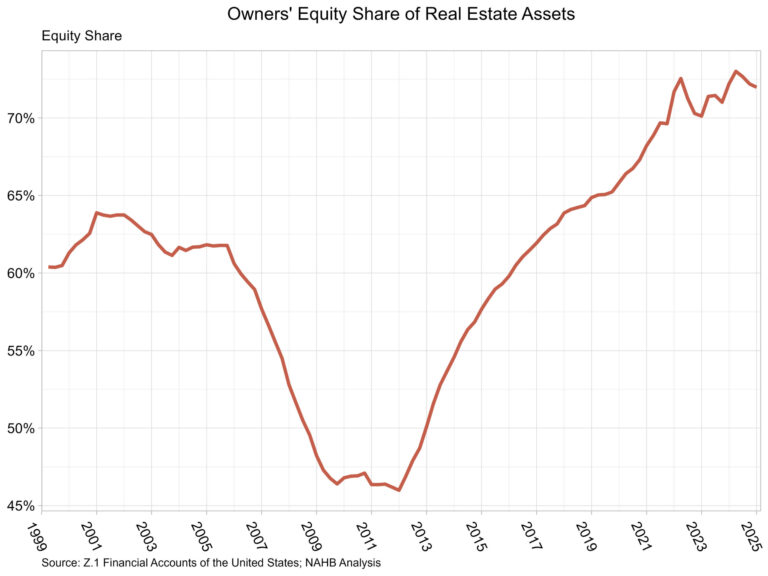
Owners’ equity share of real estate assets was 72.0% in the first quarter, marking a small decline in owners’ equity share which matches the decline in the market value of households real estate assets. The share in the first quarter of 2024 was 72.2%.

Discover more from Eye On Housing

Subscribe to get the latest posts sent to your email.


This article was originally published by a eyeonhousing.org . Read the Original article here. .


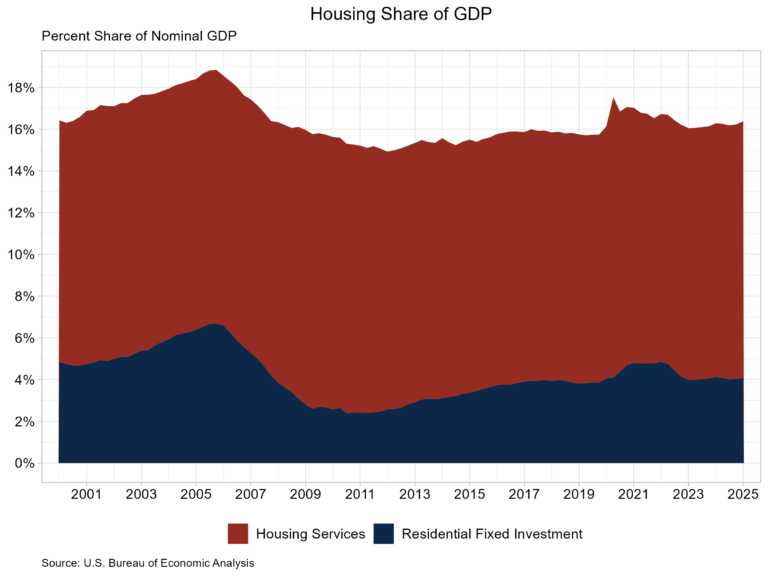
Housing’s share of the economy grew to 16.4% in the first quarter of 2025, according to the advance estimate of GDP produced by the Bureau of Economic Analysis. This is the highest reading since the third quarter of 2022 and is up 0.2 percentage points from the fourth quarter of 2024.

The more cyclical home building and remodeling component – residential fixed investment (RFI) – was 4.1% of GDP, up from 4.0% in the previous quarter. The second component – housing services – was 12.3% of GDP, up from 12.2% in the previous quarter. The graph below stacks the nominal shares for housing services and RFI, resulting in housing’s total share of the economy.

Housing service growth is much less volatile when compared to RFI due to the cyclical nature of RFI. Historically, RFI has averaged roughly 5% of GDP, while housing services have averaged between 12% and 13%, for a combined 17% to 18% of GDP. These shares tend to vary over the business cycle. However, the housing share of GDP lagged during the post-Great Recession period due to underbuilding, particularly for the single-family sector.

In the first quarter, RFI added 5 basis points to the headline GDP growth rate, marking the second straight quarter of positive contributions. RFI was 4.1% of the economy, recording a $1.216 trillion seasonally adjusted annual pace. Among the two segments of RFI, residential structures rose 1.2% while residential equipment rose 5.5%.

Breaking down the components of residential structures, single-family structure RFI grew 5.9%, while multifamily investment fell 11.5%. RFI for multifamily structures has contracted for seven consecutive quarters. Permanent site structure RFI, which is made up of single-family and multifamily RFI, grew 1.2%.  Other structures RFI rose 0.6% in the first quarter, down from 11.4% the previous period.

The second impact of housing on GDP is the measure of housing services. Similar to the RFI, housing services consumption can be broken out into two components. The first component, housing, includes gross rents paid by renters, owners’ imputed rent (an estimate of how much it would cost to rent owner-occupied units), rental value of farm dwellings, and group housing. The inclusion of owners’ imputed rent is necessary from a national income accounting approach, because without this measure, increases in homeownership would result in declines in GDP. The second component, household utilities, is composed of consumption expenditures on water supply, sanitation, electricity, and gas.

For the first quarter, housing services represented 12.4% of the economy or $3.691 trillion on a seasonally adjusted annual basis. Housing services expenditures grew 3.4% at an annual rate in the first quarter and contributed 41 basis points to GDP growth. Real personal consumption expenditures for housing grew 1.3%, while household utilities expenditures grew 18.7%. Real personal expenditures for natural gas services grew 53.1% in the first quarter, as residential consumption of natural gas recorded its highest monthly level since January 2014, at 1.035 trillion cubic feet in January 2025. Through the first two months of 2025, residential households consumed 1.833 trillion cubic feet of natural gas, higher than the 1.582 trillion in 2024 and 1.498 trillion in 2023.

Discover more from Eye On Housing

Subscribe to get the latest posts sent to your email.


This article was originally published by a eyeonhousing.org . Read the Original article here. .

Growing economic uncertainty stemming from tariff concerns and elevated building material costs kept builder sentiment in negative territory in April, despite a modest bump in confidence likely due to a slight retreat in mortgage interest rates in recent weeks.

Builder confidence in the market for newly built single-family homes was 40 in April, edging up one point from March, according to the National Association of Home Builders (NAHB)/Wells Fargo Housing Market Index (HMI).

The March dip in mortgage rates may have stimulated some sales activity in recent weeks. However, builders have expressed growing uncertainty over market conditions as tariffs have increased price volatility for building materials at a time when the industry continues to grapple with labor shortages and a lack of buildable lots.

Policy uncertainty is making it difficult for builders to accurately price homes and make critical business decisions. The April HMI data indicates that the tariff cost effect is already taking hold, with the majority of builders reporting cost increases on building materials due to tariffs.

When asked about the impact of tariffs on their business, 60% of builders reported their suppliers have already increased or announced increases of material prices due to tariffs. On average, suppliers have increased their prices by 6.3% in response to announced, enacted, or expected tariffs. This means builders estimate a typical cost effect from recent tariff actions at $10,900 per home.

The latest HMI survey also revealed that 29% of builders cut home prices in April, unchanged from March. Meanwhile, the average price reduction was 5% in April, the same rate as the previous month. The use of sales incentives was 61% in April, up from 59% in March.

Derived from a monthly survey that NAHB has been conducting for more than 35 years, the NAHB/Wells Fargo HMI gauges builder perceptions of current single-family home sales and sales expectations for the next six months as “good,” “fair” or “poor.” The survey also asks builders to rate traffic of prospective buyers as “high to very high,” “average” or “low to very low.” Scores for each component are then used to calculate a seasonally adjusted index where any number over 50 indicates that more builders view conditions as good than poor.

The HMI index gauging current sales conditions rose two points in April to a level of 45. The gauge charting traffic of prospective buyers increased one point to 25 while the component measuring sales expectations in the next six months fell four points to 43.

Looking at the three-month moving averages for regional HMI scores, the Northeast fell seven points in April to 47, the Midwest moved one point lower to 41, the South dropped three points to 39 and the West posted a two-point decline to 35.

The HMI tables can be found at nahb.org/hmi.

Discover more from Eye On Housing

Subscribe to get the latest posts sent to your email.


This article was originally published by a eyeonhousing.org . Read the Original article here. .

Constrained housing affordability conditions due to ongoing, elevated interest rates led to a reduction in single-family production to start the new year.

Overall housing starts decreased 9.8% in January to a seasonally adjusted annual rate of 1.37 million units, according to a report from the U.S. Department of Housing and Urban Development and the U.S. Census Bureau. The January reading of 1.37 million starts is the number of housing units builders would begin if development kept this pace for the next 12 months.

Within this overall number, single-family starts decreased 8.4% to a 993,000 seasonally adjusted annual rate; the January pace was 1.8% lower than a year ago. The multifamily sector, which includes apartment buildings and condos, decreased 13.5% to an annualized 373,000 pace.

As mirrored in the NAHB/Wells Fargo HMI, high construction costs, elevated mortgage rates and challenging housing affordability conditions are causing builders to approach the market with caution. There are competing upside and downside risks, including discussed tariffs and regulatory reform. Given persistent affordability concerns, reducing inefficient regulatory costs would offer the best policy path to improve attainable housing supply and bring down shelter inflation.

On a regional basis compared to the previous month, combined single-family and multifamily starts are 27.6% lower in the Northeast, 10.4% lower in the Midwest, 23.3% lower in the South and 42.3% higher in the West.

Overall permits increased 0.1% to a 1.48 million unit annualized rate in January. Single-family permits were at a 996,000 annual unit rate, remaining unchanged compared to the previous month. Multifamily permits increased 0.2% to an annualized 487,000 pace.

Looking at regional permit data compared to the previous month, permits are 6.1% lower in the Northeast, 1.8% higher in the Midwest, 0.1% lower in the South and 2.3% higher in the West.

The number of single-family homes under construction in January is down 6.3% from a year ago, to 641,000 units. The number of multifamily units under construction is down 22.1% from a year ago, to 768,000 units.

There were 669,000 multifamily completions in January, up 11% from January 2024. For each apartment starting construction, there are 1.8 apartments completing the construction process.

Discover more from Eye On Housing

Subscribe to get the latest posts sent to your email.


This article was originally published by a eyeonhousing.org . Read the Original article here. .


S T U D I O 8 ArchitectSave Photo
1. Clean Up Your In-Box

Keeping your email accounts as clutter-free as possible may improve your productivity and efficiency. Also, a continuous stream of unwanted emails can camouflage and push down important emails that are actually relevant and need your attention.

Take steps to stop the sources of spam and junk emails rather than merely deleting them. You can start by unsubscribing from legitimate company emails that you didn’t sign up for or no longer want. If you’re unsure of a sender’s legitimacy, opt to mark the email as spam and block the sender to prevent future communication.

You may also receive excess emails from senders you like or need, such as retail email marketing, magazine or news subscriptions or shipping confirmations. You won’t want to unsubscribe from these emails but you may want to delete outdated ones.

To streamline the process, focus on one sender at a time. For example, search for the newsletter you subscribe to. If you have accrued many in your inbox, you may be able to select them all, perhaps with the exception of the latest edition, and delete them en masse. Deleting by sender may save you time by not having to sort through various unrelated emails and deciding one by one.


This article was originally published by a
www.houzz.com . Read the Original article here. .

Pin It