Tag

Softens

Browsing


The U.S. labor market weakened in July, with nonfarm payrolls down 23,000 and downward revisions cutting another 103,000 jobs from May and June. Although the unemployment rate edged lower to 4.1%, the decline reflected a smaller labor force rather than stronger hiring, as overall participation fell to its lowest level since early 2021. July marked the 7th monthly job loss over the last year and a half.

Wage growth also cooled, with average hourly earnings rising 3.2% year-over-year in July to $37.62, down from 3.4% in June and the slowest pace of 2026. Despite the slowdown, wage gains continue to outpace inflation, consistent with productivity-supported real wage growth.

National Employment

According to the Employment Situation Summary reported by the Bureau of Labor Statistics (BLS), total nonfarm payroll employment decreased by 23,000 in July, following a downwardly revised gain of 20,000 in June. Revisions to prior months were broadly negative again this month. The change for May was revised down by 66,000, from a preliminarily reported +129,000 to +63,000, while the change for June was revised down by 37,000, from a preliminary +57,000 to +20,000. Combined, these revisions subtracted 103,000 jobs from previously reported totals, compared with the 74,000 downward revision reported in the prior month.

Job growth in 2026 has moderated further. Through July, monthly payroll gains have averaged 61,000 on the current data vintage, down from the 92,000 pace reported through June, reflecting both July’s soft print and the downward revisions to May and June. This compares with an average of just 10,000 per month in 2025 and 122,000 per month in 2024. Over the past 12 months, total nonfarm employment has grown by 316,000 in total, a considerably slower pace of expansion than earlier in the cycle.

The unemployment rate declined to 4.1% in July from 4.2% in June. The decrease was driven by a shrinking labor force rather than stronger hiring. Over the month, the number of unemployed persons fell by 178,000 to 6.9 million, while the number of employed persons declined by 87,000. Combined, the civilian labor force contracted by 264,000 in July.

Meanwhile, the labor force participation rate—the proportion of the population either looking for a job or already holding a job—fell 0.1 percentage point to 61.4% in July. This marks the lowest level since February 2021 and remains well below its pre-pandemic level of 63.3% recorded at the start of 2020. Among prime working-age individuals (aged 25 to 54), the participation rate rose 0.1 percentage point to 83.4%, partially reversing June’s sharp 0.6-point decline and suggesting that the drop in labor force participation in July was not widespread.

Industry-level results were mixed in July. Employment declined in local government education (-50,000) and retail trade (-19,000), while financial activities continued to trend down (-14,000). Health care employment continued to increase (+22,000), although at a slower pace than its average monthly gain over the prior 12 months. The July release also showed an increase in temporary layoffs, with the number of people on temporary layoff rising to 921,000.

Construction Employment

Employment in the overall construction sector rose by 22,000 jobs in July, following a gain of 5,000 in June. Within the industry, residential construction employment edged up by 2,100, its first monthly increase in four months, while non-residential construction added approximately 20,000 jobs.

Residential construction employment stood at 3.3 million in July, including 914,600 workers employed by builders and remodelers, down from 915,100 in June, and 2.3 million residential specialty trade contractors.

The six-month moving average of job gains for residential construction employment remains negative, reflecting an average monthly loss of approximately 5,350 jobs and declines in four of the past six months. Over the last 12 months, residential construction has shed a net of 44,200 jobs, marking the seventeenth consecutive month of year-over-year decline. Despite these losses, residential construction employment remains 1,281,200 positions above its post-Great Recession low, with that cushion widening modestly from 1,279,100 in June as July’s small gain offset part of the prior months’ losses.

Meanwhile, the unemployment rate for construction workers fell to 4.6% in July on a seasonally adjusted basis, down sharply from 6.2% in June. A year earlier, the construction unemployment rate stood at 4.2%. Despite the month-to-month volatility, the year-over-year comparison still points to modestly softer conditions for the trades than a year ago.


This article was originally published by a eyeonhousing.org . Read the Original article here. .


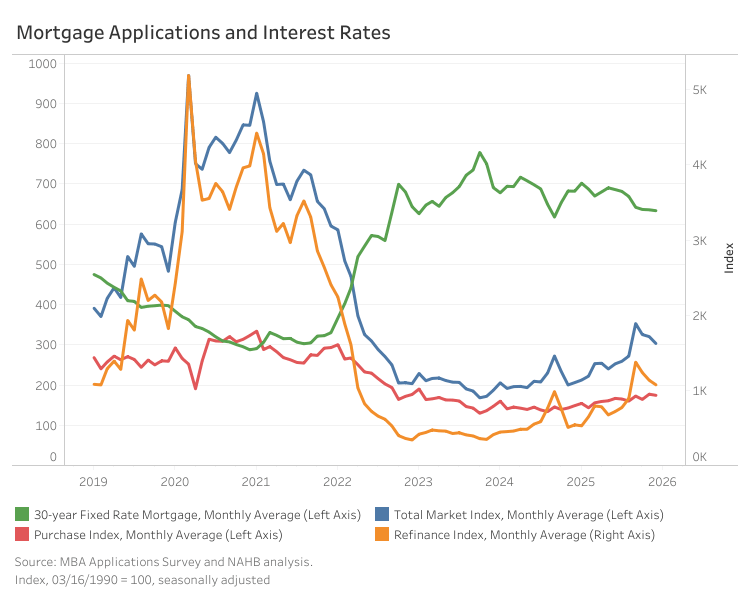
Mortgage application activity declined in December despite a modest easing in mortgage rates. The Mortgage Bankers Association’s (MBA) Market Composite Index, a measure of total mortgage application volume, fell 5.3% from November on a seasonally adjusted basis, though it remained 47.1% higher than a year ago.

The average contract interest rate for 30-year fixed mortgages edged down 2 basis points to 6.3%, the lowest level of 2025. Nonetheless, both purchase and refinance applications declined month-over-month, down 1.6% and 5.3%, respectively. Relative to December 2024, purchase activity increased 16.8%, while refinance applications were up 98.6%.

By loan type, applications for both fixed-rate mortgages (FRMs) and adjustable-rate mortgages (ARMs) declined from November, decreasing 4.8% and 13.6%, respectively. On a year-over-year basis, FRM applications were up by 43.9%, while ARM applications have more than doubled, rising 105.1%. As of December 2025, ARMs accounted for an average 7.5% of total applications on a non-seasonally adjusted basis, down 0.3 percentage points from November but 2.2 percentage points higher than a year earlier.

For loan sizes, the average loan amount across all loan types increased marginally by 0.6% to $397,500. Average purchase loan sizes declined 0.8% to $424,800, while the refinance loan size increased 2.5% to $377,300. The average size of ARM loans edged down 0.1% to $968,000.


This article was originally published by a eyeonhousing.org . Read the Original article here. .

The latest residential housing market report, delayed by the federal government shutdown last fall, indicates that builders have faced significant headwinds in recent months. Elevated mortgage rates earlier in the year have restrained buyer demand and weighed on home building activity, alongside persistently high construction costs.

Overall housing starts declined 4.6 percent in October to a seasonally adjusted annual rate of 1.25 million units, according to the U.S. Department of Housing and Urban Development and the U.S. Census Bureau. This pace reflects the number of housing units builders would begin over the next 12 months if October’s activity were sustained.

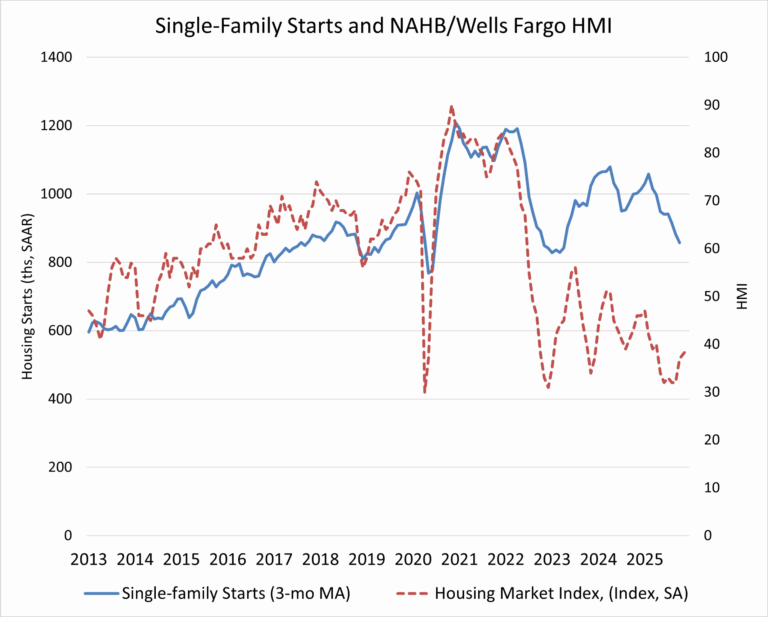
Within the total, single-family starts rose 5.4 percent to a seasonally adjusted annual rate of 874,000 units but remain 7.8 percent lower than a year earlier. On a year-to-date basis, single-family starts are down 7.0 percent. Given recent volatility, the three-month moving average provides a clearer signal, declining to 857,000 units.

In contrast, multifamily starts, which include apartment buildings and condominiums, fell sharply, down 22.0 percent to an annualized pace of 372,000 units. The three-month moving average for multifamily construction has trended lower to 424,000 units, and activity is 7.9 percent below year-ago levels.

Regionally and on a year-to-date basis, combined single-family and multifamily starts increased 9.1 percent in the Midwest and 8.5 percent in the Northeast, while declining 1.9 percent in the West and 4.1 percent in the South.

The total number of housing units under construction stood at 1.3 million in October, down 10.1 percent from a year earlier. Single-family homes under construction fell to 596,000 units, a 7.0 percent year-over-year decline and the lowest level since November 2020. Multifamily units under construction declined to 790,000, down from peaks above 1 million units in December 2023 and 4.0 percent lower than a year ago.

Completions of single-family homes remained relatively strong at an annual rate of about 1 million units, reflecting continued progress in finishing projects already underway and marking a 2.0 percent increase from a year earlier. Multifamily completions, however, dropped sharply, down 41.7 percent year over year to a 377,000-unit pace. On a year-to-date basis, total completions across both sectors are down 9.2 percent.

Overall building permits edged down 0.2 percent in October to a 1.41-million-unit annualized rate. Single-family permits declined 0.5 percent to 876,000 units and are 9.4 percent lower than a year ago, with year-to-date permits down 7.0 percent. Multifamily permits were essentially unchanged at a 536,000-unit pace compared to the previous month and are up 16.3 percent compared to October 2024. Regionally, year-to-date total permits increased 5.9 percent in the Midwest, while declining 3.3 percent in the West, 4.0 percent in the South, and 9.3 percent in the Northeast.


This article was originally published by a eyeonhousing.org . Read the Original article here. .


After a period of slowing associated with declines for some elements of the residential construction industry, the count of open construction sector jobs remained lower than a year ago, per the December Bureau of Labor Statistics Job Openings and Labor Turnover Survey (JOLTS).

The number of open jobs for the overall economy decreased from 8.16 million in November to 7.6 million in December. This is notably smaller than the 8.89 million estimate reported a year ago and reflects a softened aggregate labor market. Previous NAHB analysis indicated that this number had to fall below 8 million on a sustained basis for the Federal Reserve to feel more comfortable about labor market conditions and their potential impacts on inflation. With estimates remaining below 8 million for national job openings, the Fed in theory should be able to cut further despite a recent pause.

The number of open construction sector jobs decreased from a revised 272,000 in November to just 217,000 in December. This marks a significant reduction of open, unfilled construction jobs than that registered a year ago (434,000) due to a slowing of construction activity because of elevated interest rates.

The construction job openings rate moved lower to 2.5% in December, significantly down year-over-year from 5.1%. This is the lowest open rate for the construction sector since 2017.

The layoff rate in construction stayed low (1.8%) in December. The quits rate moved lower to 1.4% in December. This is the lowest quits rate for construction since the third quarter of 2020.

Discover more from Eye On Housing

Subscribe to get the latest posts sent to your email.


This article was originally published by a eyeonhousing.org . Read the Original article here. .
Pin It