Tag

Signs

Browsing


Housing construction activity strengthened in March, with a notable rebound in both single-family and multifamily starts, signaling improved builder activity despite ongoing headwinds from financing costs and affordability constraints. While the monthly gain points to renewed momentum, year-to-date trends remain mixed, particularly in the single-family sector, and permit activity suggests some caution moving forward.

Overall housing starts increased 10.8 percent in March to a seasonally adjusted annual rate of 1.5 million units, according to a report from the U.S. Department of Housing and Urban Development (HUD) and the U.S. Census Bureau. This pace reflects the number of housing units builders would begin over the next 12 months if March’s activity were sustained.

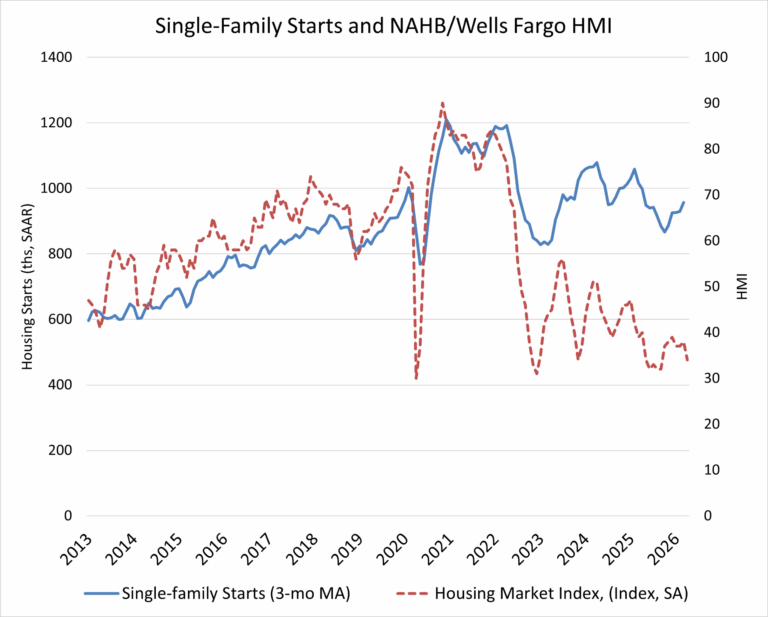
Within the total, single-family starts increased 9.7 percent to a seasonally adjusted annual rate of 1.03 million units and are up 8.9 percent compared to March 2025. On a year-to-date basis, single-family starts are down 5.5 percent. Given recent volatility, the three-month moving average provides a clearer signal, rising to 957,000 units.

Multifamily starts, which include apartment buildings and condominiums, increased 13.3 percent to an annualized 470,000-unit pace and are up 15.5 percent compared to March 2025. The three-month moving average for multifamily construction has trended higher to 462,000 units, and activity is 15.5 percent higher compared to year-ago levels.

Regionally, on a year-to-date basis, combined single-family and multifamily starts were 36 percent higher in the Northeast, 7.8 percent higher in the Midwest, 3.0 percent higher in the South, but 15.5 percent lower in the West.

The total number of housing units under construction stood at 1.3 million in March, down 9.8 percent from a year earlier. Single-family homes under construction stood at 587,000 units, a 7.3 percent year-over-year decline. Multifamily units under construction declined to 677,000, down from peaks above 1 million units in December 2023 and 11.8 percent lower than a year ago.

Completions of single-family homes have slowed down to an annual rate of about 896,000 units, reflecting ongoing challenges in the residential construction sector. This marks a 14.5 percent decline from a year earlier. Multifamily completions for buildings with five or more units followed the same trend, down 9.1 percent year over year to a 452,000-unit pace. On a year-to-date basis, total completions across both sectors are down 13.5 percent.

Overall permits decreased 10.8 percent to a 1.37 million-unit annualized rate in March. Single-family permits decreased 3.8 percent to an 895,000-unit rate and are down 7.9 percent compared to March 2025. Multifamily permits decreased 21.5 percent to an annualized 477,000-unit pace and are down 6.3 percent compared to March 2025. Looking at regional permit data on a year-to-date basis, permits were 15.4 percent higher in the Northeast, 6.0 percent higher in the West, and 1.1 percent higher in the Midwest. However, permits were 9.1 percent lower in the South.


This article was originally published by a eyeonhousing.org . Read the Original article here. .


In November, job growth slowed, and the unemployment rate rose to 4.6%, its highest level in four years. At the same time, job gains for the previous two months (August and September) were revised downward. The November’s jobs report indicates a cooling labor market as the economy heads into the final month of the year.

In November, wage growth slowed, increasing 3.5% year over year, down 0.6 percentage points from a year ago. Wage growth has been outpacing inflation for nearly two years, which typically occurs as productivity increases.

National Employment

According to Employment Situation Summary reported by the Bureau of Labor Statistics (BLS), total nonfarm payroll employment rose by 64,000 in November. This represents a notable slowdown from September’s revised gain of 108,000 and reflects continued weakness in overall hiring.

August’s growth was revised downward for the second time, from last month’s estimate of -4,000 to -26,000. September job growth was revised down by 11,000, from +119,000 to +108,000. Combined, these revisions erased 33,000 jobs from previously reported figures. October data, published for the first time, was not revised.

Through November, average monthly job growth in 2025 stands at just 11,000, well below the 168,000 monthly average recorded in 2024.

The unemployment rate rose to 4.6% in November, its highest level since September 2021. Compared to September, the number of persons unemployed rose by 228,000, while the number of persons employed increased by 96,000.

Meanwhile, the labor force participation rate—the proportion of the population either looking for a job or already holding a job—remained unchanged at 62.4%. This remains below its pre-pandemic level of 63.3% recorded at the beginning of 2020. Among prime working-age individuals (aged 25 to 54), the participation rate edged up 0.1 percentage points to 83.8%, the highest level since September 2024.

In November, employment gains were seen in health care (+46,000) and construction (+28,000), while the federal government continued to shed jobs. Federal government employment fell by 6,000 positions in November, following a sharp decline of 162,000 in October. Since peaking in January 2025, federal government employment has fallen by a total of 271,000 jobs.

Construction Employment

Employment in the overall construction sector increased by 28,000 in November, after an upwardly revised 25,000 gain in September. Within the industry, residential construction shed 300 jobs, while non-residential construction gained 28,800 positions.

Residential construction employment now stands at 3.3 million in November, including 958,000 workers employed by builders and remodelers and approximately 2.4 million residential specialty trade contractors.

The six-month moving average of job gains for residential construction remains negative at -3,600 per month, reflecting losses in five of the past six months for June, July, August, October, and November. Over the last 12 months, residential construction has seen a net loss of 42,200 jobs, marking the sixth consecutive annual decline since September 2020. Since the low point following the Great Recession, residential construction has gained 1,334,100 positions.

In November, the unemployment rate for construction workers declined to 4.7% on a seasonally adjusted basis. The unemployment rate for construction workers has remained at a relatively lower level, after reaching 15.3% in April 2020 due to the housing demand impact of the COVID-19 pandemic.


This article was originally published by a eyeonhousing.org . Read the Original article here. .
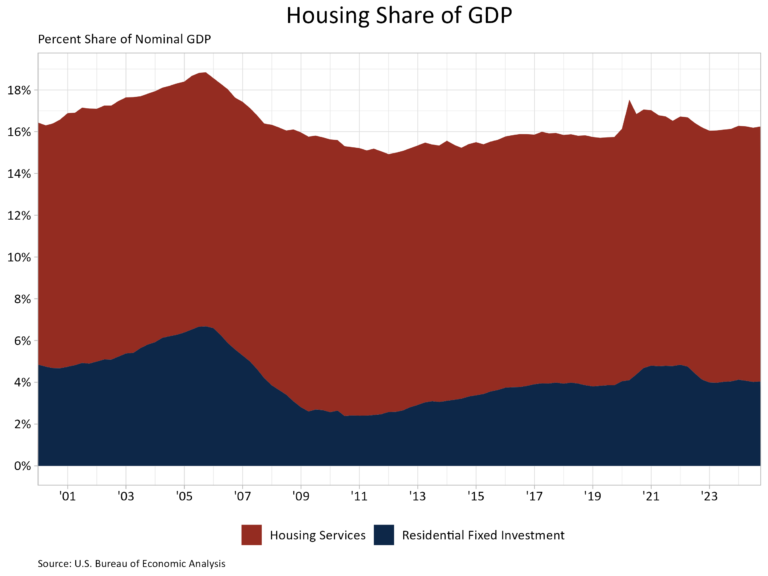

Housing’s share of the economy remained unchanged at 16.2% in the fourth quarter of 2024, according to the advance estimate of GDP produced by the Bureau of Economic Analysis. For the year, housing’s share of the economy was 16.2%, up from 16.0% in 2023 and down from 16.5% in 2022.

The more cyclical home building and remodeling component – residential fixed investment (RFI) – was 4.0% of GDP, level with the previous quarter. The second component – housing services – was 12.2% of GDP, also level with the previous quarter. The graph below stacks the nominal shares for housing services and RFI, resulting in housing’s total share of the economy.

Housing service growth is much less volatile when compared to RFI due to the cyclical nature of RFI. Historically, RFI has averaged roughly 5% of GDP while housing services have averaged between 12% and 13%, for a combined 17% to 18% of GDP. These shares tend to vary over the business cycle. However, the housing share of GDP lagged during the post-Great Recession period due to underbuilding, particularly for the single-family sector.

In the fourth quarter, RFI added 21 basis points from the headline GDP growth rate in the fourth quarter of 2024, a welcomed result as RFI previously had two consecutive quarters of negative contributions to GDP. The Federal Reserve, while keeping unchanged this month, lowered the federal funds rate by 100 basis points in September and December of 2024. This likely improved financing conditions for many builders, leading to RFI’s growth in the fourth quarter. A notable observation from the fourth quarter release was nonresidential fixed investment (similar to RFI, but for nonresidential structures) negatively contributed 31 basis points to GDP growth, the first negative effect on the economy for nonresidential fixed investment in over three years.

Housing services added 17 basis points (bps) to GDP growth.  Among household expenditures for services, housing services contributions were the fourth-highest contributor to headline GDP growth behind health care (46 bps), other services (31 bps) and financial services and insurance (18 bps).

Overall GDP increased at a 2.3% annual rate, down from a 3.1% increase in the third quarter of 2024, and down from a 3.0% increase in the second quarter of 2024. Headline GDP growth in 2024 was 2.8%, down slightly from 2.9% in 2023 but up from 2.5% in 2022.

Housing-related activities contribute to GDP in two basic ways:

The first is through residential fixed investment (RFI). RFI is effectively the measure of home building, multifamily development, and remodeling contributions to GDP. RFI consists of two specific types of investment, the first is residential structures. This investment includes construction of new single-family and multifamily structures, residential remodeling, production of manufactured homes, brokers’ fees and some types of equipment that are built into the structure. RFI’s second component, residential equipment, includes investment such as furniture or household appliances that are purchased by landlords for rental to tenants.

For the fourth quarter, RFI was 4.0% of the economy, recording a $1.200 trillion seasonally adjusted annual pace. RFI grew 5.3% at an annual rate in the fourth quarter after falling 4.4% in the third. Among the two types of RFI, real investment in residential structures rose 5.3% while for residential equipment it rose 4.9%. Investment in residential structures stood at a seasonally adjusted annual pace of $1.178 trillion, making its share of residential investment far greater than that of residential equipment, which was at seasonally adjusted annual pace of $21.5 billion.

The second impact of housing on GDP is the measure of housing services. Similar to the RFI, housing services consumption can be broken out into two components. The first component, housing, includes gross rents paid by renters, owners’ imputed rent (an estimate of how much it would cost to rent owner-occupied units), rental value of farm dwellings, and group housing. The inclusion of owners’ imputed rent is necessary from a national income accounting approach, because without this measure, increases in homeownership would result in declines in GDP. The second component, household utilities, is composed of consumption expenditures on water supply, sanitation, electricity, and gas.

For the fourth quarter, housing services represented 12.2% of the economy or $3.625 trillion on a seasonally adjusted annual basis. Housing services grew 1.4% at an annual rate in the fourth quarter. Real person consumption expenditures for housing also grew 1.4%, while household utilities expenditures grew 1.6%. At the seasonally adjusted annual pace, housing expenditures was $3.166 trillion and household utility expenditures stood at $458.9 billion in seasonally adjusted annual rates.

Discover more from Eye On Housing

Subscribe to get the latest posts sent to your email.


This article was originally published by a eyeonhousing.org . Read the Original article here. .
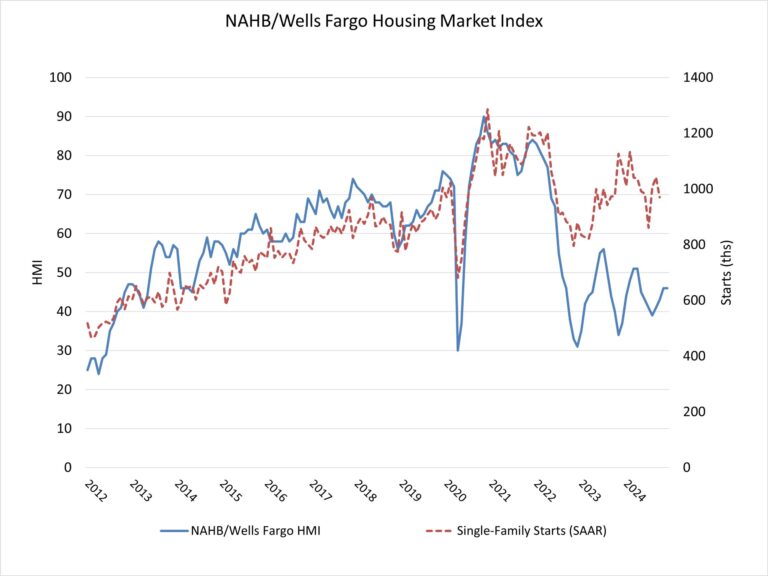

Builder sentiment held steady to end the year as high home prices and mortgage rates offset renewed hope about a better regulatory business climate in 2025. Along those lines, builders expressed increased optimism for higher sales expectations in the next months.

Builder confidence in the market for newly built single-family homes was 46 in December, the same reading as last month, according to the National Association of Home Builders (NAHB)/Wells Fargo Housing Market Index (HMI).

While builders are expressing concerns that high interest rates, elevated construction costs and a lack of buildable lots continue to act as headwinds, they are also anticipating future regulatory relief in the aftermath of the election. This is reflected in the fact that future sales expectations have increased to a nearly three-year high.

NAHB is forecasting additional interest rate cuts from the Federal Reserve in 2025, but with inflation pressures still present, we have reduced that forecast from 100 basis points to 75 basis points for the federal funds rate. Concerns over inflation risks in 2025 will keep long-term interest rates, like mortgage rates, near current levels with mortgage rates remaining above 6%.

The latest HMI survey also revealed that 31% of builders cut home prices in December, unchanged from November. Meanwhile, the average price reduction was 5% in December, the same rate as in November. The use of sales incentives was 60% in December, also unchanged from November.

Derived from a monthly survey that NAHB has been conducting for more than 35 years, the NAHB/Wells Fargo HMI gauges builder perceptions of current single-family home sales and sales expectations for the next six months as “good,” “fair” or “poor.” The survey also asks builders to rate traffic of prospective buyers as “high to very high,” “average” or “low to very low.” Scores for each component are then used to calculate a seasonally adjusted index where any number over 50 indicates that more builders view conditions as good than poor.

The HMI index gauging current sales conditions held steady at 48 while the gauge charting traffic of prospective buyers posted a one-point decline to 31. The component measuring sales expectations in the next six months rose three points to 66, the highest level since April 2022.

Looking at the three-month moving averages for regional HMI scores, the Northeast increased two points to 57, the Midwest moved two points higher to 46, the South posted a two-point gain to 44 and the West fell one point to 40. The HMI tables can be found at nahb.org/hmi.

Discover more from Eye On Housing

Subscribe to get the latest posts sent to your email.


This article was originally published by a eyeonhousing.org . Read the Original article here. .
Pin It