Tag

Shows

Browsing


Housing construction activity strengthened in March, with a notable rebound in both single-family and multifamily starts, signaling improved builder activity despite ongoing headwinds from financing costs and affordability constraints. While the monthly gain points to renewed momentum, year-to-date trends remain mixed, particularly in the single-family sector, and permit activity suggests some caution moving forward.

Overall housing starts increased 10.8 percent in March to a seasonally adjusted annual rate of 1.5 million units, according to a report from the U.S. Department of Housing and Urban Development (HUD) and the U.S. Census Bureau. This pace reflects the number of housing units builders would begin over the next 12 months if March’s activity were sustained.

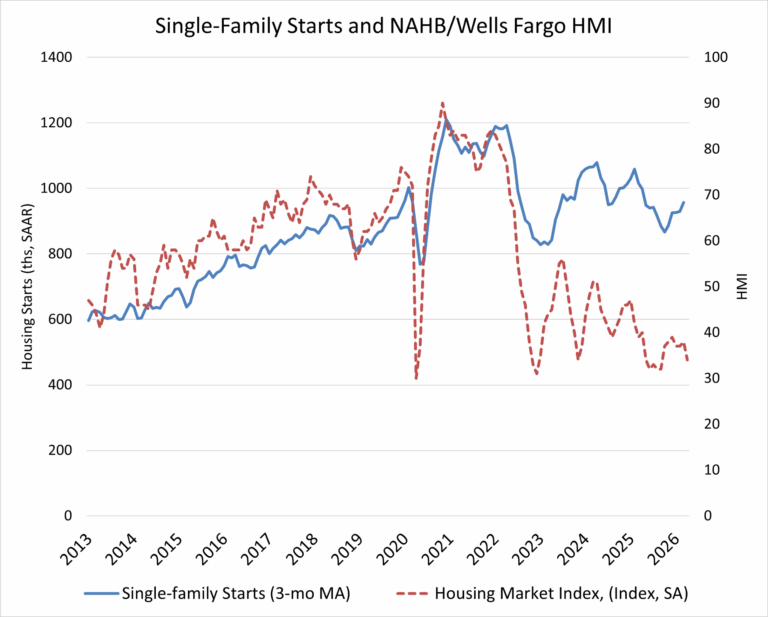
Within the total, single-family starts increased 9.7 percent to a seasonally adjusted annual rate of 1.03 million units and are up 8.9 percent compared to March 2025. On a year-to-date basis, single-family starts are down 5.5 percent. Given recent volatility, the three-month moving average provides a clearer signal, rising to 957,000 units.

Multifamily starts, which include apartment buildings and condominiums, increased 13.3 percent to an annualized 470,000-unit pace and are up 15.5 percent compared to March 2025. The three-month moving average for multifamily construction has trended higher to 462,000 units, and activity is 15.5 percent higher compared to year-ago levels.

Regionally, on a year-to-date basis, combined single-family and multifamily starts were 36 percent higher in the Northeast, 7.8 percent higher in the Midwest, 3.0 percent higher in the South, but 15.5 percent lower in the West.

The total number of housing units under construction stood at 1.3 million in March, down 9.8 percent from a year earlier. Single-family homes under construction stood at 587,000 units, a 7.3 percent year-over-year decline. Multifamily units under construction declined to 677,000, down from peaks above 1 million units in December 2023 and 11.8 percent lower than a year ago.

Completions of single-family homes have slowed down to an annual rate of about 896,000 units, reflecting ongoing challenges in the residential construction sector. This marks a 14.5 percent decline from a year earlier. Multifamily completions for buildings with five or more units followed the same trend, down 9.1 percent year over year to a 452,000-unit pace. On a year-to-date basis, total completions across both sectors are down 13.5 percent.

Overall permits decreased 10.8 percent to a 1.37 million-unit annualized rate in March. Single-family permits decreased 3.8 percent to an 895,000-unit rate and are down 7.9 percent compared to March 2025. Multifamily permits decreased 21.5 percent to an annualized 477,000-unit pace and are down 6.3 percent compared to March 2025. Looking at regional permit data on a year-to-date basis, permits were 15.4 percent higher in the Northeast, 6.0 percent higher in the West, and 1.1 percent higher in the Midwest. However, permits were 9.1 percent lower in the South.


This article was originally published by a eyeonhousing.org . Read the Original article here. .


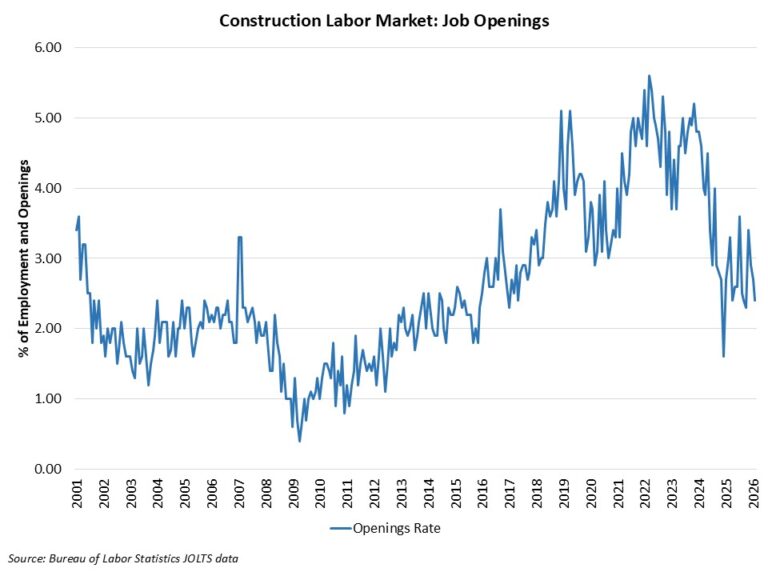
The number of open positions in construction in February was down year-over-year, per the Bureau of Labor Statistics Job Openings and Labor Turnover Survey (JOLTS). The current level of open jobs is down measurably from three years ago due to declines in construction activity, particularly in housing. However, recent gains for nonresidential construction have not fully offset soft conditions for housing with respect to the demand for construction labor.

The number of open jobs for the overall economy declined in February, falling from 7.24 million in January to 6.88 million in February. The February reading was down from a year ago (7.24 million) due to a cooling labor market.

Previous NAHB analysis indicated that this number had to fall below eight million on a sustained basis for the Federal Reserve to move forward on interest rate reductions. With estimates remaining below eight million for national job openings, the Fed, in theory, should be able to cut further.

The number of open construction sector jobs fell, declining slightly from 230,000 in January to 202,000 in February. This total was down compared to a year ago (255,000). The chart below notes the declining trend that has been in place for unfilled construction jobs since the Fed raised the federal funds rate and home building weakened. While home building employment was declining during the second half of 2025, other subsectors of the construction industry have expanded (e.g. data centers). This has produced volatility within a reduced range in the series since 2024.

The construction job openings rate decreased to 2.4% in February, down from the 3% rate estimated a year ago.

The layoff rate in construction declined slightly to 1.8% in February. The quits rate decreased to 1.3% for the month.

The current data looks similar to the much discussed low-hire, low-fire labor market paradigm.


This article was originally published by a eyeonhousing.org . Read the Original article here. .


NAHB recently released its 2026 Priced-Out Analysis, highlighting the housing affordability challenge. While previous posts discussed the impacts of rising home prices and interest rates on affordability, this post focuses on the related U.S. housing affordability pyramid. The pyramid reveals that 52% of households (70 million) cannot afford a $300,000 home, while the estimated median price of a new home is around $410,000 in 2026.

The housing affordability pyramid illustrates the number of households able to purchase a home at various price steps. Each step represents the number of households that can only afford homes within that specific price range. The largest share of households falls within the first step, where homes are priced under $200,000. As home prices increase, fewer and fewer households can afford the next price level, with the highest-priced homes, those over $2.5 million, having the smallest number of potential buyers. Housing affordability remains a critical challenge for households with income at the lower end of the spectrum.

The pyramid is based on income thresholds and underwriting standards. Under these assumptions, the minimum income required to purchase a $200,000 home at the mortgage rate of 6% is $55,500. In 2026, about 47.5 million households in the U.S. are estimated to have incomes no more than that threshold and, therefore, can only afford to buy homes priced up to $200,000. These 47.5 million households form the bottom step of the pyramid. Of the remaining households that can afford a home priced at $200,000, 22.4 million can only afford to pay a top price of somewhere between $200,000 and $300,000. These households make up the second step on the pyramid. Each subsequent step narrows further, reflecting the shrinking number of households that can afford increasingly expensive homes.

It is worthwhile to compare the number of households that can afford homes at various price levels and the number of owner-occupied homes available in those ranges, as shown in Figure 2. For example, while around 47.5 million households can afford a home priced at $200,000 or less, there are only 20.7 million owner-occupied homes valued in this price range. This trend continues in the $200,000 $300,000 price range, where the number of households that can afford homes is much higher than the number of housing units in that range. These imbalances reflect the ongoing challenges of housing affordability.


This article was originally published by a eyeonhousing.org . Read the Original article here. .


Even though garden/low-rise continues to be strong, overall confidence in the market for new multifamily housing decreased year-over-year in the fourth quarter, according to the Multifamily Market Survey (MMS) released today by the National Association of Home Builders (NAHB). The MMS produces two separate indices. The Multifamily Production Index (MPI) had a reading of 45, down three points year-over-year, while the Multifamily Occupancy Index (MOI) had a reading of 74, down seven point year-over-year.

Multifamily developers are somewhat less optimistic than they were at this time last year, except in the market segment for garden/low-rise apartments. This suggests that the 2025 trend of gains in multifamily market share for outlying metro and non-metro counties—where garden and low-rise structures are more common—is likely to continue in 2026.

Elevated construction costs and the local regulatory environment continue to be major headwinds to faster growth. While interest rates eased slightly in 2025, they still need to come down further to significantly spur new construction.

Multifamily Production Index (MPI)

The MMS asks multifamily developers to rate the current conditions as “good”, “fair”, or “poor” for multifamily starts in markets where they are active.  The index and all its components are scaled so that a number above 50 indicates that more respondents report conditions as good rather than poor. The MPI is a weighted average of four key market segments: three in the built-for-rent market (garden/low-rise, mid/high-rise, and subsidized) and the built-for-sale (or condominium) market.

The component measuring garden/low-rise was the only one to experience an increase year-over-year in the fourth quarter of 2025, rising two points to 54. This component has been above 50 every quarter in 2025. The other three components experienced year-over-year declines during the quarter. The component measuring mid/high-rise fell eight points to 31, the component measuring built-for-sale units dropped six points to 36, and the component measuring subsidized units decreased five points to 47.

Multifamily Occupancy Index (MOI)

The survey also asks multifamily property owners to rate the current conditions for occupancy of existing rental apartments in markets where they are active as “good”, “fair”, or “poor”.  Like the MPI, the MOI and all its components are scaled so that a number above 50 indicates more respondents report that occupancy is good than poor.  The MOI is a weighted average of three built-for-rent market segments (garden/low-rise, mid/high-rise, and subsidized). 

All three MOI components experienced year-over-year decreases in the fourth quarter of 2025; the mid/high-rise component plummeted 12 points to 62, the garden/low-rise component decreased five points to 76, and the subsidized component dipped three points to 88. Nevertheless, all three MOI components remain well above the break-even point of 50.

The MMS was re-designed in 2023 to produce results that are easier to interpret and consistent with the proven format of other NAHB industry sentiment surveys. Until there is enough data to seasonally adjust the series, changes in the MMS indices should only be evaluated on a year-over-year basis.

Please visit NAHB’s MMS web page for the full report.


This article was originally published by a eyeonhousing.org . Read the Original article here. .


In November, job growth slowed, and the unemployment rate rose to 4.6%, its highest level in four years. At the same time, job gains for the previous two months (August and September) were revised downward. The November’s jobs report indicates a cooling labor market as the economy heads into the final month of the year.

In November, wage growth slowed, increasing 3.5% year over year, down 0.6 percentage points from a year ago. Wage growth has been outpacing inflation for nearly two years, which typically occurs as productivity increases.

National Employment

According to Employment Situation Summary reported by the Bureau of Labor Statistics (BLS), total nonfarm payroll employment rose by 64,000 in November. This represents a notable slowdown from September’s revised gain of 108,000 and reflects continued weakness in overall hiring.

August’s growth was revised downward for the second time, from last month’s estimate of -4,000 to -26,000. September job growth was revised down by 11,000, from +119,000 to +108,000. Combined, these revisions erased 33,000 jobs from previously reported figures. October data, published for the first time, was not revised.

Through November, average monthly job growth in 2025 stands at just 11,000, well below the 168,000 monthly average recorded in 2024.

The unemployment rate rose to 4.6% in November, its highest level since September 2021. Compared to September, the number of persons unemployed rose by 228,000, while the number of persons employed increased by 96,000.

Meanwhile, the labor force participation rate—the proportion of the population either looking for a job or already holding a job—remained unchanged at 62.4%. This remains below its pre-pandemic level of 63.3% recorded at the beginning of 2020. Among prime working-age individuals (aged 25 to 54), the participation rate edged up 0.1 percentage points to 83.8%, the highest level since September 2024.

In November, employment gains were seen in health care (+46,000) and construction (+28,000), while the federal government continued to shed jobs. Federal government employment fell by 6,000 positions in November, following a sharp decline of 162,000 in October. Since peaking in January 2025, federal government employment has fallen by a total of 271,000 jobs.

Construction Employment

Employment in the overall construction sector increased by 28,000 in November, after an upwardly revised 25,000 gain in September. Within the industry, residential construction shed 300 jobs, while non-residential construction gained 28,800 positions.

Residential construction employment now stands at 3.3 million in November, including 958,000 workers employed by builders and remodelers and approximately 2.4 million residential specialty trade contractors.

The six-month moving average of job gains for residential construction remains negative at -3,600 per month, reflecting losses in five of the past six months for June, July, August, October, and November. Over the last 12 months, residential construction has seen a net loss of 42,200 jobs, marking the sixth consecutive annual decline since September 2020. Since the low point following the Great Recession, residential construction has gained 1,334,100 positions.

In November, the unemployment rate for construction workers declined to 4.7% on a seasonally adjusted basis. The unemployment rate for construction workers has remained at a relatively lower level, after reaching 15.3% in April 2020 due to the housing demand impact of the COVID-19 pandemic.


This article was originally published by a eyeonhousing.org . Read the Original article here. .


4. ‘Friends’

Fictional New York City cafe Central Perk was the primary hangout for the six twentysomethings on Friends, an era-defining sitcom that debuted in 1994, ran for 10 seasons and lives on in reruns worldwide. Relaxed and eclectic, the cafe, and especially its famous orange couch, served as a backdrop for some of the show’s most pivotal moments, as well as countless pointless conversations.

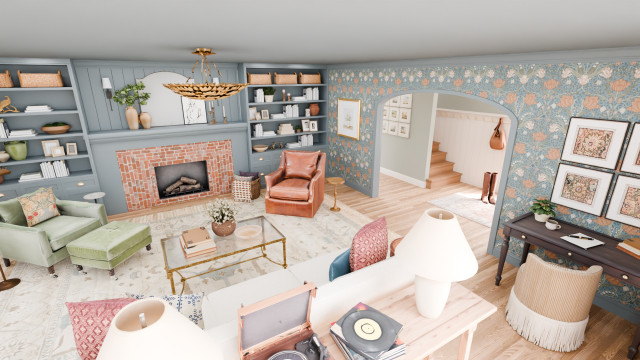
Allito Spaces combined the show’s vibe, Central Perk’s charm and the comfort of home in this colorful living room. “With this design, I wanted to capture the sense of togetherness that defined the series,” principal designer Allison Garrison says. Brick accents echo Central Perk’s walls, and a row of windows calls to mind the cafe’s view to the streets of New York. Comfy seating (including an orange-ish couch), a layered Oriental rug, fringe-trimmed upholstery and collected artwork and accessories create a homey, lived-in feel.


This article was originally published by a www.houzz.com . Read the Original article here. .


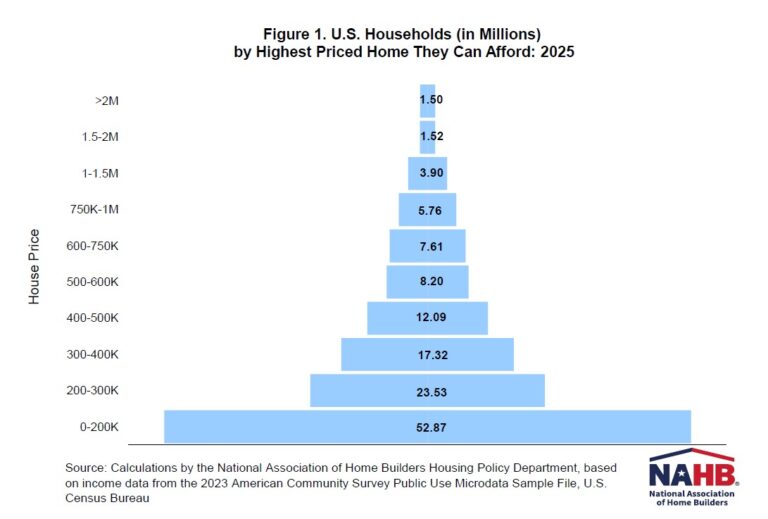
NAHB recently released its 2025 Priced-Out Analysis, highlighting the housing affordability challenge. While previous posts discussed the impacts of rising home prices and interest rates on affordability, this post focuses on the related U.S. housing affordability pyramid. The pyramid reveals that 70% of households (94 million) cannot afford a $400,000 home, while the estimated median price of a new home is around $460,000 in 2025.

The housing affordability pyramid illustrates the number of households able to purchase a home at various price steps. Each step represents the number of households that can only afford homes within that specific price range. The largest share of households falls within the first step, where homes are priced under $200,000. As home prices increase, fewer and fewer households can afford the next price level, with the highest-priced homes—those over $2 million—having the smallest number of potential buyers. Housing affordability remains a critical challenge for households with income at the lower end of the spectrum.

The pyramid is based on income thresholds and underwriting standards. Under these assumptions, the minimum income required to purchase a $200,000 home at the mortgage rate of 6.5% is $61,487. In 2025, about 52.87 million households in the U.S. are estimated to have incomes no more than that threshold and, therefore, can only afford to buy homes priced up to $200,000. These 52.87 million households form the bottom step of the pyramid. Of the remaining households who can afford a home priced at $200,000, 23.53 million can only afford to pay a top price of somewhere between $200,000 and $300,000. These households make up the second step on the pyramid. Each subsequent step narrows further, reflecting the shrinking number of households that can afford increasingly expensive homes.

It is worthwhile to compare the number of households that can afford homes at various price levels and the number of owner-occupied homes available in those ranges (excludes homes built-for-rent), as shown in Figure 2. For example, while around 53 million households can afford a home priced at $200,000 or less, there are only 22 million owner-occupied homes valued in this price range. This trend continues in the $200,000 to $300,000 price range, where the number of households that can afford homes is much higher than the number of housing units in that range. These imbalances show a shortage of affordable housing.

Discover more from Eye On Housing

Subscribe to get the latest posts sent to your email.


This article was originally published by a eyeonhousing.org . Read the Original article here. .


The allure of the real estate reality show is two-fold: showcasing luxury real estate in the world’s most desirable locations for an aspirational viewing experience and encouraging audiences to shamelessly indulge in their inner voyeur. There’s no denying the pleasure of seeing the interiors of the homes of the rich and famous, or, in what may be a more compelling draw for many viewers, granting access to the private dramas and personal conflicts of those on the show. In recent years, realty as reality show fodder has boomed, especially on Netflix, where shows like Selling Sunset and Buying Beverly Hills pair luxury real estate offerings with captivating reality TV personalities. Netflix’s latest entry, Owning Manhattan, out June 28, is real estate reality at its finest—glittering escapism with just enough personal drama to temper the opulence.

Here is a guide to the best real estate reality shows to stream on Netflix.

Buying Beverly Hills

At the center of Buying Beverly Hills is Mauricio Umansky, a familiar face to many reality television fans. That’s because Umansky has been a fixture on Bravo’s The Real Housewives of Beverly Hills since 2010, which stars his now estranged wife Kyle Richards. Buying Beverly Hills switches the spotlight over to Umansky and his lucrative real estate firm The Agency, which employs some of Umansky and Richards’ daughters as well as other young realtors hoping to make it big. The show’s got it all: tours of glitzy multi-million dollar homes, realtors clashing over deals, and, of course, casual accusations of nepotism as everyone at the office discusses who could possibly be next in line to take over the family business.—Annabel Gutterman

Marriage or Mortgage

Reality shows about the wedding industrial complex have long been a staple of the genre, but with Marriage or Mortgage, the fantasy of wedding planning is tempered by a bracing perspective about the economic realities of our time. The premise of the show is seemingly simple: couples meet with hosts Nichole Holmes, a real estate agent, and Sarah Miller, a wedding planner, to debate whether they’d like to spend their hard-earned savings on a house or a wedding. But the show cogently taps into the emotions of economics—how we spend our money and why. While it’s easy to reason that a down payment on a house is a better investment than spending tens of thousands of dollars on a wedding, for many of the couples on the show, having a blowout party to celebrate their nuptials holds far more value than owning a home (six out of the 10 couples featured in the series opted for the wedding). Adding to the emotional weight of the show is the knowledge that much of the show was filmed pre-2020, so many of the couples who chose “marriage,” were forced to postpone or downsize their weddings. Ultimately, Marriage or Mortgage is a portrait what our finances can tell us about ourselves.—Cady Lang

Selling Sunset

With seven seasons under its crystal-encrusted Gucci belt, Selling Sunset is the grand dame of Netflix real estate soaps. Starring a highly telegenic subset of female agents at twin moguls Jason and Brett Oppenheim’s exclusive Los Angeles brokerage, the Oppenheim Group, the series quickly found a following among viewers who like their drama with a side of mansion porn, rather than the other way around. In its early heyday, the central conflict pitted reigning mean girl Christine Quinn—a clotheshorse of truly demented personal style—against wide-eyed newcomer Chrishell Stause, an All My Children and Days of Our Lives alum with Disney princess sparkle and a martyr complex. The show stagnated as Quinn alienated even new co-workers who seemed to have been cast solely to give her allies, and kept declining after her departure at the end of Season 5. Yet, whether you credit it to terminal bachelor Jason’s chaotic love life or the inexplicably moving bond between his loyal ex turned deputy Mary Fitzgerald and her much-younger, French husband Romain Bonnet or simply the cast’s preternatural ability to escalate a perceived slight into a full-on feud, Selling Sunset remains perplexingly addictive. Which is, of course, how you can tell it’s a reality-TV classic.—Judy Berman

Selling Tampa

Though the properties featured on Selling Tampa are ostentatious enough to steal the show, they’re easily forgotten in the midst of the high-octane drama that fuels Allure Realty, a Black woman-owned and operated firm that aims to take over the luxury real estate market in Tampa. Led by Sharelle Rosado, the “tough love” girl boss head broker of the firm, the agents at Allure, ranging from a pair of fun-loving best friends to a seasoned agent whose ambitions point to her striking out on her own in the future, never have a dull moment between their professional rivalries and the complex personal lives. Though the ladies of Selling Tampa were undeniably compelling as both real estate agents and reality TV characters, the show was prematurely canceled after its first season, a true loss for real estate reality fans everywhere.—CL

Selling the OC

What better way to capitalize off the success of Selling Sunset than by launching a spinoff series—and opening another Oppenheim Group brokerage—just 40 miles south? Selling the OC is the Trumpier younger sibling of the Netflix hit that could double as an anthropological study of Newport Beach and its billionaire residents. In this iteration of the show, the veneers are whiter, the tans are faker, and the McMansions are even more supersized; plus, Jason says bye-bye to Brett and serves as the sole Oppenheim brother on set. The agents (three of whom are named Alex) at this coed firm are all animatronic Instagram filters come to life, which only makes the inter-office dating and drama all the more fascinating.—Meg Zukin

The Parisian Agency

Many of Netflix’s realty reality shows bring the drama, but their real estate offerings—often plain white boxes and identical modern farmhouses—leave much to be desired. But The Parisian Agency: Exclusive Properties is for the architecture and interior design nerds.

The show focuses on the Kretz family as they try to find the right million-dollar properties for France’s rich and (sometimes) famous. You’ll tour a 19th century suburban mansion, a villa in St. Tropez, and countless apartments with classical details like Haussmann facades, ornate fireplaces, and French balconies. If you want even more charm, stay for the antics of the family’s grandmother, Majo.—Samantha Cooney

Owning Manhattan

In the vein of Selling Sunset and Selling the OC, Owning Manhattan, the latest addition to the large swath of real estate reality shows, is centered around a real estate agency—SERHANT in New York City. The agency is helmed by Ryan Serhant, who boasts about being the No. 6 spot on The Real Deal’s list of Top Residential Brokerages for 2022. He’s no stranger to the camera, gaining a reputation during his time on Million Dollar Listing New York. Owning Manhattan takes viewers through jaw-dropping apartments with high price tags around New York City and provides plenty of petty drama. In particular, Serhant, who is dedicated to integrating social media into the business practice of publicizing listings and turning his agents into internet personalities, brings an alluring charisma as he shares what it’s like to sell multi-million dollar dwellings while managing multiple egos.—Moises Mendez II

Buying London

Buying London is centered around the company DDRE Global, owner Daniel Daggers, and its agents. The company prides itself on its connection to celebrities and according to House Beautiful, Daggers has worked with members of the Royal family, in addition to “high-profile people in sports, entertainment, and finance.” While the show may not bring the highest level of drama, in comparison to other Netflix real estate reality shows, it does provide a window into the housing market of a notoriously expensive city.—MM

This article was originally published by a time.com . Read the Original article here. .

Pin It