Tag

Share

Browsing


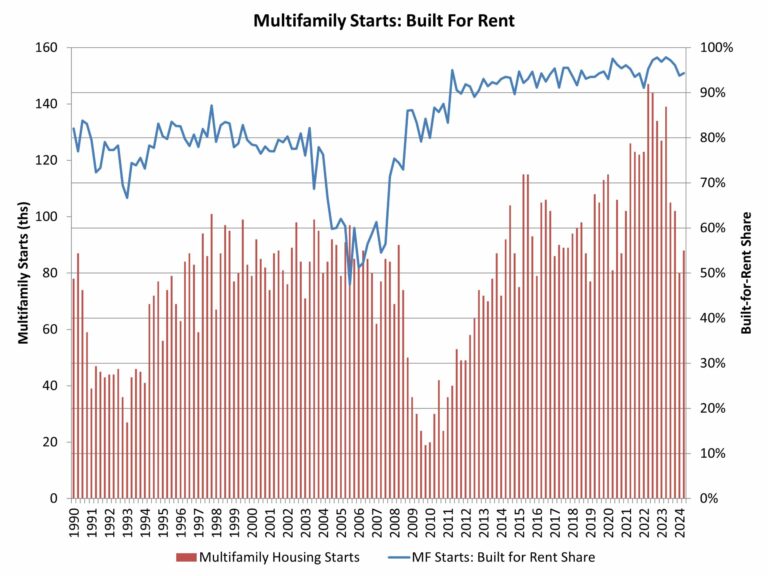
According to NAHB analysis of quarterly Census data, the count of multifamily, for-rent housing starts declined significantly during the second quarter of 2024. For the quarter, 88,000 multifamily residences started construction. Of this total, 83,000 were built-for-rent. This marks a notable 37% decline from the second quarter of 2023 for the multifamily built-for-rent category.

The market share of rental units of multifamily construction starts was flat at a still elevated 94% for the second quarter as the small condo market remained held back due to higher interest rates. In contrast, the historical low share of 47% was set during the third quarter of 2005, during the condo building boom. An average share of 80% was registered during the 1980-2002 period.

For the second quarter, there were just 5,000 multifamily condo unit construction starts.

An elevated rental share of multifamily construction is holding typical apartment size below levels seen during the pre-Great Recession period. According to second quarter 2024 data, the average square footage of multifamily construction starts was relatively unchanged at 1,034 square feet. The median declined to 955 square feet. These estimates are near multidecade lows.

Discover more from Eye On Housing

Subscribe to get the latest posts sent to your email.


This article was originally published by a eyeonhousing.org . Read the Original article here. .
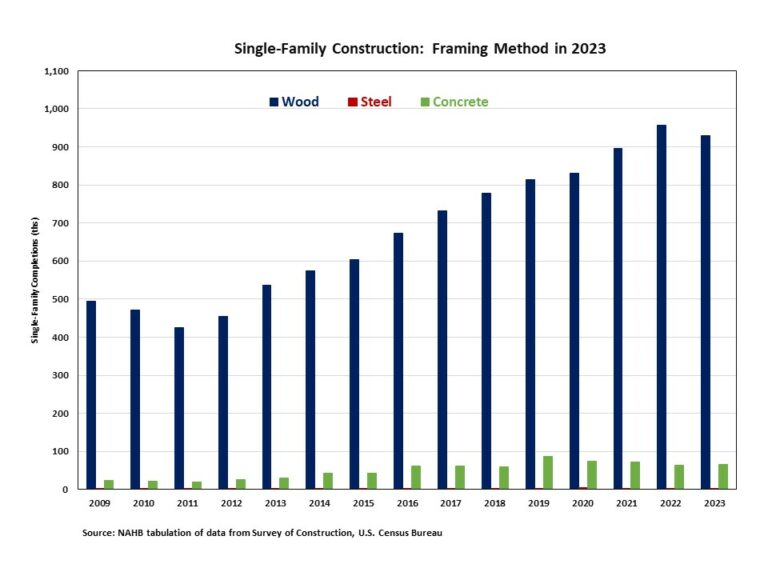

Wood framing remains the most dominant construction method for completed single-family homes in the U.S., according to NAHB analysis of 2023 Census Bureau data. For 2023 completions, 93% of new homes were wood-framed, another 7% were concrete-framed homes, and less than half a percent were steel-framed.

On a count basis, there were 930,000 wood-framed homes completed in 2023. This was a 3% decrease compared to the 2022 total. The wood-framed market share decreased to 93% in 2023, after it increased for three consecutive years, from 2019 (90%) to 2022 (94%). As noted above, steel-framed homes are relatively uncommon, with 3,000 housing completions in 2023, the same amount as the 2021 and 2022 completions.

Meanwhile, the concrete-framed market share increased from 6% in 2022 to 7% in 2023. On a count basis, there were 65,000 concrete-framed homes completed in 2023, up 3% from the previous year. This is the first increase after three straight years of declines (down 13% in 2020, 5% in 2021 and 11% in 2022).

Non-wood based framing methods are primarily concentrated in the South due to residential resiliency requirements. In 2023, concrete-framed homes made up 11% of all homes completed in the South. Additionally, approximately two-thirds of steel-framed homes completed in 2023 were in the South.

Discover more from Eye On Housing

Subscribe to get the latest posts sent to your email.


This article was originally published by a eyeonhousing.org . Read the Original article here. .
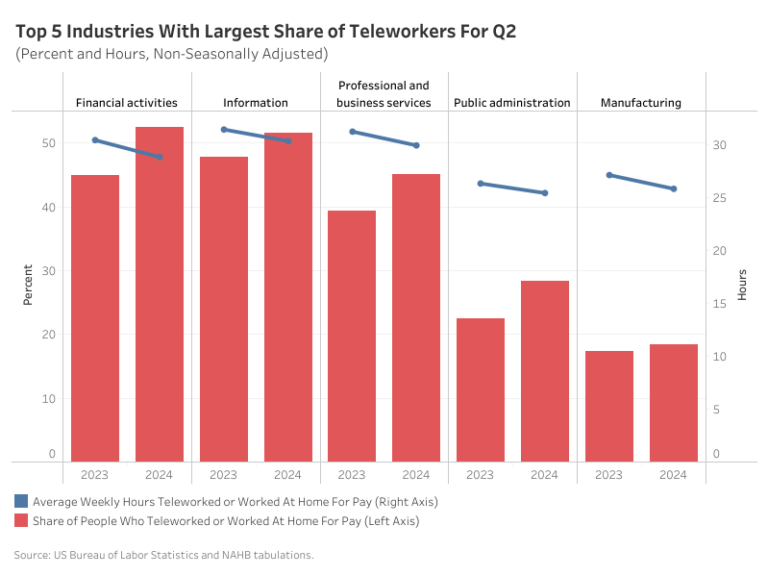

The total share of workers teleworking or working from home for pay has increased from 2023, according to the latest Telework or Work at Home for Pay Survey from the Bureau of Labor Statistics. In June 2023, 19% of the labor force teleworked on a non-seasonally adjusted basis. This share rose to 22.3% in June 2024, even though the total number of workers remained stable. However, the average weekly hours of remote work among teleworkers decreased slightly by 1.7 hours, from 28.7 to 27 hours a week. This decline is due to a shift toward hybrid work, with the proportion of people working all their hours remotely dropping from 53.2% to 48.4%.

Across all occupations, the share of teleworkers has increased, while the average weekly telework hours have declined. Management, professional, and related occupations had the highest share of teleworkers, with 37.8% working remotely in June, averaging 27.1 hours per week. In contrast, natural resources, construction, and maintenance occupations had the lowest share, with only 3.0% teleworking for an average of 21.4 hours a week.

By industry, financial activities saw the largest increase in teleworkers, rising by 7.5 percentage points from 44.9% in June 2023 to 52.4% in June 2024. Meanwhile, the average weekly telework hours for this industry decreased modestly from 30.4 hours to 28.8 hours. The information industry, previously the leader in telework, increased by 3.8 percentage points, from 47.8% to 51.6%. Its average weekly telework hours declined by 1.1 hours, from 31.4 to 30.3 hours.

The increase in teleworking has significant implications for the housing and real estate market. With more people working from home, there may be a growing demand to remodel their current homes to have dedicated office spaces. Additionally, commercial real estate could face challenges as businesses reconsider their office space needs, potentially leading to an increase in flexible workspaces or a reevaluation of leasing strategies.

There are also policy proposals that NAHB supports which aim to repurpose underused commercial spaces into residential real estate, such as the “Revitalizing Downtowns and Main Streets Act” that proposes a 20% tax credit to encourage converting vacant commercial properties into affordable housing, thereby addressing the nationwide housing shortage.

Discover more from Eye On Housing

Subscribe to get the latest posts sent to your email.


This article was originally published by a eyeonhousing.org . Read the Original article here. .


Nationwide, the share of non-conventional financing for new home sales accounted for 32.4% of the market per NAHB analysis of the 2023 Census Bureau Survey of Construction (SOC) data. This is a significant 4.3 percentage point increase from the 2022 share of 28.1%. As in previous years, conventional financing dominated the market at 67.6% of sales, albeit lower than the 2022 share of 71.9%.

Non-conventional forms of financing, as opposed to conventional mortgage loans, include loans insured by the Federal Housing Administration (FHA), VA-backed loans, cash purchases and other types of financing such as the Rural Housing Service, Habitat for Humanity, loans from individuals, or state or local government mortgage-backed bonds. The reliance on non-conventional forms of financing varied across the United States, with its share at almost 40% in West South Central but only 17.1% of new single-family home starts in the Middle Atlantic division.

Nationwide, cash purchases were the majority share of non-conventional financing of new home purchases, accounting for 14% of the market share, slightly up from 13% in 2022. NAHB survey based on builders reported that for 2024, all-cash sales are a higher share at 22%. FHA-backed loans accounted for 12%, whereas in 2022, it was only 8% of the market share. The share of VA-backed loans was at 4% market share in 2023, while Other Financing was 3% of market share.

Regionally, cash financing held the highest share in East South Central, where 24.6% of all homes started were purchased with cash. Except for the South Atlantic, West South Central, and the Pacific, cash purchases led non-conventional financing in the remaining six census regions. Cash purchases accounted for 22.0% in East North Central, 16.9% in New England, 12.3% in Mountain, 12.0% in Middle Atlantic, and 10.6% in West North Central region.   

FHA-backed loans accounted for the majority of all non-conventional financing in the West South Central division accounting for 20.8% of the homes started. This share has gone up considerably  from 12.9% in 2022. The New England division reported the lowest FHA-backed loans with only a share of 1.2% of the homes started in 2023.

VA-backed loans were most used in the South Atlantic division, which accounted for 5.9% of non-conventional forms of financing. In New England, none of the homes started used VA-backed loans in 2023.  

Other financing such as the Rural Housing Service, Habitat for Humanity, loans from individuals, state or local government mortgage-backed bonds was highest in East North Central where it was collectively 5.6% of market share, while Middle Atlantic division reported the lowest share at 0.9%.

Discover more from Eye On Housing

Subscribe to get the latest posts sent to your email.


This article was originally published by a eyeonhousing.org . Read the Original article here. .
Pin It