Tag

Sewer

Browsing


The share of new single-family homes built with individual wells and septic systems increased in 2025 compared to the previous year. According to NAHB’s analysis of the Census Bureau’s Survey of Construction (SOC), approximately 10% of single-family homes started in 2025 were served by individual (private) wells, and 17% relied on individual septic systems.

Nationally, most new homes were connected to public water systems, which include community or shared supplies/wells. The remaining 10% were built with private wells, increasing one percentage point from the previous year.

The share of private wells significantly differed by Census division.  In New England, where median lot size is double the national median, 42% of new single-family homes relied on private wells, making it the division with the highest rate in the nation. The East North Central division followed with 26%, while the Middle Atlantic stood at 15%. The South Atlantic region also exceeded the national average, with 13% of new homes using private wells. In stark contrast, private wells were uncommon in the East South Central, West South Central and Pacific divisions, where they accounted for one to two percent of new homes started.

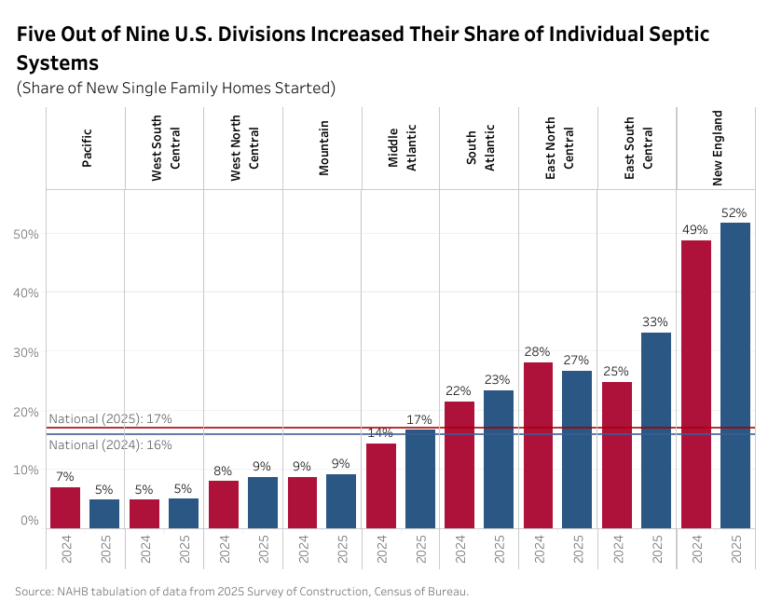
For sewage disposal, 83% of new single-family homes in 2025 were connected to public sewer systems, which include community or shared sewage/septic systems. The remaining 17% utilized individual septic systems, one percentage point higher than the previous year. As with private wells, the usage of individual septic systems varied significantly by region.

New England led the nation with 52% of new homes using individual septic systems.  The East South Central (33%), East North Central (27%), and South Atlantic (23%) divisions also reported shares above the national average. In contrast, lower usage was recorded in the Mountain (9%) and West North Central (9%) divisions, while the Pacific and West South Central divisions had the smallest shares, at 5%, respectively.

Compared to 2024, five of the nine Census divisions experienced an increase in the use of individual septic systems with four of the divisions falling below the national average of 17%. East South Central in particular saw a large increase of 8-percentage points as it surpassed East North Central as the division with the second largest share of individual septic systems. New England remained the largest shareholder with 52%, a 3-percentage point increase. Only Pacific and East North Central saw declines in shares of 2- and 1-percentage points, respectively.


This article was originally published by a eyeonhousing.org . Read the Original article here. .

The share of new single-family homes built with individual septic systems declined slightly in 2024 compared to the previous year, while the share of homes served by private wells remained steady. According to NAHB’s analysis of the Census Bureau’s Survey of Construction (SOC), approximately 16% relied on individual septic systems, and 9% of new single-family homes started in 2024 were served by private wells.

Nationally, the majority of new homes were connected to public water systems – including community or shared supplies/wells – while 9% were built with private wells. This national share held steady from the previous year, though regional differences were notable. In New England, where median lot sizes are more than three times the national average, 37% of new single-family homes relied on private wells, making it the division with the highest rate in the nation. The East North Central division followed with 27%, while the Middle Atlantic stood at 13%. The South Atlantic region also exceeded the national average, with 11% of new homes using private wells. In stark contrast, private wells were uncommon in the East South Central and West South Central divisions, each accounting for just 1% of new homes started.

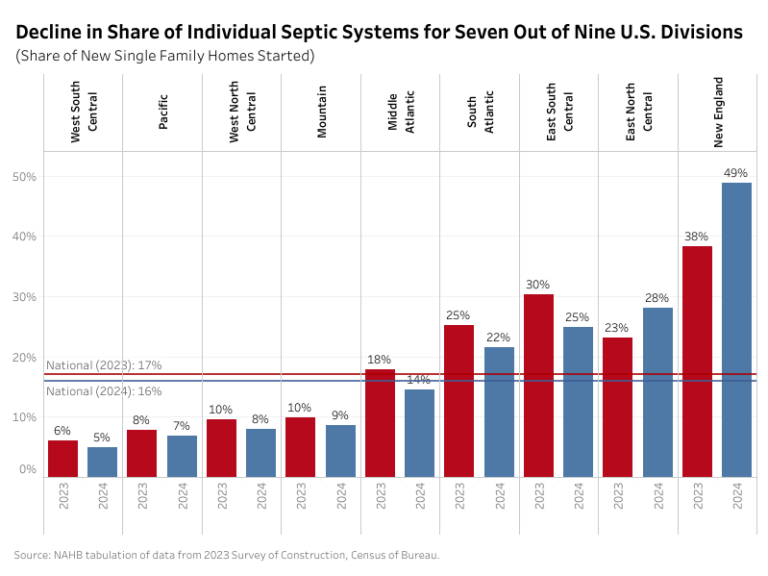
For sewage disposal, 84% of new single-family homes in 2024 were connected to public sewer systems, which include community or shared sewage/septic systems. The remaining 16% utilized individual septic systems, down slightly from 17% in the previous year. As with water sources, the usage of septic systems varied significantly by region.

New England led the nation with 49% of new homes using individual septic systems. The East North Central (28%), East South Central (25%), and South Atlantic (22%) divisions also reported shares above the national average. In contrast, lower usage was recorded in the Mountain (9%) and West North Central (8%) divisions, while the Pacific and West South Central divisions had the smallest shares, at 7% and 5%, respectively.

Compared to 2023, seven of the nine Census divisions experienced a decline in the use of individual septic systems with five of the divisions falling below the national average. New England and East North Central were the exceptions, recording increases of 11- and 5-percentage points, respectively, bringing their shares to 49% and 28% in 2024. However, these gains are not anomalies. In New England, the share had dipped to 38% in 2023, down from 46% in 2022. Similarly, East North Central’s share decreased from 27% in 2022 to 23% in 2023.    

Zooming out, the share of new homes built with individual septic systems has generally been on a decline across most regions since 2010. This trend has been slightly more pronounced in the three divisions (New England, East South Central and East North Central) with historically higher usage. The South Atlantic division stands out as an exception. While its share ranged from 13% to 17% in the early 2010s, it has steadily increased in recent years, and now exceeds 20%.

Discover more from Eye On Housing

Subscribe to get the latest posts sent to your email.


This article was originally published by a eyeonhousing.org . Read the Original article here. .
Pin It