Tag

September

Browsing


With the Federal Reserve beginning an easing of monetary policy and builder sentiment improving, single-family starts posted a modest gain in September while multifamily construction continued to weaken because of tight financing and an ongoing rise in completed apartments.

Overall housing starts decreased 0.5% in September to a seasonally adjusted annual rate of 1.35 million units, according to a report from the U.S. Department of Housing and Urban Development and the U.S. Census Bureau.

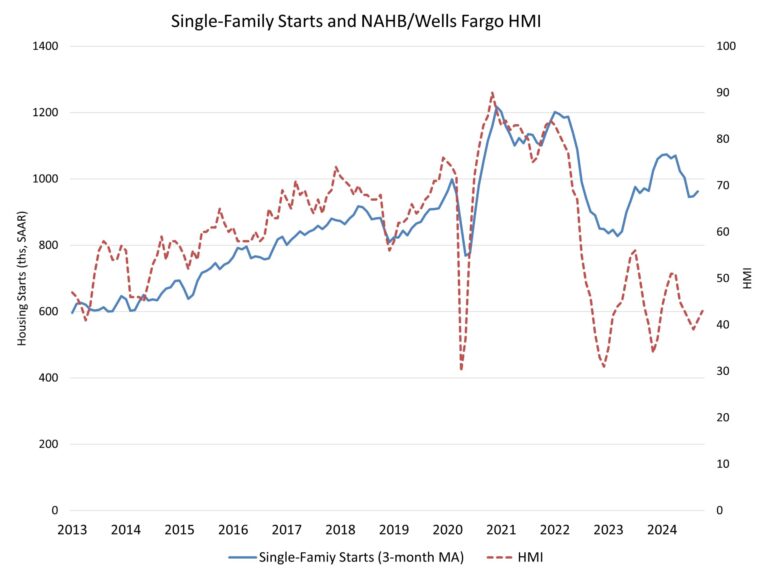
The September reading of 1.35 million starts is the number of housing units builders would begin if development kept this pace for the next 12 months. Within this overall number, single-family starts increased 2.7% to a 1.03 million seasonally adjusted annual rate. On a year-to-date basis, single-family construction is up 10.1%. The September gain for single-family home building mirrored an increase for the NAHB/Wells Fargo HMI.

While single-family home building increased in September, higher mortgage interest rates in October are likely to place a damper on growth in next month’s data. Nonetheless, NAHB is forecasting a gradual, if uneven, decline for mortgage rates in the coming quarters, with corresponding increases for single-family construction.

The multifamily sector, which includes apartment buildings and condos, decreased 9.4% to an annualized 327,000 pace. This marks the weakest pace since May. Multifamily construction will remain weak as completions of apartments are elevated.

On a regional and year-to-date basis, combined single-family and multifamily starts are 9.0% higher in the Northeast, 2.0% lower in the Midwest, 4.6% lower in the South and 5.4% lower in the West.

Overall permits decreased 2.9% to a 1.43 million unit annualized rate in September. Single-family permits increased 0.3% to a 970,000 unit rate. Multifamily permits decreased 8.9% to an annualized 458,000 pace. This is the weakest reading since May.

Looking at regional data on a year-to-date basis, permits are 0.8% higher in the Northeast, 2.6% higher in the Midwest, 2.2% lower in the South and 5.1% lower in the West.

The number of single-family homes under active construction totaled 642,000 in September. After stabilizing recently, this is down just 4.5% from a year ago. The number of multifamily units under construction declined 3.4% in September to an 842,000 total. This is 16.5% lower than a year ago and is the smallest count since February 2022.

As a sign of the reversal for multifamily construction, the seasonally adjusted annual rate of multifamily construction was 680,000 in September. This was roughly twice the pace of multifamily starts, meaning for every two apartments finishing construction, only one new unit began construction. The pace of multifamily completions was up 41% compared to a year ago.

Discover more from Eye On Housing

Subscribe to get the latest posts sent to your email.


This article was originally published by a eyeonhousing.org . Read the Original article here. .
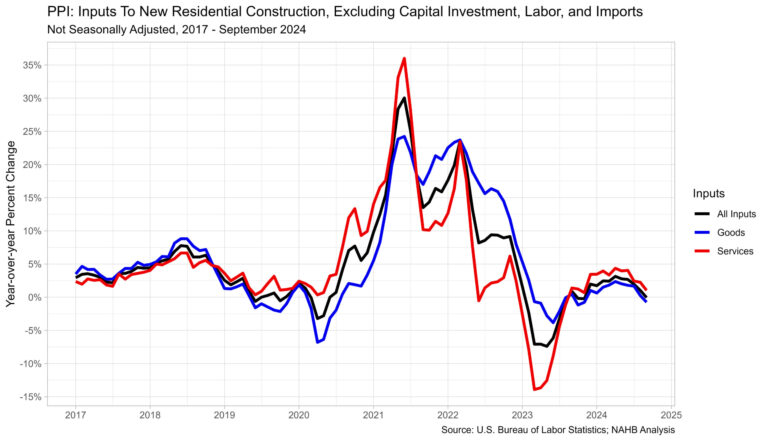

Prices for inputs to new residential construction—excluding capital investment, labor, and imports—decreased 0.6% in September according to the most recent Producer Price Index (PPI) report published by the U.S. Bureau of Labor Statistics. Compared to a year ago, this index was down 0.1% in September after an increase of 1.0% in August.

The inputs to new residential construction price index can be broken into two components­—one for goods and another for services. The goods component decreased 0.7% over the year, while services increased 1.0%. For comparison, the total final demand index increased 1.8% over the year in September, with final demand goods down 1.1% and final demand services up 3.1% over the year.

Input Goods

The goods component has a larger importance to the total residential construction inputs price index, around 60%. The price of input goods to residential construction was down 0.7% in September from August. The input goods to residential construction index can be further broken down into two separate components, one measuring energy inputs with the other measuring goods less energy inputs. The latter of these two components simply represents building materials used in residential construction, which makes up around 93% of the goods index.

Prices for inputs to residential construction, goods less energy, were up 1.5% in September compared to a year ago. This year-over-year growth has continued to slow since April when it was at 2.5% and remains well below growth in September of 2022 when it was at 14.3%. The year-over-year growth in September 2023 was 1.0%, making this year’s growth slightly higher. The index for inputs to residential construction for energy fell 23.5% in September, the largest yearly decrease since 26.1% in July 2023.

The graph below focuses on the data since the start of 2023 for residential goods inputs. Energy prices have retreated over the past year, with only two periods of growth in 2024.

Input Services

Prices of inputs to residential construction, services, fell 0.5% in September from August. The price index for service inputs to residential construction can be broken out into three separate components: the trade services component, the transportation and warehousing services component, and the services less trade, transportation and warehousing component. The most vital component is trade services (around 60%), followed by services less trade, transportation and warehousing (around 29%), and finally transportation and warehousing services (around 11%). The largest component, trade services, compared to last year was up 0.4% in September after increasing 2.1% in August.

Discover more from Eye On Housing

Subscribe to get the latest posts sent to your email.


This article was originally published by a eyeonhousing.org . Read the Original article here. .
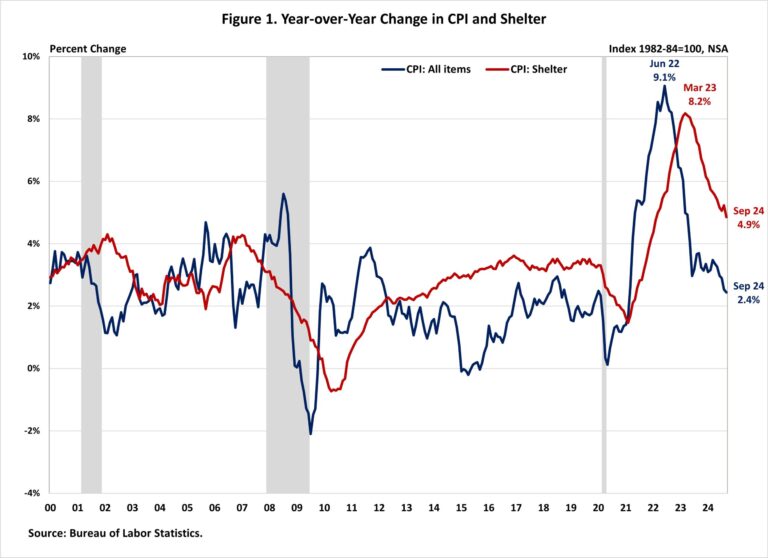

Inflation continued to ease in September and remained at a 3-year low as shelter costs continued to moderate. Shelter costs, the main driver of inflation since early 2023, saw their annual growth rate fall below 5% for the first time since February 2022. With the Fed beginning its easing cycle with a half-point cut last month, lower interest rates could help ease some pressure on the housing market.

Though shelter remains the primary driver of inflation, the Fed has limited ability to address rising housing costs, as these increases are driven by a lack of affordable supply and increasing development costs. Additional housing supply is the primary solution to tame housing inflation. However, the Fed’s tools for promoting housing supply are constrained.

In fact, tight monetary policy hurts housing supply because it increases the cost of AD&C financing. This can be seen on the graph below, as shelter costs continue to rise at an elevated pace despite Fed policy tightening. Nonetheless, with the Fed shifting to a more dovish stance, along with additional apartment supply supported by real-time private data, NAHB expects to see shelter costs to continue decline in the coming months.

The Bureau of Labor Statistics reported that the Consumer Price Index (CPI) rose by 0.2% in September on a seasonally adjusted basis, the same increase as in July and August. Excluding the volatile food and energy components, the “core” CPI increased by 0.3% in September, the same increase as in August.

The price index for a broad set of energy sources fell by 1.9% in September, with declines in gasoline (-4.1%) and fuel oil (-6.0%) offset by increases in electricity (+0.7%) and natural gas (+0.7%). Meanwhile, the food index rose 0.4%, after a 0.1% increase in August. The index for food away from home increased by 0.3% and the index for food at home rose by 0.4%.

The index for shelter (+0.2%) and food (+0.4%) were the largest contributors to the monthly increase in all items index, accounting for over 75% of the total increase. Other top contributors that rose in September include indexes for motor vehicle insurance (+1.2%), medical care (+0.4%), apparel (+1.1%) and airline fares (+3.2%). Meanwhile, the top contributors that experienced a decline include indexes for recreation (-0.4%) and communication (-0.6%).

The index for shelter makes up more than 40% of the “core” CPI. The index saw a 0.2% rise in September, following an increase of 0.5% in August. Both the indexes for owners’ equivalent rent (OER) and rent of primary residence (RPR) increased by 0.3% over the month. These gains have been the largest contributors to headline inflation in recent months. 

During the past twelve months, on a non-seasonally adjusted basis, the CPI rose by 2.4% in September, following a 2.5% increase in August. This was the slowest annual gain since February 2021. The “core” CPI increased by 3.3% over the past twelve months, following a 3.2% increase in August. The food index rose by 2.3%, while the energy index fell by 6.8%.

NAHB constructs a “real” rent index to indicate whether inflation in rents is faster or slower than overall inflation. It provides insight into the supply and demand conditions for rental housing. When inflation in rents is rising faster than overall inflation, the real rent index rises and vice versa. The real rent index is calculated by dividing the price index for rent by the core CPI (to exclude the volatile food and energy components).

In September, the Real Rent Index remained unchanged after a 0.1% increase in August. Over the first nine months of 2024, the monthly growth rate of the Real Rent Index averaged 0.1%, slower than the average of 0.2% in 2023.

Discover more from Eye On Housing

Subscribe to get the latest posts sent to your email.


This article was originally published by a eyeonhousing.org . Read the Original article here. .
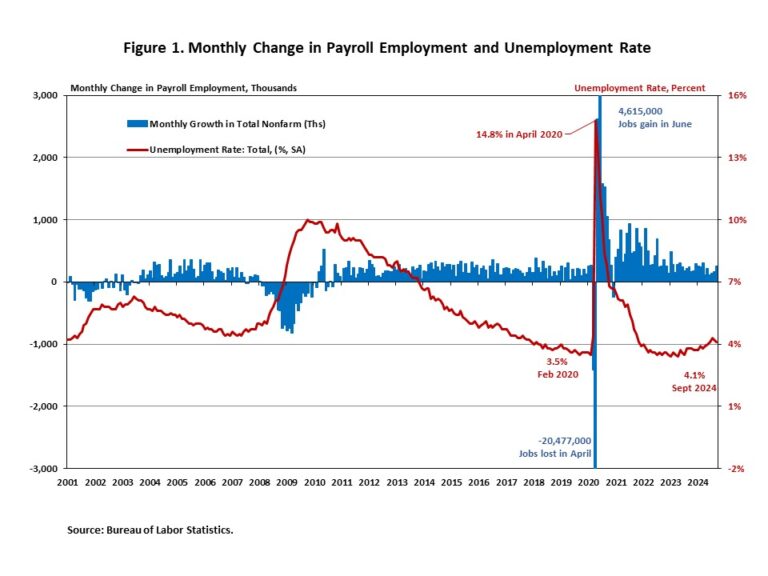

The September jobs report indicates that the U.S. labor market remains strong. Job growth accelerated, and the unemployment rate fell to a three-month low of 4.1%.  Meanwhile, job growth for the previous two months (July and August) was upwardly revised.

In September, wage growth accelerated for the second straight month. Wages grew at a 4.0% year-over-year (YOY) growth rate in September, down 0.5 percentage points from a year ago. Wage growth is outpacing inflation, which typically occurs as productivity increases.

National Employment

Total nonfarm payroll employment increased by 254,000 in September, following an upwardly revised increase of 159,000 jobs in August, as reported in the Employment Situation Summary. It marks the largest monthly job gain in the past six months. The estimates for the previous two months were revised higher. The monthly change in total nonfarm payroll employment for July was revised up by 55,000, from +89,000 to +144,000, while the change for August was revised up by 17,000 from +142,000 to +159,000. Combined, the revisions were 72,000 higher than previously reported.

In the first nine months of 2024, 1,801,000 jobs were created. Additionally, monthly employment growth averaged 200,000 per month, compared with the 251,000 monthly average gain for 2023. The Fed’s easing cycle began on September 18, marking the end of a period of restrictive monetary policy. The U.S. economy has created roughly 8 million jobs since March 2022, when the Fed enacted the first interest rate hike of this cycle.

The unemployment rate fell slightly to 4.1% in September, from 4.2% in August. The September decrease in the unemployment rate reflected the decrease in the number of persons unemployed (-281,000) and the increase in the number of persons employed (+430,000).

Meanwhile, the labor force participation rate—the proportion of the population either looking for a job or already holding a job—was 62.7% for the third consecutive month. However, for people aged between 25 and 54, the participation rate dipped slightly to 83.8%. This rate exceeds the pre-pandemic level of 83.1%. Meanwhile, the overall labor force participation rate is still below its pre-pandemic levels when it stood at 63.3% at the beginning of 2020.

In September, employment continued to trend up in food services and drinking places (+69,000), health care (+45,000), government (+31,000), social assistance (+27,000), and construction (+25,000).

Construction Employment

Job gains in the overall construction sector continued in September, averaging 20,000 per month over the past 12 months. While residential construction gained 7,800 jobs, non-residential construction employment added 17,900 jobs for the month.

Residential construction employment now stands at 3.4 million in September, broken down as 952,000 builders and 2.4 million residential specialty trade contractors. The 6-month moving average of job gains for residential construction was 3,450 a month. Over the last 12 months, home builders and remodelers added 60,500 jobs on a net basis. Since the low point following the Great Recession, residential construction has gained 1,393,800 positions.

In September, the unemployment rate for construction workers rose to 4.9% on a seasonally adjusted basis. The unemployment rate for construction workers has remained at a relatively lower level, after reaching 15.3% in April 2020 due to the housing demand impact of the COVID-19 pandemic.

Discover more from Eye On Housing

Subscribe to get the latest posts sent to your email.


This article was originally published by a eyeonhousing.org . Read the Original article here. .


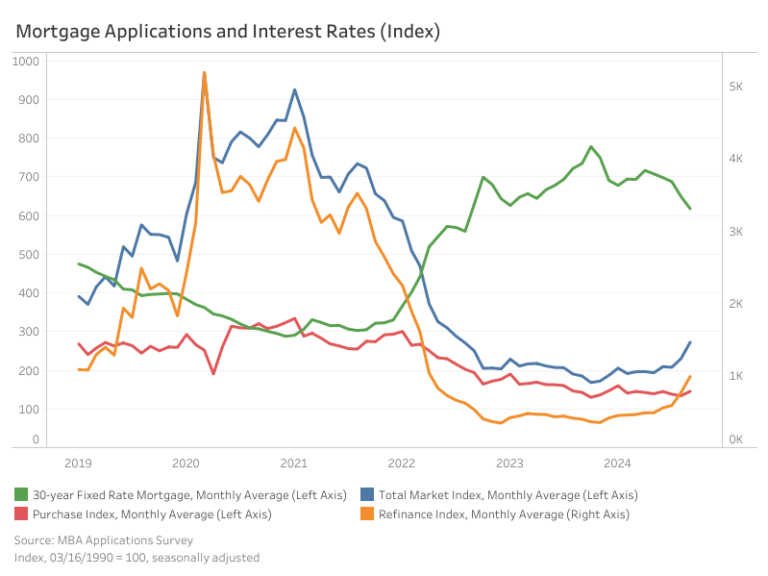
The Market Composite Index, a measure of mortgage loan application volume by the Mortgage Bankers Association’s (MBA) weekly survey, rose 18.4% month-over-month on a seasonally adjusted (SA) basis, driven primarily by a surge in refinancing activity. Compared to September 2023, the index increased by 47%. The Market Composite Index which includes the Purchase and Refinance Indices saw monthly gains, rising by 8.6% and 29%, respectively. Year-over-year, the Purchase Index showed a modest increase of 1.9%, while the Refinance Index jumped 149.9%.

The average 30-year fixed mortgage rate continued its downward trajectory for the fifth consecutive month, with September seeing a decline of 31 basis points (bps), bringing the rate to 6.18%. This is 117 bps lower than the same time last year.

Loan sizes also saw growth across the board. The average loan size for the total market (including purchases and refinances) was $400,450 on a non-seasonally adjusted (NSA) basis, an increase of 5.1% from August. Purchase loans grew by 3% to an average of $439,600, while refinance loans jumped by 11.6% to $363,825. Adjustable-rate mortgages (ARMs) saw an 8.2% increase in average loan size, rising from $1.1 million to $1.2 million.

Discover more from Eye On Housing

Subscribe to get the latest posts sent to your email.


This article was originally published by a eyeonhousing.org . Read the Original article here. .


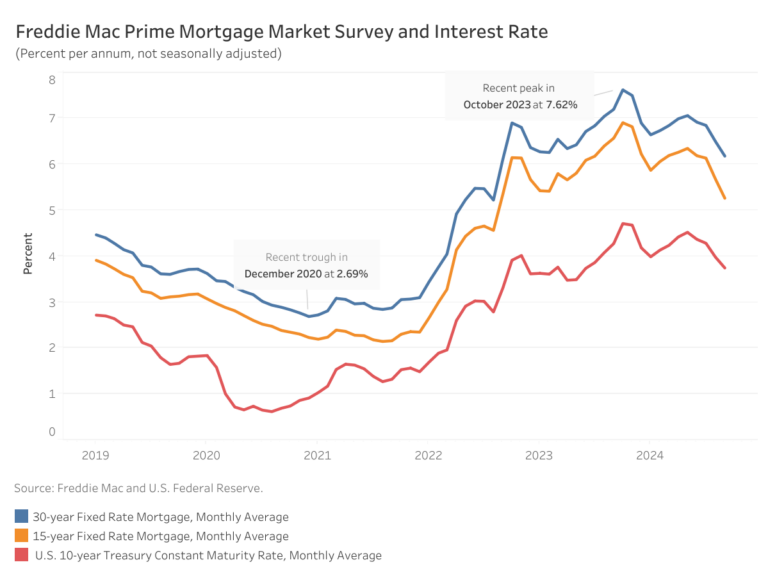
In September, mortgage rates maintained their downward trajectory, returning to levels last seen two years ago. According to Freddie Mac, the average rate for a 30-year fixed-rate mortgage fell to 6.18%, a decline of 32 basis points (bps) from August. The 15-year fixed-rate mortgage saw an even steeper decline, decreasing by 42 bps from August to 5.26%. Additionally, the 10-year Treasury rate declined by 23 bps, falling from 3.98% in August to 3.75%.

According to the NAHB forecast, the 30-year mortgage rate is expected to near 6% on a sustained basis by the end of 2024, with a further decline to just below 6% during 2025. NAHB also predicts furthering easing by the Federal Reserve before the end of 2024.

Discover more from Eye On Housing

Subscribe to get the latest posts sent to your email.


This article was originally published by a eyeonhousing.org . Read the Original article here. .


From the first days, which probably still feel like summer, to the last, when you may notice that first chill in the air, September is a time of transition. Get your home ready for the season ahead by ticking off these to-dos, from adding cozy layers to scheduling necessary maintenance — and then curl up in your favorite chair and savor the comforts of home.

Sky House CompanySave Photo
Things to Check Off Your List in an Hour or Less

1. Cozy up with warm layers. Have you felt that first nip in the air yet? When you do, think about swapping out lighter-weight bedding for flannel sheets and fluffy duvets. Bring added warmth to the other rooms in your house with throws and pillows in rich fabrics like wool, velvet or faux fur. Thicker area rugs and curtains not only feel cozier, but they also can actually help your home feel warmer — and cut down on your energy bills.

Find bedding in the Houzz Shop

Wright-Ryan HomesSave Photo
2. Order firewood. Whether you use a wood-burning stove or fireplace for actual warmth or just for coziness, now is a good time to order a delivery of firewood. If you can help it, don’t store large quantities of wood directly against the house, which can encourage pests, but do keep it protected from rain and snow beneath a shelter.

3. Check safety devices. Test smoke detectors and carbon monoxide detectors; replace batteries as needed. Check the expiration date on your fire extinguisher and replace if needed.

Shop for carbon monoxide and smoke detectors

ALIGN Austin ArchitectsSave Photo
4. Set up or improve kids’ schoolwork area. Give children an area to do their schoolwork that is comfortable, attractive and well-organized. Ideally, make a large surface available for spreading out big or messy projects. The dining table can work, but if you have the room, consider adding a dedicated project table or large desk surface and keep the necessary supplies at hand.

Shop for desks

Ryan Tuttle PhotographySave Photo
Tackle These Tasks Over a Weekend

5. Clean leather furniture. It’s important to know whether your leather furniture has a finish before treating it with any products, so check labels or look up the item on the retailer’s or manufacturer’s website before you begin.

For unprotected leather (also called aniline), less is more when it comes to cleaning: Wipe with a clean, dry cloth orone slightly dampened with distilled water.For protected leather (also called semianiline or pigmented), you can make your own cleaning solution by adding a few drops of mild nondetergent soap to distilled water, or use a commercial leather cleaning product. Apply with a microfiber cloth.How to Clean Leather Furniture

larson architecture works pllcSave Photo
6. Remove window AC units. If you use window air-conditioning units, now is the time to either remove them or cover them outside with protective insulation. Removing the units is the better option because this will allow you to close the windows, minimizing winter heat loss. If you choose to leave them in over the winter, be sure to pick up insulating covers made for this purpose and securely attach them outside.

7. Add weatherstripping. Newer double-pane windows may not need weatherstripping, but it will help most older windows retain heat and stop drafts. Check areas with previously applied weatherstripping and remove or replace as needed.

Find a handyman to help with your home projects

8. Freshen up your fall wardrobe. If you’ve bought new clothes recently, take this opportunity to sort through the rest of your wardrobe and remove pieces you no longer wear. Collect clothes that need repair and move summer clothes to an out-of-the-way spot so that your fall wardrobe can be front and center. Polish shoes, remove pilling from coats and sweaters, and clean out handbags and totes.

Shop for closet storage products on Houzz

Susan Yeley HomesSave Photo
9. Inspect the roof and gutters. It’s generally fine to wait until most of the leaves have fallen in autumn to clean out the gutters and downspouts, but giving these areas a quick visual inspection now is a good idea. Pull out any sticks or other debris blocking the gutters, and make note of any worn-out seals around vent pipes and chimneys. If you do not feel comfortable on a ladder, or have a home of two or more stories, hire someone to do a quick inspection for you. Schedule any needed repairs now so that your home will be buttoned up for winter.

How to clean your gutters

ACK Design Inc.Save Photo
Maintenance and Extras to Budget for This Month

10. Schedule chimney and furnace maintenance. Make sure your fireplace and heating system are clean, safe and ready to go by having a pro look at them now. Having your chimney cleaned will also ensure that you don’t try to start a fire when an animal family (or an old nest) is inside. And if you don’t have a chimney cap yet, speak with your chimney sweep about adding a one. The metal cap with screened sides can prevent critters from getting in and helps protect your roof from burning embers.

Not sure where to start on your home project? Learn the basics

11. Maintain the washer and dryer. Cleaning out the dryer vents can be a job you do yourself, but if you don’t feel comfortable doing so (or if you’ve been putting it off), you may want to hire a pro to do washer and dryer maintenance for you. Washing-machine hoses need to be replaced from time to time, and a cracked hose can cause a leak — which can mean costly damage to your home. Clean dryer vents and hoses will help your machine work more efficiently and reduce the risk of fire.

Browse laundry room products

Alair Homes Sherwood ParkSave Photo
12. Consider beefing up insulation. Looking for a way to save on your energy bills this winter? You may want to think about adding insulation to your attic space or inside walls. This can make a big difference in how well your home retains heat in winter and stays cool in summer.

Tell us: What’s on your to-do list for September? Share in the Comments.

More on Houzz
Read more stories
Find a home professional
Shop for home products


This article was originally published by a
www.houzz.com . Read the Original article here. .
Pin It