Tag

September

Browsing


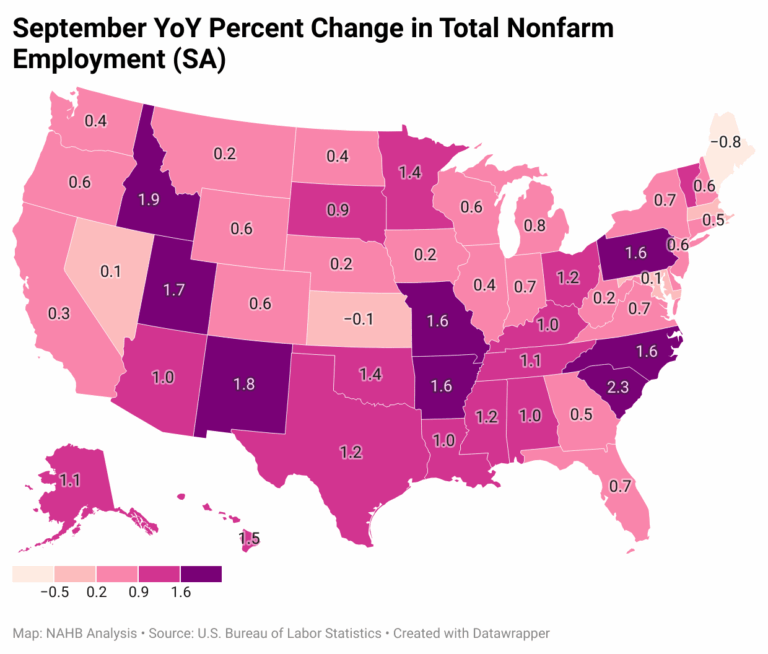
In September 2025, nonfarm payroll employment was largely unchanged across states on a monthly basis, with a limited number of states seeing statistically significant increases or decreases. This reflects generally stable job counts across states despite broader labor market fluctuations. The data were impacted by collection delays due to the federal government shutdown.

Nonfarm payroll employment increased in 29 states and the District of Columbia in September compared to the previous month, while decreasing in 20 states. New Mexico reported no change. According to the Bureau of Labor Statistics, nationwide total nonfarm payroll employment increased by 119,000 in September, following significant downward revisions to the previous two months’ figures including job losses in August. Through September, monthly job growth has averaged 76,000, a significant slowdown compared to the 168,000 monthly average gain for 2024.

On a month-over-month basis, employment data was most favorable in Missouri, which added 18,300 jobs. New Jersey came in second (+10,900), followed by North Carolina (+10,200). Meanwhile, a total of 96,300 jobs were lost across 20 states, with New York reporting the steepest job losses at 27,000. In percentage terms, employment increased the highest in Missouri at 0.6%, while Connecticut saw the largest decline at 0.3% between August and September.

Year-over-year ending in September, 1.3 million jobs have been added to the labor market, which is a 0.8% increase compared to the September 2024 level. The range of job gains spanned from 900 jobs in Montana to 168,000 jobs in Texas. Three states and the District of Columbia lost a total of 25,700 jobs in the past 12 months, with the District of Columbia reporting the steepest job losses at 9,600. In percentage terms, the range of job growth spanned 0.1% in Nevada and Maryland to 2.3% in South Carolina. The range of job losses in Kansas, Massachusetts, Maine, and the District of Columbia spanned 0.1%-1.2%.

Construction Employment

Across the nation, construction sector jobs data —which includes both residential and non-residential construction—showed that 31 states and the District of Columbia reported an increase in September compared to August, while 17 states lost construction sector jobs. The two remaining states reported no change on a month-over-month basis. Texas, with the highest increase, added 4,300 construction jobs, while Florida, on the other end of the spectrum, lost 4,400 jobs. Overall, the construction industry added a net 19,000 jobs in September compared to the previous month. In percentage terms, Michigan reported the highest increase at 2.1%, while Mississippi reported the largest decline at 4.9%.

Year-over-year, construction sector jobs in the U.S. increased by 38,000, which is a 0.5% increase compared to the September 2024 level. Texas added 16,400 jobs, which was the largest gain of any state, while New York lost 16,900 construction sector jobs. In percentage terms, New Mexico had the highest annual growth rate in the construction sector at 12.4%. During this period, New Jersey reported the largest decline of 6.0%.


This article was originally published by a eyeonhousing.org . Read the Original article here. .
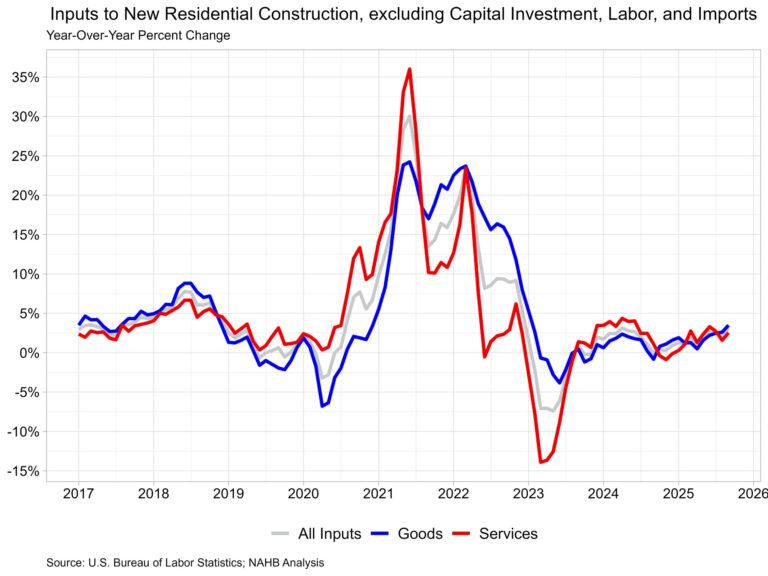

Aggregate residential building material prices rose at their fastest pace since January 2023 in the latest Producer Price Index release from the Bureau of Labor Statistics. Input energy prices increased for the first time in over a year, while service price growth remained lower than goods.

The Producer Price Index for final demand increased 0.3% in September, after falling 0.1% in August. The index for final demand goods increased 0.9% in September, the largest monthly increase since February 2024. Final demand energy prices were responsible for most of the goods index increase, as they rose 3.5% in September. This index for final demand for services was unchanged in September.

The price index for inputs to new residential construction rose 0.2% in September and was up 3.1% from last year. The price of goods inputs was up 0.1% over the month and 3.5% from last year, while prices for services were up 0.3% over the month and 2.5% from last year.

Input Goods

The goods component has a larger importance to the inputs to residential construction price index, representing around 60%. On a monthly basis, the price of input goods to new residential construction was up 0.1% in September.

The input goods to residential construction index can be further broken down into two separate components, one measuring energy inputs with the other measuring remaining goods. The latter of these two components simply represents building materials used in residential construction, which makes up around 93% of the goods index.

Energy input prices rose 1.0% in September and were 3.0% higher than one year ago. Building material prices were up 0.1% in September and up 3.5% compared to one year ago. The 3.5% year-over-year increase is the largest increase since the 4.9% experienced back in January 2023. Residential building material price inflation slowly accelerated over the year, after starting around 2.0%.

The largest year-over-year price changes continue to be parts for construction machinery and equipment, sold separately, up 41.3% compared to September of last year. Metal molding and trim prices are up 31.0% from last year. Ready-mix concrete, a key input to new residential construction, has shown little price growth in 2025, up only 0.4% from last year. Additionally, softwood lumber prices were down 2.3% in September from last year. Lumber prices have experienced declines over the past few months despite higher tariffs now in place. Ongoing weaknesses during 2025 in new residential construction have led to an acute oversupply of lumber on the market, with demand below expectations.

Input Services

Prices for service inputs to residential construction reported an increase of 0.3% in September. On a year-over-year basis, service input prices were up 2.5%. The price index for service inputs to residential construction can be broken out into three separate components: a trade services component, a transportation and warehousing services component, and a services excluding trade, transportation and warehousing component (other services).

 The most significant component is trade services (around 60%), followed by other services (around 29%), and finally transportation and warehousing services (around 11%). The largest component, trade services, was up 3.1% from a year ago. The other services component was up 1.3% over the year.  Lastly, prices for transportation and warehousing services rose 2.6% compared to August of last year.


This article was originally published by a eyeonhousing.org . Read the Original article here. .


The long-delayed September jobs report revealed that the U.S. economy added 119,000 jobs while the unemployment rate climbed to its highest level in nearly four years. Combined with downward revisions to previous months, this month’s data indicates a slowing of the U.S. labor market, though one that is still expanding. With the October jobs report cancelled due to the government shutdown and November’s report not scheduled for release until December 16, this September report now stands as the Federal Reserve’s final look at labor market conditions before its December meeting.

In September, wages grew at a 3.8% pace year over year, matching August’s increase. Wage growth has been outpacing inflation for nearly two years, which typically occurs as productivity increases.

National Employment

The September jobs report was delayed by more than six weeks due to the federal government shutdown. According to the long-awaited Employment Situation Summary reported by the Bureau of Labor Statistics (BLS), total nonfarm payroll employment rose by 119,000 in September, following a downwardly revised loss of 4,000 jobs in August. August’s growth was revised down by 26,000, from an initial estimate of +22,000 to -4,000, marking the second month of negative job growth since January 2010. July’s job growth was revised down by 7,000, from +79,000 to +72,000. Combined, the revisions erased 33,000 jobs from previously reported figures.

Through September, monthly job growth in 2025 has averaged 76,000, a significant slowdown compared to the 168,000 monthly average gain for 2024.

The unemployment rate rose to 4.4% in September, its highest level in nearly four years. The number of persons unemployed rose by 219,000 and the number of persons employed increased by 251,000.

Meanwhile, the labor force participation rate—the proportion of the population either looking for a job or already holding a job—edged up by 0.1 percentage points to 62.4%. This remains below its pre-pandemic level of 63.3% recorded at the beginning of 2020. Among prime working-age individuals (aged 25 to 54), the participation rate remained steady at 83.7%, the highest level since October 2024.

In September, employment gains were seen in health care (+43,000), food services and drinking places (+37,000), and social assistance (+14,000), while the transportation and warehousing sector and the federal government experienced job losses. Federal government employment fell by 3,000 positions in September and has now shed a total of 97,000 positions since peaking in January 2025. The BLS notes that “employees on paid leave or receiving ongoing severance pay are counted as employed in the establishment survey.”

Construction Employment

Employment in the overall construction sector increased by 19,000 in September, after three consecutive months of job losses. Within the industry, residential construction added 3,100 jobs, while non-residential construction gained 16,300 positions.

Residential construction employment now stands at 3.3 million in September, including 954,000 workers employed by builders and remodelers and 2.4 million residential specialty trade contractors.

The six-month moving average of job gains for residential construction remains negative at -3,767 per month, reflecting losses in four of the past six months for May through August 2025. Over the last 12 months, residential construction has seen a net loss of 44,900 jobs, marking the fifth consecutive annual decline since September 2020. Since the low point following the Great Recession, residential construction has gained 1,340,000 positions.

In September, the unemployment rate for construction workers jumped to 5.1% on a seasonally adjusted basis. The unemployment rate for construction workers has remained at a relatively lower level, after reaching 15.3% in April 2020 due to the housing demand impact of the COVID-19 pandemic.


This article was originally published by a eyeonhousing.org . Read the Original article here. .
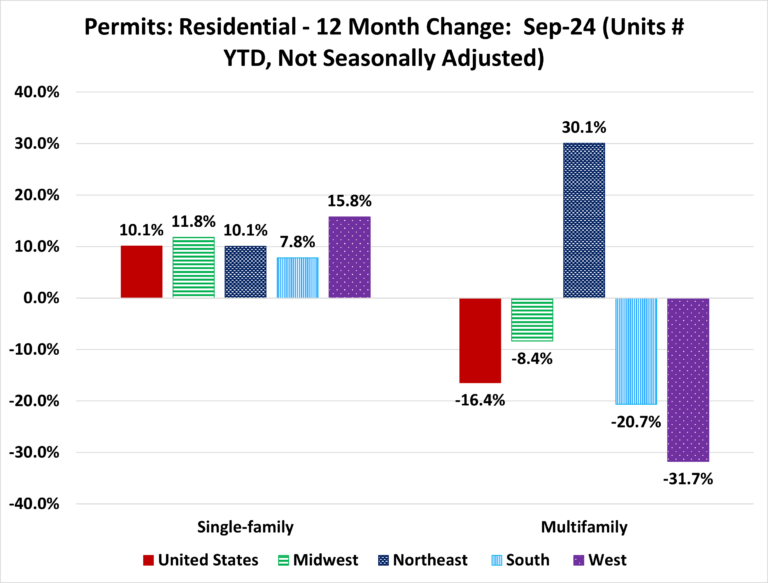

Over the first nine months of 2024, the total number of single-family permits issued year-to-date (YTD) nationwide reached 763,990. On a year-over-year (YoY) basis, this is an increase of 10.1% over the September 2023 level of 693,908.

Year-to-date ending in September, single-family permits were up in all four regions. The range of permit increases spanned 15.8% in the West to 7.8% in the South. The Midwest was up by 11.8% and the Northeast was up by 10.1% in single-family permits during this time. For multifamily permits, three out of the four regions posted declines. The Northeast, driven by New York, was the only region to post an increase and was up by 30.1%. Meanwhile, the West posted a decline of 31.7%, the South declined by 20.7%, and the Midwest declined by 8.4%.

Between September 2024 YTD and September 2023 YTD, 46 states and the District of Columbia posted an increase in single-family permits. The range of increases spanned 43.6% in New Mexico to 0.4% in Oregon. Maryland (-1.5%), New Hampshire (-1.6%), Alaska (-4.3%), and Hawaii (-7.7%) reported declines in single-family permits. The ten states issuing the highest number of single-family permits combined accounted for 63.1% of the total single-family permits issued. Texas, the state with the highest number of single-family permits, issued 122,976 permits over the first nine months of 2024, which is an increase of 10.5% compared to the same period last year. The succeeding highest state, Florida, was up by 1.7%, while the third highest, North Carolina, posted an increase of 8.5%.

Year-to-date ending in September, the total number of multifamily permits issued nationwide reached 362,543. This is 16.4% below the September 2023 level of 433,862.

Between September 2024 YTD and September 2023 YTD, 17 states recorded growth in multifamily permits, while 32 states and the District of Columbia recorded a decline. Georgia reported no change. Rhode Island (+134.6%) led the way with a sharp rise in multifamily permits from 309 to 725, while the District of Columbia had the biggest decline of 70.5% from 2,600 to 766. The ten states issuing the highest number of multifamily permits combined accounted for 63.2% of the multifamily permits issued. Over the first nine months of 2024, Texas, the state with the highest number of multifamily permits issued, experienced a decline of 27.5%. Following closely, the second-highest state in multifamily permits, Florida, saw a decline of 27.0%. California, the third largest multifamily issuing state, decreased by 33.4%.

At the local level, below are the top ten metro areas that issued the highest number of single-family permits.

For multifamily permits, below are the top ten local areas that issued the highest number of permits.

Discover more from Eye On Housing

Subscribe to get the latest posts sent to your email.


This article was originally published by a eyeonhousing.org . Read the Original article here. .
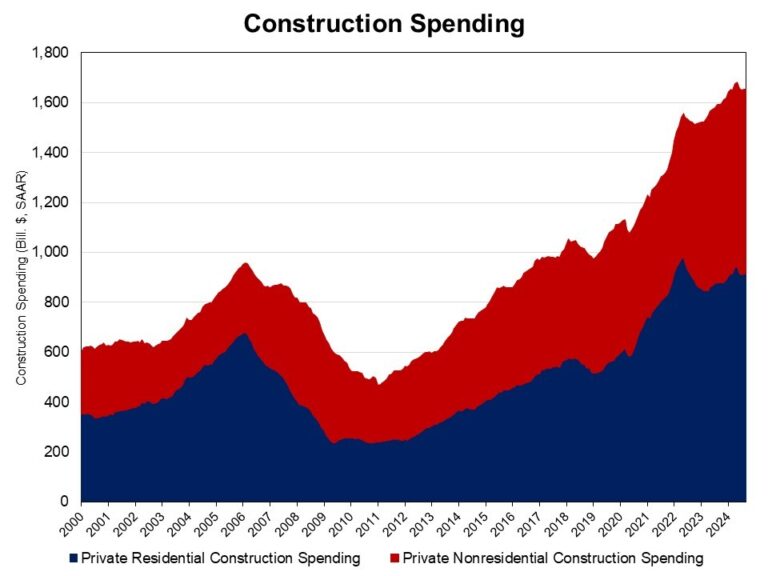

Private residential construction spending inched up 0.2% in September, according to the Census Construction Spending data. The September report shows a 4.1% rise compared to a year ago.  

The monthly increase in total private construction spending for September was largely due to more spending on single-family construction. Spending on single-family construction rose by 0.4% in September. This broke a five-month streak of declines, aligning with the modest gains in single-family starts during September. Compared to a year ago, spending on single-family construction was 0.9% higher.  

In contrast, multifamily construction spending continued to decline, edging down 0.1% in September after a dip of 0.3% in August. Year-over-year, spending on multifamily construction was down 8.1%, as there is an elevated level of apartments under construction being completed. Meanwhile, private residential improvement spending stayed flat for the month and was 13.5% higher than a year ago.  

The NAHB construction spending index is shown in the graph below. The index illustrates how spending on single-family construction has slowed since early 2024 under the pressure of elevated interest rates. Multifamily construction spending growth has also slowed down after the peak in July 2023. Meanwhile, improvement spending has increased its pace since late 2023. 

Spending on private nonresidential construction was up 3.5% over a year ago. The annual private nonresidential spending increase was mainly due to higher spending for the class of manufacturing ($39.4 billion), followed by the power category ($6.9 billion). 

Discover more from Eye On Housing

Subscribe to get the latest posts sent to your email.


This article was originally published by a eyeonhousing.org . Read the Original article here. .
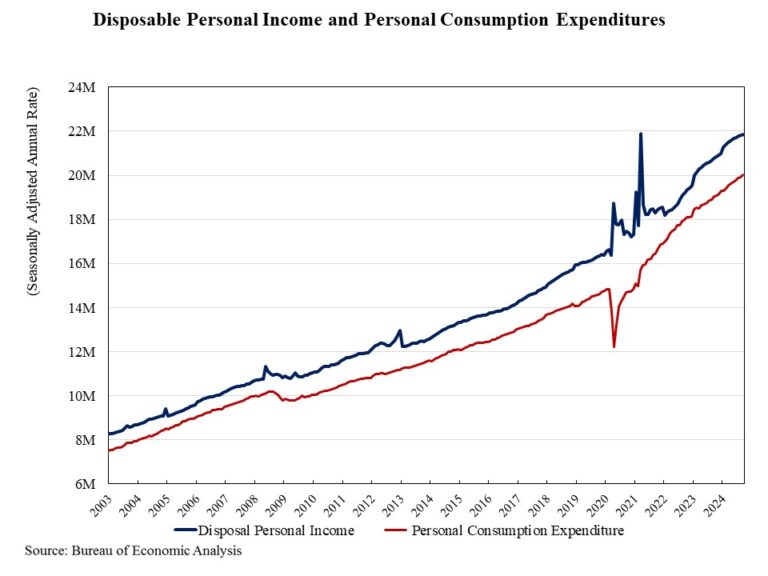

Personal income increased by 0.3% in September, following a 0.2% up in August and a 0.3% increase in July, according to the most recent data release from the Bureau of Economic Analysis. The gains in personal income were largely driven by increases in wages, salaries, and personal current transfer receipts. However, the pace of personal income growth slowed from a peak monthly gain of 1.4% seen in January 2024.

Real disposable income, income remaining after adjusted for taxes and inflation, inched up 0.1% in September. On a year-over-year basis, real (inflation adjusted) disposable income rose 3.1%. The pace of real personal income growth softened from a 6.5% year-over-year peak in June 2023.

Personal consumption expenditures  rose 0.5% in September after a 0.3% increase in August. Real spending, adjusted to remove inflation, increased 0.4% in September, with spending on goods and services each climbing 0.5%.

While spending increased more than personal income, the personal savings rate dipped to 4.6% in September, down from 4.8% in August and 4.9% in July. As inflation has almost eliminated compensation gains, people are dipping into savings to support spending. This will ultimately lead to a slowing of consumer spending.

Discover more from Eye On Housing

Subscribe to get the latest posts sent to your email.


This article was originally published by a eyeonhousing.org . Read the Original article here. .
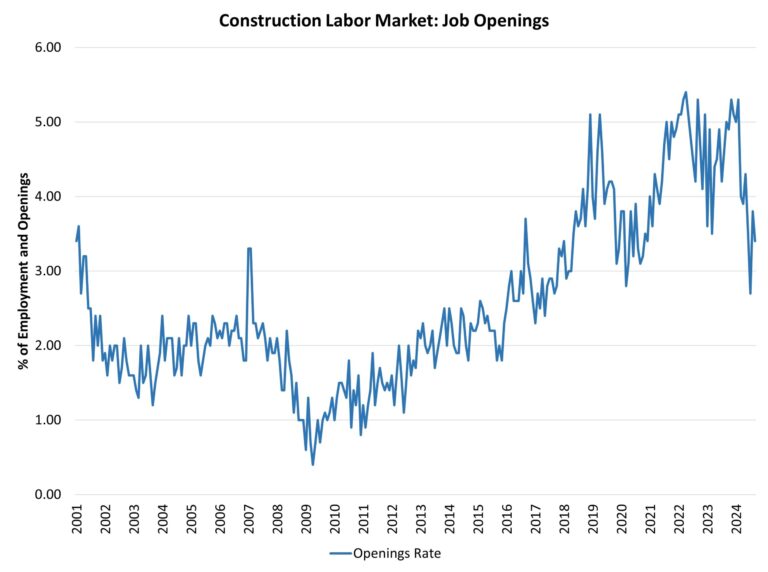

After a period of slowing associated with declines for some elements of residential construction, the count of open construction sector jobs trended lower in the September data, per the Bureau of Labor Statistics’ Job Openings and Labor Turnover Survey (JOLTS). The data indicates the demand for construction labor market remains weaker than a year ago.

In September, after revisions, the number of open jobs for the overall economy declined from 7.86 million to 7.44 million. This is notably smaller than the 9.31 million estimate reported a year ago and a clear sign of a softening aggregate labor market. Previous NAHB analysis indicated that this number had to fall below 8 million on a sustained basis for the Federal Reserve to feel more comfortable about labor market conditions and their potential impacts on inflation. With estimates now remaining near 8 million for national job openings, the Fed has begun a credit easing cycle should continue lowering rates.

The number of open construction sector jobs fell from a revised 328,000 in August to a softer 288,000 in September. Elements of the construction sector slowed in prior months as tight Fed policy persisted. The September reading of opening, unfilled construction jobs is lower than that registered a year ago: 422,000.

The construction job openings rate fell back to 3.4% in September and continues to trend lower.

The layoff rate in construction edged higher to 2.1% in September after a 2% rate in August. The quits rate in construction decreased to just 1.4% in September as job churn slowed.

Discover more from Eye On Housing

Subscribe to get the latest posts sent to your email.


This article was originally published by a eyeonhousing.org . Read the Original article here. .

Home buyers moved off the sidelines in September following the Federal Reserve’s recent move to cut interest rates for the first time in four years. 

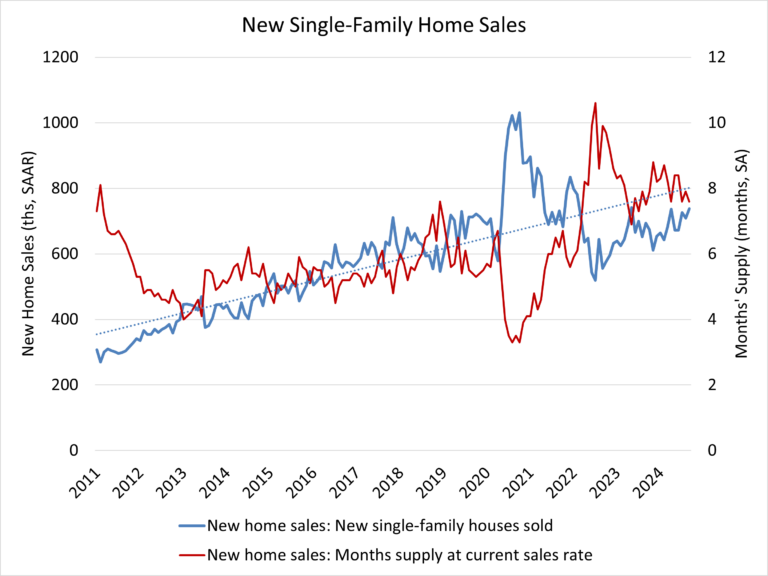
Sales of newly built, single-family homes in September increased 4.1% to a 738,000 seasonally adjusted annual rate from a downwardly revised August number, according to newly released data from the U.S. Department of Housing and Urban Development and the U.S. Census Bureau. The pace of new home sales in September is up 6.3% compared to a year earlier.

Despite challenging affordability conditions, home builder confidence edged higher in October as they anticipate that mortgage rates will gradually, in an uneven manner, moderate in the coming months. There is a significant need for additional housing supply, as many prospective home buyers are entering the market.

Following the Fed’s actions in September, mortgage rates fell to 6.18%, from 6.5% in August. However, new home sales will likely weaken in October due to a recent rise in long-term rates.

A new home sale occurs when a sales contract is signed, or a deposit is accepted. The home can be in any stage of construction: not yet started, under construction or completed. In addition to adjusting for seasonal effects, the September reading of 738,000 units is the number of homes that would sell if this pace continued for the next 12 months.

New single-family home inventory in September remained elevated at a level of 470,000, up 8.0% compared to a year earlier. This represents a 7.6 months’ supply at the current building pace. Completed for-sale new homes rose to 108,000, the highest level since 2009.

The median new home sale price in September was $426,300, essentially unchanged from a year ago. The Census data reveals a gain for new home sales priced below $300,000, which made up 17% of new home sales in September, compared to 14% a year ago.

Regionally, on a year-to-date basis, new home sales are up 19.2% in the Midwest, 1.1% in the South and 3.4% in the West. New home sales are down 1.1% in the Northeast.

Discover more from Eye On Housing

Subscribe to get the latest posts sent to your email.


This article was originally published by a eyeonhousing.org . Read the Original article here. .


Despite recent easing mortgage rates and improved inventory, existing home sales fell to a 14-year low in September as elevated home prices are causing potential buyers to hold out for lower rates, according to the National Association of Realtors (NAR). Sales remained sluggish as the lock-in effect kept home prices elevated. However, we expect increased activity in the coming months as mortgage rates moderate with additional Fed easing. Improving inventory should help slow home price growth and enhance affordability.

Homeowners with lower mortgage rates have opted to stay put, avoiding trading existing mortgages for new ones with higher rates. This trend is driving home prices higher and holding back inventory. With the Federal Reserve beginning its easing cycle at the September meeting, mortgage rates are expected to gradually decrease, leading to increased demand and unlocking lock-in inventory in the coming quarters.

Total existing home sales, including single-family homes, townhomes, condominiums, and co-ops, fell 1.0% to a seasonally adjusted annual rate of 3.84 million in September, the lowest level since October 2010. On a year-over-year basis, sales were 3.5% lower than a year ago.

The first-time buyer share remained at 26% in September, matching the lowest level since November 2021 and August 2024, but down from 27% in September 2023.

The existing home inventory level rose from 1.37 million in August to 1.39 million units in September and is up 23.0% from a year ago. At the current sales rate, September unsold inventory sits at a 4.3-months supply, up from 4.2-months last month and 3.4-months a year ago. This inventory level remains low compared to balanced market conditions (4.5 to 6 months’ supply) and illustrates the long-run need for more home construction. However, the count of single-family resale homes available for sale is up almost 22.2% on a year-over-year basis.

Homes stayed on the market for an average of 28 days in September, up from 26 days in August and 21 days in September 2023.

The September all-cash sales share was 30% of transactions, up from 26% in August and 29% a year ago. All-cash buyers are less affected by changes in interest rates.

The September median sales price of all existing homes was $404,500, up 3.0% from last year. This marked the 15th consecutive month of year-over-year increases and the highest level for the month of September. The median condominium/co-op price in September was up 2.2% from a year ago at $361,600. This rate of price growth will slow as inventory increases.

Existing home sales in September were mixed across the four major regions. In the Northeast, Midwest, and South, sales fell by 4.2%, 2.2%, and 1.7%, respectively, while sales in the Midwest rose by 4.1%. On a year-over-year basis, sales decreased in the Northeast (-6.1%), Midwest (-5.3%) and South (-5.5%). Sales in the West increased 5.6% from a year ago.

The Pending Home Sales Index (PHSI) is a forward-looking indicator based on signed contracts. The PHSI rose from 70.2 to 70.6 in August due to lower mortgage rates. On a year-over-year basis, pending sales were 3.0% lower than a year ago per National Association of Realtors data.

Discover more from Eye On Housing

Subscribe to get the latest posts sent to your email.


This article was originally published by a eyeonhousing.org . Read the Original article here. .
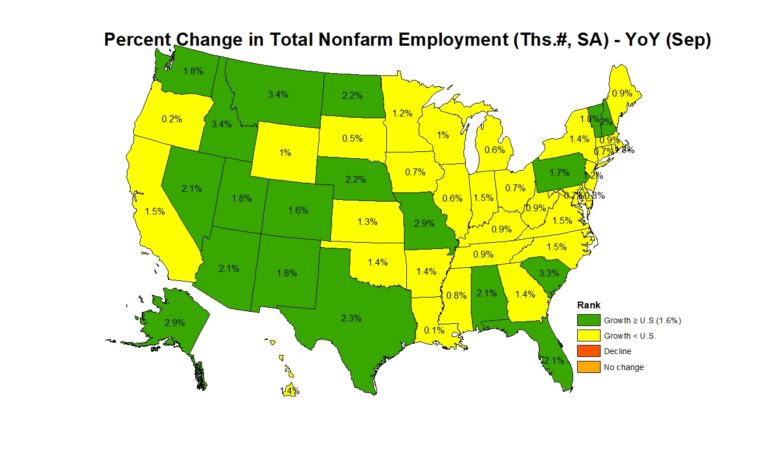

Nonfarm payroll employment increased in 41 states and the District of Columbia in September compared to the previous month, while eight states saw a decrease. Nevada reported no change. According to the Bureau of Labor Statistics, nationwide total nonfarm payroll employment increased by 254,000 in September, following a gain of 159,000 jobs in August.

On a month-over-month basis, employment data was most favorable in Texas, which added 29,200 jobs. New Jersey came in second (+19,200), followed by Florida (+17,000). A total of 17,400 jobs were lost across eight states, with Iowa reporting the steepest job losses at 4,800. In percentage terms, employment increased the highest in Idaho at 0.7%, while Iowa saw the biggest decline at 0.3% between August and September.

Year-over-year ending in September, 2.4 million jobs have been added to the labor market across all 50 states and the District of Columbia. The range of job gains spanned from 2,000 jobs in Louisiana to 327,400 jobs in Texas. In percentage terms, the range of job growth spanned 3.4% in Idaho to 0.1% in Louisiana.

Across the nation, construction sector jobs data   —which includes both residential and non-residential construction—showed that 24 states and the District of Columbia reported an increase in September compared to August, while 23 states lost construction sector jobs. The three remaining states reported no change on a month-over-month basis. Texas, with the highest increase, added 8,100 construction jobs, while Tennessee, on the other end of the spectrum, lost 1,600 jobs. Overall, the construction industry added a net 25,000 jobs in September compared to the previous month. In percentage terms, Ohio reported the highest increase at 2.7% and North Dakota reported the largest decline at 2.1%.

Year-over-year, construction sector jobs in the U.S. increased by 238,000, which is a 3.0% increase compared to the September 2023 level. Texas added 42,300 jobs, which was the largest gain of any state, while New York lost 6,900 construction sector jobs. In percentage terms, Alaska had the highest annual growth rate in the construction sector at 21.1%. Over this period, Oregon reported the largest decline of 4.1%.

Discover more from Eye On Housing

Subscribe to get the latest posts sent to your email.


This article was originally published by a eyeonhousing.org . Read the Original article here. .
Pin It