Tag

Rose

Browsing


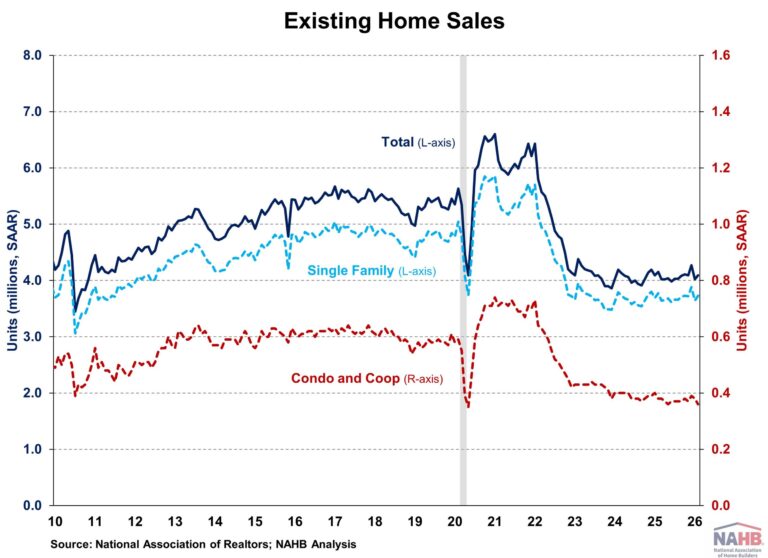
Following the sharp decline last month, existing home sales bounced back in February as housing affordability improved. Lower mortgage rates and moderating home price growth helped pull buyers back to the market. However, tight inventory will likely continue to push home prices higher if demand outpaces supply growth.

Total existing home sales, including single-family homes, townhomes, condominiums, and co-ops, rose 1.7% to a seasonally adjusted annual rate of 4.09 million in February, according to the National Association of Realtors (NAR). On a year-over-year basis, sales were 1.4% lower than a year ago.

The existing home inventory level was 1.3 million units in February, up 2.4% from January and 4.9% from a year ago. At the current sales rate, February unsold inventory sits at a 3.8-months’ supply, unchanged from last month but up from 3.6-months in February. Inventory between 4.5 to 6 months’ supply is generally considered a balanced market.

Homes stayed on the market for a median of 47 days in February, up from 46 days in the previous month and 42 days in February 2025.

The first-time buyer share was 34% in February, up from 31% in January and one year ago.

The February all-cash sales share was 31% of transactions, up from 27% in January but down from 32% a year ago. All-cash buyers are less affected by changes in interest rates.

The February median sales price of all existing homes was $398,000, up 0.3% from last year. This marks the 32nd consecutive month of year-over-year increases. However, the year-over-year growth has moderated since peaking in December 2024, suggesting that price appreciation may continue to slow. The median condominium/co-op price in February was up 0.9% from a year ago at $358,100. Recent gains for home inventory will put downward pressure on resale home prices in most markets in 2026.

Three of the four major regions saw sales increases in February, ranging from 1.1% in the Midwest to 8.2% in the West. Sales in the Northeast fell 6.0%. On a year-over-year basis, sales rose only in the South (+0.5%), while sales in the West, Midwest, and Northeast all declined (-1.3%, -4.1%, and -4.1%, respectively). 

The Pending Home Sales Index (PHSI) is a forward-looking indicator based on signed contracts. The PHSI fell from 71.5 to 70.9 in January. On a year-over-year basis, pending sales were 0.4% lower than a year ago, according to the National Association of Realtors’ data. The decline suggests buyers are holding back due to limited inventory choices.


This article was originally published by a eyeonhousing.org . Read the Original article here. .
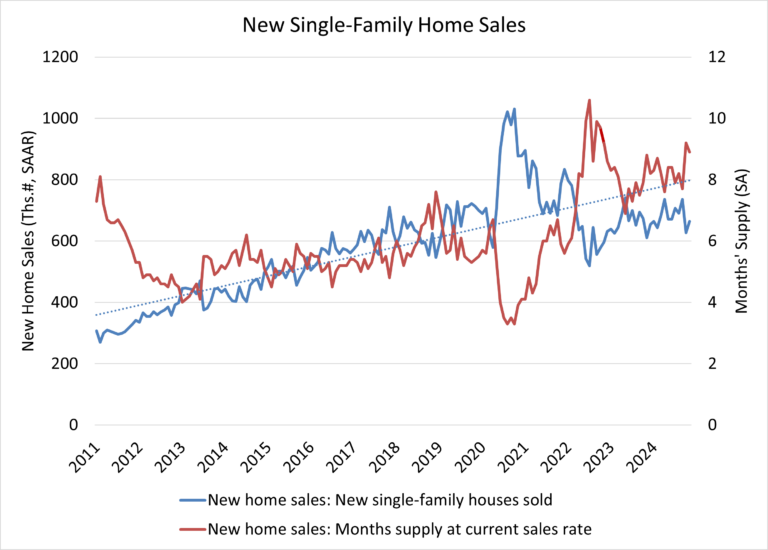

In November 2024, the U.S. housing market experienced a significant boost, with sales of new single-family homes reaching a seasonally adjusted annual rate of 664,000, according to newly released data from the U.S. Department of Housing and Urban Development and the U.S. Census Bureau. This marks a 5.9% increase from October’s revised figures and an 8.7% rise compared to November 2023. November new home sales are up 2.4% on a year-to-date basis.

A new home sale occurs when a sales contract is signed, or a deposit is accepted. The home can be in any stage of construction: not yet started, under construction or completed. In addition to adjusting for seasonal effects, the November reading of 664,000 units is the number of homes that would sell if this pace continued for the next 12 months.

New single-family home inventory in November remained elevated at a level of 490,000, up 8.9% compared to a year earlier. This represents an 8.9 months’ supply at the current building pace. A measure near a six months’ supply is considered balanced.

While an 8.9 months’ supply may be considered elevated in normal market conditions, there is currently only a 3.8 months’ supply of existing single-family homes on the market. Combined, new and existing total months’ supply remains below historic norms at approximately 4.5 months, although this measure is expected to increase as more home sellers test the market in the months ahead.

A year ago, there were 79,000 completed, ready-to-occupy homes available for sale (not seasonally adjusted). By the end of November 2024, that number increased 57% to 124,000. However, completed, ready-to-occupy inventory remains just 25% of total inventory, while homes under construction account for 54% of the inventory. The remaining 21% of new homes sold in November were homes that had not started construction when the sales contract was signed.

The median new home sale price in November edged down 5.4% to $402,600 and is down 6.3% from a year ago. In terms of affordability, the share of entry-level homes priced below $300,000 has been steadily falling in recent years. Only 25% of the homes were priced in this entry-level affordable range, while 31% of the homes were priced above $500,000. Most of the homes were priced between $300,000-$500,000.

Regionally, on a year-over-year basis, new home sales are up 13.6% in the South and 10.0% in the Midwest. New home sales are down 1.4% in the West and 11.5% in the Northeast.

Discover more from Eye On Housing

Subscribe to get the latest posts sent to your email.


This article was originally published by a eyeonhousing.org . Read the Original article here. .
Pin It