
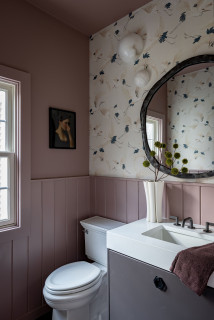
Location: New York City
Size: 15 square feet (1.4 square meters)
Homeowners’ request. “The clients dreamed of a swank loo for guests, but the old powder room was in desperate shape, additionally serving as the HVAC center and laundry room — all in a truly tiny space,” says designer Clare Donohue. “The new HVAC system required a much larger footprint, so we relocated the laundry to a separate space. I had to come up with a creative way to hide all those ugly machines and still make it special. Current visitors would never guess what lies behind the satiny paneled walls of the finished space: a mechanical closet filled with ugly machinery.”
Special features. “The renovated powder room is kitted out with custom wood panels that lift off to service the hidden HVAC equipment,” Donohue says. “Making use of every available inch, we created recessed display shelves from a small leftover niche. A beveled mirror spans the main wall. A floating sink with a wall-mounted faucet makes the most of the small space. The lower portion of the sink and toilet walls are protected from splashes with inset stone panels. Marble hex tiles cover the floor. All are color-matched to a rich charcoal color.”
Designer tip. “Don’t let small size stop you from making it special,” Donohue says. “The odds were against us here, but I was convinced we could make it beautiful despite the room being, in reality, a giant air handler.”
“Uh-oh” moment. “This one was nothing but challenges,” Donohue says. “The HVAC system went through a dozen revisions, each requiring adjustments to the room design. It ended up eating up extra ceiling and floor space and requiring the brick of the exterior wall to be opened up many floors up in a narrow outside courtyard filled with irreplaceable leaded glass windows. The engineers and co-op board feuded over what type of insulation would work, for weeks, while holding up framing and install. While we waited for the final room size to be determined, we couldn’t place the order for the custom sink, which had a huge lead time. In the end, we lucked out and were able to use a stocked size for much less money and faster delivery time.
“The room backs up to the elevator shaft, requiring us to fur out the wall for plumbing lines, making a small room even smaller. The Caesarstone wall inserts we had spec’d were based on a color sample that it turned out had been sold out without notice, and replaced with a much darker color, without a name change. So the contractor arrived with black, not gray, panels to install, at which point we had to get the whole of Caesarstone’s corporate offices involved to find a solution, all while the move-in date loomed. I swear, it felt like everything was against this design. I had to be really stubborn to get it to end up as envisioned. And we had a great team of engineers and project managers to pull it together.”
Custom cabinetry: NR Wood Design; paint: Whale Gray, Benjamin Moore
This article was originally published by a www.houzz.com . Read the Original article here. .


Designer: Sarah Montgomery Interiors
Location: Chicago
Size: 255 square feet (24 square meters)
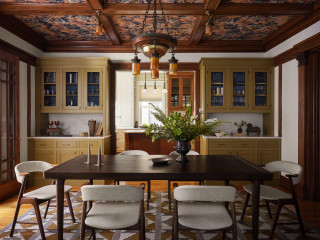
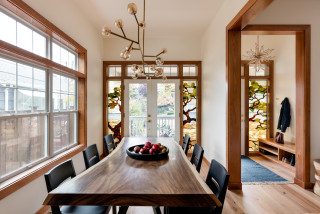
Homeowners’ request. “Set on a historic street in Logan Square, this brick Foursquare home had been carefully restored — lots of woodwork, stained glass and even its century-old dining room light fixture,” says designer Sarah Montgomery. “Our clients wanted to bring that same richness into their furnishings, creating a design-forward family space that incorporated some modern elements and could also stand up against two young boys and a pooch.”
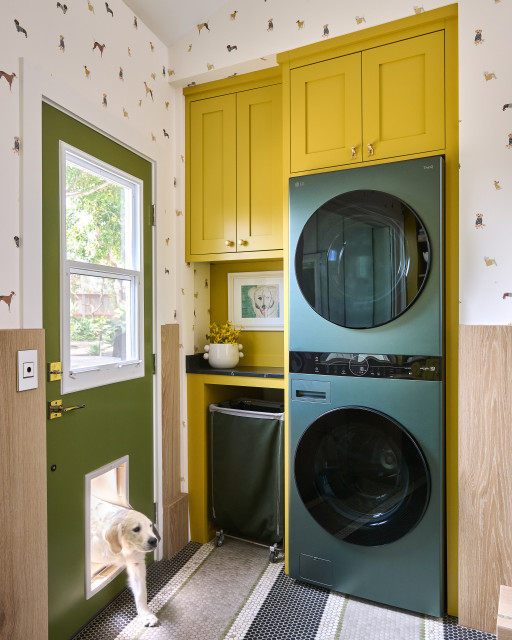
Special features. Wallpapered ceiling in botanical paper. Built-ins painted in Olivetone by Benjamin Moore. Upper cabinets backed in geometric wallpaper. Vintage dining chairs reupholstered in family-friendly fabric. The light fixtures are antique and original to the home. The millwork is also original.
Designer tip. “Always consider the ceiling as a design element and don’t be afraid of painting built-ins a fun color,” Montgomery says.
“Uh-oh” moment. “There were several design schemes for the dining room that we presented, and to better help the client visualize them, we created 3D renderings,” Montgomery says. “We don’t always do this, but in order to help them select the perfect main feature — the wallpaper — it was necessary. The dining room had so many original features that we were working with that the new elements had to complement those in just the right way.”
Montgomery says she uses Houzz Pro software for project management. “We use the Selections boards to upload our items and send them to our client for an easy approval process and so they have access to all the necessary details,” she says. “We use Houzz Pro for sending proposals. We share their client dashboard so they have easy reference for their boards and documents at all times. We also log out time through Houzz so that our client gets clear invoices breaking down the time spent month-over-month.”
Ceiling wallpaper: Pierre Frey; built-in cabinet wallpaper: Fayce; rug: Oscar Isberian; wall paint: Swiss Coffee, Benjamin Moore; project photography: Dustin Halleck; styling: Sami Wiley
See why you should hire a professional who uses Houzz Pro software