Tag

Rise

Browsing


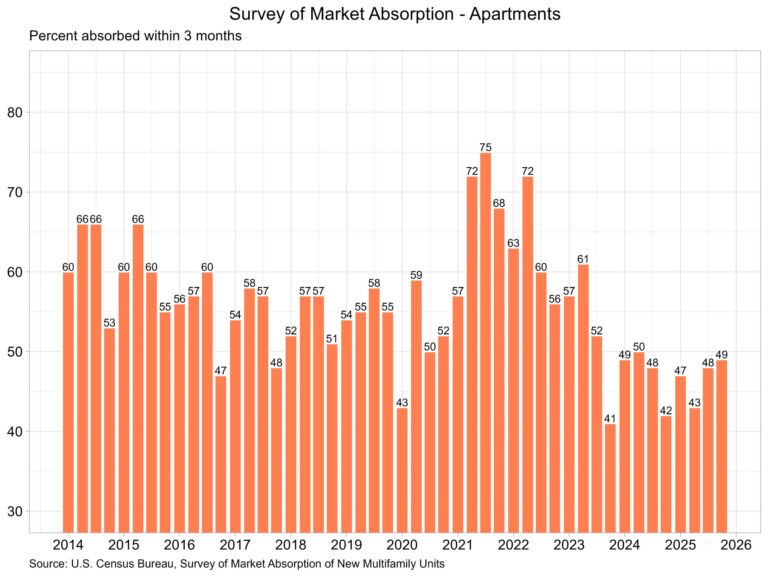
The percentage of new apartment units that were absorbed within three months after completion was up one percentage point in the fourth quarter, according to the Census Bureau’s latest release of the Survey of Market Absorption of New Multifamily Units (SOMA). The survey covers new units in multifamily residential buildings with five or more units. The number of new multifamily units completed was 77,380 in the fourth quarter, the lowest quarterly completions since the second quarter of 2022 (76,630).

Apartments

The percentage of apartments absorbed within three months after completion was 49% for those completed in the fourth quarter of 2025. This was the sixth consecutive quarter for which new apartments were absorbed at a rate below 50%. The median asking rent for apartments completed in the fourth quarter was $2,034, up 4.5% from $1,946 last year. This also marks the first quarter where the median asking rent topped $2,000.

Along with the three-month absorption rate and completions, SOMA also reports absorption rates at six, nine, and twelve months after completion. For apartments completed six months ago (97,210 units), 68% have been absorbed into the market. For apartments completed (93,140 units) nine months ago, 80% have been absorbed. For those completed twelve months ago (92,760 units), 90% have been absorbed into the multifamily market.

Condominiums and Cooperative Units

The three-month absorption rate for new condominiums and cooperative units rose to 70%. Total completions of new condominiums and cooperative units, according to SOMA, was 4,831 in the fourth quarter of 2025.


This article was originally published by a eyeonhousing.org . Read the Original article here. .


The number of open positions in the construction sector edged higher in March, per the Bureau of Labor Statistics Job Openings and Labor Turnover Survey (JOLTS). The current level of open jobs is down measurably from three years ago due to declines in construction activity, particularly in housing. However, recent gains for nonresidential construction have not fully offset soft conditions for housing with respect to the demand for construction labor.

The number of open jobs for the overall economy declined, falling from 6.92 million in February to 6.87 million in March. The March reading was down from a year ago (6.95 million) due to a cooling labor market.

Previous NAHB analysis indicated that this number had to fall below eight million on a sustained basis for the Federal Reserve to move forward on interest rate reductions. With estimates remaining below eight million for national job openings, the Fed, in theory, should be able to cut further. However, this is situation is complicated by rising energy costs due to the Iran war.

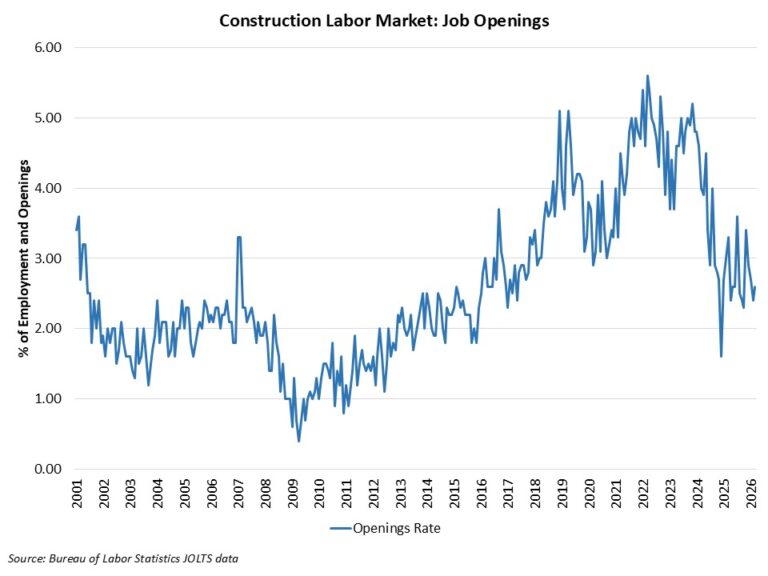
The number of open construction sector jobs increased for the month, rising slightly from 201,000 in February to 224,000 in March. This total was down compared to a year ago (278,000). The chart below notes the declining trend that has been in place for unfilled construction jobs since the Fed raised the federal funds rate and home building weakened. While home building employment was declining during the second half of 2025, other subsectors of the construction industry have expanded (e.g. data centers). This has produced volatility within a reduced range in the job openings series since 2024.

The construction job openings rate increased to 2.6% in March, down from the 3.3% rate estimated a year ago.

The layoff rate in construction declined slightly to 1.7% in March. The quits rate increased to 1.7% for the month.


This article was originally published by a eyeonhousing.org . Read the Original article here. .


The U.S. housing market showed mixed but generally improving conditions in March, as new home sales strengthened and price pressures continued to ease. While inventory dynamics varied across segments, moderating home prices and increased availability at the lower end of the market provided some relief to buyers navigating ongoing affordability challenges.

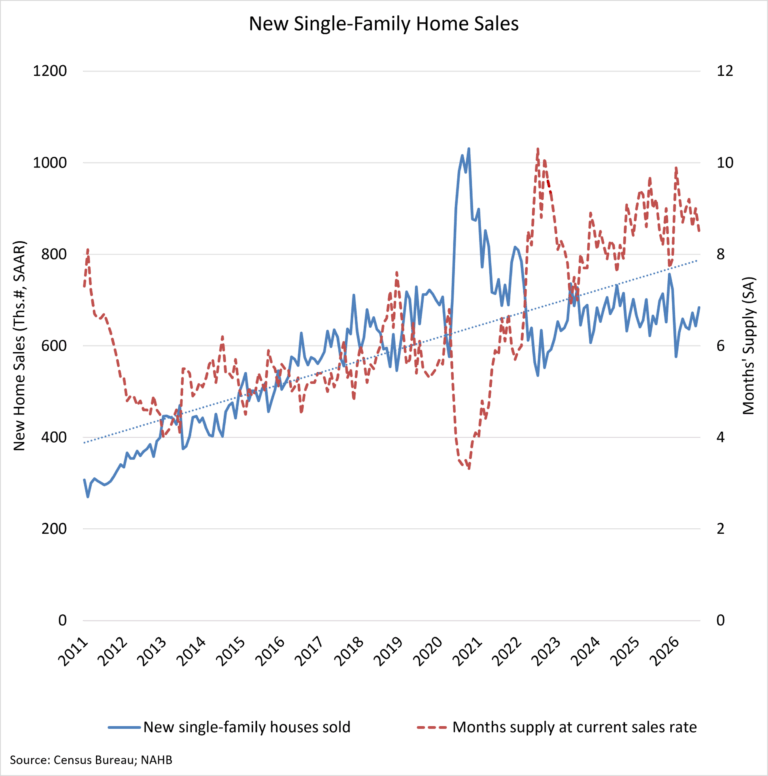
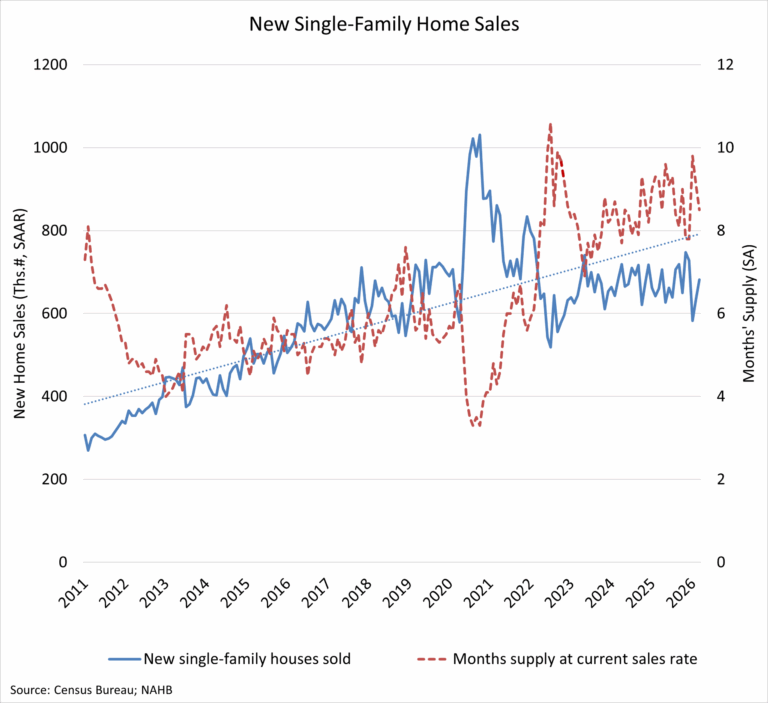
Sales of newly built single-family homes increased 7.4% month-over-month in March to a seasonally adjusted annual rate of 682,000 units, according to the U.S. Department of Housing and Urban Development and the U.S. Census Bureau. This represented a 3.3% increase compared to a year earlier. A new home sale is recorded when a contract is signed, or a deposit is accepted, regardless of the stage of construction. The seasonally adjusted annual rate reflects the pace of sales that would occur over a 12-month period if current conditions persist.

New single-family home inventory totaled 481,000 units in March, down 0.4% from the prior month and 4.6% from a year earlier. At the current sales pace, the months’ supply of new homes stood at 8.5 months, down from 9.2 months one year ago, though still above the six-month level generally considered to indicate a balanced market.

Combined new and existing home inventory has edged higher in recent months, with the total months’ supply reaching 4.8 months. Meanwhile, inventory conditions in the existing home market have retreated after showing gradual improvement in prior months. Moderating prices across both markets have helped support buyer demand amid ongoing affordability concerns.

At the end of March, there were 119,000 completed, ready-to-occupy homes available for sale on a non-seasonally adjusted basis, up 5.3% from a year earlier. Completed homes accounted for one-quarter of total inventory, while homes under construction made up 51%. The remaining 24% of homes sold in March had not yet started construction at the time the sales contract was signed.

Home prices showed further signs of cooling at the start of 2026. The median new home sale price was $387,400, down 6.2% from a year ago, and 9.7% below the recent peak of $429,100 reached in December 2025. Affordability improved at the lower end of the market, with 20 percent of new homes priced below $300,000. Over a quarter (28%) of homes were priced above $500,000, while the remaining share fell within the $300,000 to $500,000 range.

Regionally, year-over-year new home sales increased 8.0% in the Midwest, reflecting ongoing strength in residential construction across the Midwestern states. New home sales declined 17.6% in the Northeast, 14.0% in the West and 2.6% in the South.


This article was originally published by a eyeonhousing.org . Read the Original article here. .


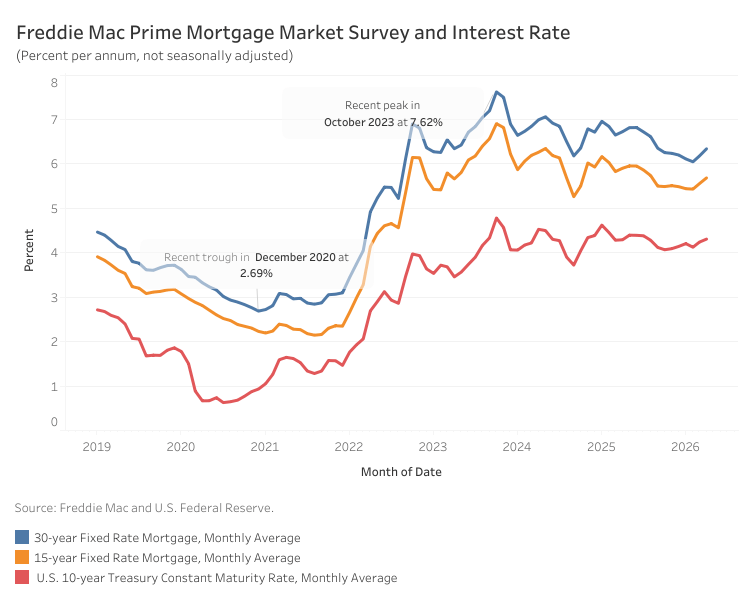
Mortgage rates continued to increase in April as ceasefire negotiations remain inconclusive. According to Freddie Mac, the 30-year fixed-rate mortgage averaged 6.34% in April, 16 basis points (bps) higher than March. The average 15-year rate also increased by 13 bps to 5.69%. Despite the recent increase, both rates remain lower than a year ago by 39 bps and 21 bps, respectively.

The 10-year Treasury yield, a key benchmark for long-term borrowing, averaged 4.31%, up 7 bps from the previous month. Ongoing blockades in the Strait of Hormuz have kept oil prices above $100 per barrel. This has passed through to inflation which climbed to 3.3%, nearing a two-year high. Energy components led the increase with fuel oil prices rising 30.7% and gasoline up 21.2% in March.

At its latest meeting, the Federal Reserve held the federal funds rates unchanged at 3.5% to 3.75% as inflation remains elevated alongside continued economic expansion. Jerome Powell’s term as Chair will end next month but has announced that he will remain on the Board of Governors. Kevin Warsh, President Trump’s pick as the next Fed Chair, indicated during a Senate Banking Committee hearing a preference for alternative inflation measures, including “trimmed averages”, which removes outliers above and below a certain threshold. For example, by stripping out outsized swings like a 50.8% annualized drop in telecom equipment and a 384.6% jump in moving and freight services, the Dallas Fed’s trimmed-mean measure last February registered 2.3%, below the 2.8% headline PCE and 3.0% core PCE.


This article was originally published by a eyeonhousing.org . Read the Original article here. .


The new home sector has played an increasingly important role in meeting housing demand as resale inventory remains constrained in many regions. The latest data released today (and delayed because of the government shutdown in fall of 2025) indicate that new single-family home sales continue to reflect a stabilizing market after a period of heightened volatility. While month-to-month activity shows some variability, sales remain stronger than a year ago, signaling that buyer interest in newly built homes has improved.

Sales of newly built single-family homes increased 18.7 percent year over year in October to a seasonally adjusted annual rate of 737,000 units, according to the U.S. Department of Housing and Urban Development and the U.S. Census Bureau. This represented a modest 0.1 percent decline from September and a 1.2 percent decrease on a year-to-date basis. A new home sale is recorded when a contract is signed or a deposit is accepted, regardless of the stage of construction. The seasonally adjusted annual rate reflects the pace of sales that would occur over a 12-month period if current conditions persisted.

New single-family home inventory totaled 488,000 units in October, unchanged from the prior month and 1.7 percent higher than a year earlier. At the current sales pace, the months’ supply of new homes stood at 7.9, down from 9.3 months one year ago, though still above the six-month level that is generally considered balanced.

Combined new and existing home inventory has edged lower in recent months, with total months’ supply declining to 4.9, reflecting slower construction activity. Meanwhile, inventory conditions in the existing home market have shown gradual improvement, and moderating prices across both markets have helped support buyer demand amid ongoing affordability concerns.

By the end of October 2025, there were 124,000 completed, ready-to-occupy homes available for sale on a not seasonally adjusted basis, up 10.7 percent from a year earlier. Completed homes accounted for roughly one-quarter of total inventory, while homes under construction made up 51 percent. The remaining 24 percent of homes sold in October had not yet started construction at the time the sales contract was signed.

Home prices showed further signs of easing in October. The median new home sale price declined 3.3 percent to $392,300, marking an 8.0 percent decrease from a year ago. Affordability improved at the lower end of the market, with 25 percent of new homes priced below $300,000, the highest share in recent months. Thirty percent of homes were priced above $500,000, while the remaining 45 percent fell within the $300,000 to $500,000 range.

Regionally, year-to-date new home sales declined in three of the four regions, falling 0.1 percent in the Midwest, 7.2 percent in the West, and 22.9 percent in the Northeast. The South was the only region to post growth, with sales up 2.9 percent.


This article was originally published by a eyeonhousing.org . Read the Original article here. .


Aggregate residential building material prices rose at their fastest pace since January 2023 in the latest Producer Price Index release from the Bureau of Labor Statistics. Input energy prices increased for the first time in over a year, while service price growth remained lower than goods.

The Producer Price Index for final demand increased 0.3% in September, after falling 0.1% in August. The index for final demand goods increased 0.9% in September, the largest monthly increase since February 2024. Final demand energy prices were responsible for most of the goods index increase, as they rose 3.5% in September. This index for final demand for services was unchanged in September.

The price index for inputs to new residential construction rose 0.2% in September and was up 3.1% from last year. The price of goods inputs was up 0.1% over the month and 3.5% from last year, while prices for services were up 0.3% over the month and 2.5% from last year.

Input Goods

The goods component has a larger importance to the inputs to residential construction price index, representing around 60%. On a monthly basis, the price of input goods to new residential construction was up 0.1% in September.

The input goods to residential construction index can be further broken down into two separate components, one measuring energy inputs with the other measuring remaining goods. The latter of these two components simply represents building materials used in residential construction, which makes up around 93% of the goods index.

Energy input prices rose 1.0% in September and were 3.0% higher than one year ago. Building material prices were up 0.1% in September and up 3.5% compared to one year ago. The 3.5% year-over-year increase is the largest increase since the 4.9% experienced back in January 2023. Residential building material price inflation slowly accelerated over the year, after starting around 2.0%.

The largest year-over-year price changes continue to be parts for construction machinery and equipment, sold separately, up 41.3% compared to September of last year. Metal molding and trim prices are up 31.0% from last year. Ready-mix concrete, a key input to new residential construction, has shown little price growth in 2025, up only 0.4% from last year. Additionally, softwood lumber prices were down 2.3% in September from last year. Lumber prices have experienced declines over the past few months despite higher tariffs now in place. Ongoing weaknesses during 2025 in new residential construction have led to an acute oversupply of lumber on the market, with demand below expectations.

Input Services

Prices for service inputs to residential construction reported an increase of 0.3% in September. On a year-over-year basis, service input prices were up 2.5%. The price index for service inputs to residential construction can be broken out into three separate components: a trade services component, a transportation and warehousing services component, and a services excluding trade, transportation and warehousing component (other services).

 The most significant component is trade services (around 60%), followed by other services (around 29%), and finally transportation and warehousing services (around 11%). The largest component, trade services, was up 3.1% from a year ago. The other services component was up 1.3% over the year.  Lastly, prices for transportation and warehousing services rose 2.6% compared to August of last year.


This article was originally published by a eyeonhousing.org . Read the Original article here. .


Existing home sales rose to an eight-month high in October as buyers took advantage of lower mortgage rates, according to the National Association of Realtors (NAR). Resale inventory improved from a year ago but remained below pre-pandemic levels. Relatively tight supply continued to push home prices higher and challenge housing affordability. These affordability pressures vary by region, with first-time buyers in the Northeast facing limited inventory, while buyers in the West struggle with elevated home prices.

Mortgage rates hovered between 6.5% and 7% earlier this year due to economic and tariff uncertainty. However, with the Fed resuming rate cuts in September, mortgage rates have fallen gradually. As of October 30th, the average mortgage rate decreased to 6.17%, the lowest in over a year. With additional rate cuts expected in coming months, lower mortgage rates and improved inventory should bring more buyers and sellers into the market.

Total existing home sales, including single-family homes, townhomes, condominiums, and co-ops, rose 1.2% to a seasonally adjusted annual rate of 4.10 million in October, the highest level since February. On a year-over-year basis, sales were 1.7% higher than a year ago.

The existing home inventory level was 1.52 million units in October, down 0.7% from September but up 10.9% from a year ago. At the current sales rate, October unsold inventory sits at a 4.4-months’ supply, down from 4.5-months in September but up from 4.1-months in October 2024. Inventory between 4.5 to 6 months’ supply is generally considered a balanced market.

Homes stayed on the market for a median of 34 days in October, up from 33 days last month and 29 days in October 2024.

The first-time buyer share was 32% in October, up from 30% in September and 27% from a year ago.

The October all-cash sales share was 29% of transactions, down from 30% in September but up from 27% a year ago. All-cash buyers are less affected by changes in interest rates.

The October median sales price of all existing homes was $415,200, up 2.1% from last year. This marks the 28th consecutive month of year-over-year increases. The median condominium/co-op price in October was up 0.9% from a year ago at $363,700.  Recent gains for home inventory will put downward pressure on resale home prices in most markets in 2025.

Existing home sales in October were mixed across the four major regions. Sales rose in the Midwest (5.3%) and South (0.5%), fell in the West (-1.3%), and remained unchanged in the Northeast. On a year-over-year basis, sales were up in the Northeast (4.3%), South (2.8%) and Midwest (2.1%), while down in the West (-2.6%).

The Pending Home Sales Index (PHSI) is a forward-looking indicator based on signed contracts. The PHSI remained unchanged at 74.8 in September, suggesting job market concerns kept buyers on the sideline despite mortgage rates near one-year lows. On a year-over-year basis, pending sales were 0.9% lower than a year ago, according to the National Association of Realtors’ data.


This article was originally published by a eyeonhousing.org . Read the Original article here. .


All types of mortgage activity rose on a year-over-year basis in October, supported by recent declines in interest rates. Notably, adjustable-rate mortgage (ARM) applications more than doubled from a year ago, and refinancing activity continued to strengthen. 

The Mortgage Bankers Association’s (MBA) Market Composite Index, a measure of total mortgage application volume, fell 7.7% from September on a seasonally adjusted basis but was 39.0% higher than a year ago. 

The average contract interest rate for 30-year fixed mortgages fell 5.4 basis points to 6.37%, the lowest in over a year. Following a strong increase in September, refinancing activity in October dropped 10% month over month, while purchase applications decreased 4.8%. Compared to a year ago, purchase and refinance applications were up 18.1% and 63.0%, respectively. 

By loan type, fixed-rate mortgage applications decreased 7% from September but were 34% higher year-over-year. Adjustable-rate mortgage applications dropped 13% month-over-month, yet surged 116.5% from a year earlier, following a 124% annual gain in September. As a result, ARMs accounted for 9.44% of total applications in October, one of the highest shares in the past three years. 

The average loan size across all mortgages was $408,000, down 3% from the previous month. The average purchase loan size remained steady at $437,000, while the average refinance loan size declined 6% to $385,000. For adjustable-rate mortgages, the average loan size fell 5% to $938,000, compared to a 2% decline for fixed-rate mortgages to $353,000. 


This article was originally published by a eyeonhousing.org . Read the Original article here. .


Prices for residential building materials rose again in July, marking the largest year-over-year increase in over two years. The underlying price growth trend remained the same, with service prices continuing to grow at a faster pace than goods prices. Similar to last month, parts for construction machinery and metal molding/trim experienced significant price growth, as both increased over 25% compared to last year.

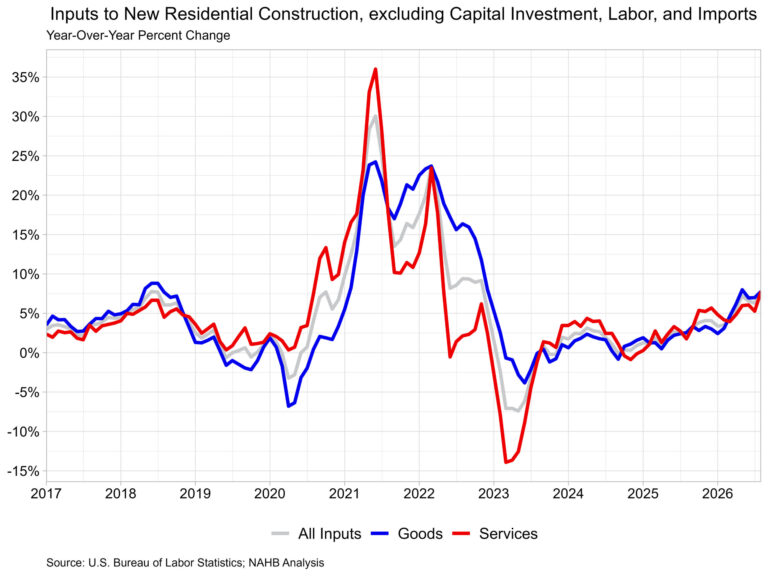
Prices for inputs to new residential construction—excluding capital investment, labor, and imports—rose 0.2% in July, following a 0.8% increase in June. These figures are taken from the most recent Producer Price Index (PPI) report published by U.S. Bureau of Labor Statistics. The PPI measures prices that domestic producers receive for their goods and services; this differs from the Consumer Price Index which measures what consumers pay and includes both domestic products as well as imports.

The inputs to the new residential construction price index grew 2.8% from July of last year. The index can be broken into two components­—the goods component increased 2.4% over the year, while services increased 3.3%. For comparison, the total final demand index, which measures all goods and services across the economy, increased 3.3% over the year, with final demand with respect to goods up 1.9% and final demand for services up 4.0%.

Input Goods

The goods component has a larger importance to the total residential construction inputs price index, representing around 60%. On a monthly basis, the price of input goods to new residential construction was up 0.4% in July.

The input goods to residential construction index can be further broken down into two separate components, one measuring energy inputs with the other measuring remaining goods. The latter of these two components simply represents building materials used in residential construction, which makes up around 93% of the goods index.

Energy input prices jumped up 3.9% between June and July but were 8.1% lower than one year ago. Building material prices were up 0.2% between June and July and up 3.3% compared to one year ago.

Tariffs on building materials do not directly show up in the PPI data because the PPI measures prices for domestically produced goods and services. In fact, tariffs and taxes are explicitly excluded from the PPI. Despite this, price changes in reaction to tariffs are included in the PPI, meaning price increases to pass on increased costs of materials will show up in this pricing data.  Announced tariffs in recent months have resulted in material increases across a few different goods, specifically certain metal products and equipment.

In July, the largest year-over-year input price increase was for construction machinery and equipment parts, reporting a 31.4% increase over the year. Meanwhile, metal molding and trim prices were up 25.6%, fabricated steel plate prices were up 14.3%, and nonferrous wire/cable up 10.5%. Metal commodities have been the primary targets of tariffs, with 50% tariffs in effect on steel and aluminum products and a 50% tariff on semifinished products of copper.

Input Services

Prices for service inputs to residential construction reported a decrease of 0.2% in July. On a year-over-year basis, service input prices are up 3.3%. The price index for service inputs to residential construction can be broken out into three separate components: a trade services component, a transportation and warehousing services component, and a services excluding trade, transportation and warehousing component (other services).

 The most significant component is trade services (around 60%), followed by other services (around 29%), and finally transportation and warehousing services (around 11%). The largest component, trade services, was up 5.2% from a year ago. The other services component was up 1.2% over the year.  Lastly, prices for transportation and warehousing services fell 0.6% compared to July of last year.

Inputs to New Construction Satellite Data

Within the PPI that BLS publishes, new experimental data was recently published regarding inputs to new construction. The data expands existing inputs to industry indexes by incorporating import prices with prices for domestically produced goods and services. With this additional data, users can track how industry input costs are changing among domestically produced products and imported products. This data focuses on new construction, but the complete dataset includes indices across numerous industries that can be found here on the BLS website.

New construction input prices are primarily influenced by domestically produced goods and services, with domestic products accounting for 90% of the weight of the industry index for new construction. Imported goods make up the remaining 10% of the index.

The latest available data, for May 2025, showed that domestically produced goods have experienced faster price growth compared to imported goods used in new construction. On a year-over-year basis, the index for domestic goods increased 1.6%, while prices for imported goods rose 0.1% over the same period. Comparatively, service prices have risen more than good prices over the past year, rising 2.7% year-over-year. Across the three indexes, all inputs remain at higher levels compared to pre-pandemic prices.

Discover more from Eye On Housing

Subscribe to get the latest posts sent to your email.


This article was originally published by a eyeonhousing.org . Read the Original article here. .


Overall consumer credit continued to rise in 2025, but the pace of growth remains slow. Student loan balances also rose year-over-year as borrowers resumed payments following the end of pandemic-era relief. Meanwhile, credit card and auto loan debt both experienced their slowest annual growth rates in years. Despite historically high interest rates, credit card and auto loan rates have eased slightly, providing some relief for consumers facing elevated borrowing costs.

Total outstanding U.S. consumer credit reached $5.05 trillion for the second quarter of 2025, according to the Federal Reserve’s G.19 Consumer Credit Report. This is an increase of 2.32% at a seasonally adjusted annual rate (SAAR) compared to the previous quarter, and a 2.09% increase compared to last year. Both rates have increased from last quarter.

Nonrevolving Credit

Nonrevolving credit, largely driven by student and auto loans (the G.19 report excludes mortgage loans), reached $3.76 trillion (SA) in the second quarter of 2025. This marks a 2.90% increase (SAAR) from the previous quarter, and a 1.94% increase from last year.

Student loan debt stood at $1.81 trillion (NSA) for the second quarter of 2025, marking a 4.16% increase from a year ago. The end of the COVID-19 Emergency Relief—which allowed 0% interest and halted payments until September 1, 2023—led year-over-year growth to decline for four consecutive quarters, from Q3 2023 through Q2 2024 as borrowers resumed payments and took on less new debt. The past four quarters have shown a return to growth, nearly matching pre-pandemic growth rates.

Auto loans reached a level of $1.56 trillion (NSA), showing a year-over-year increase of only 0.31%, marking the slowest growth rate since 2010. The deceleration in growth can be attributed to several factors, including stricter lending standards, elevated interest rates, and overall inflation. Auto loan rates for a 60-month new car stood at 7.67% (NSA) for the second quarter of 2025, a historically elevated level. However, auto rates have slowed modestly, decreasing by 0.53 percentage points compared to a year ago.

Revolving Credit

Revolving credit, primarily made up of credit card debt, rose to $1.30 trillion (SA) in the second quarter of 2025. This represents a 0.66% increase (SAAR) from the previous quarter and a 2.54% increase year-over-year. Both measures reflect a notable slowdown, marking the weakest growth in revolving credit in several years. This deceleration comes as credit card interest rates remain elevated, with the average rate held by commercial banks (NSA) at 21.16%. Although rates have hovered near historic hi­ghs since Q4 2022, the past two quarters have shown modest year-over-year declines, reflecting the impact of rate cuts that began in 2024.

Discover more from Eye On Housing

Subscribe to get the latest posts sent to your email.


This article was originally published by a eyeonhousing.org . Read the Original article here. .

Pin It