Tag

Retreat

Browsing


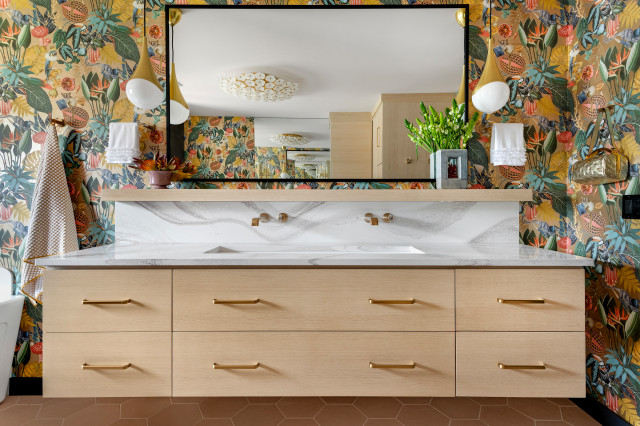
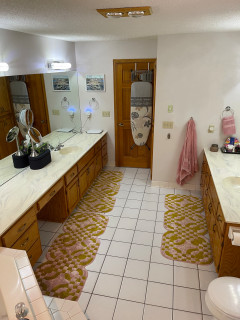
This Plymouth, Minnesota, primary bathroom was stuck in the past with two aging wood vanities, a tiny corner shower and a massive step-up tub with a tiled deck. The homeowners wanted more function, better storage and a splash of personality — especially for the wife, who uses the space most.

She turned to McDonald Remodeling with a collection of Houzz inspiration photos for a full transformation. A bold botanical print wallpaper sets the eclectic, resort-like tone. A custom rift-sawn white oak floating double vanity and matching makeup station boost storage, while a spacious open shower and freestanding tub give the room an airy, modern feel. Carefully chosen light fixtures, tiles, art and accessories layer in style and color, turning this once-bland bathroom into a joyful, tropical escape from Minnesota winters.


This article was originally published by a www.houzz.com . Read the Original article here. .


Time spent outdoors can be good for your health, and you can enhance your outdoor spaces to bring a sense of calmness and relaxation. “Spending time in nature has many physical and mental health benefits. According to the Mayo Clinic, it can be an effective tool for managing stress, even for a few minutes a day,” says Jamie Gold, a Mayo Clinic-certified wellness coach and author of the book Wellness by Design: A Room-by-Room Guide to Optimizing Your Home for Health, Fitness and Happiness.

Integrating ways to promote wellness outdoors can stray into more aspirational projects, such as cold plunges and saunas (and this list will too). However, since not everyone can live like a full-time lifestyle guru, below are plenty of simple and inexpensive other ways your outdoor spaces can help improve your health. Check out these 12 ideas for promoting wellness through the landscape to see which ones are a good fit for your home.


This article was originally published by a www.houzz.com . Read the Original article here. .


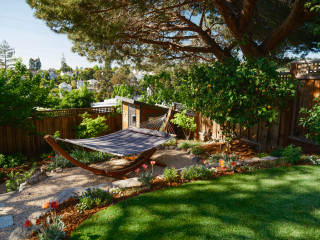
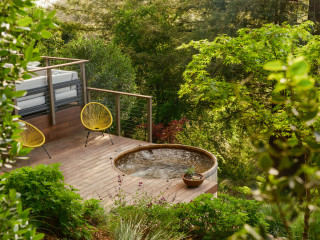
When this family purchased a home in California’s Oakland Hills, there wasn’t much in the steeply sloped backyard to encourage spending time outdoors. But what the yard lacked in usable space, it more than made up for in natural beauty, with sweeping views down a hillside of native oaks and redwoods.

Seeing the site’s potential, the homeowners enlisted Barry Sacher, owner of Rock Paper Scissors Landscape, to craft an outdoor retreat that would both serve their family’s needs and work in harmony with the landscape. “Embracing the existing natural landscape drove the design,” Sacher says. “It was and still is the star of the show.”


This article was originally published by a www.houzz.com . Read the Original article here. .


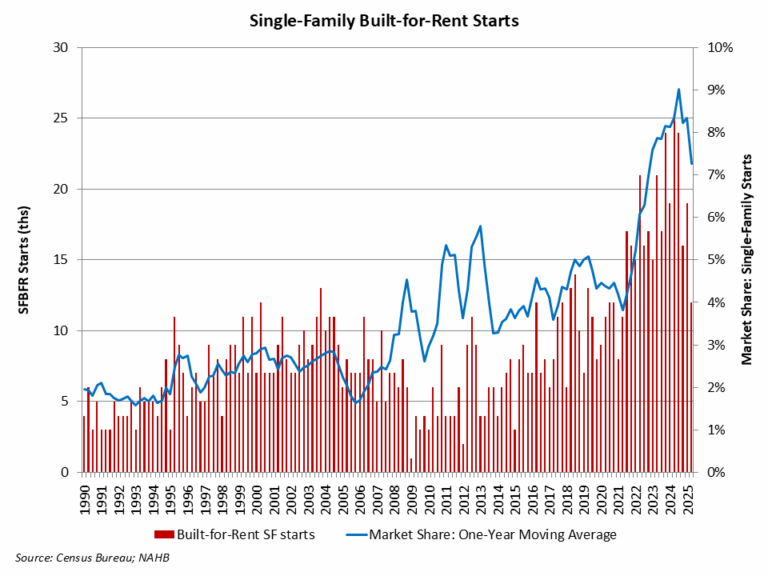
Single-family built-for-rent construction fell back in the second quarter, as a higher cost of financing crowded out development activity.

According to NAHB’s analysis of data from the Census Bureau’s Quarterly Starts and Completions by Purpose and Design, there were approximately 12,000 single-family built-for-rent (SFBFR) starts during the second quarter of 2025. This is down significantly relative to the second quarter of 2024 (25,000 starts). Over the last four quarters, 71,000 such homes began construction, which is a 16% decrease compared to the 85,000 estimated SFBFR starts in the four quarters prior to that period.

The SFBFR market is a source of inventory amid challenges over housing affordability and downpayment requirements in the for-sale market, particularly during a period when a growing number of people want more space and a single-family structure. Single-family built-for-rent construction differs in terms of structural characteristics compared to other newly-built single-family homes, particularly with respect to home size. However, investor demand for single-family homes, both existing and new, has cooled with higher interest rates.

Given the relatively small size of this market segment, the quarter-to-quarter movements typically are not statistically significant. The current four-quarter moving average of market share (7%) is nonetheless higher than the historical average of 2.7% (1992-2012).

Importantly, as measured for this analysis, the estimates noted above include only homes built and held by the builder for rental purposes. The estimates exclude homes that are sold to another party for rental purposes, which NAHB estimates may represent another three to five percent of single-family starts based on industry surveys.

The Census data notes an elevated share of single-family homes built as condos (non-fee simple), with this share averaging more than 4% over recent quarters. Some, but certainly not all, of these homes will be used for rental purposes. Additionally, it is theoretically possible some single-family built-for-rent units are being counted in multifamily starts, as a form of “horizontal multifamily,” given these units are often built on a single plat of land. However, spot checks by NAHB with permitting offices indicate no evidence of this data issue occurring.

With the onset of the Great Recession and declines for the homeownership rate, the share of built-for-rent homes increased in the years after the recession. While the market share of SFBFR homes is small, it has clearly expanded. Given affordability challenges in the for-sale market, the SFBFR market will likely retain an elevated market share. However, in the near-term, SFBFR construction is likely to slow until the return on new deals improves.

Discover more from Eye On Housing

Subscribe to get the latest posts sent to your email.


This article was originally published by a eyeonhousing.org . Read the Original article here. .


When you hear the word “retreat,” what comes to mind — writing in a cabin by a lonesome lake, engaging in spiritual study or practicing yoga on the beach? How about doing a retreat in your own home? It may at first seem like an improbable idea (although that yoga-on-the-beach thing sounds pretty good), but there are some surprising positives to crafting your own retreat at home. For one thing, it’s free. For another, you can decide exactly the sort of activities you want to focus on, including things that may not be combined in most retreats (novel writing and cupcake baking, anyone?). Check out these 10 steps to designing your own retreat in the comfort of your home.

Pearce Scott ArchitectsSave Photo
1. Decide on a Focus

Are you craving a spiritual retreat? Time to work on your craft, write, do yoga or meditate? Make a short list of the things you want to incorporate into your retreat so you can start planning.

Need a pro for your custom home project?
Let Houzz find the best pros for you

Raina Henderson Interior Design, LLCSave Photo
2. Get Your Household on Board

If you live with others, and especially if you have children, going on a retreat at home can be a challenge. Try to plan the retreat for a time when your family or housemates will be away, particularly during the day. At the very least, try to get everyone to agree to respect what you are doing. This includes not speaking to you too much if you decide to maintain silence (see No. 8) during your retreat. If you have children, it can be worthwhile to do a shorter (even a one-day) retreat when you know the kids will be out of the house.

3. Set an Intention

An intention is different from a goal. A goal might be, “I will meditate two hours each day,” whereas an intention could be, “I will be mindful and appreciate each moment.”

To set an intention for your retreat, answer these two questions:

What do you hope to gain from your retreat?
What do you hope your experience will be?Setting intentions before your retreat can help keep you focused on the experience you want to have.

SHKS ArchitectsSave Photo
4. Shop for Groceries and Plan Meals

Retreats you travel to, no matter what the focus, tend to offer fresh, healthful food — so try to offer yourself the same. Get the main work out of the way before your retreat begins, so you can focus on the good stuff.

Emily Roose InteriorsSave Photo
5. Gather Other Materials

Depending on what sort of activities you will be focusing on, you may want to pick up books, instructional videos, craft supplies, notebooks and pens, a yoga mat or meditation cushions.

6. Create a Schedule

Any proper retreat has a schedule mapped out in advance, and there’s no reason you can’t do the same. Decide what time you would like to rise, eat, work on your project, read, have downtime and go to sleep each day. Of course, the beauty of having an at-home retreat is that you are free to leave your schedule as open or as structured as you like.

Modify Interiors LLCSave Photo
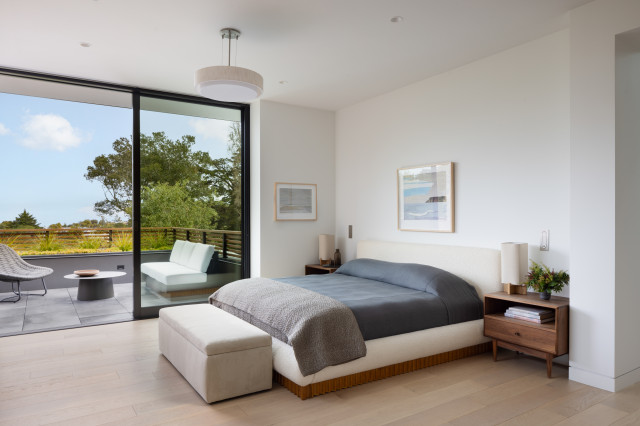
7. Prepare Your Space

There’s no need to go overboard cleaning and scrubbing, but beginning your retreat in a neat, clean home will help set a positive tone. Plan to spend a few hours getting rid of clutter and cleaning up before you begin your retreat.

Pay special attention to clearing away clutter and electronic devices in the bedroom so you can sleep restfully. And elsewhere in the house, put away anything that reminds you of work or things you may be feeling stressed about.

Biotope Architecture and InteriorsSave Photo
8. Try Silence

Consider going without speaking during some or all of your retreat — you may be surprised how refreshing it can feel to get a break from constant chatter.

Of course, the more people in your household, the more difficult it will be. Perhaps someone else would like to participate in silence with you, or you can enjoy a silent break during the times you have the house to yourself. And, of course, talk if you really need to!

10 Tips for a More Peaceful Home

9. Unplug

If there is one thing that seems to be a given at a retreat, it’s that you disconnect your devices. No going online and no checking your phone or tablet. If you are used to being on your devices frequently, it can be hard to do, but it’s worth trying!

Tennille Joy InteriorsSave Photo
10. Consider Your Media Consumption

In addition to what you might be used to seeing online, consider taking a break from the things you usually read. Be intentional about the material you choose to read or watch during your retreat. If you want to read a book or watch a film, pick one that meshes with the intention you set for the retreat.

ODS ArchitectureSave Photo


This article was originally published by a
www.houzz.com . Read the Original article here. .


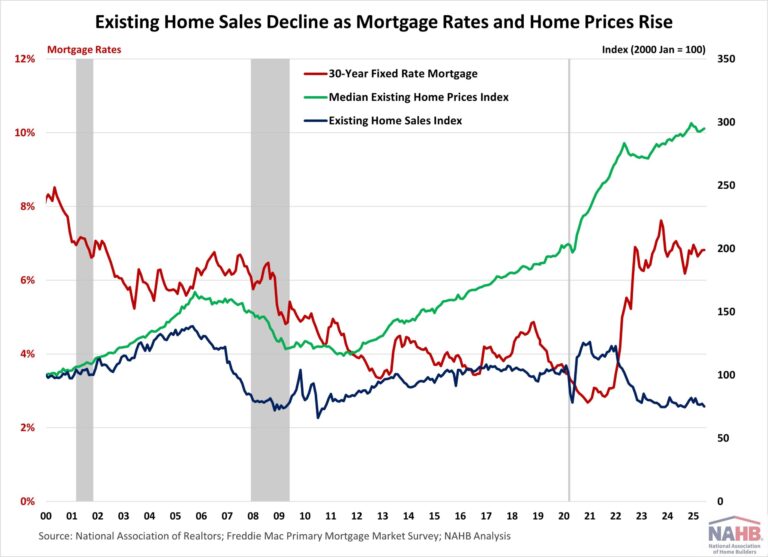
Existing home sales fell to 9-month low in June as home prices hit another monthly record high, according to the National Association of Realtors (NAR). Sluggish pace of sales suggest that higher mortgage rates and elevated home prices are continuing to sideline buyers, despite improved inventory conditions.

Mortgage rates have hovered between 6.5% and 7% due to ongoing economic and tariff uncertainty this year, prompting the Fed to pause interest rate cuts. With mortgage rates expected to stay above 6% for longer due to an anticipated slower easing pace in 2025, these prolonged higher rates and high home prices would continue to weigh on the market. As such, sales are likely to remain limited in the coming months.

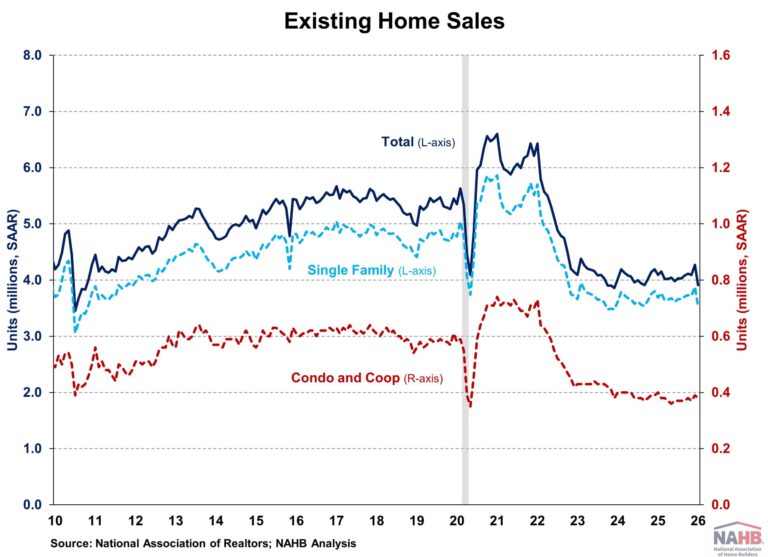
Total existing home sales, including single-family homes, townhomes, condominiums, and co-ops, fell 2.7% to a seasonally adjusted annual rate of 3.93 million in June, the lowest level since October 2024. On a year-over-year basis, sales were unchanged from a year ago.

The existing home inventory level was 1.53 million units in June, down 0.6% from May, but up 15.9% from a year ago. At the current sales rate, June unsold inventory sits at a 4.7-months’ supply, up from 4.6-months in May and 4.0-months in June 2024. Inventory between 4.5 to 6 month’s supply is generally considered a balanced market.

Homes stayed on the market for a median of 27 days in June, unchanged from May but up from 22 days in June 2024.

The first-time buyer share was 30% in June, unchanged from May but up 29% from a year ago.

The June all-cash sales share was 29% of transactions, up from 27% in May and 28% a year ago. All-cash buyers are less affected by changes in interest rates.

The June median sales price of all existing homes was $453,300, up 2.0% from last year. This marked an all-time high for the month of June and the 24th consecutive month of year-over-year increases. The median condominium/co-op price in June was up 0.8% from a year ago at $374,500.  Recent gains for home inventory will put downward pressure on resale home prices in most markets in 2025.

Geographically, three of the four regions experienced a decline in existing home sales in June, with a decrease of 2.2% in the South, 4.0% in the Midwest, and 8.0% in the Northeast. Meanwhile, sales in the West rose 1.4%. On a year-over-year basis, sales were up in the Midwest (2.2%) and the South (1.7%) but were down in the West (-4.1%) and the Northeast (-4.2%).

The Pending Home Sales Index (PHSI) is a forward-looking indicator based on signed contracts. The PHSI rose from 71.3 to 72.6 in May, suggesting a solid labor market is supporting the market despite the elevated mortgage rates. On a year-over-year basis, pending sales were 1.1% higher than a year ago, per National Association of Realtors data.

Discover more from Eye On Housing

Subscribe to get the latest posts sent to your email.


This article was originally published by a eyeonhousing.org . Read the Original article here. .

Constrained housing affordability conditions due to ongoing, elevated interest rates led to a reduction in single-family production to start the new year.

Overall housing starts decreased 9.8% in January to a seasonally adjusted annual rate of 1.37 million units, according to a report from the U.S. Department of Housing and Urban Development and the U.S. Census Bureau. The January reading of 1.37 million starts is the number of housing units builders would begin if development kept this pace for the next 12 months.

Within this overall number, single-family starts decreased 8.4% to a 993,000 seasonally adjusted annual rate; the January pace was 1.8% lower than a year ago. The multifamily sector, which includes apartment buildings and condos, decreased 13.5% to an annualized 373,000 pace.

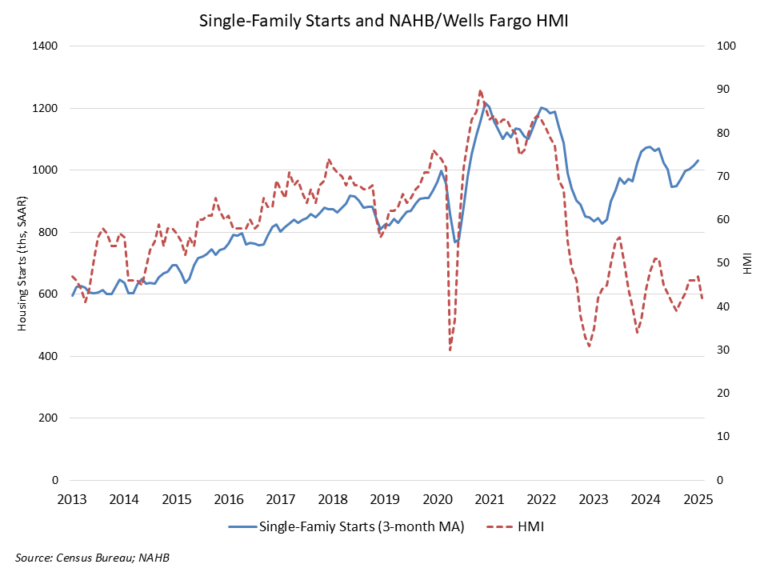
As mirrored in the NAHB/Wells Fargo HMI, high construction costs, elevated mortgage rates and challenging housing affordability conditions are causing builders to approach the market with caution. There are competing upside and downside risks, including discussed tariffs and regulatory reform. Given persistent affordability concerns, reducing inefficient regulatory costs would offer the best policy path to improve attainable housing supply and bring down shelter inflation.

On a regional basis compared to the previous month, combined single-family and multifamily starts are 27.6% lower in the Northeast, 10.4% lower in the Midwest, 23.3% lower in the South and 42.3% higher in the West.

Overall permits increased 0.1% to a 1.48 million unit annualized rate in January. Single-family permits were at a 996,000 annual unit rate, remaining unchanged compared to the previous month. Multifamily permits increased 0.2% to an annualized 487,000 pace.

Looking at regional permit data compared to the previous month, permits are 6.1% lower in the Northeast, 1.8% higher in the Midwest, 0.1% lower in the South and 2.3% higher in the West.

The number of single-family homes under construction in January is down 6.3% from a year ago, to 641,000 units. The number of multifamily units under construction is down 22.1% from a year ago, to 768,000 units.

There were 669,000 multifamily completions in January, up 11% from January 2024. For each apartment starting construction, there are 1.8 apartments completing the construction process.

Discover more from Eye On Housing

Subscribe to get the latest posts sent to your email.


This article was originally published by a eyeonhousing.org . Read the Original article here. .

Pin It