Tag

Remodelers

Browsing


Profitability for residential remodelers reached its highest level in more than two decades in 2024. Industry-wide profit benchmarks are important because they allow companies to evaluate their financial performance in context with the industry. Doing so can guide resource allocation, budgeting, and target setting for costs and expense lines, leading to a more successful business strategy. This post summarizes the results from NAHB’s most recent edition of the Remodelers’ Cost of Doing Business Study.

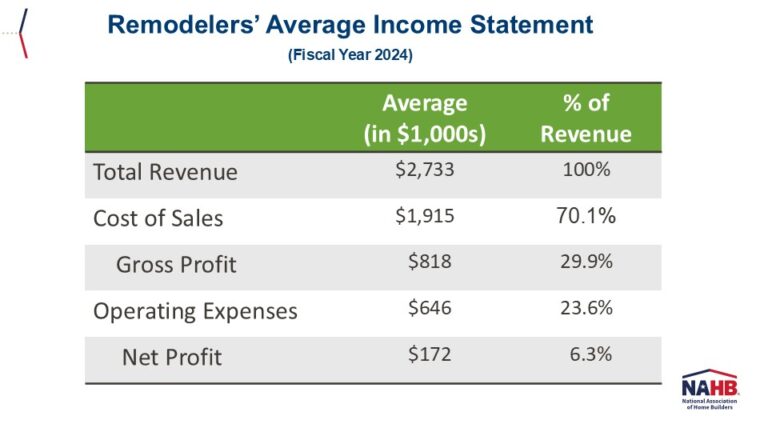
On average, residential remodelers reported $2.7 million in total revenue for fiscal year 2024. Of that, about $1.9 million (70.1%) was spent on cost of sales (i.e., labor, materials, contractors), which translates into an average gross profit margin of 29.9%. Operating expenses (i.e., indirect construction costs, finance, S&M, G&A, and owner’s compensation) cost remodelers an average of $646,000 (23.6% of revenue), leaving them with an average net profit margin of 6.3%. 

Remodelers’ 29.9% average gross profit margin in 2024 was a solid five percentage points higher than in 2021, when the metric sank to a record low of 24.9%. The improvement was due in large part to a significant reduction in trade contractor costs, which dropped from 36% of revenue in 2021 to 30% in 2024. The average gross margin in 2024 (29.9%) marked a return to gross profitability levels at par with 2018 (30.1%).

Successfully reducing their costs of sales improved remodelers’ bottom line. In 2024, their average net profit margin (6.3%) was higher than in 2021 (4.7%) and 2018 (5.2%). It was also the highest net margin reported by remodelers since 1996 (6.8%).

The Cost of Doing Business Study also tracks residential remodelers’ balance sheets. On average, they reported $668,000 in total assets on their 2024 balance sheets. Of that, $331,000 (50%) was financed by liabilities (either short- or long-term) and the other $337,000 (50%) by equity builders held in their companies.

Historical data show remodelers’ balance sheets expanded significantly in 2024, with average total assets ($668,000) up 34% compared to 2021 ($497,000). But perhaps more important than fluctuations in the nominal size of their balance sheets, the data clearly point to remodelers deleveraging their businesses in the last decade. In 2015, 68% of remodelers’ assets were financed through debt. By 2021, that share was down to 49%, where it remained essentially unchanged in 2024 (50%). Logically, the latter means remodelers are using more of their own capital to run their companies, as illustrated by their equity share rising from 33% in 2015 to 50% in 2024.

More specific data about remodelers’ various cost of sales lines (e.g., the share of revenue spent on materials), operating expenses (e.g., how much owners were paid as compensation), or types of assets (e.g., cash) are available in the official publication of the 2026 Remodelers’ Cost of Doing Business Study.


This article was originally published by a eyeonhousing.org . Read the Original article here. .
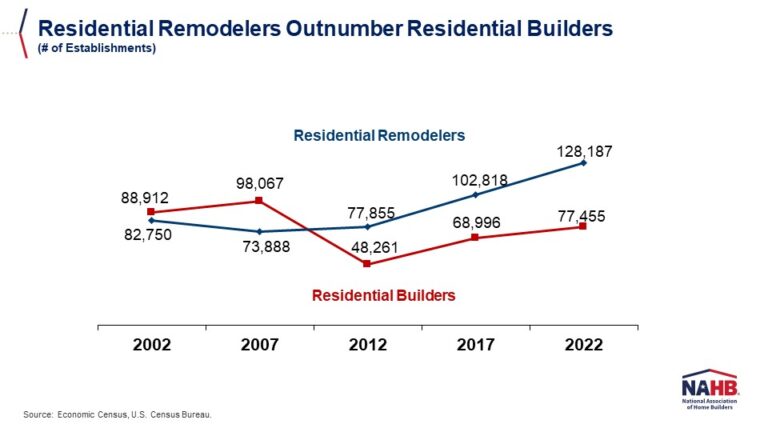

The number of residential remodelers in the U.S. has reached a record high of 128,187 establishments, 65% higher than the number of residential builders (single-family and multifamily), which stands at 77,455.  These official government counts were released by the U.S. Census Bureau as part of its 2022 Economic Census, which tallies American businesses every five years (in years ending in 2 and 7).

Growth in the number of remodelers significantly outpaced that of builders between 2017 and 2022. In that 5-year span, the remodeler count increased by 25% (102,818 to 128,187), while the number of builders grew at half that pace–by 12% (68,996 to 77,455).

A starker dichotomy emerges when comparing 2022 counts to those in 2007, prior to the financial crisis and the ensuing housing recession.  In that 15-year period, the official number of residential remodelers in the U.S. grew by 73% (73,888 to 128,187), while the official number of residential builders contracted by 21% (98,067 to 77,455).

Another way to analyze this data is by creating a combined universe of both builders and remodelers and then calculating each group’s share of the total. In 2022, for example, remodelers represented 62% of the total number of builders and remodelers in the U.S, while builders made up a minority share of 38%.  Remodelers have accounted for at least 60% of this total in the last three Economic Census (2012, 2017, and 2022). 

The last time builders comprised a majority share was in 2007, when they represented 57% of the combined total number of builders and remodelers in the country.


This article was originally published by a eyeonhousing.org . Read the Original article here. .
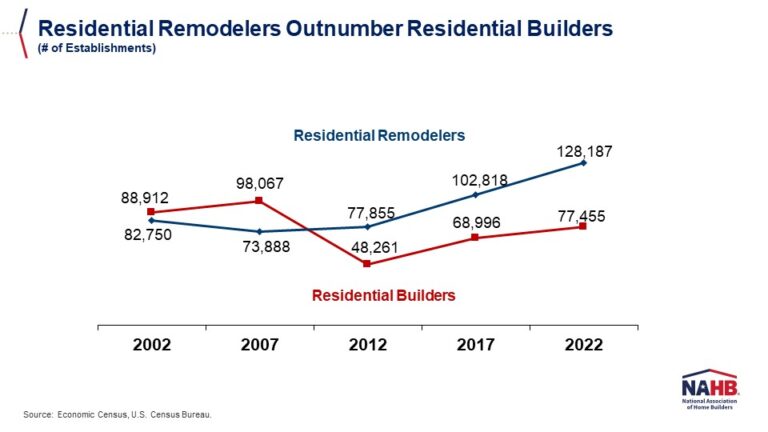

The number of residential remodelers in the U.S. has reached a record high of 128,187 establishments, 65% higher than the number of residential builders (single-family and multifamily), which stands at 77,455.  These official government counts were released by the U.S. Census Bureau as part of its 2022 Economic Census, which tallies American businesses every five years (in years ending in 2 and 7).

Growth in the number of remodelers significantly outpaced that of builders between 2017 and 2022. In that 5-year span, the remodeler count increased by 25% (102,818 to 128,187), while the number of builders grew at half that pace–by 12% (68,996 to 77,455).

A starker dichotomy emerges when comparing 2022 counts to those in 2007, prior to the financial crisis and the ensuing housing recession.  In that 15-year period, the official number of residential remodelers in the U.S. grew by 73% (73,888 to 128,187), while the official number of residential builders contracted by 21% (98,067 to 77,455).

Another way to analyze this data is by creating a combined universe of both builders and remodelers and then calculating each group’s share of the total. In 2022, for example, remodelers represented 62% of the total number of builders and remodelers in the U.S, while builders made up a minority share of 38%.  Remodelers have accounted for at least 60% of this total in the last three Economic Census (2012, 2017, and 2022). 

The last time builders comprised a majority share was in 2007, when they represented 57% of the combined total number of builders and remodelers in the country.

Discover more from Eye On Housing

Subscribe to get the latest posts sent to your email.


This article was originally published by a eyeonhousing.org . Read the Original article here. .


The most common sources for products used in home building and remodeling are specialty retailers, lumber yards, and wholesale distributors, according to two recent NAHB surveys. The surveys include one of single-family homebuilders in the October 2024 NAHB/Wells Fargo Housing Market Index (HMI) and one of remodelers in the Q3 2024 NAHB/Westlake Royal Remodeling Market Index (RMI). Both surveys asked respondents where they purchase building products, regardless of who ultimately purchases them (themselves or subcontractors)

When averaging across 24 building product categories, the top three major channels of distribution are roughly the same for both builders and remodelers. Specialty retailers, lumber yards, and wholesale distributors together account for around 70% of building product purchases.

When analyzing the specific products purchased at lumber yards, the top products purchased by both builders and remodelers were basic lumber products including plywood & OSB, sawn lumber, and engineered lumber & I-joists.

One major difference between builders and remodelers was the share of those who purchase products from home improvement centers.  Remodelers are three times as likely to buy products at this channel of distribution compared to builders.  Nevertheless, one specific product category, hand & power tools, is purchased at home improvement centers by a majority of both remodelers (68%) and builders (56%).  Of those that do purchase hand & power tools at home improvement centers, 11% of remodelers purchased at least one other product there compared to 3% of builders. 

A subsequent post on who is most often responsible for choosing these products will come later. Please click here to be redirected to the full report.

Discover more from Eye On Housing

Subscribe to get the latest posts sent to your email.


This article was originally published by a eyeonhousing.org . Read the Original article here. .

In the latest 2023 NAHB member census, 21% of NAHB builder members listed residential remodeling as their primary business. These remodelers tend to be relatively small, with a median of five employees and a median annual revenue of $1.8 million.  They are thus even smaller than NAHB builder members in general, who had a median of six employees and median annual revenue of $3.4 million, as reported in a recent post.

Among the residential remodelers, 21% reported a dollar volume of less than $500,000 in 2023, 20% reported between $500,000 and $999,999, 47% between $1.0 and $4.9 million, 8% between $5.0 and $9.9 million, 2% between $10.0 million and $14.9 million, and another 2% reported $15.0 million or more. None reported zero business activity in 2023.

The median annual revenue for residential remodelers in 2023 was $1.8 million—considerably below the $3.4 million median calculated across all NAHB builder members, and a small fraction of the $45.0 million threshold the Small Business Administration uses to classify construction businesses as small. Even so, residential remodelers’ median revenue was up from the $1.2 million recorded in 2022.

The median number of payroll employees was also relatively small among NAHB’s residential remodelers in 2023—five, compared to six for all NAHB builder members. Both numbers were unchanged from 2022.

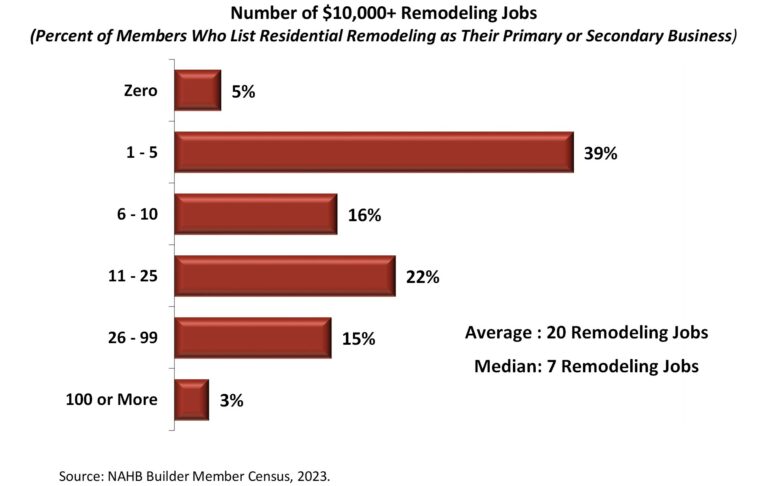
To provide a measure of housing activity roughly analogous to starts, the NAHB census asked builder members who are primarily or secondarily residential remodelers about the number of remodeling jobs they completed in 2023 costing $10,000 or more. The responses show that a plurality of 39% completed 1 to 5 jobs of this size, 16% did 6 to 10, 22% did 11 to 25, 15% did 26 to 99, and 3% completed 100 or more jobs costing more than $10,000. On average, builder members involved in residential remodeling as a primary or secondary activity completed 20 jobs costing $10,000 or more in 2023. The median number was 7.

The numbers are significantly higher if the calculations are confined to the 21% of NAHB builder members who list residential remodeling specifically as their primary activity. These members completed an average of 32 and a median of 15 $10,000-plus jobs in 2023. These results are not significantly different from the ones reported in 2022, when NAHB first included the remodeling jobs question in its member census.

Discover more from Eye On Housing

Subscribe to get the latest posts sent to your email.


This article was originally published by a eyeonhousing.org . Read the Original article here. .
Pin It