Tag

Rate

Browsing


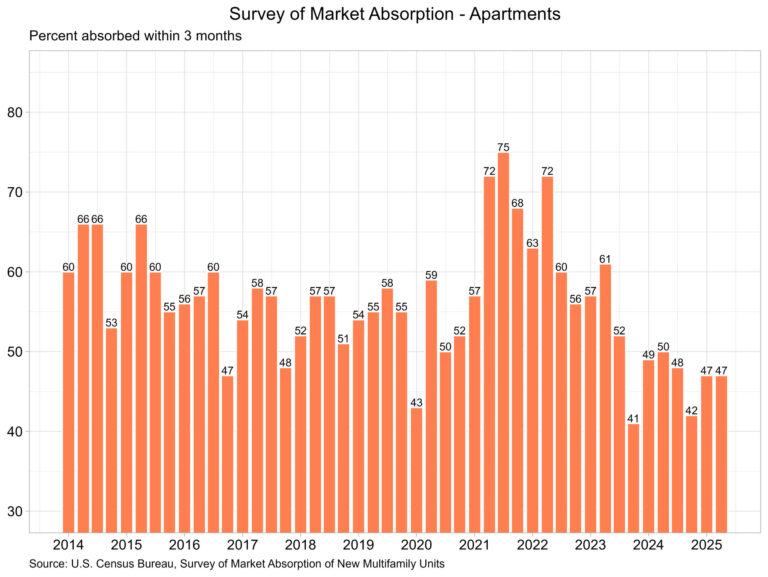
The percentage of new apartment units that were absorbed within three months after completion was unchanged for new units completed in the second quarter, according to the Census Bureau’s latest release of the Survey of Market Absorption of New Multifamily Units (SOMA). The survey covers new units in multifamily residential buildings with five or more units. The number of new multifamily units completed rose marginally in the second quarter and remained above 90,000 units for the seventh consecutive quarter.

Apartments

The percentage of apartments absorbed within three months has remained below 50% for four straight quarters. The SOMA data has never featured more than two consecutive quarters with under 50% absorption rates. Currently, the rate stands at 47%, meaning that 47% of the 93,680 units completed in the second quarter were rented within three months of completion. The median asking rent in the second quarter was $1,860, up 5.3% from $1,766 last year. The SOMA data has also displayed two quarters of median rent declines, as the asking rent has fallen from $1,941 for completions in the fourth quarter of 2024.

Along with the three-month absorption rate and completions, SOMA also reports absorption rates at six, nine, and twelve months after completion. For apartments completed six months ago (93,400 units), 70% have been absorbed into the market. Of the 125,100 apartments completed nine months ago, 85% have been absorbed. For those completed twelve months ago (142,700 units), 91% were absorbed into the multifamily market.

Condominiums and Cooperative Units

The three-month absorption rate for new condominiums and cooperative units rose to 69%. Total completions of new condominiums and cooperative units, according to SOMA, doubled in the second quarter from 2,551 to 5,167.


This article was originally published by a eyeonhousing.org . Read the Original article here. .

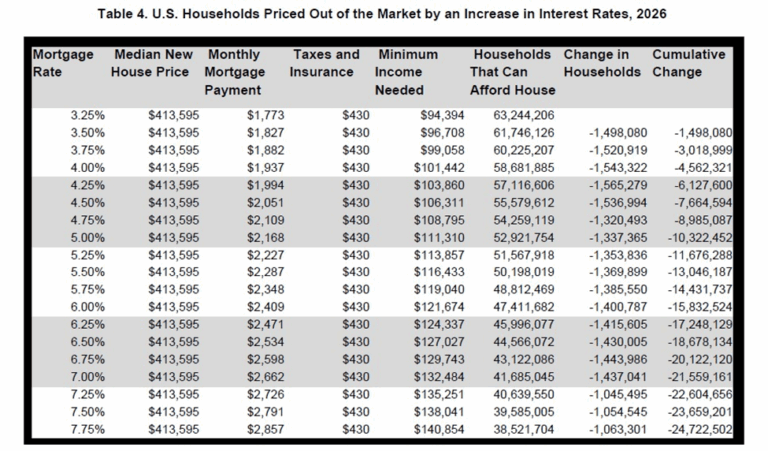
Housing affordability remains a critical challenge nationwide, and mortgage rates continue to play a central role in shaping homebuying power. Although rates have declined from the recent peak of about 7.6% in 2023 to around 6.01% as of February 19,2026, they remain elevated relative to typical levels in the 2010s. During that decade, mortgage rates generally ranged between 4% and 5%. They also remain well above the historic lows reached during the pandemic. Even modest declines in mortgage rates can have a significant impact on housing affordability, pricing more households back into the market. New NAHB Priced-Out Estimates illustrate how changes in interest rates affect the number of households that can afford a median-priced new home.

At the beginning of 2026, with the average 30-year fixed mortgage rate at 6.25%, around 31.5 million households could afford a median-priced new home at $413,595. This requires a household income of $124,336 by the front-end underwriting standards. A modest 25 basis-point rate reduction from 6.25% to 6% would lower the qualifying income threshold sufficiently to allow 1.42 million additional households to afford a median-priced new home in 2026.

This sizable affordability response reflects the underlying distribution of U.S. household incomes. Household incomes are heavily concentrated in the middle of the distribution, with many households near key affordability thresholds. Approximately 79.8 million households earn less than $105,880, and an additional 14 million households earn between $105,881 and $132,350. When mortgage rates decline, the qualifying minimum income shifts downward into these densely populated income ranges, bringing a substantial number of households into the market.

In contrast, an equivalent 25 basis-point cut at higher interest rate levels has a smaller impact on affordability. For example, a decline from 7.75% to 7.5% would only price around 1 million households into the market. At higher rate levels, fewer households remain near the margin of qualification.

Overall, the estimates demonstrate that modest mortgage rate relief at current levels can translate into significant gains in housing affordability, highlighting the importance of mortgage interest rates for prospective homebuyers and the housing market.


This article was originally published by a eyeonhousing.org . Read the Original article here. .

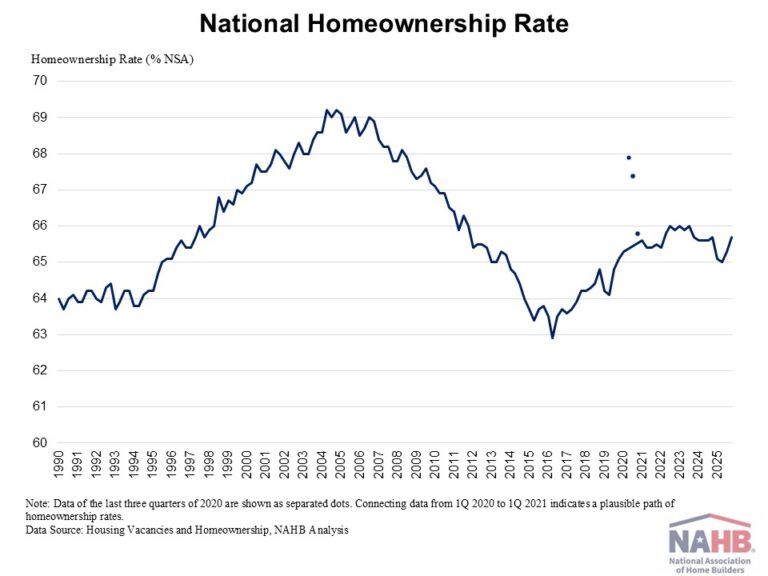
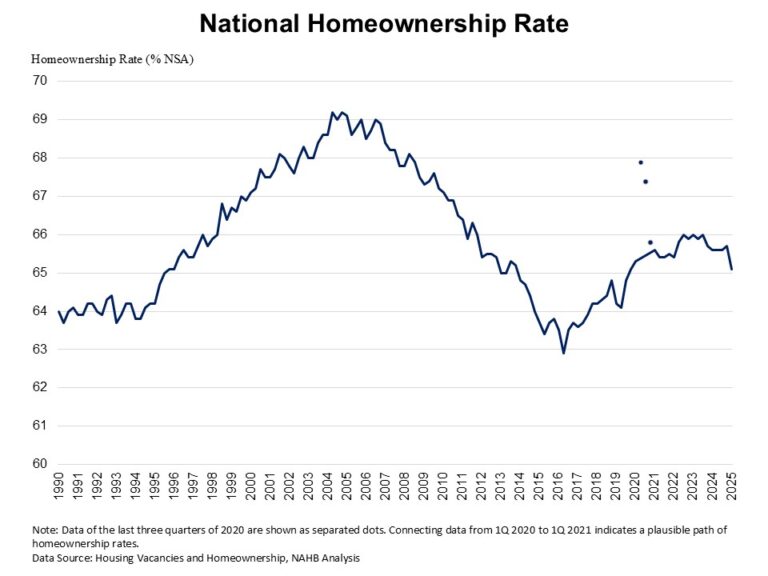
The latest homeownership rate rose to 65.7% in the last quarter of 2025, according to the Census’s Housing Vacancy Survey (HVS). While this was a modest quarterly increase, the broader picture continues to reflect significant affordability challenges. With mortgage interest rates remaining elevated, and housing supply still tight, housing affordability is at a multidecade low.

Compared to the peak of 69.2% in 2004, the homeownership rate is currently 3.5 percentage points lower and remains below the 25-year average rate of 66.3%. It is also important to note that the fourth quarter’s data comes with a higher level of uncertainty. Due to the government shutdown, the Census only collected data for the last two months of 2025.

Compared to the previous year, homeownership rates increased in only two age groups. Among younger households, the homeownership rate for those under 35 increased 1.6 percentage points to 37.9% in the last quarter of 2025. This age group is particularly sensitive to mortgage rates and the inventory of entry-level homes. Homeownership rates for householders ages 55-64 inched up by 0.4 percentage points over the same time. In contrast, several middle-aged and older groups saw declines. Householders ages 45-54 experienced the largest drop, declining  1.5 percentage points from 71.0% to 69.5%. The 35-44 age group saw a 0.5 percentage point decrease, decreasing from 61.4% to 60.9%.  Homeownership rates for householders aged 65 years and over declined 0.5 percentage points from a year ago.

The national rental vacancy rate inched up to 7.2% for the fourth quarter of 2025, on a steadily increasing trend since 2023. Meanwhile, the homeowner vacancy rate stayed at 1.2%. The upticks in both homeowner and rental vacancy rate signal an increase in the existing home supply.

The housing stock-based HVS revealed that the number of total households increased to 133.7 million in the last quarter of 2025 from 132.2 million a year ago. This increase was driven by both owner and renter household growth. The number of renter households rose by 0.46 million, while owner-occupied households increased by around 1 million over the same period.


This article was originally published by a eyeonhousing.org . Read the Original article here. .

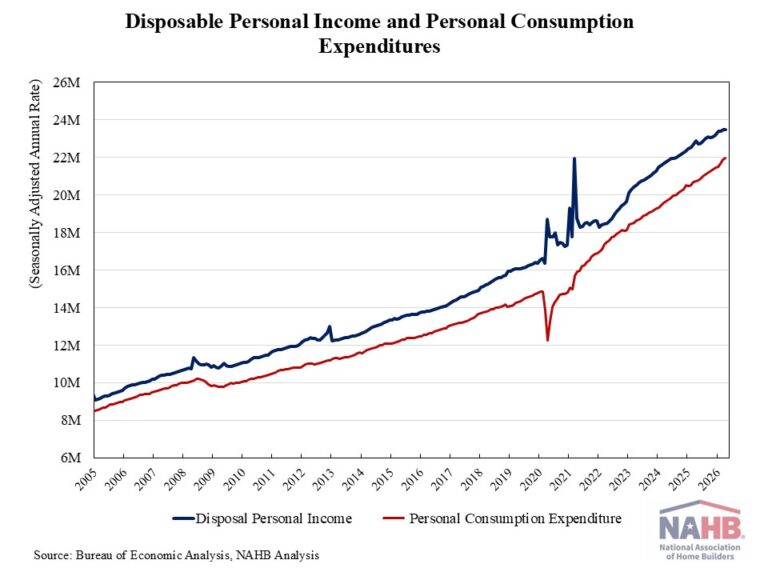
Personal income rose 0.3% in November 2025, following a 0.1% increase in October, according to the latest data from the Bureau of Economic Analysis. Gains were largely driven by higher wages and dividend income. However, income growth has cooled noticeably from peaking at a monthly increase of 1.1% in July 2022 to 0.3% now.

Real disposable income, the amount remaining after adjusted for taxes and inflation, was up 0.1% in November, reversing a 0.1% decline in October. On a year-over-year basis, real (inflation-adjusted) disposable income rose 1%, down from a 7.2% year-over-year recent peak recorded in June 2023.

Consumer spending, meanwhile, remained robust but showed signs of softening. Personal consumption expenditures rose 0.5% in November. Real spending, adjusted to remove inflation, increased 0.3% in November, with expenditures on goods climbing 0.6% and spending on services up 0.2%.

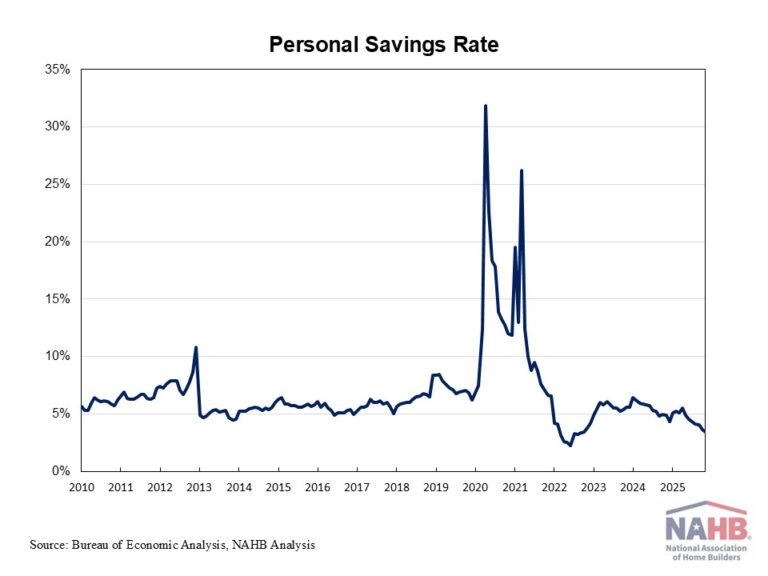
With spending growth outpacing income growth, the personal saving rate decreased to 3.5% in November, the lowest level since late 2022, when core CPI was around the peak. With inflation eroding compensation gains, households are dipping into savings to support spending, especially during the period when some payments were disrupted by the government shutdown. This trend will ultimately lead to a slowing of consumer spending.


This article was originally published by a eyeonhousing.org . Read the Original article here. .

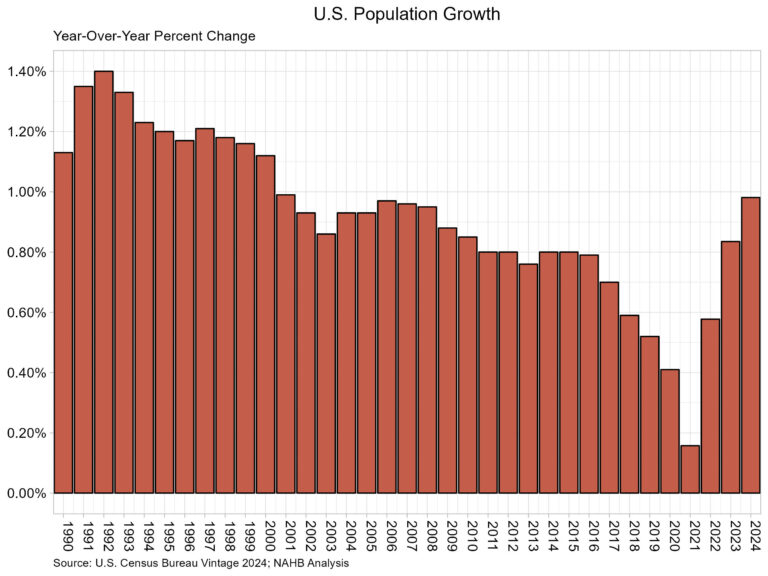
According to the U.S. Census Bureau’s latest estimates, the U.S. resident population grew by 3,304,757 to a total population of 340,110,988. The population grew at a rate of 0.98%, the highest rate since 0.99% in 2001. This also marked the third straight increase in the growth rate of the U.S. population. The vintage population estimates are released annually and represent the change in the U.S. population between July 1st of 2023 and 2024.

The Census Bureau reports that the primary source of population growth was net international migration (immigration), as international migration levels once again were higher than the previous year. The level of net international migration between 2023 and 2024 was 2,786,119. The second component of population growth is natural growth, which represents births minus deaths. Births totaled 3,605,563, down slightly from last year, while the number of deaths was reported at 3,086,925, also a decrease from last year. The natural growth, therefore, between 2023 and 2024 was 518,638.

Each region in the U.S. experienced population growth for the 2023-2024 period. The South led in population growth at 1.34% followed by the West at 0.85%. Meanwhile, the Midwest population grew 0.75%, while the Northeast grew the least at 0.59%.  

At the State level, 47 States and the District of Columbia had a population increase over the year. Of note, D.C. had the highest growth rate at 2.13%. Florida was second with population growth at 2.00% followed by Texas at 1.80%. Numerically, Texas experienced the largest population increase gaining 562,941. This was followed by Florida at 467,347 and California at 232,570.

Only three states lost population or remained level according to Census estimates. Vermont and West Virginia tied with a decline of 0.03%. Meanwhile Mississippi saw no population change.

California remained the most populous state by a healthy margin. California’s population was at 39,198,693, while the next most populous state was Texas at 31,290,831. To round out the top five States by total population the proceeding highest were Florida (23,372,215), New York (19,867,248), and Pennsylvania (13,078,751).


This article was originally published by a eyeonhousing.org . Read the Original article here. .

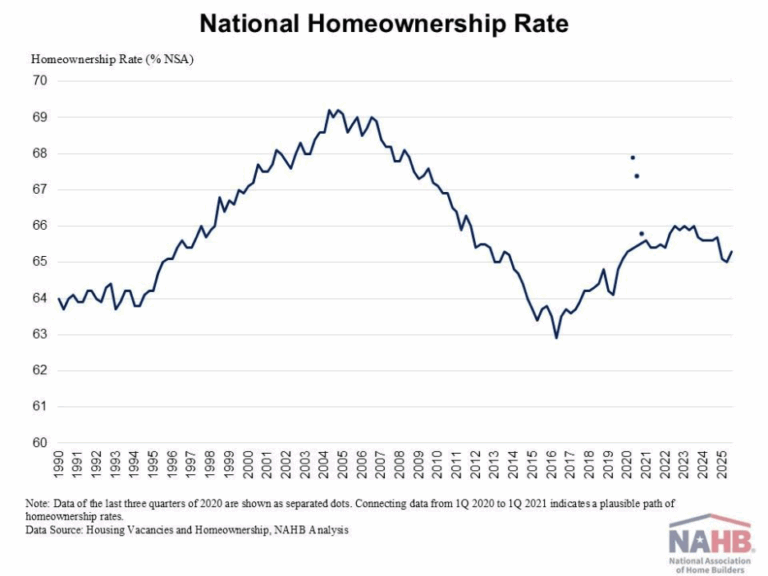
The latest homeownership rate rose to 65.3% in the third quarter of 2025, according to the Census’s Housing Vacancy Survey (HVS). Despite this quarterly increase, the trend continues to reflect significant affordability challenges. With mortgage interest rates remaining elevated, and housing supply still tight, housing affordability is at a multidecade low. Compared to the peak of 69.2% in 2004, the homeownership rate is currently 3.9 percentage points lower and remains below the 25-year average rate of 66.3%.  

Compared to the previous year, homeownership rates increased in three age groups. Among younger households, the homeownership rate for those under 35 increased 0.5 percentage points to 37.5% in the third quarter of 2025. This age group is particularly sensitive to mortgage rates and the inventory of entry-level homes. Householders ages 45-54 experienced a 0.3 percentage-point increase from 69.7% to 70%. Homeownership rates for householders aged 55-64 inched up by 0.1 percentage point over the same time. However, homeownership rates for householders aged 35-44 and those aged 65 years and over each declined 1.2 percentage points from a year ago. 

The national rental vacancy rate inched up to 7.1% for the third quarter of 2025, on steadily increasing trend since 2023. Meanwhile, the homeowner vacancy rate rose to 1.2%. These upticks in both the homeowner and rental vacancy rate signal an increase in the existing home supply. 

The housing stock-based HVS revealed that the number of total households increased to 133.1 million in the third quarter of 2025 from 132.0 million a year ago. This increase was driven by both owner and renter household growth. The number of renter households rose by 0.7 million, while owner-occupied households increased by 0.4 million over the same period.


This article was originally published by a eyeonhousing.org . Read the Original article here. .

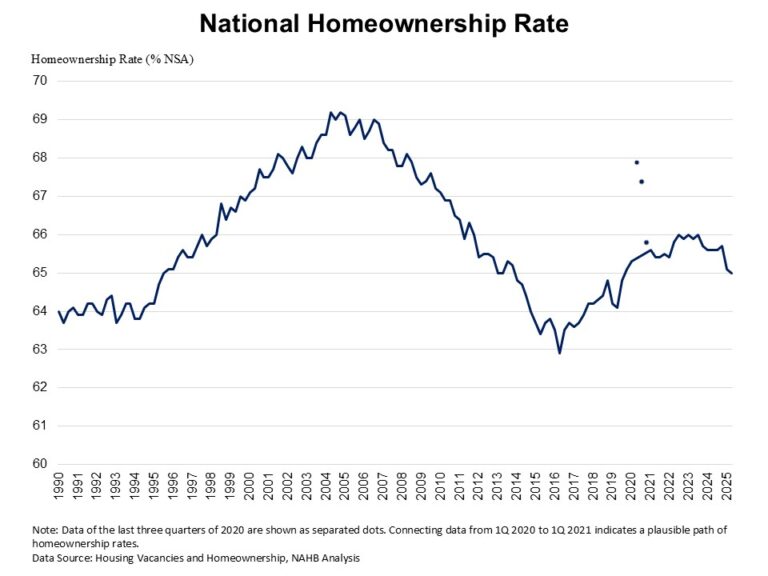
The latest homeownership rate declined to 65% in the second quarter of 2025, marking its lowest level since late 2019, according to the Census’s Housing Vacancy Survey (HVS). With mortgage interest rates remaining elevated and housing supply still tight, housing affordability is at a multidecade low. Compared to the peak of 69.2% in 2004, the homeownership rate is currently 4.2 percentage points lower and remains below the 25-year average rate of 66.3%.

Compared to the previous quarter, the homeownership rate dropped by 0.1 percentage point.[OD1]  Additionally, homeownership rates dropped amongst almost all age groups. Householders aged 45-54 experienced the largest drop, declining by 1.9 percentage points from 71.1% to 69.2%. The 35-44 age group saw a 1.2 percentage point decrease, decreasing from 62.2% to 61%. Among younger households, the homeownership rate for those under 35 dropped 1percentage points to 36.4% in the second quarter of 2025, hovering near the lowest rate in the last 6 years. This age group, particularly sensitive to mortgage rates and the inventory of entry-level homes. However, homeownership rates for householders aged 55-64 and 65 years and over stayed unchanged from a year ago.

The national rental vacancy rate inched down to 7% for the second quarter of 2025, after steadily increasing since 2021. Meanwhile, the homeowner vacancy rate stayed at 1.1%, remaining near the survey’s 67-year low of 0.7%.

The housing stock-based HVS revealed that the count of total households increased to 132.5 million in the second quarter of 2025 from 131.3 million a year ago. This increase was driven entirely by renter household growth, which added 1.2 million new households. Meanwhile, the number of owner-occupied households declined by 39,000 over the same period.

Discover more from Eye On Housing

Subscribe to get the latest posts sent to your email.


This article was originally published by a eyeonhousing.org . Read the Original article here. .

The homeownership rate declined to 65.1% in the first quarter of 2024, the lowest level since the first quarter of 2020, according to the Census’s Housing Vacancy Survey (HVS). Amid elevated mortgage interest rates and tight housing supply, housing affordability is at a multidecade low. Compared to the peak of 69.2% in 2004, the homeownership rate is 4.1 percentage points lower and remains below the 25-year average rate of 66.3%.

Homeownership rates declined across nearly all age groups over the past year, except those aged 65 and older. Among younger households, the homeownership rate for those under 35 rose slightly to 36.6% in the first quarter of 2024. However, it is still hovering at the lowest rate in the last 6 years. This age group, particularly sensitive to mortgage rates and the inventory of entry-level homes, saw the largest decline among all age categories (1.1 percentage points down). Similar declines were seen among the 35-44 group and 55-64 age group, with rates decreasing from 61.4% to 60.3% and from 76.3% to 75.2%, respectively. Homeownership rates for householders aged 45-54 dipped slightly from 70.8% to 70.6%. In contrast, those 65 years and over experienced a modest increase from 78.7% to 79%.

The national rental vacancy rate increased to 7.1% for the first quarter of 2025, returning to the pre-pandemic levels after several years of tight rental market. Meanwhile, the homeowner vacancy rate stayed at 1.1%, remaining near the survey’s 67-year low of 0.7%.

The housing stock-based HVS revealed that the count of total households increased to 132.2 million in the first quarter of 2025 from 131.0 million a year ago. The gains are due to gains in both renter household formation (1.2 million increase), and owner-occupied households (106,000 increase).

Discover more from Eye On Housing

Subscribe to get the latest posts sent to your email.


This article was originally published by a eyeonhousing.org . Read the Original article here. .

Total outstanding U.S. consumer credit stood at $5.15 trillion for the fourth quarter of 2024, increasing at an annualized rate of 4.22% (seasonally adjusted), according to the Federal Reserve’s G.19 Consumer Credit Report. This is an uptick from the third quarter of 2024’s rate of 2.47%. 

The G.19 report excludes mortgage loans, so the data primarily reflects consumer credit in the form of student loans, auto loans, and credit card plans. As consumer spending has outpaced personal income, savings rates have been declining, and consumer credit has increased. Previously, consumer credit growth had slowed, as high inflation and rising interest rates led people to reduce their borrowing. However, in the last two quarters, growth rates have increased, reflecting the rate cuts that took place at the end of the third quarter.  

Nonrevolving Credit  

Nonrevolving credit, largely driven by student and auto loans, reached $3.76 trillion (SA) in the fourth quarter of 2024, marking a 3.11% increase at a seasonally adjusted annual rate (SAAR). This is an uptick from last quarter’s rate of 2.28%, and the highest in two years.  

Student loan debt balances stood at $1.78 trillion (NSA) for the fourth quarter of 2024. Year-over-year, student loan debt rose 2.77%, the largest yearly increase since the second quarter of 2021. This shift partially reflects the expiration of the COVID-19 Emergency Relief for student loans’ 0-interest payment pause that ended September 1, 2023. 

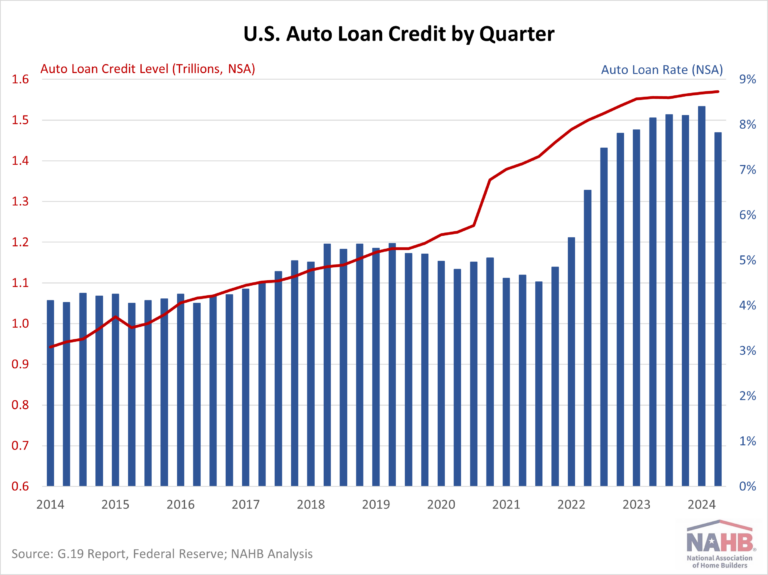
Auto loans reached a total of $1.57 trillion, showing a year-over-year increase of only 0.93%. This marks the second slowest growth rate since 2010, slightly above last quarter’s rate of 0.91%. The deceleration in growth can be attributed to several factors, including stricter lending standards, elevated interest rates, and overall inflation. Although interest rates for 5-year new car loans fell to 7.82% in the fourth quarter from a high of 8.40% in the third quarter, they remain at their highest levels in over a decade. 

Revolving Credit 

Revolving credit, primarily credit card debt, reached $1.38 trillion (SA) in the fourth quarter, rising at an annualized rate of 7.34%. This marked a significant increase from the third quarter’s 3.01% rate but was notably down from the peak growth rate of 17.58% seen in the first quarter of 2022. The surge in credit card balances in early 2022 was accompanied by an increase in the credit card rate which climbed by 4.51 percentage points over 2022. This was an exceptionally steep increase, as no other year in the past two decades had seen a rate jump of more than two percentage points.  

Comparatively, so far in 2024 the credit card rate decreased 0.12 percentage points. For the fourth quarter of 2024, the average credit card rate held by commercial banks (NSA) was 21.47%. 

Discover more from Eye On Housing

Subscribe to get the latest posts sent to your email.


This article was originally published by a eyeonhousing.org . Read the Original article here. .

The homeownership rate for those under the age of 35 dropped to 36.3% in the last quarter of 2024, reaching the lowest level since the third quarter of 2019, according to the Census’s Housing Vacancy Survey (HVS). Amidst elevated mortgage interest rates and tight housing supply, housing affordability is at a multidecade low. The youngest age group, who are particularly sensitive to mortgage rates, home prices, and the inventory of entry-level homes, saw the largest decline among all age categories.

The U.S. homeownership rate inch up to 65.7% in the last quarter of 2024, hovering at the lowest rate in the last two years. The homeownership rate remains below the 25-year average rate of 66.4%.

The national rental vacancy rate stayed at 6.9% for the last quarter of 2024, and the homeowner vacancy rate inched up to 1.1%. The homeowner vacancy rate remains close to the survey’s 67-year low of 0.7%.

Homeownership rates declined for under 35 and 35-44 age groups compared to a year ago. Householders under 35 experienced the largest drop, declining by 1.8 percentage points from 38.1% to 36.3%. The 35-44 age group also saw a 0.6 percentage point decrease, decreasing from 62% to 61.4%. Conversely, homeownership rates for householders aged 45-54 increased from 70.3% to 71%. Among those aged 55-64, homeownership inched up slightly from 76% to 76.3%. Those 65 years and over experienced a modest increase from 79% to 79.5%.

The housing stock-based HVS revealed that the count of total households increased to 132.4 million in the last quarter of 2024 from 131.1 million a year ago. The gains are due to gains in both renter household formation (509,000 increase), and owner-occupied households (783,000 increase).

Discover more from Eye On Housing

Subscribe to get the latest posts sent to your email.


This article was originally published by a eyeonhousing.org . Read the Original article here. .
Pin It