Tag

Rate

Browsing


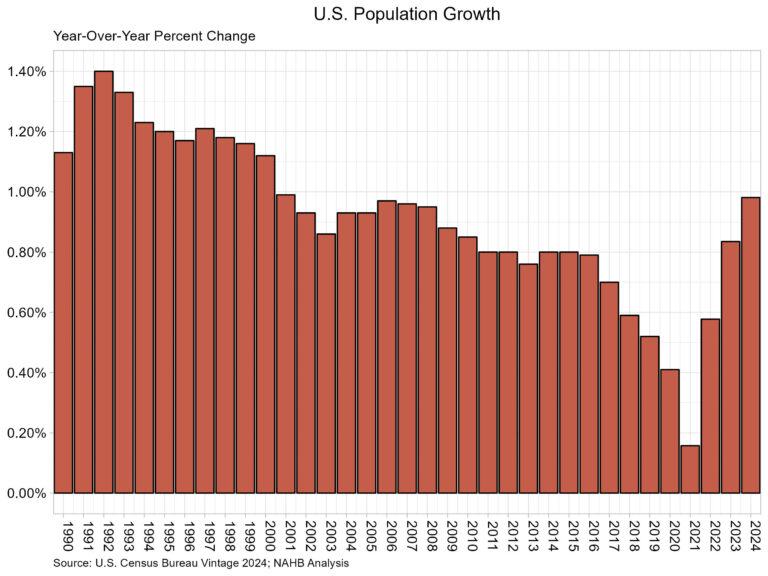
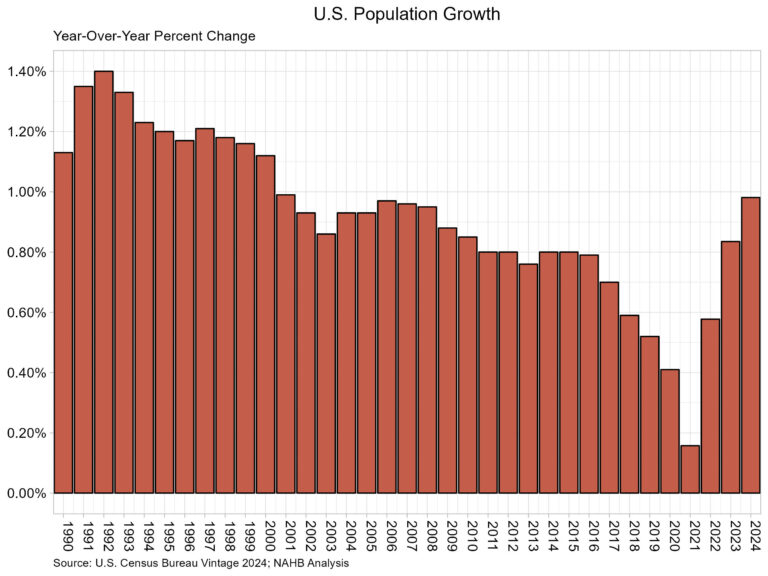
According to the U.S. Census Bureau’s latest estimates, the U.S. resident population grew by 3,304,757 to a total population of 340,110,988. The population grew at a rate of 0.98%, the highest rate since 0.99% in 2001. This also marked the third straight increase in the growth rate of the U.S. population. The vintage population estimates are released annually and represent the change in the U.S. population between July 1st of 2023 and 2024.

The Census Bureau reports that the primary source of population growth was net international migration (immigration), as international migration levels once again were higher than the previous year. The level of net international migration between 2023 and 2024 was 2,786,119. The second component of population growth is natural growth, which represents births minus deaths. Births totaled 3,605,563, down slightly from last year, while the number of deaths was reported at 3,086,925, also a decrease from last year. The natural growth, therefore, between 2023 and 2024 was 518,638.

Each region in the U.S. experienced population growth for the 2023-2024 period. The South led in population growth at 1.34% followed by the West at 0.85%. Meanwhile, the Midwest population grew 0.75%, while the Northeast grew the least at 0.59%.  

At the State level, 47 States and the District of Columbia had a population increase over the year. Of note, D.C. had the highest growth rate at 2.13%. Florida was second with population growth at 2.00% followed by Texas at 1.80%. Numerically, Texas experienced the largest population increase gaining 562,941. This was followed by Florida at 467,347 and California at 232,570.

Only three states lost population or remained level according to Census estimates. Vermont and West Virginia tied with a decline of 0.03%. Meanwhile Mississippi saw no population change.

California remained the most populous state by a healthy margin. California’s population was at 39,198,693, while the next most populous state was Texas at 31,290,831. To round out the top five States by total population the proceeding highest were Florida (23,372,215), New York (19,867,248), and Pennsylvania (13,078,751).


This article was originally published by a eyeonhousing.org . Read the Original article here. .


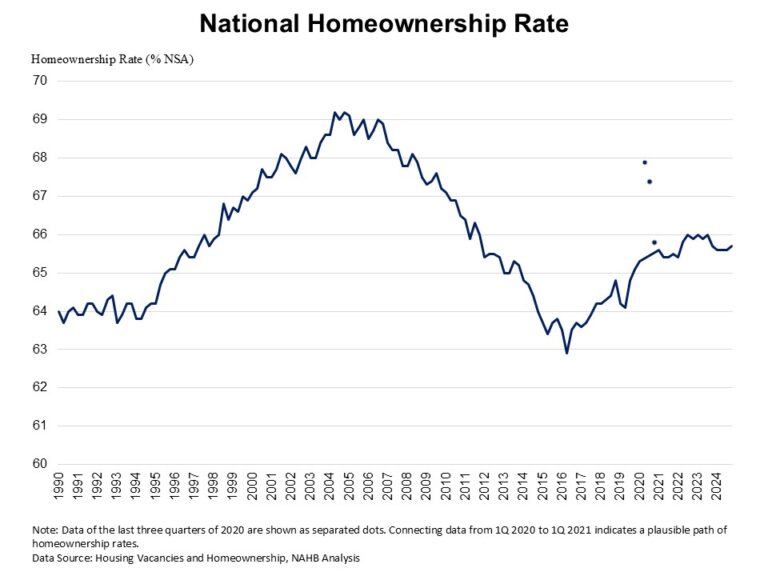
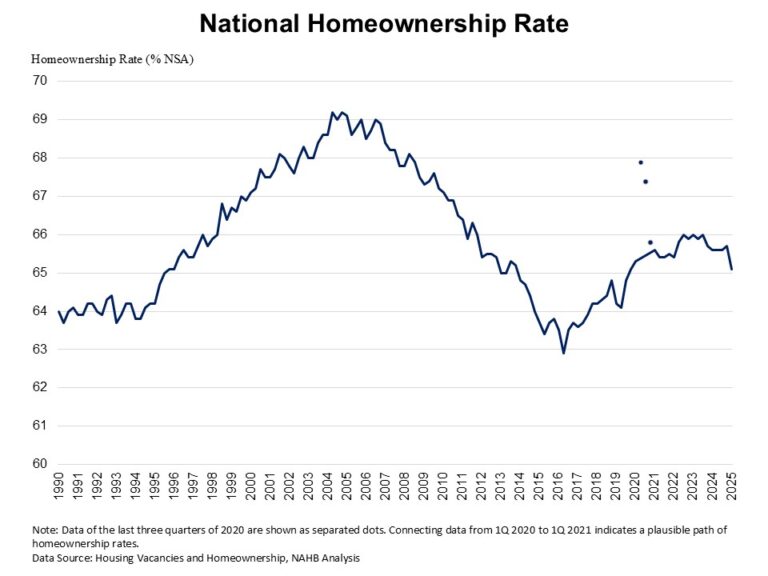
The latest homeownership rate rose to 65.3% in the third quarter of 2025, according to the Census’s Housing Vacancy Survey (HVS). Despite this quarterly increase, the trend continues to reflect significant affordability challenges. With mortgage interest rates remaining elevated, and housing supply still tight, housing affordability is at a multidecade low. Compared to the peak of 69.2% in 2004, the homeownership rate is currently 3.9 percentage points lower and remains below the 25-year average rate of 66.3%.  

Compared to the previous year, homeownership rates increased in three age groups. Among younger households, the homeownership rate for those under 35 increased 0.5 percentage points to 37.5% in the third quarter of 2025. This age group is particularly sensitive to mortgage rates and the inventory of entry-level homes. Householders ages 45-54 experienced a 0.3 percentage-point increase from 69.7% to 70%. Homeownership rates for householders aged 55-64 inched up by 0.1 percentage point over the same time. However, homeownership rates for householders aged 35-44 and those aged 65 years and over each declined 1.2 percentage points from a year ago. 

The national rental vacancy rate inched up to 7.1% for the third quarter of 2025, on steadily increasing trend since 2023. Meanwhile, the homeowner vacancy rate rose to 1.2%. These upticks in both the homeowner and rental vacancy rate signal an increase in the existing home supply. 

The housing stock-based HVS revealed that the number of total households increased to 133.1 million in the third quarter of 2025 from 132.0 million a year ago. This increase was driven by both owner and renter household growth. The number of renter households rose by 0.7 million, while owner-occupied households increased by 0.4 million over the same period.


This article was originally published by a eyeonhousing.org . Read the Original article here. .


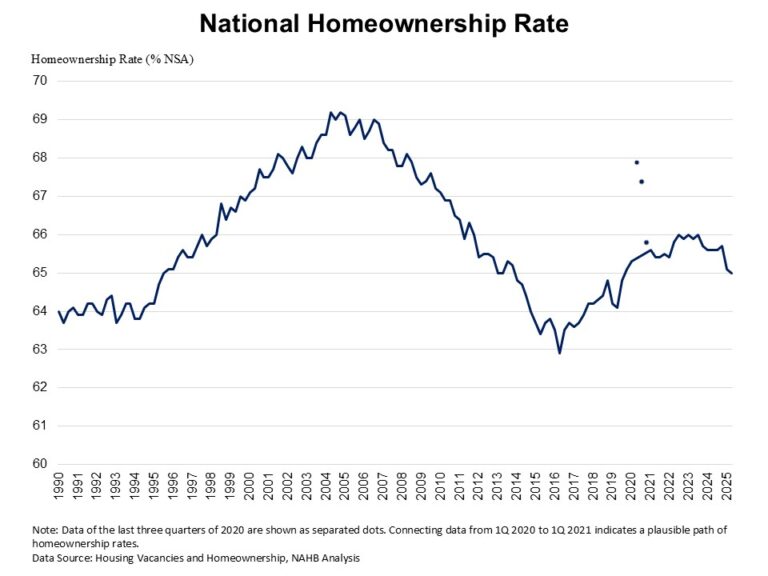
The latest homeownership rate declined to 65% in the second quarter of 2025, marking its lowest level since late 2019, according to the Census’s Housing Vacancy Survey (HVS). With mortgage interest rates remaining elevated and housing supply still tight, housing affordability is at a multidecade low. Compared to the peak of 69.2% in 2004, the homeownership rate is currently 4.2 percentage points lower and remains below the 25-year average rate of 66.3%.

Compared to the previous quarter, the homeownership rate dropped by 0.1 percentage point.[OD1]  Additionally, homeownership rates dropped amongst almost all age groups. Householders aged 45-54 experienced the largest drop, declining by 1.9 percentage points from 71.1% to 69.2%. The 35-44 age group saw a 1.2 percentage point decrease, decreasing from 62.2% to 61%. Among younger households, the homeownership rate for those under 35 dropped 1percentage points to 36.4% in the second quarter of 2025, hovering near the lowest rate in the last 6 years. This age group, particularly sensitive to mortgage rates and the inventory of entry-level homes. However, homeownership rates for householders aged 55-64 and 65 years and over stayed unchanged from a year ago.

The national rental vacancy rate inched down to 7% for the second quarter of 2025, after steadily increasing since 2021. Meanwhile, the homeowner vacancy rate stayed at 1.1%, remaining near the survey’s 67-year low of 0.7%.

The housing stock-based HVS revealed that the count of total households increased to 132.5 million in the second quarter of 2025 from 131.3 million a year ago. This increase was driven entirely by renter household growth, which added 1.2 million new households. Meanwhile, the number of owner-occupied households declined by 39,000 over the same period.

Discover more from Eye On Housing

Subscribe to get the latest posts sent to your email.


This article was originally published by a eyeonhousing.org . Read the Original article here. .


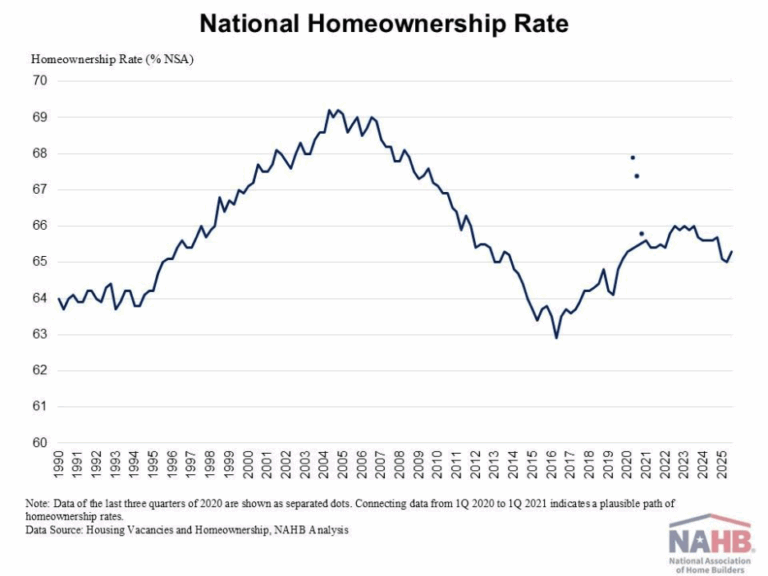
The homeownership rate declined to 65.1% in the first quarter of 2024, the lowest level since the first quarter of 2020, according to the Census’s Housing Vacancy Survey (HVS). Amid elevated mortgage interest rates and tight housing supply, housing affordability is at a multidecade low. Compared to the peak of 69.2% in 2004, the homeownership rate is 4.1 percentage points lower and remains below the 25-year average rate of 66.3%.

Homeownership rates declined across nearly all age groups over the past year, except those aged 65 and older. Among younger households, the homeownership rate for those under 35 rose slightly to 36.6% in the first quarter of 2024. However, it is still hovering at the lowest rate in the last 6 years. This age group, particularly sensitive to mortgage rates and the inventory of entry-level homes, saw the largest decline among all age categories (1.1 percentage points down). Similar declines were seen among the 35-44 group and 55-64 age group, with rates decreasing from 61.4% to 60.3% and from 76.3% to 75.2%, respectively. Homeownership rates for householders aged 45-54 dipped slightly from 70.8% to 70.6%. In contrast, those 65 years and over experienced a modest increase from 78.7% to 79%.

The national rental vacancy rate increased to 7.1% for the first quarter of 2025, returning to the pre-pandemic levels after several years of tight rental market. Meanwhile, the homeowner vacancy rate stayed at 1.1%, remaining near the survey’s 67-year low of 0.7%.

The housing stock-based HVS revealed that the count of total households increased to 132.2 million in the first quarter of 2025 from 131.0 million a year ago. The gains are due to gains in both renter household formation (1.2 million increase), and owner-occupied households (106,000 increase).

Discover more from Eye On Housing

Subscribe to get the latest posts sent to your email.


This article was originally published by a eyeonhousing.org . Read the Original article here. .


Total outstanding U.S. consumer credit stood at $5.15 trillion for the fourth quarter of 2024, increasing at an annualized rate of 4.22% (seasonally adjusted), according to the Federal Reserve’s G.19 Consumer Credit Report. This is an uptick from the third quarter of 2024’s rate of 2.47%. 

The G.19 report excludes mortgage loans, so the data primarily reflects consumer credit in the form of student loans, auto loans, and credit card plans. As consumer spending has outpaced personal income, savings rates have been declining, and consumer credit has increased. Previously, consumer credit growth had slowed, as high inflation and rising interest rates led people to reduce their borrowing. However, in the last two quarters, growth rates have increased, reflecting the rate cuts that took place at the end of the third quarter.  

Nonrevolving Credit  

Nonrevolving credit, largely driven by student and auto loans, reached $3.76 trillion (SA) in the fourth quarter of 2024, marking a 3.11% increase at a seasonally adjusted annual rate (SAAR). This is an uptick from last quarter’s rate of 2.28%, and the highest in two years.  

Student loan debt balances stood at $1.78 trillion (NSA) for the fourth quarter of 2024. Year-over-year, student loan debt rose 2.77%, the largest yearly increase since the second quarter of 2021. This shift partially reflects the expiration of the COVID-19 Emergency Relief for student loans’ 0-interest payment pause that ended September 1, 2023. 

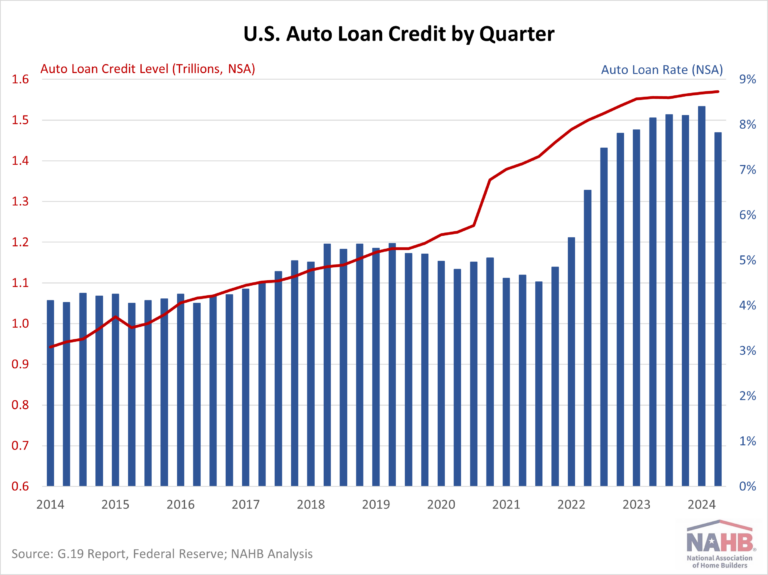
Auto loans reached a total of $1.57 trillion, showing a year-over-year increase of only 0.93%. This marks the second slowest growth rate since 2010, slightly above last quarter’s rate of 0.91%. The deceleration in growth can be attributed to several factors, including stricter lending standards, elevated interest rates, and overall inflation. Although interest rates for 5-year new car loans fell to 7.82% in the fourth quarter from a high of 8.40% in the third quarter, they remain at their highest levels in over a decade. 

Revolving Credit 

Revolving credit, primarily credit card debt, reached $1.38 trillion (SA) in the fourth quarter, rising at an annualized rate of 7.34%. This marked a significant increase from the third quarter’s 3.01% rate but was notably down from the peak growth rate of 17.58% seen in the first quarter of 2022. The surge in credit card balances in early 2022 was accompanied by an increase in the credit card rate which climbed by 4.51 percentage points over 2022. This was an exceptionally steep increase, as no other year in the past two decades had seen a rate jump of more than two percentage points.  

Comparatively, so far in 2024 the credit card rate decreased 0.12 percentage points. For the fourth quarter of 2024, the average credit card rate held by commercial banks (NSA) was 21.47%. 

Discover more from Eye On Housing

Subscribe to get the latest posts sent to your email.


This article was originally published by a eyeonhousing.org . Read the Original article here. .


The homeownership rate for those under the age of 35 dropped to 36.3% in the last quarter of 2024, reaching the lowest level since the third quarter of 2019, according to the Census’s Housing Vacancy Survey (HVS). Amidst elevated mortgage interest rates and tight housing supply, housing affordability is at a multidecade low. The youngest age group, who are particularly sensitive to mortgage rates, home prices, and the inventory of entry-level homes, saw the largest decline among all age categories.

The U.S. homeownership rate inch up to 65.7% in the last quarter of 2024, hovering at the lowest rate in the last two years. The homeownership rate remains below the 25-year average rate of 66.4%.

The national rental vacancy rate stayed at 6.9% for the last quarter of 2024, and the homeowner vacancy rate inched up to 1.1%. The homeowner vacancy rate remains close to the survey’s 67-year low of 0.7%.

Homeownership rates declined for under 35 and 35-44 age groups compared to a year ago. Householders under 35 experienced the largest drop, declining by 1.8 percentage points from 38.1% to 36.3%. The 35-44 age group also saw a 0.6 percentage point decrease, decreasing from 62% to 61.4%. Conversely, homeownership rates for householders aged 45-54 increased from 70.3% to 71%. Among those aged 55-64, homeownership inched up slightly from 76% to 76.3%. Those 65 years and over experienced a modest increase from 79% to 79.5%.

The housing stock-based HVS revealed that the count of total households increased to 132.4 million in the last quarter of 2024 from 131.1 million a year ago. The gains are due to gains in both renter household formation (509,000 increase), and owner-occupied households (783,000 increase).

Discover more from Eye On Housing

Subscribe to get the latest posts sent to your email.


This article was originally published by a eyeonhousing.org . Read the Original article here. .


A key indicator of the labor market is the labor force participation rate. This rate is the percentage of working-age adults in a population who are working or looking for work. The rate is a critical measure connected to both housing demand and housing supply (via the construction labor force).

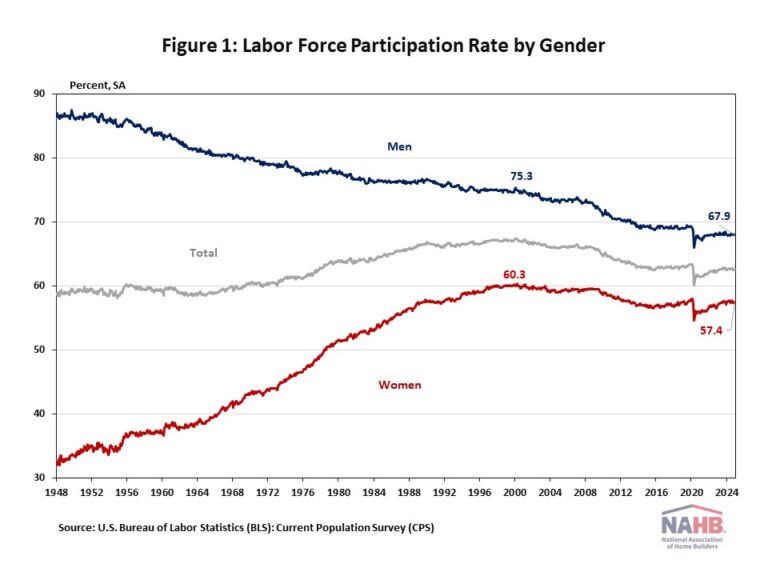
According to the Employment Situation Summary reported by the Bureau of Labor Statistics (BLS), the labor force participation rate remained at 62.5% for the third month in December 2024. After the labor force participation rate reached 67.3% at the beginning of 2000, it has been trending lower. When COVID-19 hit the labor market, the labor force participation rate dropped dramatically from 63.3% in February 2020 to 60.1% in April 2020. The latest labor force participation rate remains below its pre-pandemic levels of 63.3% at the beginning of 2020.

The participation rate is directly connected to the supply of labor. Labor supply varies across different demographic groups, such as age, gender, race, and educational attainment.

Gender

Over time, labor force participation changed dramatically by gender due to evolving societal norms around gender roles. Historically, women experienced a significant increase in labor force participation while men’s participation rates declined. However, over the past 20 years both genders’ labor force participation rates have moved in parallel and been trending downwards. Women’s labor force participation rate is 2.9 percentage points below the peak level in 2000 of 60.3%, while men’s labor force participation rate is 7.4 percentage points lower than the level in 2000 of 75.3%.

According to the latest data from the Current Population Survey (CPS), women currently make up roughly half of the U.S. labor force, representing about 47% of the labor force market. By industry, women accounted for more than half of all workers within several sectors in 2023, such as education and health services (74.4%), other services (53.3%), financial activities (51.1%), and leisure and hospitality (50.8%). Comparably, women were substantially underrepresented (relative to their share of total employment) in manufacturing (29.5%), agriculture (29.3%), transportation and utilities (24.3%), mining (15.3%), and construction (10.8%).

Men tend to have a higher labor force participation rate than women historically, even though this gap has narrowed from 54.7 percentage points in January 1948 to a difference of 10.5 percentage points in December 2024.

Age

The labor force participation rate differs across age groups as well. People ages 65 and older had the lowest labor force participation rate of 19.2%, followed by the youngest age group (16-19 years old) with a participation rate of 36.9%.

Among all age groups, workers aged 25-54, also known as prime-age workers, have the highest labor force participation rate of 83% in 2023. They form the core of the U.S. labor force, accounting for nearly two-thirds (63.8%) of the total labor force. Prime-age workers’ labor force participation rate has fully recovered from the COVID-19 pandemic, surpassing the prior peak of February 2020. The high labor force participation among prime-age men and the rapid increase in prime-age women’s labor force participation contributed to the increase in the labor force over time. By December 2024, prime-age women’s participation rate had hovered near its highest level of 78.1% on record, and 89.0% of prime-age men stayed in the labor force market.

Race and Ethnicity

Labor force participation varies among the largest race and ethnic groups living in the United States, and each group’s labor participation differs according to their gender as well.

Men had a higher labor force participation rate than women in each racial and ethnic group. Among men ages 16 years and over, Hispanic men were the most likely to be in the labor force, with a participation rate of 75.1%, followed by Asian men (76.8%), White men (68.2%), and Black men (65.6%). Among women ages 16 and over, Black women (61.0%) were most likely to participate in the labor force, followed by Hispanic women (58.7%), Asian women (58.1%), and White women (56.5%).

Educational Attainment

Higher levels of educational attainment are generally associated with higher labor force participation rates and lower unemployment rates. It is true for both men and women, and the four selected racial and ethnic groups that people with higher educational attainment tend to have greater employment opportunities and potentially later retirement ages.

With the same level of educational attainment, men are more likely to work than women. Among men with less than a high school diploma, the labor force participation rate was 59.4%, compared to a 34.3% participation rate for women with the same level of educational attainment. The gap of the labor force participation rate between men and women narrows as people achieve higher educational attainment. Women with the highest broad level of education (a bachelor’s degree or higher) have a 69.6% participation rate, a 7.3 percentage point difference from men with the same level of education (76.9%).

Discover more from Eye On Housing

Subscribe to get the latest posts sent to your email.


This article was originally published by a eyeonhousing.org . Read the Original article here. .


According to the U.S. Census Bureau’s latest estimates, the U.S. resident population grew by 3,304,757 to a total population of 340,110,988. The population grew at a rate of 0.98%, the highest rate since 0.99% in 2001. This also marked the third straight increase in the growth rate of the U.S. population. The vintage population estimates are released annually and represent the change in the U.S. population between July 1st of 2023 and 2024.

The Census Bureau reports that the primary source of population growth was net international migration (immigration), as international migration levels once again were higher than the previous year. The level of net international migration between 2023 and 2024 was 2,786,119. The second component of population growth is natural growth, which represents births minus deaths. Births totaled 3,605,563, down slightly from last year, while the number of deaths was reported at 3,086,925, also a decrease from last year. The natural growth, therefore, between 2023 and 2024 was 518,638.

Each region in the U.S. experienced population growth for the 2023-2024 period. The South led in population growth at 1.34% followed by the West at 0.85%. Meanwhile, the Midwest population grew 0.75%, while the Northeast grew the least at 0.59%.  

At the State level, 47 States and the District of Columbia had a population increase over the year. Of note, D.C. had the highest growth rate at 2.13%. Florida was second with population growth at 2.00% followed by Texas at 1.80%. Numerically, Texas experienced the largest population increase gaining 562,941. This was followed by Florida at 467,347 and California at 232,570.

Only three states lost population or remained level according to Census estimates. Vermont and West Virginia tied with a decline of 0.03%. Meanwhile Mississippi saw no population change.

California remained the most populous state by a healthy margin. California’s population was at 39,198,693, while the next most populous state was Texas at 31,290,831. To round out the top five States by total population the proceeding highest were Florida (23,372,215), New York (19,867,248), and Pennsylvania (13,078,751).

Discover more from Eye On Housing

Subscribe to get the latest posts sent to your email.


This article was originally published by a eyeonhousing.org . Read the Original article here. .


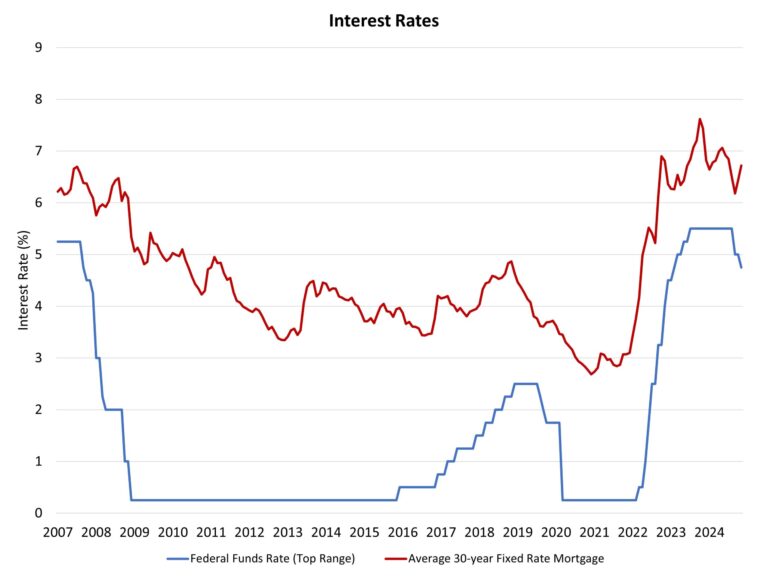
The Fed cut the short-term federal funds rate by an additional 25 basis points at the conclusion of its November meeting, reducing the top target rate to 4.75%. However, while the Fed noted it is making progress to its 2% inflation target, it did not provide post-election guidance on the pace and ultimate path for future interest rate cuts. The bond market is not waiting, with the 10-year Treasury rate rising from 3.6% in mid-September to close to 4.3% due to changing growth and government deficit expectations.

Today’s statement from the Fed noted:

“Recent indicators suggest that economic activity has continued to expand at a solid pace. Since earlier in the year, labor market conditions have generally eased, and the unemployment rate has moved up but remains low. Inflation has made progress toward the Committee’s 2 percent objective but remains somewhat elevated.

The Committee seeks to achieve maximum employment and inflation at the rate of 2 percent over the longer run. The Committee judges that the risks to achieving its employment and inflation goals are roughly in balance. The economic outlook is uncertain, and the Committee is attentive to the risks to both sides of its dual mandate.”

Inflation risks for 2025 are evolving. The policy risks for the central bank had recently been between inflation (decreasing risks) and concerns regarding the health of the labor market (risks rising). However, the 2024 election result changes this outlook somewhat. In particular, the election increases the probability of additional economic growth, a tighter labor market, larger government deficits, and higher tariffs. All of these factors can be inflationary, even if they yield other macroeconomic benefits.

Consequently, the Fed will need to recalibrate its economic and policy outlook given the large number of changes that markets have digested in just the past week alone. In particular, how far will the Fed ultimately cut into 2025 and perhaps 2026? A 3% terminal federal funds rate is unlikely. Some commentators have suggested a 4% rate would at least be a threshold of reevaluation. NAHB’s outlook is for a terminal rate of 3.25%, perhaps 3.5%. However, that decision, or destination, will be dependent on factors like tariff adoption.

Markets and analysts will receive additional information at the conclusion of the December Fed meeting, which will include an update of the central bank’s Summary of Economic Projections. Given the election discussion, is worth noting that the Fed does not try to anticipate changes to future fiscal policy. The Fed will study and model anticipated changes, but such impacts would not be formally incorporated into the Fed’s outlook until such proposals are, at the very least, fully detailed and analyzed. All market participants should be aware that rising government debt levels will push nominal long-term interest rates higher.

While the question of the future policy path matters for long-term interest rates, there is a direct benefit to current easing like today’s rate cut. For example, the November rate reduction will be felt for builder and land developer loan conditions. Interest rates for such loans should move lower by approximately 25 in the coming weeks.

A reduction for the cost of builder and developer loans is a bullish sign for housing affordability. The pace of overall inflation has remained elevated due to the growth of housing/construction costs and elevated measures of shelter inflation, which can only be tamed in the long-run by increases in housing supply. Fed Chair Powell has previously noted it will take some time for rent cost growth to slow. Given recent tight financing conditions, however, the Fed noted that while consumer spending is resilient, “…activity in the housing sector has been weak.”

All things considered, with inflation having moved lower (the September core PCE measure of inflation is at 2.7%, down from 3.7% a year ago), there is clearly policy room for future rate reductions as the Fed normalizes monetary policy. A further cut to the federal funds rate in December, to a 4.5% top rate, seems likely. After that, given expected changes for fiscal policy and fiscal policy impacts, the Fed is likely to slow its pace of rate cuts, perhaps moving to one 25 basis point cut per quarter in 2025 to the ultimate terminal rate. As noted earlier, the level of this terminal rate is likely to be reevaluated in the coming months.

Discover more from Eye On Housing

Subscribe to get the latest posts sent to your email.


This article was originally published by a eyeonhousing.org . Read the Original article here. .


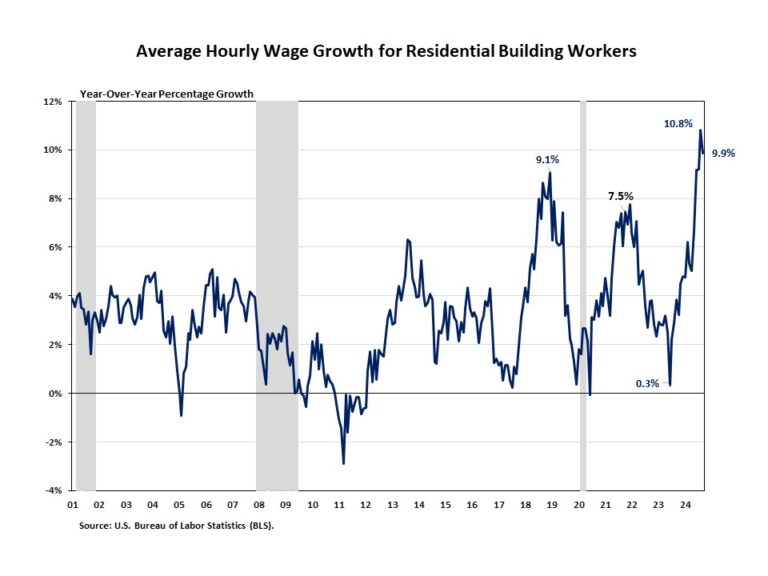
Wages for residential building workers grew at a fast pace of 9.9% in September, following a 10.8% gain in August. These year-over-year growth rates in the past four months were unprecedented in the history of the data series since 1990. After a 0.3% increase in June 2023, the YOY growth rate for residential building worker wages has been trending higher over the past year.

The ongoing skilled labor shortage in the construction labor market and lingering inflation impacts account for the recent acceleration in wage growth. However, the demand for construction labor remained weaker than a year ago. As mentioned in the latest JOLTS blog, the number of open construction sector jobs fell from a revised 328,000 in August to a softer 288,000 in September. Nonetheless, the ongoing skilled labor shortage continues to challenge the construction sector.

According to the Bureau of Labor Statistics report, average hourly earnings for residential building workers was $33.51 per hour in September 2024, increasing 9.9% from $30.5 per hour a year ago. This was 19.2% higher than the manufacturing’s average hourly earnings of $28.12 per hour, 14.7% higher than transportation and warehousing ($29.21 per hour), and 8.1% lower than mining and logging ($36.46 per hour).

Discover more from Eye On Housing

Subscribe to get the latest posts sent to your email.


This article was originally published by a eyeonhousing.org . Read the Original article here. .

Pin It