Tag

Prices

Browsing


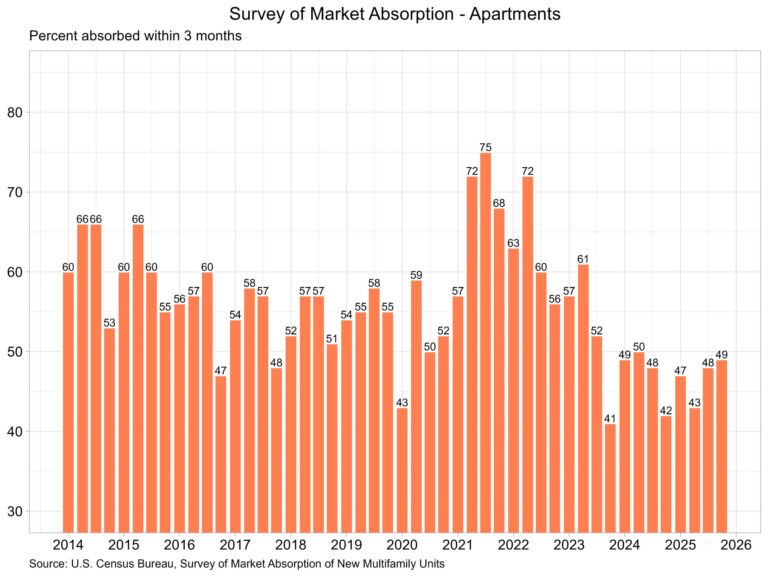
The percentage of new apartment units that were absorbed within three months after completion was up one percentage point in the fourth quarter, according to the Census Bureau’s latest release of the Survey of Market Absorption of New Multifamily Units (SOMA). The survey covers new units in multifamily residential buildings with five or more units. The number of new multifamily units completed was 77,380 in the fourth quarter, the lowest quarterly completions since the second quarter of 2022 (76,630).

Apartments

The percentage of apartments absorbed within three months after completion was 49% for those completed in the fourth quarter of 2025. This was the sixth consecutive quarter for which new apartments were absorbed at a rate below 50%. The median asking rent for apartments completed in the fourth quarter was $2,034, up 4.5% from $1,946 last year. This also marks the first quarter where the median asking rent topped $2,000.

Along with the three-month absorption rate and completions, SOMA also reports absorption rates at six, nine, and twelve months after completion. For apartments completed six months ago (97,210 units), 68% have been absorbed into the market. For apartments completed (93,140 units) nine months ago, 80% have been absorbed. For those completed twelve months ago (92,760 units), 90% have been absorbed into the multifamily market.

Condominiums and Cooperative Units

The three-month absorption rate for new condominiums and cooperative units rose to 70%. Total completions of new condominiums and cooperative units, according to SOMA, was 4,831 in the fourth quarter of 2025.


This article was originally published by a eyeonhousing.org . Read the Original article here. .


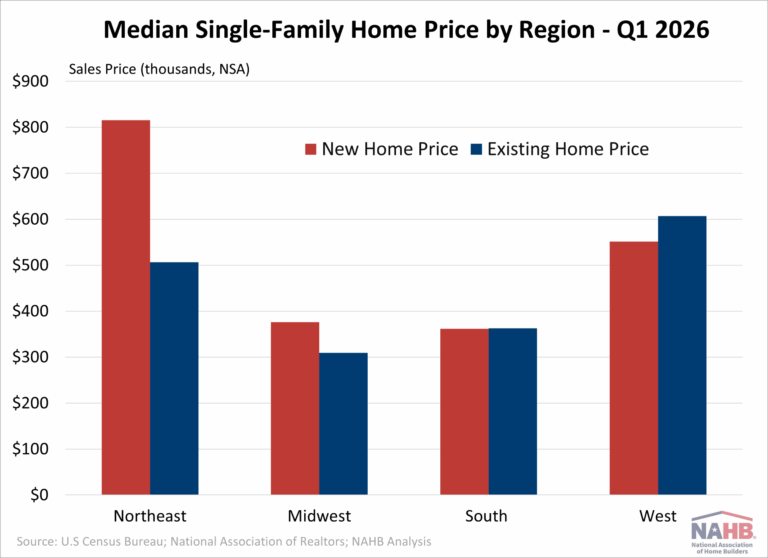
In the first quarter of 2026, the median price for a new single-family home was $403,200, which was $1,400 lower than the median price of an existing home, which stood at $404,600. This marks the fourth consecutive quarter for which existing home prices have exceeded new homes prices, according to U.S. Census Bureau and National Association of Realtors data (not seasonally adjusted – NSA)

Typically, new homes carry a price premium over existing homes. However, beginning in the second quarter of 2024, this relationship reversed, with existing home prices exceeding new home prices in six of the past eight quarters.

Both new and existing homes saw dramatic increases in prices post-pandemic due to higher construction costs and limited supply. While overall home prices remain elevated compared to historical norms, new homes prices have moderated due to tactical builder business decisions, whereas existing homes prices continue to increase because of lean supply and in some markets a lack of price discovery for existing homeowners.

The median price for a new single-family home sold in the first quarter of 2026 decreased by 4.7% from the previous year. New home price annual growth has been trending downwards since the second quarter of 2023.

Although existing home prices have continued to experience year-over-year increases for past 11 quarters, annual growth has slowed from a high of 4.9% two years ago to just 0.6% in the first quarter of 2026.

There are several factors as to why new and existing homes are selling at similar price points. Tight inventory continues to push up prices for existing homes, as many homeowners who secured low mortgage rates during the pandemic are hesitant to sell due to current high interest rates.

Meanwhile, new home pricing is more volatile – prices change due to the types and locations of homes being built. Despite various challenges facing the industry, home builders are adapting to affordability challenges by building on smaller lots, constructing smaller homes, and offering incentives. Additionally, there has been a shift in home building toward the South, associated with less expensive homes because of policy effects. This has occurred in an environment in which construction costs continue to rise, which is the fundamental driver of home prices.

The least expensive region for new homes in the fourth quarter was the South, with a median price of $361,800. The Midwest followed closely behind at $375,900. For existing homes, the Midwest was the most affordable region at $309,100, followed by the South at $362,500.

New homes were most expensive in the Northeast with a median price of $815,600, while the West sold at $551,500. For existing homes, the West led as the most expensive region at $607,000, followed by Northeast at $506,400.

The new home price premium was most pronounced in the Northeast, where new homes sold for $309,200 more than existing homes. Additionally, in the Midwest homes new homes sold for $66,800 more than existing homes. The West and South followed the national trend, with existing homes priced $55,500 more than new homes in the West and $700 more in the South.


This article was originally published by a eyeonhousing.org . Read the Original article here. .


Prices rose across a host of goods and services used in residential construction. Rising energy prices were the primary driver, but transportation service prices also rose at their fastest pace since 2022. Meanwhile, building material prices, excluding energy, rose at their highest yearly rate in three years, up 3.7% from a year ago.

The Producer Price Index for final demand increased 1.4% in April, after rising 0.7% in March. Compared to a year ago, final demand prices were up 6.0%. The index for final demand services rose 1.2% in April, while the index for final demand goods rose 2.0% over the month.

The price index for inputs to new residential construction rose 1.3% in April and was up 5.9% from last year. The price of goods used in new residential construction was up 1.2% over the month and up 6.1% from last year, while the price of services was up 1.3% over the month and up 3.7% from last year.

Input Goods

The goods component has a larger importance to the inputs to residential construction price index, representing around 60% of the total. On a monthly basis, the price of input goods to new residential construction was up 1.2% in April.

The input goods to residential construction index can be further broken down into two separate components, one measuring energy inputs with the other measuring remaining goods. The latter of these two components simply represents building materials used in residential construction, which makes up around 93% of the goods index.

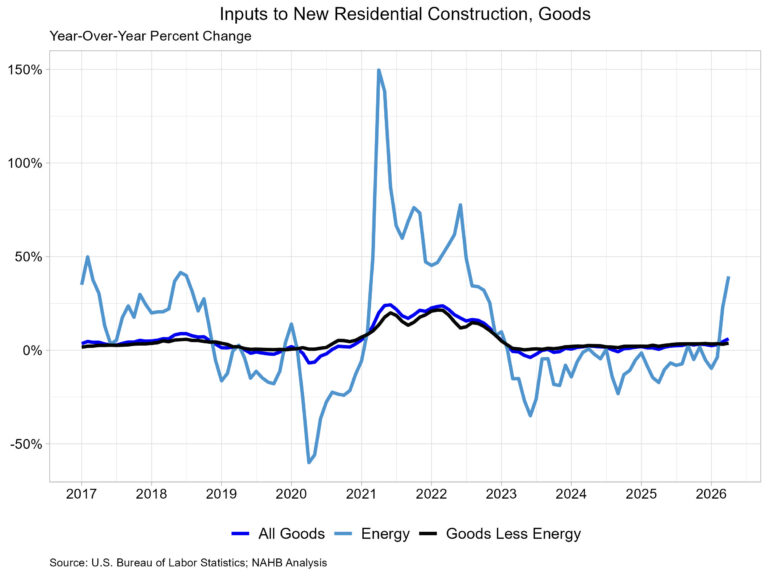
Energy input prices rose 13.8% in April and were 39.4% higher than a year ago. Building material prices were up 0.1% in April and up 3.7% compared to one year ago. Building material prices have continued to grow above 3.0% since July of last year.

Among input goods, the largest year-over-year increase was for No. 2 diesel fuel as prices were 74.4% higher than a year ago. Asphalt prices rose 18.0% higher than April 2025 after declining in March. Softwood lumber prices were up 1.1% in April after declining on a yearly basis for several months. Fewer materials showed yearly price declines than in March. Particleboard and fiberboard prices were down 12.0%, while softwood veneer/plywood prices were down 1.7%.

Input Services

Prices for service inputs to residential construction reported an increase of 1.3% in April. On a year-over-year basis, service input prices were up 5.6%. The price index for service inputs to residential construction can be broken out into three separate components: a trade services component, a transportation and warehousing services component, and a services excluding trade, transportation, and warehousing component (other services).

The most significant component is trade services (around 60%), followed by other services (around 29%), and finally transportation and warehousing services (around 11%). The largest component, trade services, was up 5.6% from a year ago. The price of transportation and warehousing services rose 15.3%, while prices for other services were up 1.6% over the year. Long-distance motor carrying service prices rose 10.4% in April and were 18.3% higher than a year ago, while local motor carrying service prices rose 1.4% in April and were 6.3% higher than a year ago. These are the two transportation services that are represented as inputs in the residential construction price index.


This article was originally published by a eyeonhousing.org . Read the Original article here. .


Energy input prices increased in March at their fastest pace since June of 2020 as the conflict in Iran shocked critical global supply chains. Building material prices, excluding energy, rose for the eleventh straight month. Price growth for trade services slowed while transportation and warehousing price growth accelerated.  

The Producer Price Index for final demand increased 0.5% in March, after rising 0.5% in February. The index for final demand services was unchanged in March, while the index for final demand goods rose 1.6% over the month.

The price index for inputs to new residential construction rose 1.2% in March and was up 3.8% from last year. The price of goods used in new residential construction was up 1.8% over the month and up 4.3% from last year, while the price of services was up 0.3% over the month and up 3.1% from last year.

Input Goods

The goods component has a larger importance to the inputs to residential construction price index, representing around 60% of the total. On a monthly basis, the price of input goods to new residential construction was up 1.8% in March.

The input goods to residential construction index can be further broken down into two separate components, one measuring energy inputs with the other measuring remaining goods. The latter of these two components simply represents building materials used in residential construction, which makes up around 93% of the goods index.

Energy input prices rose 21.4% in March and were 20.8% higher than one year ago. The monthly increase in March was the largest since prices rose 30.6% in June 2020. Building material prices were up 0.4% in March and up 3.1% compared to one year ago.

Among input goods, the largest year-over-year increase was for No. 2 diesel fuel as prices were 51.2% higher than a year ago. Metal molding and trim continued to show high price increases, as there were up 45.5% from last year. On the opposite end, the largest yearly declines in prices were for particleboard and fiberboard with prices down 15.7%. Notably, asphalt reported a price decline of 12.3% in March. For key inputs, ready-mix concrete prices were 0.5% higher than a year ago while softwood lumber prices were 7.8% lower than a year ago.

Input Services

Prices for service inputs to residential construction reported an increase of 0.3% in March. On a year-over-year basis, service input prices were up 3.1%. The price index for service inputs to residential construction can be broken out into three separate components: a trade services component, a transportation and warehousing services component, and a services excluding trade, transportation, and warehousing component (other services).

The most significant component is trade services (around 60%), followed by other services (around 29%), and finally transportation and warehousing services (around 11%). The largest component, trade services, was up 3.3% from a year ago. The price of transportation and warehousing services rose 6.2%, while prices for other services were up 1.5% over the year.

Expanded Inputs to New Construction Data

Within the PPI that BLS publishes, new experimental data was recently published regarding inputs to new construction. The data expands existing inputs to industry indexes by incorporating import prices with prices for domestically produced goods and services. With this additional data, users can track how industry input costs are changing among domestically produced products and imported products. This data focuses on new construction, but the complete dataset includes indices across numerous industries that can be found here on BLS website.

New construction input prices are primarily influenced by domestically produced goods and services, with domestic products accounting for 90% of the weight of the industry index for new construction. Imported goods make up the remaining 10% of the index.

The latest available data, for January 2026, showed that domestically produced goods continue to show price growth compared to imported goods used in new construction. On a year-over-year basis, the index for domestic goods increased 2.6%, while prices for imported goods have fallen 2.7%.


This article was originally published by a eyeonhousing.org . Read the Original article here. .


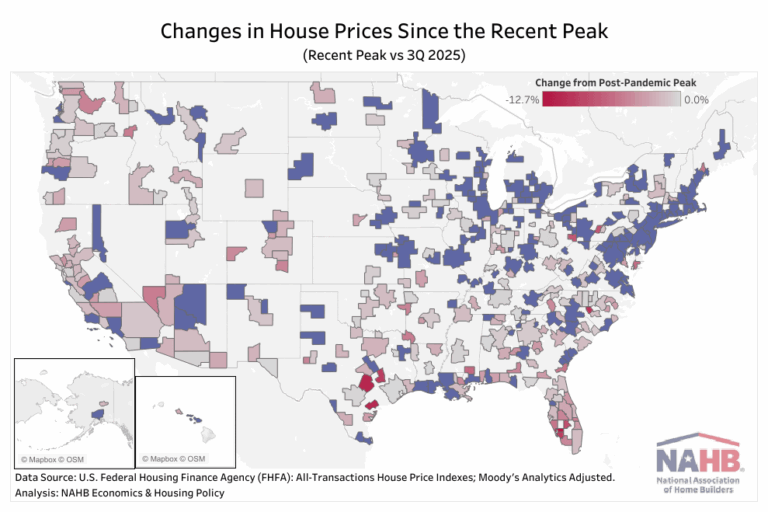
Nationally, house prices continued to rise at a modest pace in the third quarter of 2025, as mentioned in our previous quarterly house prices post. However, this national trend masks significant variation across local markets. While many metro areas continued to see house price appreciation, others experienced notable declines following several years of rapid growth.

Since the onset of the COVID-19 pandemic, house prices have surged nationwide. Between the first quarter of 2020 and the third quarter of 2025, national house prices climbed 54.9%. Local markets saw broad gains as well, with cumulative appreciation ranging from 18.3% to 88.4%, and 159 metro areas reached their highest recorded house prices in the third quarter of 2025.

Yet despite these increases, more than half of metro areas have now experienced at least some decline from their recent price peak. These declines range from a slight 0.1% dip to a more substantial 12.7% decline, with most of the downward trends beginning in last 2024 or early 2025.

House price declines have been most widespread in the West and South, regions that saw some of the fastest appreciation during the pandemic boom.  Several markets stand out for their significant corrections:

Punta Gorda, FL has experienced the sharpest decline, with prices falling 12.7% since its peak in the fourth quarter of 2022.

Austin–Round Rock–San Marcos, TX, one of the nation’s hottest markets during the pandemic, has seen prices drop 11.3% since reaching a peak in the second quarter of 2022.

Victoria, TX reached its peak more recently in the fourth quarter of 2024 and has since seen prices decline 11.0% over the past three quarters.

In contrast, many metro areas in the Midwest and Northeast have avoided significant price declines. These regions continue to see slower but steady price growth, supported by persistent inventory shortages and solid demand. Their more moderate appreciation during the pandemic has also helped limit the risk of sharp price corrections. Here are some examples (listed in no particular order):

York–Hanover, PA recorded a 6.0% year-over-year increase in house prices in the third quarter of 2025, reflecting stable demand and limited housing supply.

Worcester, MA continues to experience price growth, slowing from the rapid 18.0% growth in the third quarter of 2021 to a still-solid 4.4% year-over-year gain in the third quarter of 2025.

Wausau, WI experienced a robust 9.5% year-over-year increase in home prices, standing out as one of the strongest and most resilient housing markets in the region.

Milwaukee-Waukesha, WI continue to see rising house prices, with growth easing from a peak of 16.7% growth in the second quarter of 2022 to a more sustainable 5.6% year-over-year increase in the third quarter of 2025.


This article was originally published by a eyeonhousing.org . Read the Original article here. .


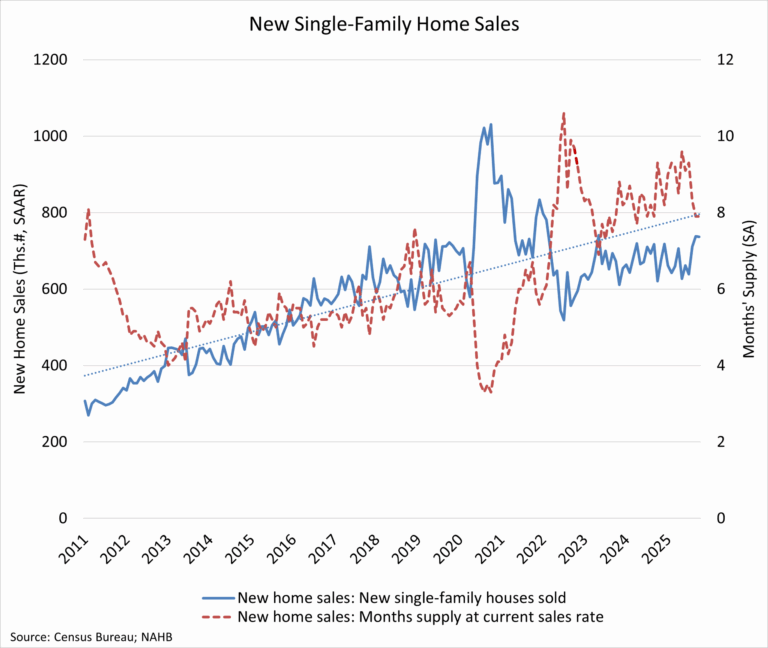
The new home sector has played an increasingly important role in meeting housing demand as resale inventory remains constrained in many regions. The latest data released today (and delayed because of the government shutdown in fall of 2025) indicate that new single-family home sales continue to reflect a stabilizing market after a period of heightened volatility. While month-to-month activity shows some variability, sales remain stronger than a year ago, signaling that buyer interest in newly built homes has improved.

Sales of newly built single-family homes increased 18.7 percent year over year in October to a seasonally adjusted annual rate of 737,000 units, according to the U.S. Department of Housing and Urban Development and the U.S. Census Bureau. This represented a modest 0.1 percent decline from September and a 1.2 percent decrease on a year-to-date basis. A new home sale is recorded when a contract is signed or a deposit is accepted, regardless of the stage of construction. The seasonally adjusted annual rate reflects the pace of sales that would occur over a 12-month period if current conditions persisted.

New single-family home inventory totaled 488,000 units in October, unchanged from the prior month and 1.7 percent higher than a year earlier. At the current sales pace, the months’ supply of new homes stood at 7.9, down from 9.3 months one year ago, though still above the six-month level that is generally considered balanced.

Combined new and existing home inventory has edged lower in recent months, with total months’ supply declining to 4.9, reflecting slower construction activity. Meanwhile, inventory conditions in the existing home market have shown gradual improvement, and moderating prices across both markets have helped support buyer demand amid ongoing affordability concerns.

By the end of October 2025, there were 124,000 completed, ready-to-occupy homes available for sale on a not seasonally adjusted basis, up 10.7 percent from a year earlier. Completed homes accounted for roughly one-quarter of total inventory, while homes under construction made up 51 percent. The remaining 24 percent of homes sold in October had not yet started construction at the time the sales contract was signed.

Home prices showed further signs of easing in October. The median new home sale price declined 3.3 percent to $392,300, marking an 8.0 percent decrease from a year ago. Affordability improved at the lower end of the market, with 25 percent of new homes priced below $300,000, the highest share in recent months. Thirty percent of homes were priced above $500,000, while the remaining 45 percent fell within the $300,000 to $500,000 range.

Regionally, year-to-date new home sales declined in three of the four regions, falling 0.1 percent in the Midwest, 7.2 percent in the West, and 22.9 percent in the Northeast. The South was the only region to post growth, with sales up 2.9 percent.


This article was originally published by a eyeonhousing.org . Read the Original article here. .


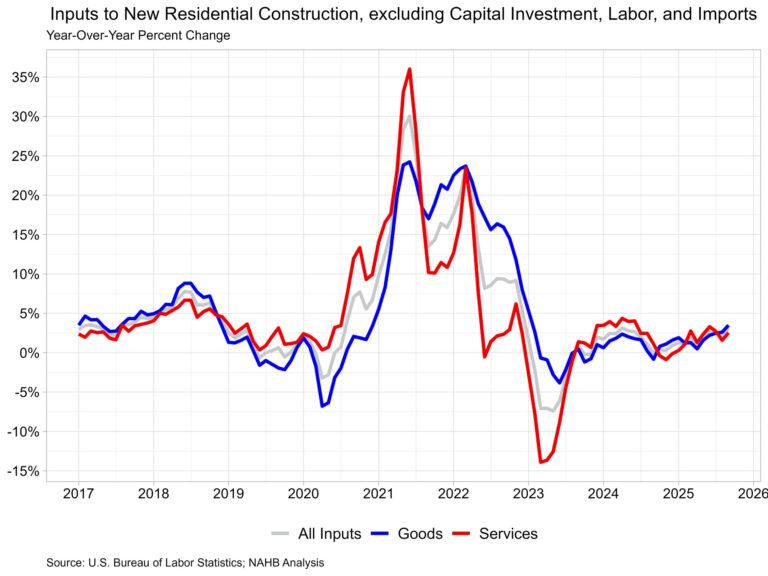
Aggregate residential building material prices rose at their fastest pace since January 2023 in the latest Producer Price Index release from the Bureau of Labor Statistics. Input energy prices increased for the first time in over a year, while service price growth remained lower than goods.

The Producer Price Index for final demand increased 0.3% in September, after falling 0.1% in August. The index for final demand goods increased 0.9% in September, the largest monthly increase since February 2024. Final demand energy prices were responsible for most of the goods index increase, as they rose 3.5% in September. This index for final demand for services was unchanged in September.

The price index for inputs to new residential construction rose 0.2% in September and was up 3.1% from last year. The price of goods inputs was up 0.1% over the month and 3.5% from last year, while prices for services were up 0.3% over the month and 2.5% from last year.

Input Goods

The goods component has a larger importance to the inputs to residential construction price index, representing around 60%. On a monthly basis, the price of input goods to new residential construction was up 0.1% in September.

The input goods to residential construction index can be further broken down into two separate components, one measuring energy inputs with the other measuring remaining goods. The latter of these two components simply represents building materials used in residential construction, which makes up around 93% of the goods index.

Energy input prices rose 1.0% in September and were 3.0% higher than one year ago. Building material prices were up 0.1% in September and up 3.5% compared to one year ago. The 3.5% year-over-year increase is the largest increase since the 4.9% experienced back in January 2023. Residential building material price inflation slowly accelerated over the year, after starting around 2.0%.

The largest year-over-year price changes continue to be parts for construction machinery and equipment, sold separately, up 41.3% compared to September of last year. Metal molding and trim prices are up 31.0% from last year. Ready-mix concrete, a key input to new residential construction, has shown little price growth in 2025, up only 0.4% from last year. Additionally, softwood lumber prices were down 2.3% in September from last year. Lumber prices have experienced declines over the past few months despite higher tariffs now in place. Ongoing weaknesses during 2025 in new residential construction have led to an acute oversupply of lumber on the market, with demand below expectations.

Input Services

Prices for service inputs to residential construction reported an increase of 0.3% in September. On a year-over-year basis, service input prices were up 2.5%. The price index for service inputs to residential construction can be broken out into three separate components: a trade services component, a transportation and warehousing services component, and a services excluding trade, transportation and warehousing component (other services).

 The most significant component is trade services (around 60%), followed by other services (around 29%), and finally transportation and warehousing services (around 11%). The largest component, trade services, was up 3.1% from a year ago. The other services component was up 1.3% over the year.  Lastly, prices for transportation and warehousing services rose 2.6% compared to August of last year.


This article was originally published by a eyeonhousing.org . Read the Original article here. .


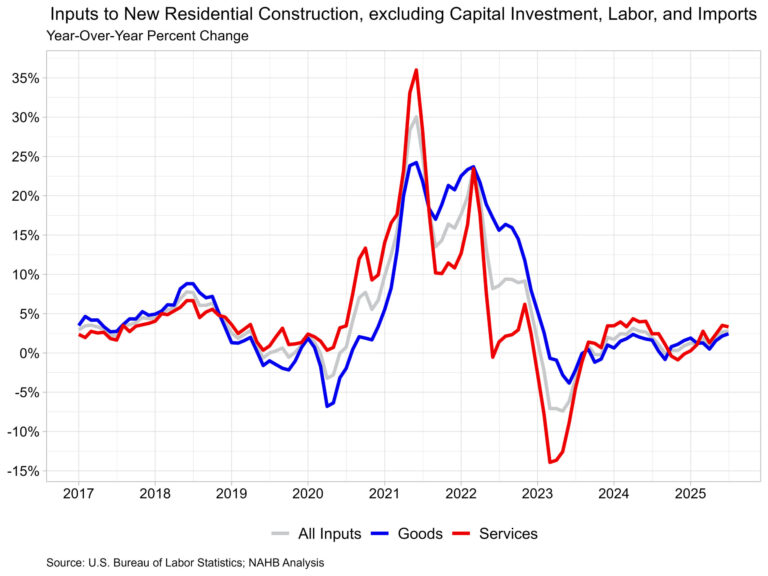
Prices for residential building materials rose again in July, marking the largest year-over-year increase in over two years. The underlying price growth trend remained the same, with service prices continuing to grow at a faster pace than goods prices. Similar to last month, parts for construction machinery and metal molding/trim experienced significant price growth, as both increased over 25% compared to last year.

Prices for inputs to new residential construction—excluding capital investment, labor, and imports—rose 0.2% in July, following a 0.8% increase in June. These figures are taken from the most recent Producer Price Index (PPI) report published by U.S. Bureau of Labor Statistics. The PPI measures prices that domestic producers receive for their goods and services; this differs from the Consumer Price Index which measures what consumers pay and includes both domestic products as well as imports.

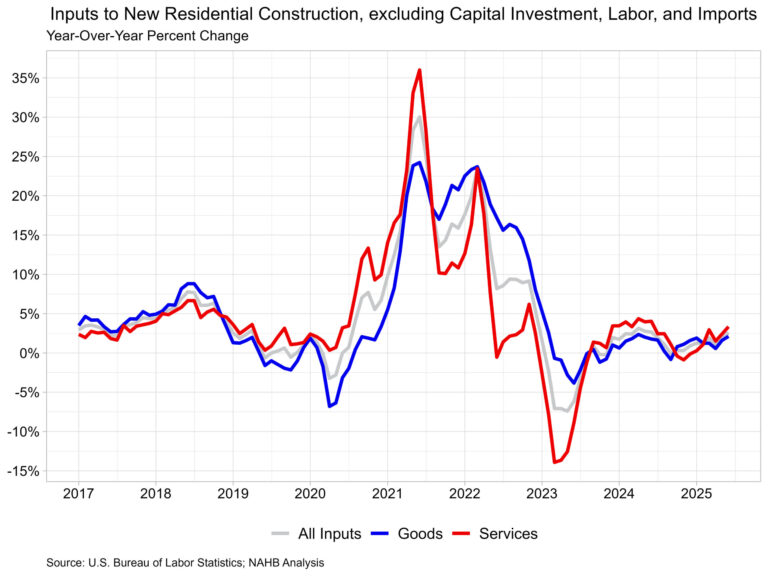
The inputs to the new residential construction price index grew 2.8% from July of last year. The index can be broken into two components­—the goods component increased 2.4% over the year, while services increased 3.3%. For comparison, the total final demand index, which measures all goods and services across the economy, increased 3.3% over the year, with final demand with respect to goods up 1.9% and final demand for services up 4.0%.

Input Goods

The goods component has a larger importance to the total residential construction inputs price index, representing around 60%. On a monthly basis, the price of input goods to new residential construction was up 0.4% in July.

The input goods to residential construction index can be further broken down into two separate components, one measuring energy inputs with the other measuring remaining goods. The latter of these two components simply represents building materials used in residential construction, which makes up around 93% of the goods index.

Energy input prices jumped up 3.9% between June and July but were 8.1% lower than one year ago. Building material prices were up 0.2% between June and July and up 3.3% compared to one year ago.

Tariffs on building materials do not directly show up in the PPI data because the PPI measures prices for domestically produced goods and services. In fact, tariffs and taxes are explicitly excluded from the PPI. Despite this, price changes in reaction to tariffs are included in the PPI, meaning price increases to pass on increased costs of materials will show up in this pricing data.  Announced tariffs in recent months have resulted in material increases across a few different goods, specifically certain metal products and equipment.

In July, the largest year-over-year input price increase was for construction machinery and equipment parts, reporting a 31.4% increase over the year. Meanwhile, metal molding and trim prices were up 25.6%, fabricated steel plate prices were up 14.3%, and nonferrous wire/cable up 10.5%. Metal commodities have been the primary targets of tariffs, with 50% tariffs in effect on steel and aluminum products and a 50% tariff on semifinished products of copper.

Input Services

Prices for service inputs to residential construction reported a decrease of 0.2% in July. On a year-over-year basis, service input prices are up 3.3%. The price index for service inputs to residential construction can be broken out into three separate components: a trade services component, a transportation and warehousing services component, and a services excluding trade, transportation and warehousing component (other services).

 The most significant component is trade services (around 60%), followed by other services (around 29%), and finally transportation and warehousing services (around 11%). The largest component, trade services, was up 5.2% from a year ago. The other services component was up 1.2% over the year.  Lastly, prices for transportation and warehousing services fell 0.6% compared to July of last year.

Inputs to New Construction Satellite Data

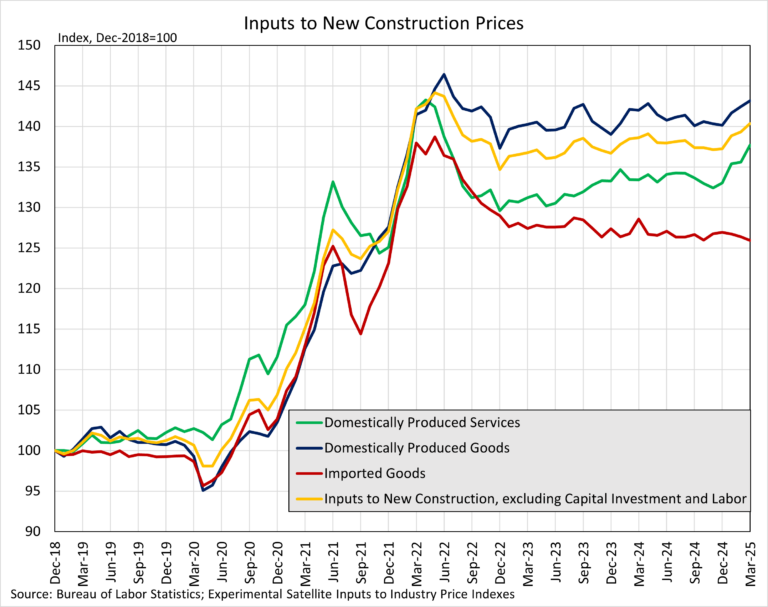
Within the PPI that BLS publishes, new experimental data was recently published regarding inputs to new construction. The data expands existing inputs to industry indexes by incorporating import prices with prices for domestically produced goods and services. With this additional data, users can track how industry input costs are changing among domestically produced products and imported products. This data focuses on new construction, but the complete dataset includes indices across numerous industries that can be found here on the BLS website.

New construction input prices are primarily influenced by domestically produced goods and services, with domestic products accounting for 90% of the weight of the industry index for new construction. Imported goods make up the remaining 10% of the index.

The latest available data, for May 2025, showed that domestically produced goods have experienced faster price growth compared to imported goods used in new construction. On a year-over-year basis, the index for domestic goods increased 1.6%, while prices for imported goods rose 0.1% over the same period. Comparatively, service prices have risen more than good prices over the past year, rising 2.7% year-over-year. Across the three indexes, all inputs remain at higher levels compared to pre-pandemic prices.

Discover more from Eye On Housing

Subscribe to get the latest posts sent to your email.


This article was originally published by a eyeonhousing.org . Read the Original article here. .


Residential building material prices rose in June, driven primarily by higher construction machinery and equipment part prices. Metal commodities also experienced significant increases, following recently implemented tariffs on steel and aluminum.  Meanwhile, price growth for services used in construction continues to outpace both domestic and imported goods. 

Prices for inputs to new residential construction—excluding capital investment, labor, and imports—rose 0.7% in June, following a (revised) flat change in May. These figures are taken from the most recent Producer Price Index (PPI) report published by U.S. Bureau of Labor Statistics. The PPI measures prices that domestic producers receive for their goods and services; this differs from the Consumer Price Index which measures what consumers pay and includes both domestic products as well as imports.  

The inputs to the New Residential Construction Price Index grew 2.6% from June of last year. The index can be broken into two components—the goods component increased 2.1% over the year, while services increased 3.3%. For comparison, the total final demand index, which measures all goods and services across the economy, increased 2.3% over the year, with final demand with respect to goods up 1.7% and final demand for services up 2.7%. 

Input Goods

The goods component has a larger importance to the total residential construction inputs price index, representing around 60%. On a monthly basis, the price of input goods to new residential construction was up 0.2% in June.  

The input goods to residential construction index can be further broken down into two separate components, one measuring energy inputs with the other measuring remaining goods. The latter of these two components simply represents building materials used in residential construction, which makes up around 93% of the goods index.  

Energy input prices were up 0.9% between May and June but were 7.4% lower than one year ago. Building material prices were up 0.1% between May and June and up 2.9% compared to one year ago.  

Tariffs on building materials do not directly show up in the PPI data because the PPI measures prices for domestically produced goods and services. In fact, tariffs and taxes are explicitly excluded from the PPI. Despite this, price changes in reaction to tariffs are included in the PPI, meaning price increases to pass on increased costs of materials will show up in this pricing data. Announced tariffs in recent months have resulted in material increases across a few different goods, specifically certain metal products and equipment.

In June, the largest year-over-year price increase was for construction machinery and equipment parts, reporting a 24.2% increase over the year. Meanwhile, metal molding and trim prices were up 15.1%, fabricated steel plate prices were up 13.6%, ornamental and architectural metal work prices were up 9.0%, and fabricated structural metal prices were up 9.0% compared to last year. Metal commodities have been the primary targets of tariffs, with 50% tariffs in effect on steel and aluminum products and a potential 50% tariff on copper products coming this August.

Input Services

Prices for service inputs to residential construction reported an increase of 1.5% in June. On a year-over-year basis, service input prices are up 3.3%. The price index for service inputs to residential construction can be broken out into three separate components: a trade services component, a transportation and warehousing services component, and a services excluding trade, transportation and warehousing component (other services).

The most significant component is trade services (around 60%), followed by other services (around 29%), and finally transportation and warehousing services (around 11%). The largest component, trade services, was up 4.7% from a year ago. The other services component was up 1.1% over the year. Lastly, prices for transportation and warehousing services advanced 2.1% compared to June of last year.

Inputs to New Construction Satellite Data

Within the PPI that BLS publishes, new experimental data was recently published regarding inputs to new construction. The data expands existing inputs to industry indexes by incorporating import prices with prices for domestically produced goods and services. With this additional data, users can track how industry input costs are changing among domestically produced products and imported products. This data focuses on new construction, but the complete dataset includes indices across numerous industries that can be on the BLS website.

New construction input prices are primarily influenced by domestically produced goods and services, with domestic products accounting for 90% of the weight of the industry index for new construction. Imported goods make up the remaining 10% of the index.  

The latest available data, for April 2025, showed that domestically produced goods have experienced faster price growth compared to imported goods used in new construction. On a year-over-year basis, the index for domestic goods increased 0.4%, while prices for imported goods fell 0.1% over the same period. Comparatively, service prices have risen more than good prices over the past year, rising 3.1% year-over-year. Across the three indexes, all inputs remain at higher levels compared to pre-pandemic prices.  

Discover more from Eye On Housing

Subscribe to get the latest posts sent to your email.


This article was originally published by a eyeonhousing.org . Read the Original article here. .


Prices for inputs to new residential construction—excluding capital investment, labor, and imports—rose 0.2% in May, following a (revised) decrease of 0.2% in April. These figures are taken from the most recent Producer Price Index (PPI) report published by U.S. Bureau of Labor Statistics. The PPI measures prices that domestic producers receive for their goods and services; this differs from the Consumer Price Index which measures what consumers pay and includes both domestic products as well as imports.

The inputs to the New Residential Construction Price Index grew 1.9% from May of last year. The index can be broken into two components­—the goods component increased 1.6% over the year, with services increasing 2.3%. For comparison, the total final demand index, which measures all goods and services across the economy, increased 2.6% over the year, with final demand with respect to goods up 1.3% and final demand for services up 3.2% over the year.

Input Goods

The goods component has a larger importance to the total residential construction inputs price index, representing around 60%. For the month, the price of input goods to new residential construction was up 0.1% in May.

The input goods to residential construction index can be further broken down into two separate components, one measuring energy inputs with the other measuring remaining goods. The latter of these two components simply represents building materials used in residential construction, which makes up around 93% of the goods index.

Energy input prices were up 0.8% between April and May but were 9.8% lower than one year ago. Building material prices were up 0.1% between April and May while up 2.5% compared to one year ago. Across building material inputs, the commodity with the largest monthly increase in May was parts for construction machinery and equipment, which increased 6.8% after increasing 8.4% in April.

Input Services

Prices for service inputs to residential construction reported an increase of 0.3% in May. On a year-over-year basis, service input prices are up 2.3%. The price index for service inputs to residential construction can be broken out into three separate components: a trade services component, a transportation and warehousing services component, and a services excluding trade, transportation and warehousing component (other services). The most significant component is trade services (around 60%), followed by other services (around 29%), and finally transportation and warehousing services (around 11%). The largest component, trade services, was up 2.9% from a year ago. The other services component was up 1.4% over the year.  Lastly, prices for transportation and warehousing services advanced 1.8% compared to May of last year.

Inputs to New Construction Satellite Data

Within the PPI that BLS publishes, new experimental data was recently published regarding inputs to new construction. The data expands existing inputs to industry indexes by incorporating import prices with prices for domestically produced goods and services. With this additional data, users can track how industry input costs are changing among domestically produced products and imported products. This data focuses on new construction, but the complete dataset includes indices across numerous industries, found here.

New Construction input prices are primarily influenced by domestically produced goods and services, with domestic products accounting for 90% of the weight of the industry index for new construction. Imported goods make up the remaining 10% of the index. The latest available data, for March 2025, showed that domestically produced goods have experienced faster price growth compared to imported goods used in new construction. On a year-over-year basis, the index for domestic goods increased 0.8%, while prices for imported inputs fell 2.1% over the same period. Across all inputs to new construction, services prices have risen more than good inputs over the past year, as domestic services prices rose 2.2%. Across the three indexes, all inputs remain at higher levels compared to pre-pandemic prices.

Discover more from Eye On Housing

Subscribe to get the latest posts sent to your email.


This article was originally published by a eyeonhousing.org . Read the Original article here. .

Pin It