Tag

Price

Browsing


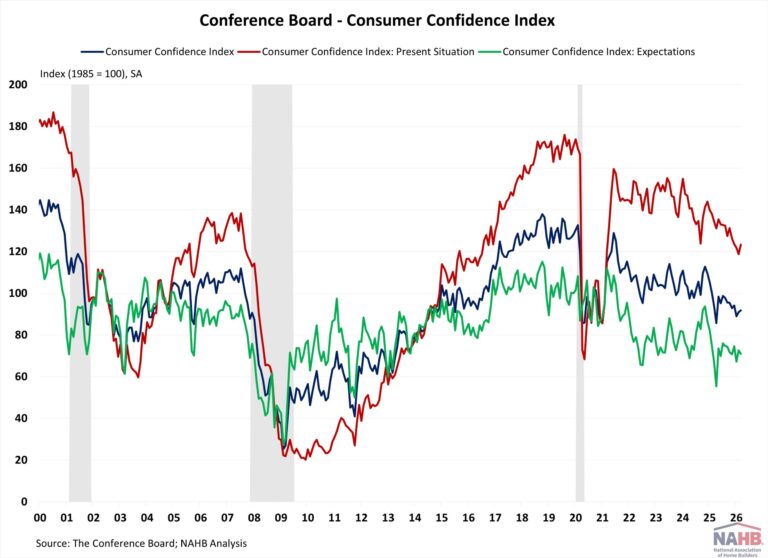
Consumer confidence in March rose to a three-month high as consumers’ improved view of current business and labor market conditions outweighed weaker future expectations. Despite the increase, consumers remained concerned as inflation expectations surged to a seven-month high due to the Iran war and job worries from economic uncertainty. The labor market differential, which measures the gap between consumers viewing jobs as plentiful and hard-to-get, remained narrow and reached its second lowest level since February 2021.This is consistent with recent job reports showing fewer job openings and slower hiring.

The Consumer Confidence Index, reported by the Conference Board, is a survey measuring how optimistic or pessimistic consumers feel about their financial situation. This index rose from 91.0 to 91.8 in March, the highest level this year. The Consumer Confidence Index consists of two components: how consumers feel about their present situation and their expected situation. In March, the Present Situation Index increased 4.6 points from 118.7 to 123.3, the largest monthly increase since November 2024; the Expectation Situation Index dropped 1.7 points from 72.6 to 70.9. This is the fourteenth consecutive month for which the Expectation Index has been below 80, a threshold that often signals a recession within a year.

Consumers’ assessment of current business conditions improved in March. The share of respondents rating business conditions as “good” increased by 1.5 percentage points to 21.9%, while those claiming business conditions as “bad” fell by 2.7 percentage points to 16.3%. Meanwhile, consumers’ assessments of the labor market were mixed in March. The share of respondents reporting that jobs were “plentiful” rose by 0.6 percentage points to 27.3%; meanwhile, those who saw jobs as “hard to get” increased by 0.5 percentage points to 21.5%, the highest level since February 2021.

Consumers were more pessimistic about the short-term outlook. The share of respondents expecting business conditions to improve rose from 17.6% to 18.2%, while those expecting business conditions to deteriorate slightly increased from 21.2% to 21.3%. Similarly, expectations of employment over the next six months were more negative. The share of respondents expecting “more jobs” fell from 16% to 15.4%, and those anticipating “fewer jobs” rose by 1.7 percentage points to 27.9%.

The Conference Board also reported the share of respondents planning to buy a home within six months. The share of respondents planning to buy a home fell slightly to 5.7% in March. Of those, the shares planning to buy a newly constructed home and an existing home were unchanged at 0.7% and 2.6%, respectively. The remaining 2.4% were planning to buy a home but were undecided between new or existing homes.


This article was originally published by a eyeonhousing.org . Read the Original article here. .


Residential building material price growth accelerated in February after slowing a month prior, according to the latest Producer Price Index release from the Bureau of Labor Statistics. Since the BLS collects pricing data during the week of the 13th, these figures were finalized before the onset of the conflict in Iran.

The Producer Price Index for final demand increased 0.7% in February, after rising 0.5% in January. The index for final demand services rose 0.5% in February, while the index for final demand goods rose 1.1% over the month. The monthly increase in the index for final demand goods was the largest since it rose 1.6% back in August of 2023.

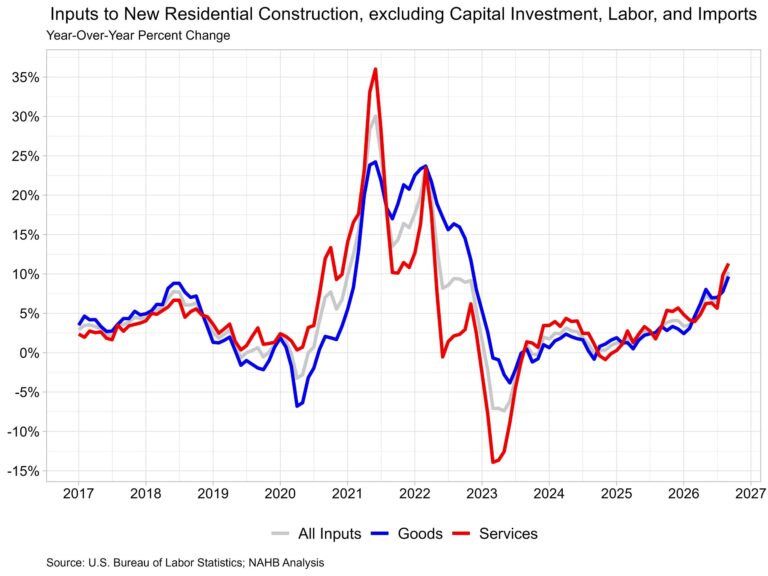
The price index for inputs to new residential construction rose 0.7% in February and was up 3.4% from last year. The price of goods used in new residential construction was up 1.1% over the month and 3.0% from last year, while the price of services was up 0.1% over the month and up 4.2% from last year.

Input Goods

The goods component has a larger importance to the inputs to residential construction price index, representing around 60%. On a monthly basis, the price of input goods to new residential construction was up 1.1% in February. The last time this index increased over 1.0% on a monthly basis was January of 2025.

The input goods to residential construction index can be further broken down into two separate components, one measuring energy inputs with the other measuring remaining goods. The latter of these two components simply represents building materials used in residential construction, which makes up around 93% of the goods index.

Energy input prices rose 9.3% in February but were 3.5% lower than one year ago. Building material prices were up 0.6% in February and up 3.5% compared to one year ago.

The largest year-over-year price increases continue to show in metal products with the largest being for metal molding and trim, as prices are now up 61.7% from a year ago. Metal windows price growth has continued to accelerate with prices up 20.2% from last year. Across all metals and metal products, prices are up 16.6% from last year. Yearly price declines were prevalent among energy products, due to the timing of the survey. For building materials, particleboard and fiberboard prices were down 17.4%, while softwood veneer and plywood prices were down 4.0%.

Input Services

Prices for service inputs to residential construction reported an increase of 0.1% in February. On a year-over-year basis, service input prices were up 4.2%. The price index for service inputs to residential construction can be broken out into three separate components: a trade services component, a transportation and warehousing services component, and a services excluding trade, transportation, and warehousing component (other services).

The most significant component is trade services (around 60%), followed by other services (around 29%), and finally transportation and warehousing services (around 11%). The largest component, trade services, was up 5.8% from a year ago. The transportation and warehousing services rose 3.0%, while prices for other services were up 1.3% over the year.

Expanded Inputs to New Construction Data

Within the PPI that BLS publishes, new experimental data was recently published regarding inputs to new construction. The data expands existing inputs to industry indexes by incorporating import prices with prices for domestically produced goods and services. With this additional data, users can track how industry input costs are changing among domestically produced products and imported products. This data focuses on new construction, but the complete dataset includes indices across numerous industries that can be found here on BLS website.

New construction input prices are primarily influenced by domestically produced goods and services, with domestic products accounting for 90% of the weight of the industry index for new construction. Imported goods make up the remaining 10% of the index.

The latest available data, for December 2025, showed that domestically produced goods continue to show price growth compared to imported goods used in new construction. On a year-over-year basis, the index for domestic goods increased 3.0%, while prices for imported goods have fallen 3.2%.


This article was originally published by a eyeonhousing.org . Read the Original article here. .


Residential building material prices rose at a slower rate in January, according to the latest Producer Price Index release from the Bureau of Labor Statistics. This was the first decline in the rate of price growth since April of last year. Metal products continue to experience price increases, while specific wood products are showing declines in prices.

The Producer Price Index for final demand increased 0.5% in January, after rising 0.4% in December. The January increase in final demand is linked directly to final demand services, which saw prices rise 0.8% in January. The index for final demand goods decreased 0.3% in January.

The price index for inputs to new residential construction rose 0.7% in January and was up 3.3% from last year. The price of goods used in new residential construction was up 0.9% over the month and 2.4% from last year. Meanwhile, the price for services was up 0.3% over the month and up 4.7% from last year.

Input Goods

The goods component has a larger importance to the inputs to residential construction price index, representing around 60%. On a monthly basis, the price of input goods to new residential construction was up 0.9% in January.

The input goods to residential construction index can be further broken down into two separate components, one measuring energy inputs with the other measuring remaining goods. The latter of these two components simply represents building materials used in residential construction, which makes up around 93% of the goods index.

Energy input prices fell 0.9% in January and were 10.3% lower than one year ago. Building material prices were up 1.0% in January and up 3.3% compared to one year ago, marking the lowest year-over-year price change since July of last year.

The largest year-over-year price increases continue to show in metal products. Topping the list in January was metal molding and trim, with prices up 48.3% from last year. One product that has seen rapid price growth acceleration over the past few months has been nonferrous metal and cable with prices up 19.7%. Price declines for materials over the year are concentrated among wood products with prices for particleboard and fiberboard down 24.4%, treated wood products down 5.0%, and softwood lumber down 3.3%.

Input Services

Prices for service inputs to residential construction reported an increase of 0.3% in January. On a year-over-year basis, service input prices were up 4.7%. The price index for service inputs to residential construction can be broken out into three separate components: a trade services component, a transportation and warehousing services component, and a services excluding trade, transportation, and warehousing component (other services).

The most significant component is trade services (around 60%), followed by other services (around 29%), and finally transportation and warehousing services (around 11%). The largest component, trade services, was up 7.1% from a year ago. The transportation and warehousing services rose 2.0%, while prices for other services were up 1.1% over the year.

Expanded Inputs to New Construction

Within the PPI that BLS publishes, new experimental data was recently published regarding inputs to new construction. The data expands existing inputs to industry indexes by incorporating import prices with prices for domestically produced goods and services. With this additional data, users can track how industry input costs are changing among domestically produced products and imported products. This data focuses on new construction, but the complete dataset includes indices across numerous industries that can be found here on BLS website. 

New construction input prices are primarily influenced by domestically produced goods and services, with domestic products accounting for 90% of the weight of the industry index for new construction. Imported goods make up the remaining 10% of the index.  

The latest available data, for November 2025, showed that domestically produced goods continue to have faster price growth compared to imported goods used in new construction. On a year-over-year basis, the index for domestic goods increased 3.0%, while prices for imported goods have fallen 3.0%.


This article was originally published by a eyeonhousing.org . Read the Original article here. .


House price growth slowed in the first quarter of 2025, partly due to a decline in demand and an increase in supply. Persistent high mortgage rates and increased inventory combined to ease upward pressure on house prices. These factors signaled a cooling market, following rapid gains seen in previous years.

Nationally, according to the quarterly all-transactions House Price Index (HPI) released by the Federal Housing Finance Agency (FHFA), U.S. house prices rose 4.7% in the first quarter of 2025, compared to the first quarter of 2024. This year-over-year (YoY) rate was lower than the previous quarter’s rate of 5.5%. The FHFA’s all-transactions HPI tracks average price changes based on repeat sales and refinancings of the same single-family properties. It offers insights not only at the national level but also across states and metropolitan areas.

Between the first quarter of 2024 and the first quarter of 2025, all 50 states and the District of Columbia experienced positive house price appreciation, ranging from 1.0% to 8.4%. Connecticut and Rhode Island topped the house price appreciation list with an 8.4% gain each, followed by New Jersey with a 7.8% gain. On the opposite end, Louisiana recorded the lowest house price appreciation at 1.0%. Out of all 50 states and the District of Columbia, 26 states exceeded the national YoY growth rate of 4.7%. However, on a quarterly basis, home price appreciation slowed in 39 states compared to the fourth quarter of 2024, highlighting a broad-based deceleration in the housing market.

House price growth widely varied across U.S. metro areas year-over-year, ranging from -7.0% to +23.0%. Rome, GA recorded the largest decline in house prices, whereas Johnstown, PA posted the highest increase over the previous four quarters. In the first quarter of 2025, 28 metro areas, in reddish color on the map above, experienced negative house price appreciation. Meanwhile, 356 metro areas experienced price increases.

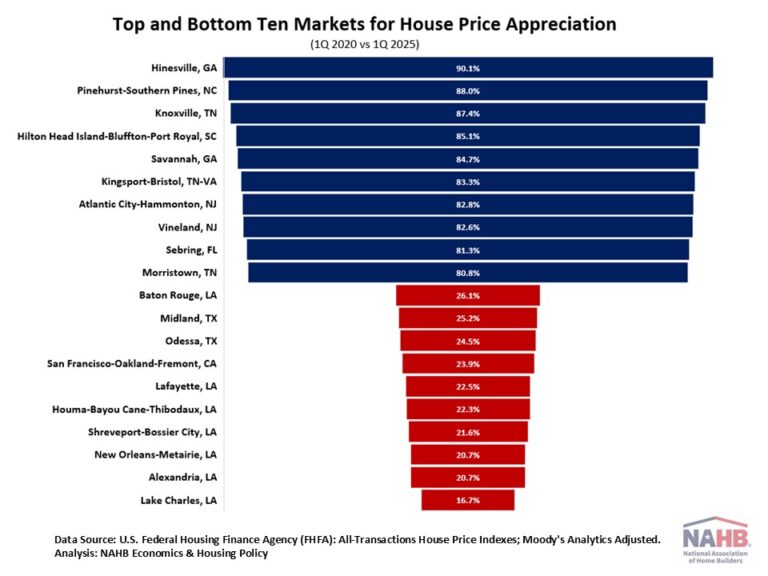
Since the onset of the COVID-19 pandemic, house prices have surged nationally. Between the first quarter of 2020 and the first quarter of 2025, house prices rose by 54.9% nationwide. More than half of metro areas outpaced this national price growth rate of 54.9%.

The table below highlights the top ten and bottom ten markets for house price appreciation during this five-year period. Among all the metro areas, house price appreciation ranged from 16.7% to 90.1%. Hinesville, GA led the nation with the highest house price appreciation. Lake Charles, LA recorded the lowest appreciation, marking its fourth consecutive quarter at the bottom.

Discover more from Eye On Housing

Subscribe to get the latest posts sent to your email.


This article was originally published by a eyeonhousing.org . Read the Original article here. .

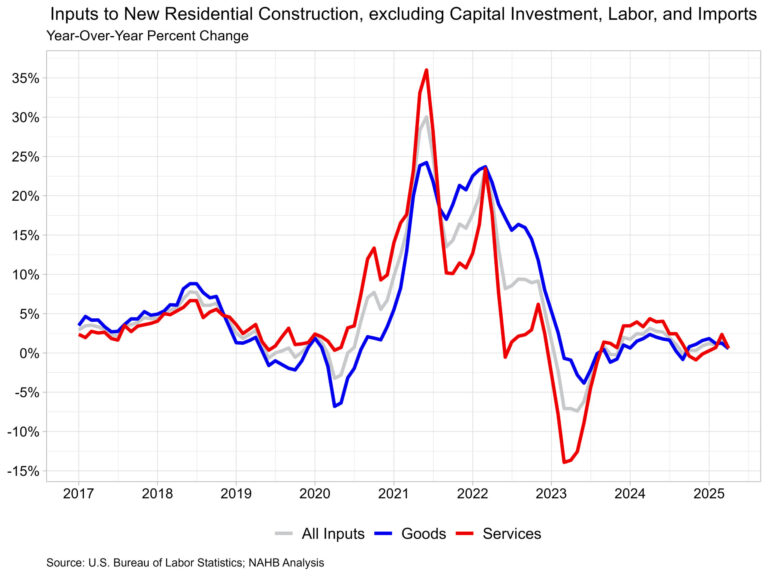
Prices for inputs to new residential construction—excluding capital investment, labor, and imports—fell 0.4% in April, following a (revised) increase of 0.8% in March. These figures are taken from the most recent Producer Price Index (PPI) report published by U.S. Bureau of Labor Statistics. The PPI measures prices that domestic producers receive for their goods and services; this differs from the Consumer Price Index which measures what consumers pay and includes both domestic products as well as imports.

The inputs to the New Residential Construction Price Index grew 0.6% from April of last year. The index can be broken into two components­—the goods component also increased 0.6% over the year, with services increasing 0.6% as well. For comparison, the total final demand index, which measures all goods and services across the economy, increased 2.4% over the year, with final demand with respect to goods up 0.5% and final demand for services up 3.3% over the year.

Input Goods Prices

The goods component has a larger importance to the total residential construction inputs price index, representing around 60%. For the month, the price of input goods to new residential construction was down 0.2% in April.

The input goods to residential construction index can be further broken down into two separate components, one measuring energy inputs with the other measuring goods less energy inputs. The latter of these two components simply represents building materials used in residential construction, which makes up around 93% of the goods index.

Energy input prices were up 0.1% between March and April but were 17.6% lower than one year ago. Building material prices were down 0.3% between March and April but up 2.2% compared to one year ago. Energy costs have continued to fall on a year-over-year basis, as this marks the ninth consecutive month of lower input energy costs.

Input Services Prices

Prices for service inputs to residential construction reported its first monthly decline in five months, down 0.6% in April. On a year-over-year basis, service input prices are up 0.6%.

The price index for service inputs to residential construction can be broken out into three separate components: a trade services component, a transportation and warehousing services component, and a services excluding trade, transportation and warehousing component (other services). The most significant component is trade services (around 60%), followed by other services (around 29%), and finally transportation and warehousing services (around 11%). The largest component, trade services, was up 0.2% from a year ago. The other services component was up 1.4% over the year. Lastly, prices for transportation and warehousing services advanced 0.6% compared to April last year.

Discover more from Eye On Housing

Subscribe to get the latest posts sent to your email.


This article was originally published by a eyeonhousing.org . Read the Original article here. .


Prices for inputs to new residential construction—excluding capital investment, labor, and imports—were up 0.5% in February according to the most recent Producer Price Index (PPI) report published by the U.S. Bureau of Labor Statistics. The increase in January was revised downward to 1.1%. The Producer Price Index measures prices that domestic producers receive for their goods and services, this differs from the Consumer Price Index which measures what consumers pay and includes both domestic products as well as imports.

The inputs to the New Residential Construction Price Index grew 0.7% from February of last year. The index can be broken into two components—the goods component increased 1.2% over the year, while services decreased 0.1%. For comparison, the total final demand index, which measures all goods and services across the economy, increased 3.2% over the year, with final demand with respect to goods up 1.7% and final demand for services up 3.9% over the year.

Input Goods

The goods component has a larger importance to the total residential construction inputs price index, representing around 60%. For the month, the price of input goods to new residential construction was up 0.6% in February.

The input goods to residential construction index can be further broken down into two separate components, one measuring energy inputs with the other measuring goods less energy inputs. The latter of these two components simply represents building materials used in residential construction, which makes up around 93% of the goods index.

Energy input prices grew 2.6% between January and February but remained 8.5% lower compared to one year ago. Building material prices were up 0.5% between January and February while they were up 2.0% compared to one year ago.

Among materials used in residential construction, lumber and wood products ranks 3rd in terms of importance for the Inputs to New Residential Construction Index. Nonmetallic mineral products and metal products rank 1st and 2nd, respectively. The top lumber and wood products include general millwork, prefabricated structural members, not-edge worked softwood lumber, softwood veneer/plywood and hardwood veneer/plywood. Prices for these wood commodities experienced little growth for most of 2024. Currently, softwood lumber prices were 11.7% higher compared to one year ago while on a monthly basis, prices rose 3.0%. This marks the fourth straight month where yearly price growth was above 10% for softwood lumber.

Input Services

While prices of inputs to residential construction for services were down 0.1% over the year, they were up 0.4% in February from January. The price index for service inputs to residential construction can be broken out into three separate components: a trade services component, a transportation and warehousing services component, and a services excluding trade, transportation and warehousing component. The most significant component is trade services (around 60%), followed by services less trade, transportation and warehousing (around 29%), and finally transportation and warehousing services (around 11%). The largest component, trade services, was down 1.5% from a year ago. The services less trade, transportation and warehousing component was up 1.6% over the year.  Lastly, prices for transportation and warehousing services advanced 2.2% compared to February last year.

Discover more from Eye On Housing

Subscribe to get the latest posts sent to your email.


This article was originally published by a eyeonhousing.org . Read the Original article here. .


Following two straight quarters of deceleration, house price appreciation accelerated slightly in the fourth quarter of 2024 due to the persistent high mortgage rates and low inventory. Although inventories of existing homes have improved from a year ago, the current 3.5-month supply remains below the 4.5- to 6-month supply that considered a balanced housing market.

Nationally, according to the quarterly all-transactions House Price Index (HPI) released by the Federal Housing Finance Agency (FHFA), U.S. house prices rose 5.4% in the fourth quarter of 2024, compared to the fourth quarter of 2023. The year-over-year rate has decreased from a high of 20.6% in the second quarter of 2022, but is higher than the previous quarter’s rate of 5.2%.

The quarterly FHFA HPI not only reports house prices at the national level but also provides insights about house price fluctuations at the state and metro area levels. The FHFA HPI used in this article is the all-transactions index, measuring average price changes in repeat sales or refinancings on the same single-family properties.  

Between the fourth quarter of 2023 and the fourth quarter of 2024, 49 states and the District of Columbia had positive house price appreciation. Vermont topped the house price appreciation list with an 8.9% gain, followed by New Jersey and Connecticut both with 8.3% gains. At the other end, Louisiana had the lowest house price appreciation (+2.1%), while Hawaii was the only state to experience a price decline (-4.3%). Among all 50 states and the District of Columbia, 31 states reached or exceeded the national growth rate of 5.4%. Compared to the third quarter of 2024, 32 out of the 50 states had an acceleration in house price appreciation in the fourth quarter.

House price growth widely varied across U.S. metro areas year-over-year, ranging from -4.9% to +24.7%. In the fourth quarter of 2024, 18 metro areas, in reddish color on the map above, had negative house price appreciation, while the remaining 366 metro areas experienced positive price appreciation. Punta Gorda, FL had the largest decline in house prices, while Cumberland, MD-WV saw the highest increase over the previous four quarters.

Additionally, house prices have increased dramatically since the COVID-19 pandemic. Nationally, house prices rose 53% between the first quarter of 2020 and the fourth quarter of 2024. More than half of metro areas saw house prices rise by more than the national price growth rate of 53%.

The table below shows the top and bottom ten markets for house price appreciation between the first quarter of 2020 and the fourth quarter of 2024. Among all the metro areas, house price appreciation ranged from 11.2% to 87.8%. Ocean City, NJ experienced the highest house price appreciation. Lake Charles, LA had the lowest appreciation for the third quarter in a row.

Discover more from Eye On Housing

Subscribe to get the latest posts sent to your email.


This article was originally published by a eyeonhousing.org . Read the Original article here. .

The traditional price gap between new and existing homes was nearly nonexistent at the end of 2024. The median price for a new single-family home sold in the fourth quarter of 2024 was $419,200, a mere $9,100 above the existing home sales price of $410,100, according to U.S. Census Bureau and National Association of Realtors data (not seasonally adjusted – NSA).

Typically, new homes carry a price premium over existing homes. However, for the first time in the quarterly data since 1989, the median existing home price exceeded the new home price in the second quarter of 2024, and again in the third quarter of 2024. The average price premium of new home sales over existing home sales for 2024 was $8,725. To put this into perspective, 2023’s premium average was $33,750 and the 10-year average is $50,657.

Both new and existing homes saw dramatic price increases post-pandemic due to higher construction costs and limited supply. Although overall home prices remain elevated compared to historical norms, new home prices have moderated due to builder business decisions, while existing home prices continue to increase due to lean supply.

The median price for a single-family new home sold in the fourth quarter of 2024 decreased by 0.95% from the previous year. New home prices have continued to decline year-over-year for the previous seven quarters.

Meanwhile, the median price for existing single-family homes increased 4.80% from one year ago. Existing home prices have continued to experience year-over-year increases for six consecutive quarters.

There are several factors as to why new and existing homes are selling at similar price points. Tight inventory continues to push up prices for existing homes, as many homeowners who secured low mortgage rates during the pandemic are hesitant to sell due to current high interest rates.

Meanwhile, new home pricing is more volatile – prices change due to the types and locations of homes being built. Despite various challenges facing the industry, home builders are adapting to affordability challenges by selling smaller lots, constructing smaller homes, and offering incentives.

Additionally, there has been a shift in home building toward the South, associated with less expensive homes because of policy effects. In the fourth quarter of 2024, the percentage of new homes sold in the South was 63%, compared to 44% of existing homes (NSA).

The least expensive region for homes in the fourth quarter was the Midwest, with a median price of $368,000 for new homes and $304,800 for existing homes. The South followed closely, with a median new home price of $377,200 and an existing home price of $366,800. New homes were most expensive in the Northeast with a median price of $798,000, while the West sold at $560,000. However, for existing homes, the West led as the most expensive region at $633,500 homes, followed by the Northeast at $487,900.

The new home price premium was most pronounced in the Northeast, where new homes sold for $310,900 more than existing homes. In contrast, the South saw little difference with a modest $10,400—similar to the national trend. Uniquely, this pattern reversed in the West, where existing homes were $72,600 more than new homes.

Discover more from Eye On Housing

Subscribe to get the latest posts sent to your email.


This article was originally published by a eyeonhousing.org . Read the Original article here. .

On a year-over-year basis, home prices grew at a rate of 3.75% for November, according to the S&P CoreLogic Case-Shiller Home Price Index (NSA). This marks an increase from the 3.59% growth rate recorded in October but is down from a peak of 6.54% in March 2024.

By Metro Area

In addition to tracking national home price changes, the S&P CoreLogic Index (SA) also reports home price indexes across 20 metro areas. Compared to last year, 19 of 20 metro areas reported a home price increase. There were 10 metro areas that grew more than the national rate of 3.75%. The highest annual rate was New York at 7.37%, followed by Chicago at 6.22% and Washington DC at 5.90%. Denver grew at the smallest rate at 0.92%, followed closely by Dallas at 1.02%. Tampa was the only area that experienced a decline from last year at a rate of -0.33%.

By Census Division

A similar index, the Federal Housing Finance Agency Home Price Index (SA) publishes not only national data but also data by census division. The national year-over-year rate was 4.22% for November. Meanwhile, the division with the highest year-over-year rate was 7.67% in New England, while the lowest was 1.81% in West South Central. A three-month trend in rates is shown for each division below. The FHFA Home Price Index releases their metro and state data on a quarterly basis, which NAHB analyzed in a previous post.

Discover more from Eye On Housing

Subscribe to get the latest posts sent to your email.


This article was originally published by a eyeonhousing.org . Read the Original article here. .
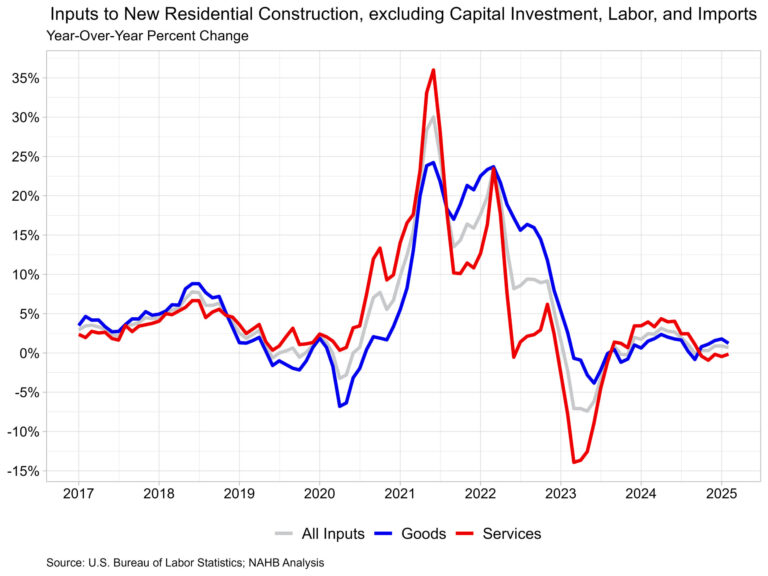

Prices for inputs to new residential construction—excluding capital investment, labor, and imports—were unchanged in December according to the most recent Producer Price Index (PPI) report published by the U.S. Bureau of Labor Statistics. This index grew 0.8% over 2024, the lowest yearly increase in the index since its inception in 2014.

The inputs to the new residential construction price index can be broken into two components—one for goods and another for services. The goods component increased 1.7% over the year, while services decreased 0.4%. For comparison, the total final demand index increased 3.3% in 2024, with final demand with respect to goods up 1.8% and final demand for services up 4.0% over the year.

Input Goods

The goods component has a larger importance to the total residential construction inputs price index, representing around 60%. The price of input goods to new residential construction was down 0.1% in December from November. The input goods to residential construction index can be further broken down into two separate components, one measuring energy inputs with the other measuring goods less energy inputs. The latter of these two components simply represents building materials used in residential construction, which makes up around 93% of the goods index.

The price of goods used in residential construction grew 1.7% in 2024, slightly higher than the growth in 2023 of 1.0%. This growth can be attributed to the rise in the prices of building materials, which grew 2.2% in 2024. The price of energy inputs fell for the second straight year, down 5.3% in 2024.

At the individual commodity level, the five commodities with the highest importance for building materials to the new residential construction index were as follows: ready-mix concrete, general millwork, paving mixtures/blocks, sheet metal products, and wood office furniture/store fixtures. Across these commodities, there was price growth for most commodities in 2024 except for sheet metal products. Ready-mix concrete was up 5.1%, wood office furniture/store fixtures up 4.3%, general millwork up 2.5%, paving mixtures/blocks up 2.3% while sheet metal products were down 0.2%. The commodity used in new residential construction the featured the highest price growth in 2024 was softwood lumber, not edge worked, which increased 14.7% in 2024. The commodity where prices declined the most was No. 2 diesel fuel, down 13.9%.

Input Services

Prices of inputs to residential construction for services were up 0.5% in December from November. The price index for service inputs to residential construction can be broken out into three separate components: a trade services component, a transportation and warehousing services component, and a services excluding trade, transportation and warehousing component. The most significant component is trade services (around 60%), followed by services less trade, transportation and warehousing (around 29%), and finally transportation and warehousing services (around 11%). The largest component, trade services, was down 1.8% in 2024 after growing 5.8% in 2023.  Across individual services, credit deposit services advanced the most in 2024, up 21.2% over the year while the prices for metal, mineral and ore wholesaling services fell the most, down 19.2%.

Discover more from Eye On Housing

Subscribe to get the latest posts sent to your email.


This article was originally published by a eyeonhousing.org . Read the Original article here. .
Pin It