Tag

Positions

Browsing


The number of open positions in the construction sector increased in July per the Bureau of Labor Statistics Job Openings and Labor Turnover Survey (JOLTS). The current level of open jobs is down from three years ago due to declines in construction activity, particularly in housing. Nonetheless, strength in construction for subsectors like data center construction (up 46% year-over-year) is creating demand for construction workers. Further, increasing immigration enforcement actions is having an effect on worker availability, which is also contributing to the number of open positions.

The number of open jobs for the overall economy increased slightly in July, rising to 7.27 million. The July reading was higher than a year ago (7.09 million). The recent increase in job openings for the overall economy indicates that the labor market remained resilient during the summer, despite concerns over headline risk and AI.

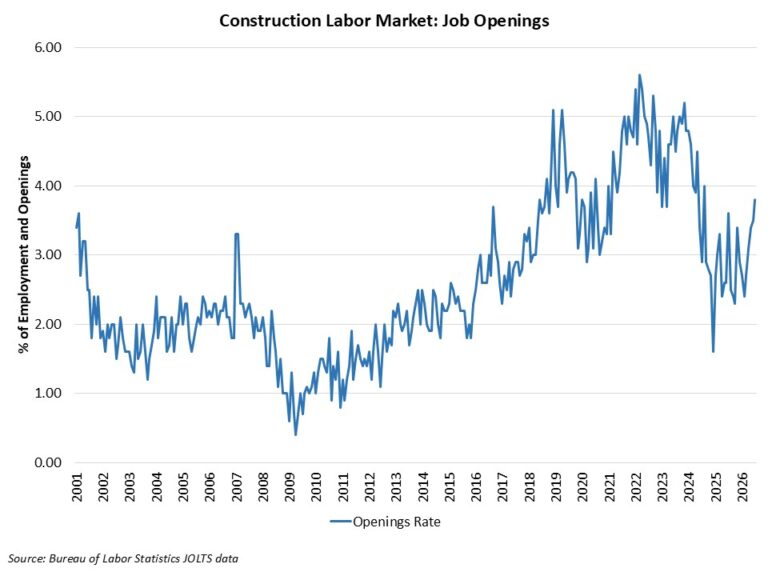
The number of open construction sector jobs increased for the month, rising slightly from 298,000 in June to 326,000 in July. This total is also higher than the total from a year ago (305,000). The chart below notes a declining trend followed by a new range for unfilled construction jobs since the Fed raised the federal funds rate and home building weakened.

While home building employment has declined over the last year, other subsectors of the construction industry have expanded (e.g. data center construction). The July data suggest a breakout from the range for the last two years is possible given the crosswinds affecting the construction labor market.

The construction job openings rate increased to 3.8% in July, up from the 3.6% rate estimated a year ago.

Construction hiring picked up in July, with the hires rate rising from 3.8% to 4.4%.

The layoff rate in construction was flat at 1.9% in July. The quits rate increased to 2.3% in July.


This article was originally published by a eyeonhousing.org . Read the Original article here. .

The number of open positions in construction in February was down year-over-year, per the Bureau of Labor Statistics Job Openings and Labor Turnover Survey (JOLTS). The current level of open jobs is down measurably from three years ago due to declines in construction activity, particularly in housing. However, recent gains for nonresidential construction have not fully offset soft conditions for housing with respect to the demand for construction labor.

The number of open jobs for the overall economy declined in February, falling from 7.24 million in January to 6.88 million in February. The February reading was down from a year ago (7.24 million) due to a cooling labor market.

Previous NAHB analysis indicated that this number had to fall below eight million on a sustained basis for the Federal Reserve to move forward on interest rate reductions. With estimates remaining below eight million for national job openings, the Fed, in theory, should be able to cut further.

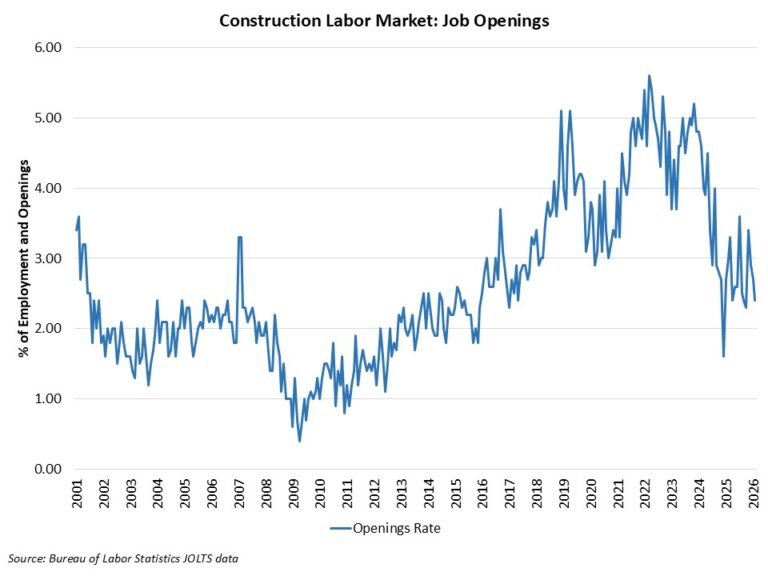
The number of open construction sector jobs fell, declining slightly from 230,000 in January to 202,000 in February. This total was down compared to a year ago (255,000). The chart below notes the declining trend that has been in place for unfilled construction jobs since the Fed raised the federal funds rate and home building weakened. While home building employment was declining during the second half of 2025, other subsectors of the construction industry have expanded (e.g. data centers). This has produced volatility within a reduced range in the series since 2024.

The construction job openings rate decreased to 2.4% in February, down from the 3% rate estimated a year ago.

The layoff rate in construction declined slightly to 1.8% in February. The quits rate decreased to 1.3% for the month.

The current data looks similar to the much discussed low-hire, low-fire labor market paradigm.


This article was originally published by a eyeonhousing.org . Read the Original article here. .
Pin It