Tag

Number

Browsing


The number of open positions in the construction sector increased in July per the Bureau of Labor Statistics Job Openings and Labor Turnover Survey (JOLTS). The current level of open jobs is down from three years ago due to declines in construction activity, particularly in housing. Nonetheless, strength in construction for subsectors like data center construction (up 46% year-over-year) is creating demand for construction workers. Further, increasing immigration enforcement actions is having an effect on worker availability, which is also contributing to the number of open positions.

The number of open jobs for the overall economy increased slightly in July, rising to 7.27 million. The July reading was higher than a year ago (7.09 million). The recent increase in job openings for the overall economy indicates that the labor market remained resilient during the summer, despite concerns over headline risk and AI.

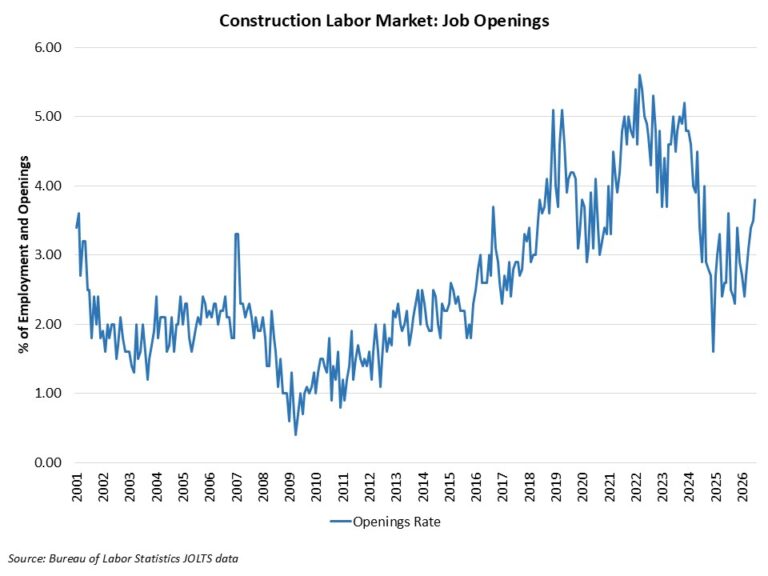
The number of open construction sector jobs increased for the month, rising slightly from 298,000 in June to 326,000 in July. This total is also higher than the total from a year ago (305,000). The chart below notes a declining trend followed by a new range for unfilled construction jobs since the Fed raised the federal funds rate and home building weakened.

While home building employment has declined over the last year, other subsectors of the construction industry have expanded (e.g. data center construction). The July data suggest a breakout from the range for the last two years is possible given the crosswinds affecting the construction labor market.

The construction job openings rate increased to 3.8% in July, up from the 3.6% rate estimated a year ago.

Construction hiring picked up in July, with the hires rate rising from 3.8% to 4.4%.

The layoff rate in construction was flat at 1.9% in July. The quits rate increased to 2.3% in July.


This article was originally published by a eyeonhousing.org . Read the Original article here. .
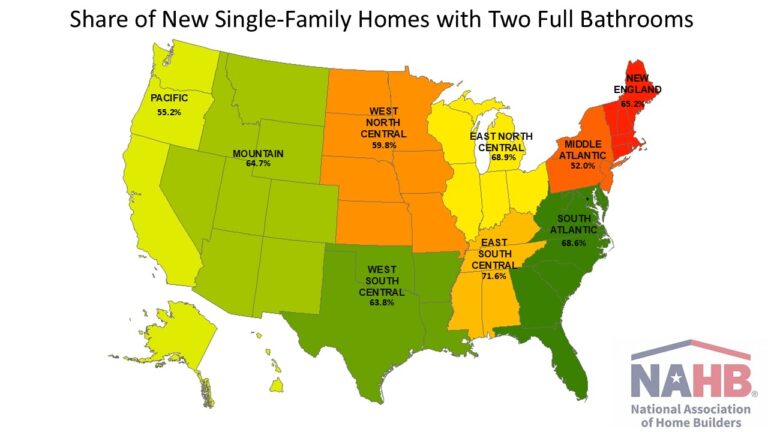

Single-family homes started in 2024 typically had two full bathrooms, according to the U.S. Census Bureau’s Annual Survey of Construction. Homes with three full bathrooms continued to have the second largest share of starts at around 23%. Meanwhile, both homes with four full bathrooms or more and homes with one bathroom or less made up under ten percent of homes started.

A full bathroom, as defined by the Bureau, is one that has a washbasin, a toilet and either a bathtub or shower, or a combination of a bathtub and shower. In 2024, 65.0% of new single-family homes started in 2024 had two full bathrooms, marking  the second consecutive year that this share has increased.  The share of single-family starts with three full bathrooms fell for the third straight year, down to 23.3%, while the share of single-family starts with four or more bathrooms increased to 7.2%. For starts with one full bathroom or less, the share fell to 4.5%.

Across the U.S., the East South Central division had the highest share, 71.6%, of new single-family starts having two full bathrooms. No other division had above a 70% share. The Census division with the lowest share was the Middle Atlantic, with 52.0% of new single-family starts reporting two full bathrooms. Starts in Middle Atlantic division were far more likely to have 4 full bathrooms or more, at 20.2%, more than double any other division in terms of share.

Half-Bathrooms

Most new single-family homes started in 2024 had no half-bathrooms at 53.7%. Following closely is the share of new single-family homes with one half-bathroom at 44.9%. New single-family starts with two or more half-bathrooms had a small share of 1.4% in 2024.  A half bathroom contains a toilet, bathtub, or shower, but not all facilities to be classified as a full bathroom.

Half-bathrooms are historically more prevalent in the New England Census division as compared to the other eight divisions. In 2024, 64.0% of new single-family homes started in the New England division had at least one half-bathroom. The lowest share occurred in the Pacific division, where only 38.3% of starts had at least one half-bathroom.


This article was originally published by a eyeonhousing.org . Read the Original article here. .
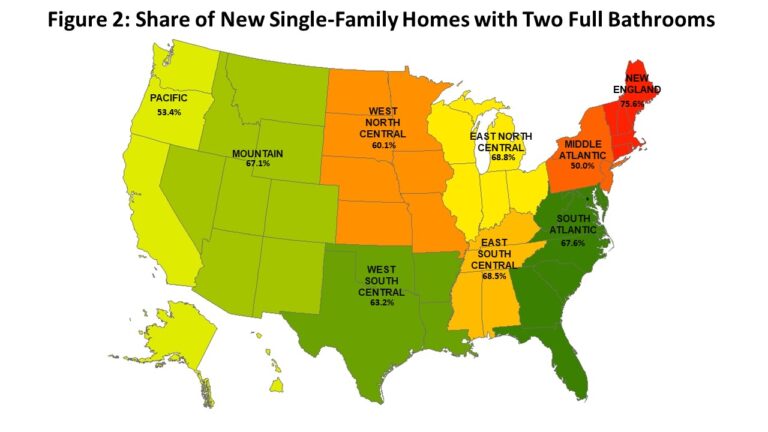

A majority of single-family homes started in 2023 continued to have two full bathrooms according to the latest release of the Census Bureau’s Survey of Construction.  According to the latest data, 64.7% of new single-family homes started in 2023 had two full bathrooms, 23.8% had three full bathrooms, 6.9% had 4 or more full bathrooms, and only 4.6% had one full bathroom or less.

The recent data features the largest increase since 2018 in single-family homes with two bathrooms, as the share increased from 62.3% to 64.7%. This reverses the trend of the past two years when this share consecutively decreased. The share of single-family starts with 3 full bathrooms fell for the second straight year, down to 23.8%, while the share of single-family starts with 1 full bathroom or less rose to 4.6%, the third straight increase. Single-family homes started with 4 or more bathrooms share decreased to 6.9%, after increasing the prior two years.

Across the U.S., the New England census division had the highest share at 75.6% of new single-family starts having two full bathrooms. This share jumped by 22.2 percentage points from 2022, and this was the first time since 2017 that the New England share was the largest in the nation. The lowest share census division was the Middle Atlantic, with 50.0% of new single-family starts reporting two full bathrooms. The share of new single-family started with two full bathrooms fell 9.2 percentage points from 2022 in the Middle Atlantic.

Half-Bathrooms

Most new single-family homes started in 2023 have no half-bathrooms at 54.7%. Following closely is the share of new single-family homes with one half-bathroom at 43.8% . New single-family starts with two or more half-bathrooms had a small share of 1.5% in 2023.

Half-bathrooms are historically prevalent in the New England census division as 79.8% of new single-family starts had at least one in 2023. Half-bathrooms were the least common in the West South Central, with only 38.3% of new single-family starts reporting at least one half-bathroom. A trend of note is in the Pacific, where the share has fallen for five consecutive years, from 53.2% in 2018 to 40.7% in 2023.

Discover more from Eye On Housing

Subscribe to get the latest posts sent to your email.


This article was originally published by a eyeonhousing.org . Read the Original article here. .
Pin It