Tag

November

Browsing


Personal income rose 0.3% in November 2025, following a 0.1% increase in October, according to the latest data from the Bureau of Economic Analysis. Gains were largely driven by higher wages and dividend income. However, income growth has cooled noticeably from peaking at a monthly increase of 1.1% in July 2022 to 0.3% now.

Real disposable income, the amount remaining after adjusted for taxes and inflation, was up 0.1% in November, reversing a 0.1% decline in October. On a year-over-year basis, real (inflation-adjusted) disposable income rose 1%, down from a 7.2% year-over-year recent peak recorded in June 2023.

Consumer spending, meanwhile, remained robust but showed signs of softening. Personal consumption expenditures rose 0.5% in November. Real spending, adjusted to remove inflation, increased 0.3% in November, with expenditures on goods climbing 0.6% and spending on services up 0.2%.

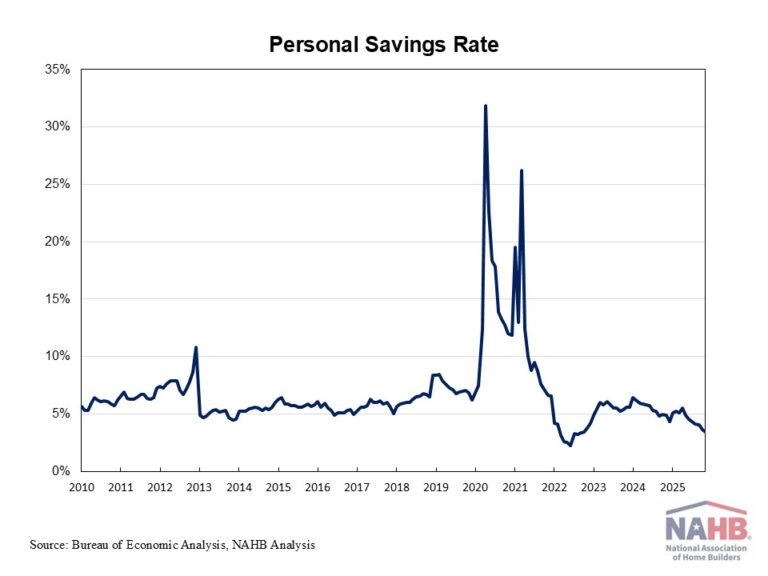
With spending growth outpacing income growth, the personal saving rate decreased to 3.5% in November, the lowest level since late 2022, when core CPI was around the peak. With inflation eroding compensation gains, households are dipping into savings to support spending, especially during the period when some payments were disrupted by the government shutdown. This trend will ultimately lead to a slowing of consumer spending.


This article was originally published by a eyeonhousing.org . Read the Original article here. .


Residential building material prices continued to experience elevated growth, according to the latest Producer Price Index release from the Bureau of Labor Statistics. Price growth has been above 3.0% since June this year, despite continued weakness in the new residential construction market. Across building materials, metal products continue to experience price increases, while ready-mix concrete and softwood lumber have experienced price declines over the past year.

The Producer Price Index for final demand increased 0.2% in November, after rising 0.1% in October. The index for final demand goods increased 0.9% in November. Over 80% of the November increase is due to prices for final demand energy, which was up 4.6% in November. This index for final demand for services was unchanged in November.

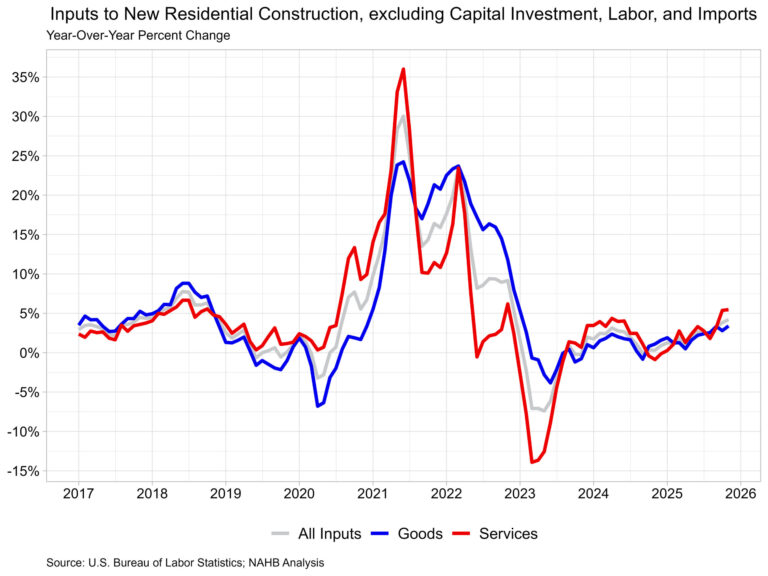
The price index for inputs to new residential construction rose 0.1% in November and was up 4.2% from last year. The price of goods used in new residential construction was up 0.4% over the month and 3.4% from last year. Meanwhile, the price for services was down 0.4% over the month and up 5.5% from last year.

Input Goods

The goods component has a larger importance to the inputs to residential construction price index, representing around 60%. On a monthly basis, the price of input goods to new residential construction was up 0.4% in November.

The input goods to residential construction index can be further broken down into two separate components, one measuring energy inputs with the other measuring remaining goods. The latter of these two components simply represents building materials used in residential construction, which makes up around 93% of the goods index.

Energy input prices rose 3.8% in November and were 2.0% higher than one year ago. Building material prices were up 0.2% in September and up 3.5% compared to one year ago. The 3.5% year-over-year increase is the largest increase since the 4.9% experienced back in January of 2023.

The largest year-over-year price increases continue to show in metal products. Topping the list in November was metal molding and trim, with prices up 48.2% from last year. Two key inputs, ready-mix concrete and softwood lumber, experienced price decreases from last year. Ready-mix concrete prices are down 0.7% compared to a year ago, likely a result of the recent stagnation in construction spending. Softwood lumber prices were down 8.0% in November from last year as prices continue to remain low.

Input Services

Prices for service inputs to residential construction reported a decline of 0.4% in November. On a year-over-year basis, service input prices were up 5.6%. The price index for service inputs to residential construction can be broken out into three separate components: a trade services component, a transportation and warehousing services component, and a services excluding trade, transportation and warehousing component (other services).

The most significant component is trade services (around 60%), followed by other services (around 29%), and finally transportation and warehousing services (around 11%). The largest component, trade services, was up 7.7% from a year ago. The transportation and warehousing services rose 4.2% while prices for other services were up 1.5% over the year.

Expanded Inputs to New Construction Data

Within the PPI that BLS publishes, new experimental data was recently published regarding inputs to new construction. The data expands existing inputs to industry indexes by incorporating import prices with prices for domestically produced goods and services. With this additional data, users can track how industry input costs are changing among domestically produced products and imported products. This data focuses on new construction, but the complete dataset includes indices across numerous industries that can be found here on BLS website. 

New construction input prices are primarily influenced by domestically produced goods and services, with domestic products accounting for 90% of the weight of the industry index for new construction. Imported goods make up the remaining 10% of the index.  

The latest available data, for August 2025, showed that domestically produced goods continue to have faster price growth compared to imported goods used in new construction. On a year-over-year basis, the index for domestic goods increased 2.5%, while prices for imported goods fell 0.7% over the same period.


This article was originally published by a eyeonhousing.org . Read the Original article here. .


In November 2025, employment levels were largely unchanged across all states, with year-over-year growth holding near 2%. In contrast, construction employment showed greater variation, with some states experiencing declines of up to 7.5% while others posted gains approaching 10%.

The recent federal government shutdown provides important context for this Bureau of Labor Statistics release, as it disrupted the regular collection of survey data and delayed some statistical reporting. Because of this interruption, the November release focuses on year-over-year comparisons rather than the typical month-to-month changes.

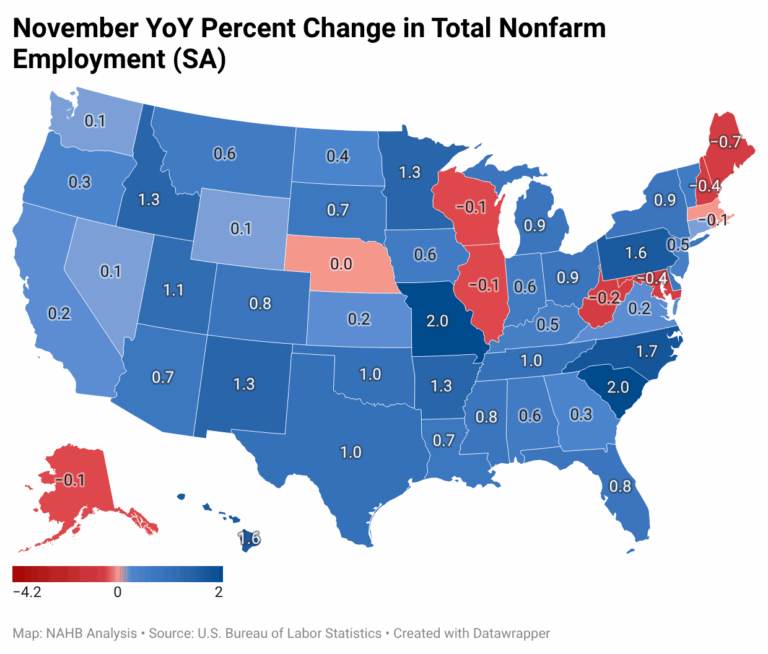
Year-over-year ending in November, 933,000 jobs have been added to the labor market, which is a 0.6% increase compared to the November 2024 level. The range of job gains spanned from 200 jobs in Wyoming to 146,300 jobs in Texas. Nine states and the District of Columbia lost a total of 58,900 jobs in the past 12 months, with the District of Columbia reporting the steepest job losses at 32,800. In percentage terms, the range of job growth spanned 0.1% in Nevada, Connecticut, Wyoming, and Washington to 2.0% in South Carolina. The range of job losses across states spanned 0.1%-0.7%. However, the District of Colombia posted a decline of 4.2%.

Construction Employment

Across the nation, construction sector jobs data 1—which includes both residential and non-residential construction—showed an increase of 58,000 jobs over the year. This is a 0.7% increase compared to the November 2024 level. Texas added 24,000 jobs, which was the largest gain of any state, while New York lost 18,100 construction sector jobs. In percentage terms, Iowa had the highest annual growth rate in the construction sector at 9.9%. During this period, New Jersey reported the largest decline of 7.5%.

For this analysis, BLS combined employment totals for mining, logging, and construction are treated as construction employment for the District of Columbia, Delaware, and Hawaii.


This article was originally published by a
eyeonhousing.org . Read the Original article here. .


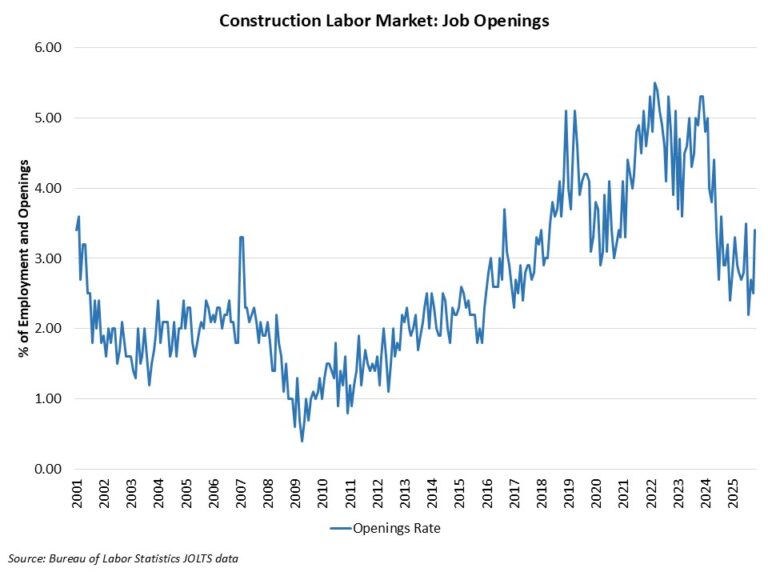
The count of open, unfilled positions in the construction industry increased in November, per the delayed Bureau of Labor Statistics Job Openings and Labor Turnover Survey (JOLTS). The current level of open jobs is down measurably from two years ago due to declines in construction activity, particularly in housing.

The number of open jobs for the overall economy declined as the labor market weakened at the end of 2025, falling from 7.449 million in October to 7.146 million in November. The November reading was down from a year ago (8.031 million).

Previous NAHB analysis indicated that this number had to fall below eight million on a sustained basis for the Federal Reserve to move forward on interest rate reductions. With estimates remaining below eight million for national job openings, the Fed, in theory, should be able to cut further.

The number of open construction sector jobs increased from 202,000 in October to 292,000 in November. This total is relatively stable compared to a year ago (272,000), although the reading is notably lower than two years ago. The chart below notes the declining trend that has been in place for unfilled construction jobs since the Fed raised the federal funds rate and home building weakened. While home building employment was declining during the second half of 2025, other subsectors of the construction industry have expanded (e.g. data centers).

The construction job openings rate increased to 3.4% in November, higher than the 3.2% rate estimated a year ago.

The layoff rate in construction declined to 1.7% in November. The quits increased to 1.5% for the month.


This article was originally published by a eyeonhousing.org . Read the Original article here. .


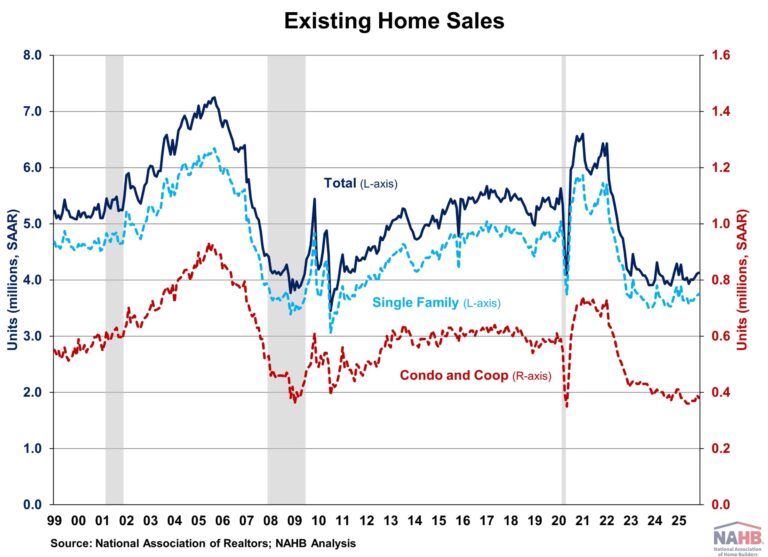
Existing home sales rose for the third consecutive month in November as lower mortgage rates continued to boost home sales, according to the National Association of Realtors (NAR). However, the increase remained modest as mortgage rates still stayed above 6% while down from recent highs. The weakening job market also weighed on buyer activity.

Meanwhile, inventory fell for the fourth consecutive month as homeowners with record-high housing wealth held back from listing properties. Relatively tight supply continued to push home prices higher and challenge housing affordability, even as wage growth outpaced home price gains.

Total existing home sales, including single-family homes, townhomes, condominiums, and co-ops, rose 0.5% to a seasonally adjusted annual rate of 4.13 million in November, the highest level since February. However, on a year-over-year basis, sales were 1.0% lower than a year ago.

The existing home inventory level was 1.43 million units in November, down 5.9% from October but up 7.5% from a year ago. At the current sales rate, November unsold inventory sits at a 4.2-months’ supply, down from 4.4-months in October but up from 3.8-months in November 2024. Inventory between 4.5 to 6 months’ supply is generally considered a balanced market.

Homes stayed on the market for a median of 36 days in November, up from 34 days last month and 32 days in November 2024.

The first-time buyer share was 30% in November, down from 32% in October but unchanged from a year ago.

The November all-cash sales share was 27% of transactions, down from 29% in October but up from 25% a year ago. All-cash buyers are less affected by changes in interest rates.

The November median sales price of all existing homes was $409,200, up 1.2% from last year. This marks the 29th consecutive month of year-over-year increases. The median condominium/co-op price in November was up 0.1% from a year ago at $358,600.  Recent gains for home inventory will put downward pressure on resale home prices in most markets in 2025.

Existing home sales in November were mixed across the four major regions. Sales rose in the Northeast (+4.1%) and South (+1.1%), fell in the Midwest (-2.0%), and remained unchanged in the West. On a year-over-year basis, sales were unchanged in the Northeast and South (2.8%), while down in the Midwest (-3.0%) and West (-1.3%).

The Pending Home Sales Index (PHSI) is a forward-looking indicator based on signed contracts. The PHSI rose from 74.9 to 76.3 in October. On a year-over-year basis, pending sales were 0.4% lower than a year ago, according to the National Association of Realtors’ data.


This article was originally published by a eyeonhousing.org . Read the Original article here. .


Inflation unexpectedly eased in November, according to the Bureau of Labor Statistics (BLS) latest report. This data release was originally scheduled for December 10 but was delayed due to the recent government shutdown. While most indexes showed deceleration, this report does not necessarily prove a downward trend in inflation due to missing October data and incomplete November collection. December’s report may be more pivotal for markets and the Fed.

The recent record-long government shutdown disrupted data collection for many macroeconomic indicators including the CPI. About two-thirds of price data is collected through personal visits to brick-and-mortar stores, with the remaining third collected online or via telephone. Since the government remained shut down throughout October, BLS cannot retroactively collect survey data for the month. While data collection resumed on November 14 following the November 13 reopening, this month’s report potentially has downward bias due to lower collection rates and holiday sales promotions. This also suggests higher likelihood for monthly volatility in the near term.

Though inflation is expected to peak in the first quarter of 2026, the Fed is likely to continue easing given signs of labor market weakening. The housing market’s sensitivity to interest rates suggests rate cuts could help ease the affordability crisis and support housing supply even as builders continue to face supply-side challenges.

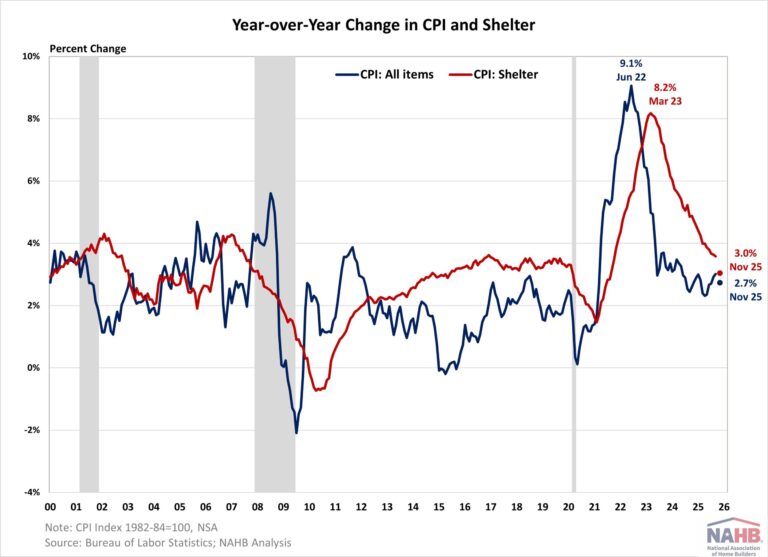
During the past twelve months, on a non-seasonally adjusted basis, the Consumer Price Index (CPI) rose by 2.7% in November. Excluding the volatile food and energy components, the “core” CPI increased by 2.6% over the past twelve months, the lowest reading since April 2021. A large portion of the “core” CPI is the housing shelter index, which increased 3.0% over the year, the lowest reading since August 2021. Meanwhile, the component index of food rose by 2.6%, and the energy component index increased by 4.2%.

Given the notable shift in the November data, especially for the shelter inflation component, the November data are shown with data dot points (red for shelter, blue for overall CPI respectively) in the chart below. The December report will identify whether these data points are confirmed positive trends.

Due to the gap in data collection during the government shutdown, this report covers a two-month period instead of the standard one month. From September to November, the CPI rose by 0.2% (seasonally adjusted), down from a 0.7% increase over the two-month period ending in September. The “core” CPI increased by 0.2% over the two months ending in November, compared to 0.6% in the prior two-month period.

From September to November, the price index for a broad set of energy sources rose by 1.1% and the food index rose by 0.1%. The index for shelter, which makes up more than 40% of the “core” CPI, rose by 0.2% over the two-month period, down from 0.6% in the previous period. Other contributors that increased included indexes for household furnishings and operations, communication, as well as personal care.

NAHB constructs a “real” rent index to indicate whether inflation in rents is faster or slower than core inflation. It provides insight into the supply and demand conditions for rental housing. When inflation in rents is rising faster than core inflation, the real rent index rises and vice versa. The real rent index is calculated by dividing the price index for rent by the core CPI (to exclude the volatile food and energy components).

From September to November, the Real Rent Index remained unchanged over the two-month period. Due to the missing October data, the average monthly growth rate for 2025 cannot be directly compared to prior years.


This article was originally published by a eyeonhousing.org . Read the Original article here. .


In November, job growth slowed, and the unemployment rate rose to 4.6%, its highest level in four years. At the same time, job gains for the previous two months (August and September) were revised downward. The November’s jobs report indicates a cooling labor market as the economy heads into the final month of the year.

In November, wage growth slowed, increasing 3.5% year over year, down 0.6 percentage points from a year ago. Wage growth has been outpacing inflation for nearly two years, which typically occurs as productivity increases.

National Employment

According to Employment Situation Summary reported by the Bureau of Labor Statistics (BLS), total nonfarm payroll employment rose by 64,000 in November. This represents a notable slowdown from September’s revised gain of 108,000 and reflects continued weakness in overall hiring.

August’s growth was revised downward for the second time, from last month’s estimate of -4,000 to -26,000. September job growth was revised down by 11,000, from +119,000 to +108,000. Combined, these revisions erased 33,000 jobs from previously reported figures. October data, published for the first time, was not revised.

Through November, average monthly job growth in 2025 stands at just 11,000, well below the 168,000 monthly average recorded in 2024.

The unemployment rate rose to 4.6% in November, its highest level since September 2021. Compared to September, the number of persons unemployed rose by 228,000, while the number of persons employed increased by 96,000.

Meanwhile, the labor force participation rate—the proportion of the population either looking for a job or already holding a job—remained unchanged at 62.4%. This remains below its pre-pandemic level of 63.3% recorded at the beginning of 2020. Among prime working-age individuals (aged 25 to 54), the participation rate edged up 0.1 percentage points to 83.8%, the highest level since September 2024.

In November, employment gains were seen in health care (+46,000) and construction (+28,000), while the federal government continued to shed jobs. Federal government employment fell by 6,000 positions in November, following a sharp decline of 162,000 in October. Since peaking in January 2025, federal government employment has fallen by a total of 271,000 jobs.

Construction Employment

Employment in the overall construction sector increased by 28,000 in November, after an upwardly revised 25,000 gain in September. Within the industry, residential construction shed 300 jobs, while non-residential construction gained 28,800 positions.

Residential construction employment now stands at 3.3 million in November, including 958,000 workers employed by builders and remodelers and approximately 2.4 million residential specialty trade contractors.

The six-month moving average of job gains for residential construction remains negative at -3,600 per month, reflecting losses in five of the past six months for June, July, August, October, and November. Over the last 12 months, residential construction has seen a net loss of 42,200 jobs, marking the sixth consecutive annual decline since September 2020. Since the low point following the Great Recession, residential construction has gained 1,334,100 positions.

In November, the unemployment rate for construction workers declined to 4.7% on a seasonally adjusted basis. The unemployment rate for construction workers has remained at a relatively lower level, after reaching 15.3% in April 2020 due to the housing demand impact of the COVID-19 pandemic.
This article was originally published by a eyeonhousing.org . Read the Original article here. .


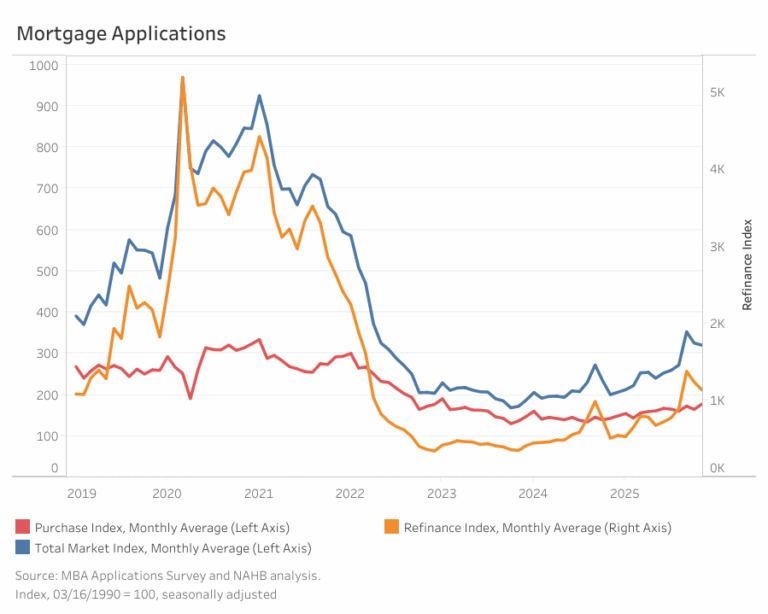
Mortgage activity continued to climb in November, posting the largest year-over-year increase in more than five years. Every major category increased on a year-over-year basis as mortgage rates continue to trend lower, led by strong increases in refinancing and adjustable-rate mortgage activity. 

The Mortgage Bankers Association’s (MBA) Market Composite Index, a measure of total mortgage application volume, fell 1.6% from October on a seasonally adjusted basis but was 60% higher than a year ago.  

The average contract interest rate for 30-year fixed mortgages basis continued to fall for the sixth month in a row to 6.36%, the lowest in over a year. After a strong jump in September, refinancing activity in November decreased 8.3% month-over-month. However, refinancing increased 123.7% on an annual basis, the largest gain in over a year. Meanwhile, purchase applications increased 7.9% over the month and rose 34.1% compared to a year ago, the highest increase since 2021.  

By loan type, fixed-rate mortgage applications were unchanged from October but were 57.6% higher year-over-year. Adjustable-rate mortgage applications dropped 19% month-over-month, yet surged 94.9% from a year earlier, following an 116% annual gain in October.  

The average loan size across all mortgages was $396,000, down 3% from the previous month. The average purchase loan size was $429,000, down 2% from last month, while the average refinance loan size declined 4% to $369,000. For adjustable-rate mortgages, the average loan size increased 3% to $969,000, compared to a 2% decline for fixed-rate mortgages to $348,000.


This article was originally published by a eyeonhousing.org . Read the Original article here. .


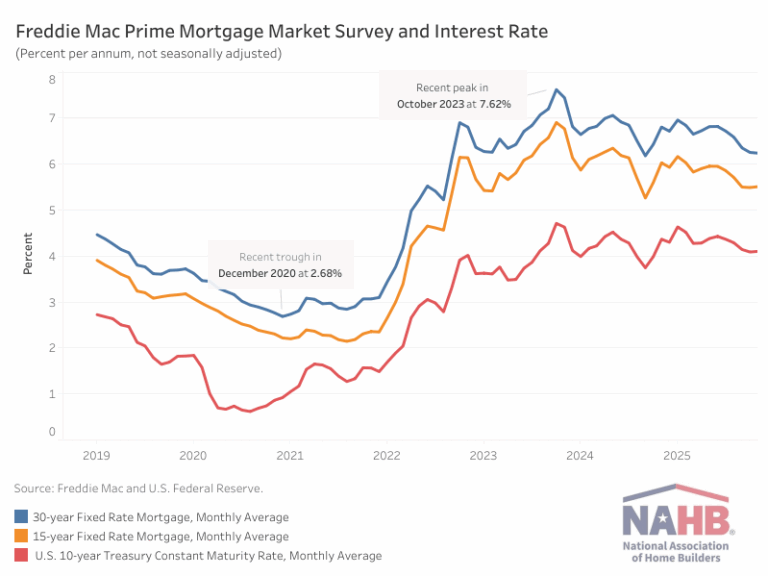
The average mortgage rate in November continued to trend lower to its lowest level in over a year. According to Freddie Mac, the 30-year fixed-rate mortgage averaged 6.24% in November, 2 basis points (bps) lower than in October. Meanwhile, the 15-year rate increased 3 bps to 5.51%. Both the 30-year and 15-year rates remain lower than a year ago, dropping by 57 bps and 52 bps year-over-year, respectively.

The 10-year Treasury yield, a key benchmark for long-term borrowing, averaged 4.09% in November– a 3-basis point increase from the previous month. The spread between the 30-year fixed mortgage rate and the 10-year Treasury remains somewhat elevated at 215 basis points, well above the roughly 150-180 basis points seen in a stable market. While the spread has narrowed from the wide gap in 2023, it continues to reflect ongoing market uncertainty, keeping mortgage rates higher than their historical relationship to 10-year Treasury yields.

Falling mortgage rates have shown some impact on housing activity. Mortgage application activity continues to strengthen, led by increases in adjustable-rate mortgages and refinancing applications. Additionally, existing home sales rose to an eight-month high in October. There is no data available for new home sales in October due to the government shutdown.


This article was originally published by a eyeonhousing.org . Read the Original article here. .


Market uncertainty exacerbated by the government shutdown along with economic uncertainty stemming from tariffs and rising construction costs kept builder confidence firmly in negative territory in November.

Builder confidence in the market for newly built single-family homes rose one point to 38 in November, according to the National Association of Home Builders (NAHB)/Wells Fargo Housing Market Index (HMI).

While lower mortgage rates are a positive development for affordability conditions, many buyers remain hesitant because of the recent record-long government shutdown and concerns over job security and inflation. We continue to see demand-side weakness as a softening labor market and stretched consumer finances are contributing to a difficult sales environment. After a decline for single-family housing starts in 2025, NAHB is forecasting a slight gain in 2026 as builders continue to report future sales conditions  in marginally positive territory.

In a further sign of ongoing challenges for the housing market, the latest HMI survey also revealed that 41% of builders reported cutting prices in November, a record high in the post-Covid period and the first time this measure has passed 40%. Meanwhile, the average price reduction was 6% in November, the same rate as the previous month. The use of sales incentives was 65% in November, tying the share in September and October.

Derived from a monthly survey that NAHB has been conducting for more than 40 years, the NAHB/Wells Fargo HMI gauges builder perceptions of current single-family home sales and sales expectations for the next six months as “good,” “fair” or “poor.” The survey also asks builders to rate traffic of prospective buyers as “high to very high,” “average” or “low to very low.” Scores for each component are then used to calculate a seasonally adjusted index where any number over 50 indicates that more builders view conditions as good than poor.

The HMI index gauging current sales conditions increased two points to 41, the index measuring future sales fell three points to 51 and the gauge charting traffic of prospective buyers posted a one-point gain to 26.

Looking at the three-month moving averages for regional HMI scores, the Northeast rose two points to 48, the Midwest fell one point to 41, the South increased three points to 34 and the West gained two points to 30. HMI tables can be found at nahb.org/hmi.


This article was originally published by a eyeonhousing.org . Read the Original article here. .

Pin It