Tag

Note

Browsing


Single-family permitting softened over the course of 2025 and finished the year weaker than the prior year. After showing some resilience in 2024, permitting activity gradually lost momentum as elevated mortgage rates and ongoing affordability constraints weighed on buyer demand. By year’s end, the pace of single-family permit issuance was below the level recorded in 2024, signaling a pullback in new construction. Multifamily permitting followed a more uneven path during 2025, reflecting the sector’s typical volatility, but ended the year on a stronger footing.

Over the year, the number of single-family permits issued nationwide reached 909,280. On a year-over-year basis, this represents a 7.4 percent decline compared with the December 2024 year-to-date total of 981,834. Multifamily permitting activity was stronger, with 516,886 permits issued nationwide, marking a 5.6 percent increase from the same period last year.

Regionally, year-to-date single-family permitting increased in only one of the four regions through December. The Midwest posted a slight gain of 0.3 percent, while activity declined in the Northeast (down 1.9 percent), the South (down 8.5 percent), and the West (down 10.4 percent). Multifamily permits increased in three of the four regions, led by gains in the West (up 17.6 percent), followed by the Midwest (up 9.8 percent), and then the South (up 4.9 percent). The Northeast saw a sharp decline of 12.4 percent, driven largely by a 21.0 percent drop in the New York–Newark–Jersey City metropolitan area.

At the state level, 16 states recorded year-over-year increases in single-family permits between December 2025 year-to-date and December 2024 year-to-date, with gains ranging from 24.0 percent in the District of Columbia to 0.1 percent in New York. The remaining 34 states reported declines, led by Nevada, which posted the steepest drop at 21.3 percent.

The ten states issuing the highest number of single-family permits accounted for 61.8 percent of all single-family permits issued nationwide. Texas continued to lead the country, with 140,002 permits issued over 2025, although this represented an 11.7 percent decline compared with 2024. Florida, the second-highest state, saw permits fall by 10.3 percent, while North Carolina, ranked third, experienced a decline of 6.9 percent.

Between December 2025 year-to-date and December 2024 year-to-date, 31 states recorded increases in multifamily building permits, while 19 states and the District of Columbia experienced declines. Mississippi posted the largest percentage increase, with multifamily permits surging 195.8 percent, rising from 357 to 1,056 units. In contrast, Maryland recorded the steepest decline, with permits falling 32.7 percent, from 5,797 to 3,902 units.

The ten states issuing the highest number of multifamily permits accounted for 60.5 percent of all multifamily permits issued nationwide. Over the course of 2025, Texas, which issued the most multifamily permits, recorded a modest increase of 1.7 percent. Florida, the second-highest state, posted a stronger gain of 29.6 percent, while California, ranking third, saw multifamily permits rise by 21.6 percent.

At the local level, the following are the ten metropolitan areas with the highest number of single-family permits issued.

Below are the ten metropolitan areas with the highest levels of multifamily permitting activity.


This article was originally published by a eyeonhousing.org . Read the Original article here. .
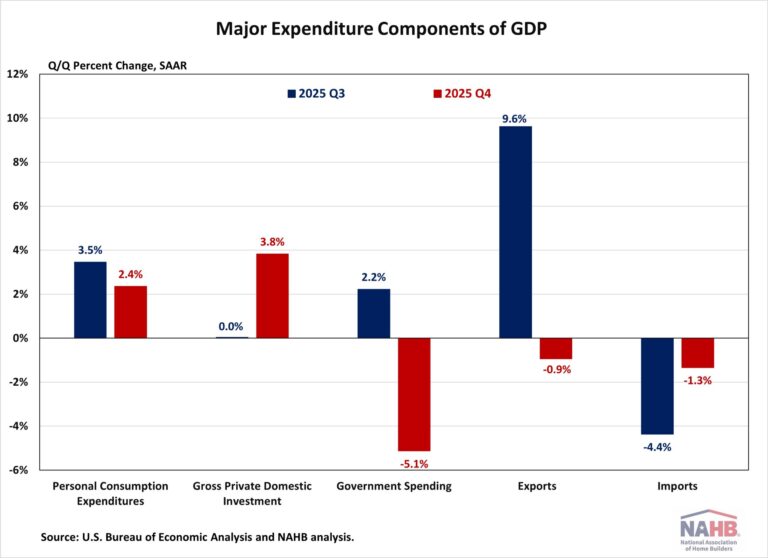

Real GDP growth slowed sharply in the fourth quarter of 2025 as the historic government shutdown weighed on economic activity. While consumer spending continued to drive growth, federal government spending subtracted over a full percentage point from overall growth.

According to the “advance” estimate released by the Bureau of Economic Analysis (BEA), real gross domestic product (GDP) expanded at an annual rate of 1.4% in the final quarter of 2025, a notable deceleration from a 4.4% increase in the third quarter. This growth rate was below the NAHB forecast for the quarter.

Furthermore, the latest data from the GDP report indicates that inflationary pressures intensified over the quarter. The price index for gross domestic purchases rose 3.7%, up from a 3.4% increase in the third quarter of 2025. The Personal Consumption Expenditures Price (PCE) Index, which measures inflation (or deflation) across various consumer expenses and reflects changes in consumer behavior, increased 2.9% in the fourth quarter. This is slightly higher than a 2.8% rise in the previous quarter.

For the full year, real GDP grew 2.2% in 2025. It marks a slowdown from the 2.8% increase in 2024 and stands as the weakest annual growth rate since the pandemic. The annual gain matched NAHB’s forecast and primarily reflected continued strength in consumer spending and gains in investment.

Breaking down the fourth-quarter data further, the increase in real GDP primarily reflected increases in consumer spending and investment, partially offset by decreases in government spending and exports. Imports, which are a subtraction in the calculation of GDP, decreased during the quarter as tariffs had measurable effects.

Consumer spending, the backbone of the U.S. economy, rose at an annual rate of 2.4% in the fourth quarter, the slowest pace since the first quarter of 2025. Spending on services remained solid, increasing at a 3.4% annual rate, while spending on goods edged down 0.1%.

Gross private domestic investment added 0.66 percentage points to headline GDP growth in the fourth quarter. The gain in investment was primarily driven by increases in intellectual property products, private inventory investment, and equipment spending.

Government spending fell, reflecting the effects of a prolonged federal government shutdown. 

Nonresidential fixed investment increased 3.7% in the fourth quarter. The increases in equipment (+3.2%) and intellectual property products (+7.4%) offset the decrease in structures (-2.4%). Meanwhile, residential fixed investment (RFI) declined 1.6% in the fourth quarter, marking the fourth consecutive quarterly decline. Within the residential category, single-family permanent site structures fell 5.2% at an annual rate, multifamily permanent site structures declined 3.6%, and spending on home improvements dropped 3.2%.

For the common BEA terms and definitions, please access bea.gov/Help/Glossary.


This article was originally published by a eyeonhousing.org . Read the Original article here. .
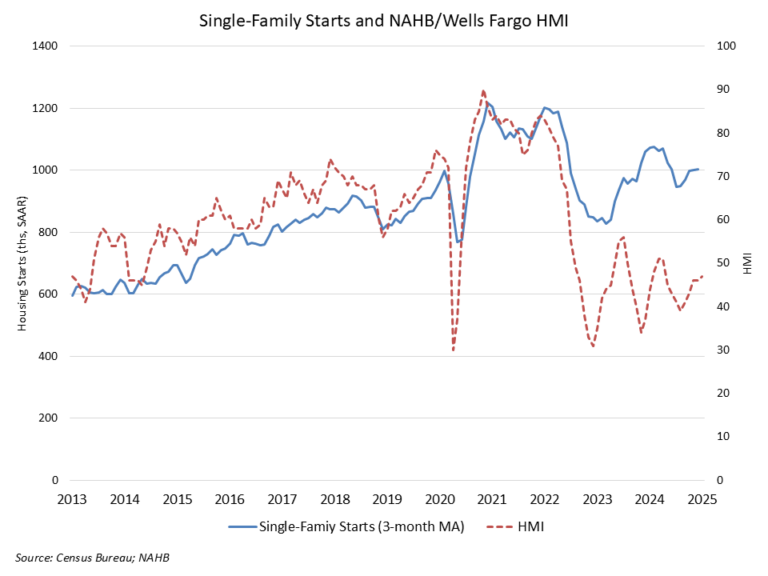

Fueled by solid demand, single-family construction moved higher in December despite several headwinds facing the industry, including high mortgage rates, elevated financing costs for builders and a lack of buildable lots.

Overall housing starts increased 15.8% in December to a seasonally adjusted annual rate of 1.50 million units, according to a report from the U.S. Department of Housing and Urban Development and the U.S. Census Bureau. This is the highest rate since February 2024.

The December reading of 1.50 million starts is the number of housing units builders would begin if development kept this pace for the next 12 months. Within this overall number, single-family starts increased 3.3% to a 1.05 million seasonally adjusted annual rate. The multifamily sector, which includes apartment buildings and condos, increased 61.5%for December to a 449,000 pace.

Total housing starts for 2024 were 1.36 million, a 3.9% decline from the 1.42 million total from 2023. Single-family starts in 2024 totaled 1.01 million, up 6.5% from the previous year. NAHB is forecasting a slight gain for single-family home building in 2025 because of a persistent housing shortage and ongoing solid economic conditions.

Multifamily starts ended the year down 25% from 2023. In December, and on a three-month moving average basis, there were 1.7 apartments completing construction for every one apartment starting construction. Multifamily construction will stabilize later in 2025 as more deals pencil out, with the industry supported by a low national unemployment rate.

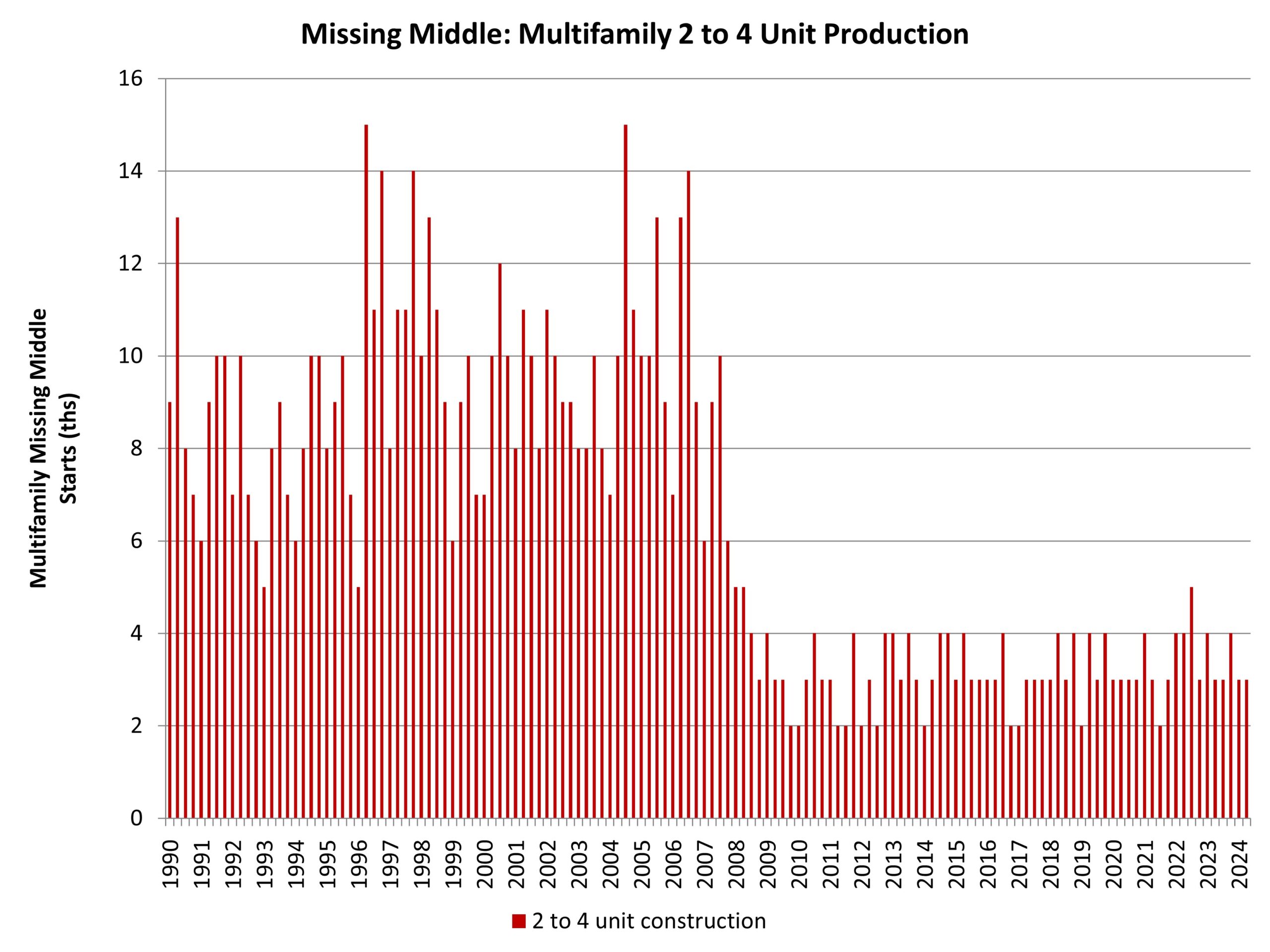
Single-family completions ended 2024 up 2.2%.  Multifamily completions ended 2024 up 35%.  Within multifamily, the missing middle (two- to four-unit completions) were up 42.5%, for a total of 16,600 duplexes through quadplexes. Like ongoing strength for townhouse construction, this market data indicates that with zoning reform more medium density housing can be built in markets where such demand exists.

On a regional and for 2024 year, combined single-family and multifamily starts were 9.1% higher in the Northeast, 0.1% lower in the Midwest, 5.2% lower in the South and 7.7% lower in the West.

Overall permits decreased 0.7% a 1.48 million unit annualized rate in December and were down 3.1% compared to December 2023. Single-family permits increased 1.6% to a 992,000 unit rate but were down 2.5% in December compared to the previous year. Multifamily permits decreased 5.0% to a 491,000 pace.

Looking at regional permit data for 2024 permits were 1.5% higher in the Northeast, 3.5% higher in the Midwest, 3.1% lower in the South and 6.6% lower in the West.

Total permits for 2024 were 1.47 million, a 2.6% decline from the 1.51 million total from 2023. Single-family permits in 2024 totaled 981,000 up 6.6% from the previous year, a positive sign for 2025.

The number of single-family homes under construction was down 5.3% from a year ago, at 641,000 homes. The number of apartments under construction was down 21% from a year ago, at 790,000. The count of apartments under construction peaked in July 2023 at 1.02 million and has been trending lower since that time.

Discover more from Eye On Housing

Subscribe to get the latest posts sent to your email.


This article was originally published by a eyeonhousing.org . Read the Original article here. .
Pin It