Tag

Materials

Browsing


Beautiful materials take the spotlight in these five kitchens, where designers layered natural stone, warm wood cabinetry, handcrafted tile and refined finishes to elevate everyday function. Thoughtful layouts, carefully edited palettes and a mix of modern, classic and artisanal details allow standout features to shine, creating spaces that feel welcoming, cohesive and timeless. Here, the pros share how they brought it all together.

805 Interiors, Inc.Save Photo
1. Mediterranean Charm

Designer: Michelle and Jeff Price of 805 Interiors
Location: Westlake Village, California

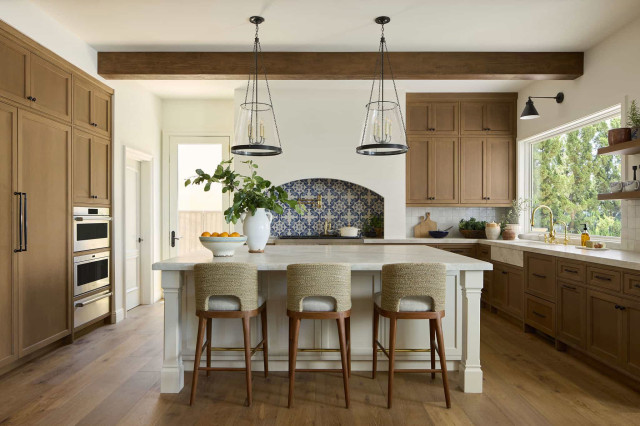
Homeowners’ request. “The original kitchen was a dated faux Tuscan style with brown-on-brown finishes and a maze of ’90s soffits that made the ceilings feel oppressively low and forced a cramped, inflexible layout,” says designer Michelle Price. “Our goal was a transitional Mediterranean Revival, replacing those dated features with a blend of artisanal textures and modern restraint, while bringing real architectural integrity back to the space. We stripped the soffits away and introduced architectural beams to reclaim the volume of the room, adding authentic Mediterranean character in the process. This completely opened up the space and allowed us to maximize the stunning lake and mountain views.”

Price uses

Houzz Pro to manage her projects. “We love the Clipper and use it for all of our sourcing, as well as the Room Board features,” she says. “This was a whole-home project, so the Room Boards were invaluable for organizing. We use all the ordering and tracking features as well as proposal and invoice creation, so our client benefited from us having information and answers quickly at our fingertips.”

Luxurious materials and features. “We knew the range and hood would be the focal point of the kitchen, so we designed an arched niche finished in Venetian plaster and set it off with hand-painted Portuguese tile for a truly bespoke moment,” Price says. “To let that anchor breathe, we intentionally kept the rest of the space quiet: custom white oak cabinets stained in a warm, medium tone and neutral zellige tile for the remaining backsplash to bring an organic, old-world feel. The countertops are leathered Taj Mahal quartzite, chosen for its soft texture and natural variation. The sink wall has a large window framing stunning views. Unlacquered brass fixtures feel both refined and timeless.” The flooring is smoked white oak.

Designer tip. “I always tell my clients that every space should have only one or two ‘stars’ and that everything else needs to play a supporting role so those stars can truly shine,” Price says. “Homeowners often make selections in isolation, feeling that each element needs to be special or exciting on its own. The result is usually a space that feels disjointed or overly busy. Giving your stars room to have their moment is what allows a design to feel cohesive and intentional.”

Paint colors: Cloud White (walls) and Ballet White (island), Benjamin Moore

See why you should hire a professional who uses Houzz Pro software

Debra Geller Interior DesignSave Photo
2. Marble Drama

Designer: Debra Geller Interior Design
Construction: Phil Kouffman Builder
Location: Montauk, New York

Homeowners’ request. “The homeowner envisioned a drop-dead stunning kitchen — artistic, modern, layered and luxurious — yet warm enough to support everyday family life,” says designer Debra Geller. “As an entertainer she required a space that could function effortlessly during large gatherings while maintaining a refined, elevated aesthetic. As part of a full-home renovation, we doubled the size of the kitchen, removed walls, reworked structural elements and installed oversized picture windows to frame uninterrupted views of the Atlantic.”

Geller uses Houzz Pro to manage her business. “We utilize Houzz Pro for client leads and for its visual planning tools, including the 3D scanning feature,” she says. “This tool allows us to scan a room onsite and convert it into a 2D plan directly from our phones, enabling us to quickly test layouts and place furnishings without opening CAD programs. It streamlines onsite meetings and allows our team to make informed layout decisions efficiently prior to implementation.”

Luxurious materials and features. “Luxury in this kitchen is expressed through scale, natural stone, customization and craftsmanship,” Geller says. “The 14-foot island is topped in Invisible Blue marble, showcasing fluid movement and subtle veining reminiscent of the ocean beyond. The perimeter countertops, full-height backsplash and custom 60-inch hood are also clad in Invisible Blue marble, creating continuity and a dramatic sculptural focal point. The island seating countertop section is Black Absolute leathered granite, selected for its depth, durability and rich tactile quality. The cabinetry is painted in Benjamin Moore Chantilly Lace, enhancing brightness and architectural contrast. The island and refrigerator wall are constructed in white oak with a custom stained whitewash finish, introducing warmth and organic texture.”

Other special features. A 48-inch double workstation sink with integrated cutting and straining accessories. Toe-kick lighting for a soft ambient evening glow. Walk-in butler’s pantry with secondary refrigerator, filtered water station and curated coffee center. Custom bar stools upholstered in vegan leather.

Designer tip. “In larger kitchens, mixing painted cabinetry with natural wood adds warmth and visual depth,” Geller says. “Keeping the perimeter light while introducing wood on the island or feature wall grounds the space and prevents it from feeling sterile.”

Cabinetry: Ciuffo Cabinetry; island light: Gabriel Scott

Find a kitchen designer on Houzz

Natalia Avalos Interiors LLCSave Photo
3. Sculptural Elegance

Designer: Natalia Avalos Interiors
Location: Alamo, California

Homeowners’ request. “Their goal was to create a home that felt elevated yet livable — moody but inviting, refined yet comfortable,” says designer Natalia Avalos, whose clients found her on Houzz. “They wanted richer materials, more intentional detailing and a sense of flow from room to room.”

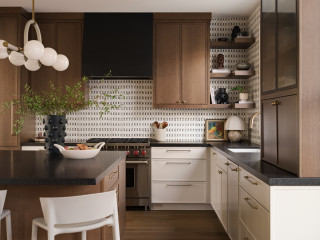
Luxurious materials and features. “This kitchen is elevated through a thoughtful combination of polished marble countertops and backsplash, a sculptural plaster hood, rich natural walnut cabinetry and warm brass fixtures,” Avalos says. “Each material was intentionally selected to create depth, warmth and a refined sense of contrast.

“The polished marble brings timeless elegance and light reflection, enhancing the overall brightness of the space. The plaster hood introduces an artisanal, sculptural quality that softens the architecture and adds visual interest beyond standard cabinetry. Natural walnut cabinetry was chosen for its richness and warmth, balancing the coolness of the stone while adding organic texture. The detailed end of the island was designed to be both practical and visually striking, breaking away from the enclosed, boxy feel that kitchens often have.” The cabinets are painted in Feather Down by Benjamin Moore.

Designer tip. “Be intentional about how you use your countertops,” Avalos says. “Identify which areas will serve primarily as functional prep zones and which can be styled more decoratively. Incorporate everyday objects — beautiful cutting boards, ceramic vessels, curated oils or frequently used cookware — and treat them as part of the design. When thoughtfully selected, these functional pieces become both practical and visually pleasing, making the kitchen feel lived-in yet elevated.”

Wall paint: Sea Salt, Benjamin Moore; project photography: Jessica Brydson Photography

5 Trends in Countertops and Other Surfaces Shaping 2026

4. Classic Appeal

Designers: Mia Rao and Robyn Swanson of Mia Rao Design
Builder: Dave Knecht
Location: La Grange, Illinois

Homeowners’ request. “This 1870s Second Empire Italianate home is rich with history,” says designer Robyn Swanson. “The home once belonged to Civil War Capt. George Pratt and his family after the war. Also, it was the boyhood home of 1990s heartthrob David Hasselhoff. Now it’s the home base for a retired couple with three grown children, and the goal was to restore and modernize this Victorian beauty and create a family retreat to hang out and entertain for generations to come. With an addition to the back of the home, the kitchen was enlarged into the bright, airy space it is today.”

Mia Rao Design uses Houzz Pro software to manage its business. “We currently use Houzz Pro for Selection Boards, Mood Boards, orders and tracking and find it to be a great platform,” Swanson says.

Luxurious materials and features. Custom cabinetry painted in Benjamin Moore White Dove and Stained Glass (bar). White oak island with deep espresso stain. Marble-look porcelain countertops. Subtle coffered ceiling. Polished nickel faucet and island pendant lights. “These items were chosen for their classic style and quality,” Swanson says. “The porcelain counters are beautiful and durable. The stool fabric is rated for outdoor and resiliency. The idea is for this bright space to be used with love by the family and continue to look spectacular. The view from the pass-through above the sink is to the back gardens. The bright white and sea glass cabinets come alive in the natural sunlight.”

Designer tip. “Design for what you love, not for trends,” Swanson says. “The bright sea glass blue is a statement but the homeowners love it. It reflects their vibrant personalities.”

“Uh-oh” moment. “Making the kitchen larger and more open was a must-have,” Swanson says. “The original kitchen had a lower ceiling. During demo it was discovered that the ceiling was concealing a very deep load-bearing beam. The architect and the builder put their heads together and devised a plan to raise the beam into the floor joists above to create the ceiling height desired for the space.”

Range wall tile: Embossed in white, 6 by 6 inches, Pratt + Larson; bar backsplash tile: Clover Leaf in West Point Blue, 6 by 6 inches, Quemere Designs; pendant lights: Chapman & Myers Prestwick in polished nickel and clear glass, Visual Comfort

New to home remodeling? Learn the basics

5. Light-Filled Luxury

Designer: Whitney Gelinas of Wit Interiors
Location: Berkeley, California

Homeowners’ request. “In this extensive renovation of a 20th-century Tudor, we thoughtfully restored and reimagined the home to support a lively family of six,” says designer Whitney Gelinas. “Obviously, one of the most important rooms was the kitchen. Our clients wanted a big, open space in their kitchen and dining area, as that’s where everyone naturally gathers. They also wanted extra stools at the countertop so their kids could easily spend time with their cousins. Now seven stools fit comfortably. We opened up the room and fully modernized it to improve storage, flow and durability.”

Luxurious materials and features. “This light-filled kitchen has white oak floating shelves and white custom cabinetry,” Gelinas says. “We paired a marble arabesque mosaic backsplash tile with Taj Mahal quartzite countertops for a timeless and sophisticated feel. And the emerald Zellige tile range backsplash truly steals the spotlight. We installed it in a unique pattern that brings a touch of our clients’ vibrant personality and love of color to the kitchen.” The custom cabinetry is painted in Chantilly Lace by Benjamin Moore.

Other special features. “We’re really happy with how the arched wall between the dining room and kitchen and the curved hood turned out, both thoughtfully designed to echo the doorways found throughout the home,” Gelinas says. “We also love the balance of hues in the details, including a matte black Bertazzoni induction range, warm brass hardware and plumbing fixtures and smoky glass pendant lights, which help make a space filled with mostly hard finishes feel layered with character and texture.”

Designer tip. “Don’t be afraid to mix backsplashes and play with unique tile layouts,” Gelinas says. “Layering different materials, like pairing a marble mosaic with handcrafted tile, adds depth and personality. Varying the scale, shape or pattern keeps the eye moving and makes the space feel custom rather than cookie-cutter. It’s a simple way to elevate your kitchen and create a look that feels thoughtfully designed and completely your own.”

More on Houzz
Read more stories
Browse photos for ideas
Find home professionals


This article was originally published by a
www.houzz.com . Read the Original article here. .


Residential building material prices rose at a slower rate in January, according to the latest Producer Price Index release from the Bureau of Labor Statistics. This was the first decline in the rate of price growth since April of last year. Metal products continue to experience price increases, while specific wood products are showing declines in prices.

The Producer Price Index for final demand increased 0.5% in January, after rising 0.4% in December. The January increase in final demand is linked directly to final demand services, which saw prices rise 0.8% in January. The index for final demand goods decreased 0.3% in January.

The price index for inputs to new residential construction rose 0.7% in January and was up 3.3% from last year. The price of goods used in new residential construction was up 0.9% over the month and 2.4% from last year. Meanwhile, the price for services was up 0.3% over the month and up 4.7% from last year.

Input Goods

The goods component has a larger importance to the inputs to residential construction price index, representing around 60%. On a monthly basis, the price of input goods to new residential construction was up 0.9% in January.

The input goods to residential construction index can be further broken down into two separate components, one measuring energy inputs with the other measuring remaining goods. The latter of these two components simply represents building materials used in residential construction, which makes up around 93% of the goods index.

Energy input prices fell 0.9% in January and were 10.3% lower than one year ago. Building material prices were up 1.0% in January and up 3.3% compared to one year ago, marking the lowest year-over-year price change since July of last year.

The largest year-over-year price increases continue to show in metal products. Topping the list in January was metal molding and trim, with prices up 48.3% from last year. One product that has seen rapid price growth acceleration over the past few months has been nonferrous metal and cable with prices up 19.7%. Price declines for materials over the year are concentrated among wood products with prices for particleboard and fiberboard down 24.4%, treated wood products down 5.0%, and softwood lumber down 3.3%.

Input Services

Prices for service inputs to residential construction reported an increase of 0.3% in January. On a year-over-year basis, service input prices were up 4.7%. The price index for service inputs to residential construction can be broken out into three separate components: a trade services component, a transportation and warehousing services component, and a services excluding trade, transportation, and warehousing component (other services).

The most significant component is trade services (around 60%), followed by other services (around 29%), and finally transportation and warehousing services (around 11%). The largest component, trade services, was up 7.1% from a year ago. The transportation and warehousing services rose 2.0%, while prices for other services were up 1.1% over the year.

Expanded Inputs to New Construction

Within the PPI that BLS publishes, new experimental data was recently published regarding inputs to new construction. The data expands existing inputs to industry indexes by incorporating import prices with prices for domestically produced goods and services. With this additional data, users can track how industry input costs are changing among domestically produced products and imported products. This data focuses on new construction, but the complete dataset includes indices across numerous industries that can be found here on BLS website. 

New construction input prices are primarily influenced by domestically produced goods and services, with domestic products accounting for 90% of the weight of the industry index for new construction. Imported goods make up the remaining 10% of the index.  

The latest available data, for November 2025, showed that domestically produced goods continue to have faster price growth compared to imported goods used in new construction. On a year-over-year basis, the index for domestic goods increased 3.0%, while prices for imported goods have fallen 3.0%.


This article was originally published by a eyeonhousing.org . Read the Original article here. .


The halls of the Maison & Objet 2026 trade fair, held Jan. 15-19 at the Paris Nord Villepinte exhibition center, were ablaze with interior inspiration and new product launches. But an area that stood out for its creativity was the Eco Responsible Design Collective. Bringing together a curated group of brands that have developed sustainable material solutions without compromising on aesthetics, the bustling booths drew much attention.

Throughout the show, messages of lessening environmental impact with sustainable materials, circular manufacturing practices and a more mindful approach to design were seen in interior architecture, decoration and furniture. Here, we spotlight nine of the companies championing an ecological approach and out-of-the-box thinking to transform waste into beautiful pieces.

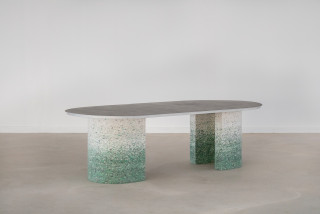
FabBrick table in Jungle Gradient with metal top

1. Fabric Bricks

Bold, colorful and no doubt a design statement, the furniture designed by Clarisse Merlet, architect and founder of FabBrick, is made by stacking bricks created from repurposed textiles. Unwanted fabric remnants are collected primarily from the brand’s clients in France, ensuring traceability and coherence throughout the process, and transformed into products for the home.

Soft to the touch, the material is juxtaposed with sculptural metal to form a tabletop or a chair, and wood and glass can also feature. The bricks can also be used as a wall covering. There are nine colors and three patterns, and custom shades can be developed.

Find an interior designer on Houzz

Adaozañ. Photo by Youenn Le Pocréau

2. Apples for Architecture

Ever wondered what happens to apple waste after apples are pressed to make juice and cider? Neither did we — until we discovered Adaozañ. The brand takes vast amounts of apple pomace — a wet, acidic mass made up of apple flesh, skin and seed waste — from the cider industry in Brittany and turns it into a 100% natural, biodegradable construction material.

With an appearance similar to cork or chipboard, it can be worked like wood and drilled, screwed or assembled using carpentry methods. It can also be laser-cut, CNC-engraved or printed with text or a logo. Once moisture-treated, it is resistant to humidity.

Plush line by Pierreplume. Photo by Sarah Annie Photographie

3. Toys Reimagined

Pierreplume specializes in creating acoustic materials for architecture and interiors — all made from recycled fibers. With a mission to encourage a more environmentally friendly approach to design, the brand’s latest launch is the Plush line. It is the first recycling channel for end-of-line plush toys, turning them into wall coverings that are aesthetically pleasing and functional.

According to the brand, more than 5,000 tons of plush toys are thrown away each year in France, where the team is based. They are collected, sorted by color, hard points removed, stuffing and skins separated and then frayed and finely blended to form five usable materials in shades of brown and pink.

6 Interior Design Trends From Maison & Objet 2026

Sonite Solid Surfaces

4. Sustainable Surfaces

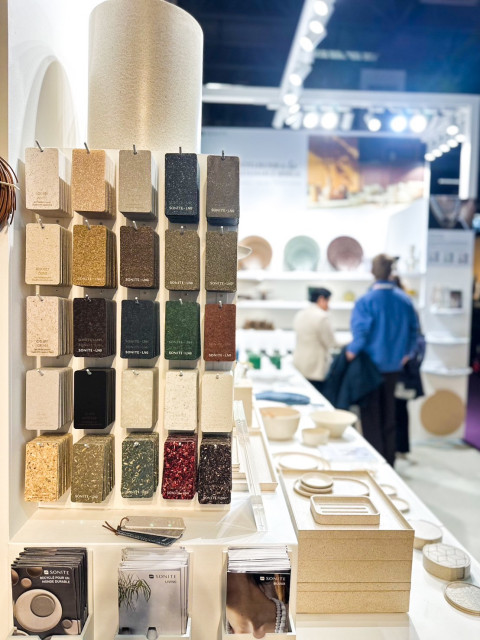
Based in Thailand, Sonite champions a circular view to homeware production. From tableware and furniture to tiles and countertops, the brand makes its products using upcycled materials such as hemp, coconut fibers, rice husk, button scrap, coffee grounds, eggshell and PET bottles.

For example, the Scapa line is an innovative material that resembles reconstituted stone made from used thermoset plastic, while Husk is made of rice husks discarded as part of the milling process in agriculture.

See why you should hire a professional who uses Houzz Pro software

Purefin wallcoverings, Vescom

5. Walls for Well-Being

The trend toward a healthy home continues to grow. In Paris, Vescom showcased its Purefin line of wallcoverings, which feature low-emission materials designed for better air quality. The olefin-based product is free of PVC, plasticizers, chlorine, heavy metals, formaldehyde, halogenated flame retardants and phthalates, resulting in lower VOC levels inside the home.

The material comes in two embossed designs that have a natural, chalky look. Concreed is more rough and rugged and Lynn has a linen-like appearance inspired by traditional plant-based weaving materials.

25 Home Design Trends Defining How We’ll Live in 2026

Gwëmon

6. From the Sea

Working with seaweed harvesters less than 30 miles from its studio in North Finistère, France, Gwëmon’s new material is made from more than 90% brown algae and contains no petroleum-based glues or resins. It can be used for a variety of applications, including cladding, furniture and accessories, and features a distinctive flecked earthy appearance true to its raw state.

The solid material is made by grinding the seaweed into flakes, forming it with a natural binder and molding it into the desired shape before air drying for 14 days at a low temperature to stiffen. Once dry, it’s fashioned into products such as door handles and tabletops.

Les Matériaux Urbains

7. A New View

When eyewear is discarded, what happens to the frames? Les Matériaux Urbains has decided to turn them into lighting and other stylish pieces.

This lamp at the Eco Responsible Design Collective has a tortoiseshell look reminiscent of eyewear in the same style — an homage to a previous life.

10 Lighting Trends That Lit Up Maison & Objet 2026

Atmosphere & Bois

8. Reclaimed Timber

From Canada to Europe, Belgian brand Atmosphere & Bois has launched a collection of furniture made of wood recovered from Canadian barns and old wagon beds, giving new life to a material rich in heritage.

Once sourced, the planks are treated and assembled into new pieces such as tables, seating and storage using traditional carpentry methods. The brand also offers wall cladding and custom designs, including kitchen cabinets.

Check out our guide to get started on your home project

“Forest Song” by Iryna Konakova, Levada

9. Fashion Into Art

Displayed as part of the Ukrainian Neo-Folklore installation at the show, Iryna Konakova’s brand Levada showed how used clothes can become pieces of art when recycled.

Iryna handcrafts textile art using 100% pre-owned clothing, with each vibrant piece reflecting the multicolored traditional ornaments and embroideries typical of Ukraine’s Poltava region, where she was born and still works.

More on Houzz
Read more stories
Browse photos for ideas
Find a home professional


This article was originally published by a www.houzz.com . Read the Original article here. .


Mia Karlsson Interior Design LtdSave Photo
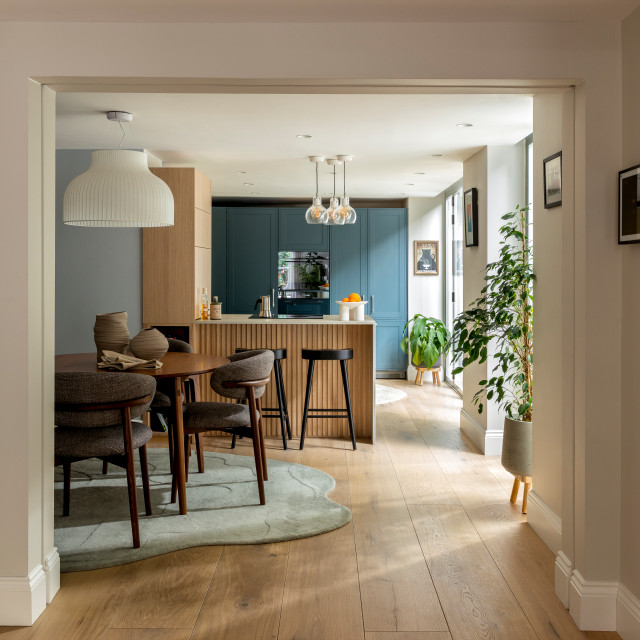
“The rugs, dining chairs and table, armoire and lighting in the dining area all share the same soft curves to create a beautiful flow through the space,” Matthews says.

A soft pendant lamp over the table provides a warm glow in the evening.

The team used Houzz Pro tools to share the design with their clients, as well as the products they specified.

“We use Houzz to manage all our projects and, in particular, the Selections boards, where clients can see all the items we’ve proposed,” Matthews says.

The Selections boards allow professionals to present items they’re considering for the project in a simple format that helps clients feel in control. They can see an image of each product and all of the information at a glance, then quickly press Approve or Decline.

Wall paint: Slate ll and Lead IV, both Paint & Paper Library

See why you should hire a professional who uses Houzz Pro software


This article was originally published by a
www.houzz.com . Read the Original article here. .


Mia Karlsson Interior Design LtdSave Photo
“The rugs, dining chairs and table, armoire and lighting in the dining area all share the same soft curves to create a beautiful flow through the space,” Matthews says.

A soft pendant lamp over the table provides a warm glow in the evening.

The team used Houzz Pro tools to share the design with their clients, as well as the products they specified.

“We use Houzz to manage all our projects and, in particular, the Selections boards, where clients can see all the items we’ve proposed,” Matthews says.

The Selections boards allow professionals to present items they’re considering for the project in a simple format that helps clients feel in control. They can see an image of each product and all of the information at a glance, then quickly press Approve or Decline.

Wall paint: Slate ll and Lead IV, both Paint & Paper Library

See why you should hire a professional who uses Houzz Pro software


This article was originally published by a
www.houzz.com . Read the Original article here. .


Airehart Construction, Inc.Save Photo
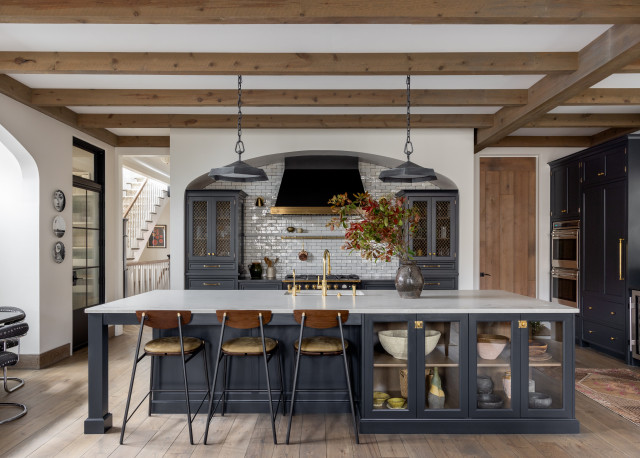
“Uh-oh” moment. “During the installation of the zellige tile backsplash, the design process hit a significant snag,” contractor Brian Airehart says. “The vision was for a glossy, light gray backsplash with organic variations. However, when the tiles arrived, the batch had more color variation than expected. Some tiles were noticeably darker, almost a charcoal gray, which clashed with the airy, cohesive aesthetic the homeowner had envisioned. Compounding the issue, the installers began setting the tiles in a stacked pattern as planned, but the uneven edges of the handmade zellige tiles made the grout lines appear inconsistent, creating a messy, unfinished look.

“The homeowner, seeing the partially installed backsplash, panicked. The designer suggested pausing the installation to reassess the tiles, proposing that they hand-sort the tiles to use the lighter gray ones on the main walls and reserve the darker ones for a smaller accent area, like above the range, to create a subtle contrast that could enhance the design. To address the grout issue, they switched to a thinner grout line with a custom-mixed light gray grout that blended better with the tiles, minimizing the uneven appearance, a technique the designer had seen in a recent Houzz article on working with handmade tiles. After a few extra days of work, the backsplash came together beautifully.”

Shop for your kitchen


This article was originally published by a
www.houzz.com . Read the Original article here. .


Above The Grade LandscapeSave Photo
Tile

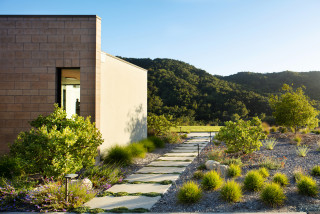
If you live in an area with a warm-winter climate, you might want to consider a tile path.

Tiles can be less expensive than concrete, stone and brick while still delivering plenty of style. Options include terra-cotta and clay tiles as well as unglazed ceramic and porcelain tiles.

Glazed terra-cotta or clay tiles, with their rustic appeal, earth tones and natural variations, are a great choice for paths in the Southwest, but they also can feel at home in other warm-climate areas. These tiles can take day-to-day wear; between the two, terra-cotta tiles are less prone to cracking. You can set either on a concrete or sand-and-gravel base, although the former will provide more stability. Clay tile can be more slippery than terra-cotta tile when wet.

The porous nature of terra-cotta and clay tiles makes them more susceptible to stains, fading and surface damage. To keep them looking their best, clean up dirt and debris regularly and address any stains as soon as they appear. Applying a sealant can help protect against discoloration and wear, but keep in mind that resealing every few years would be necessary to maintain that protection.


This article was originally published by a
www.houzz.com . Read the Original article here. .


Above The Grade LandscapeSave Photo
Tile

If you live in an area with a warm-winter climate, you might want to consider a tile path.

Tiles can be less expensive than concrete, stone and brick while still delivering plenty of style. Options include terra-cotta and clay tiles as well as unglazed ceramic and porcelain tiles.

Glazed terra-cotta or clay tiles, with their rustic appeal, earth tones and natural variations, are a great choice for paths in the Southwest, but they also can feel at home in other warm-climate areas. These tiles can take day-to-day wear; between the two, terra-cotta tiles are less prone to cracking. You can set either on a concrete or sand-and-gravel base, although the former will provide more stability. Clay tile can be more slippery than terra-cotta tile when wet.

The porous nature of terra-cotta and clay tiles makes them more susceptible to stains, fading and surface damage. To keep them looking their best, clean up dirt and debris regularly and address any stains as soon as they appear. Applying a sealant can help protect against discoloration and wear, but keep in mind that resealing every few years would be necessary to maintain that protection.


This article was originally published by a
www.houzz.com . Read the Original article here. .

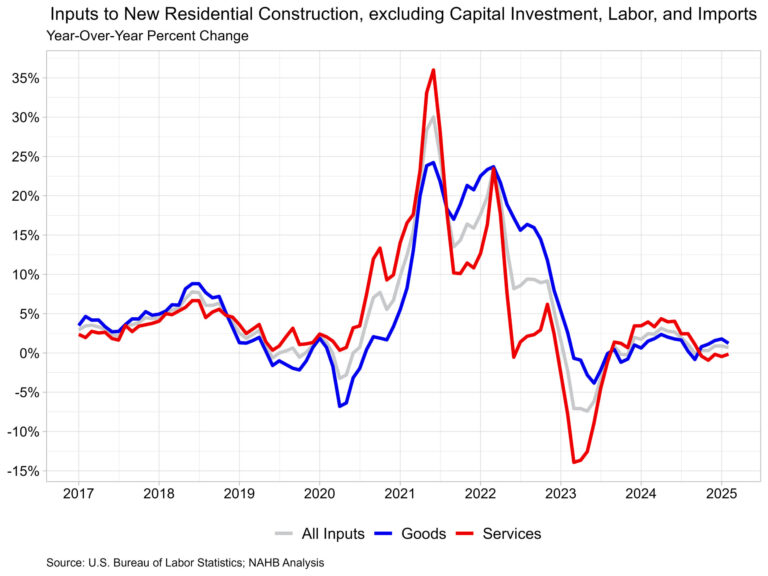
Prices for inputs to new residential construction—excluding capital investment, labor, and imports—were up 0.5% in February according to the most recent Producer Price Index (PPI) report published by the U.S. Bureau of Labor Statistics. The increase in January was revised downward to 1.1%. The Producer Price Index measures prices that domestic producers receive for their goods and services, this differs from the Consumer Price Index which measures what consumers pay and includes both domestic products as well as imports.

The inputs to the New Residential Construction Price Index grew 0.7% from February of last year. The index can be broken into two components—the goods component increased 1.2% over the year, while services decreased 0.1%. For comparison, the total final demand index, which measures all goods and services across the economy, increased 3.2% over the year, with final demand with respect to goods up 1.7% and final demand for services up 3.9% over the year.

Input Goods

The goods component has a larger importance to the total residential construction inputs price index, representing around 60%. For the month, the price of input goods to new residential construction was up 0.6% in February.

The input goods to residential construction index can be further broken down into two separate components, one measuring energy inputs with the other measuring goods less energy inputs. The latter of these two components simply represents building materials used in residential construction, which makes up around 93% of the goods index.

Energy input prices grew 2.6% between January and February but remained 8.5% lower compared to one year ago. Building material prices were up 0.5% between January and February while they were up 2.0% compared to one year ago.

Among materials used in residential construction, lumber and wood products ranks 3rd in terms of importance for the Inputs to New Residential Construction Index. Nonmetallic mineral products and metal products rank 1st and 2nd, respectively. The top lumber and wood products include general millwork, prefabricated structural members, not-edge worked softwood lumber, softwood veneer/plywood and hardwood veneer/plywood. Prices for these wood commodities experienced little growth for most of 2024. Currently, softwood lumber prices were 11.7% higher compared to one year ago while on a monthly basis, prices rose 3.0%. This marks the fourth straight month where yearly price growth was above 10% for softwood lumber.

Input Services

While prices of inputs to residential construction for services were down 0.1% over the year, they were up 0.4% in February from January. The price index for service inputs to residential construction can be broken out into three separate components: a trade services component, a transportation and warehousing services component, and a services excluding trade, transportation and warehousing component. The most significant component is trade services (around 60%), followed by services less trade, transportation and warehousing (around 29%), and finally transportation and warehousing services (around 11%). The largest component, trade services, was down 1.5% from a year ago. The services less trade, transportation and warehousing component was up 1.6% over the year.  Lastly, prices for transportation and warehousing services advanced 2.2% compared to February last year.

Discover more from Eye On Housing

Subscribe to get the latest posts sent to your email.


This article was originally published by a eyeonhousing.org . Read the Original article here. .

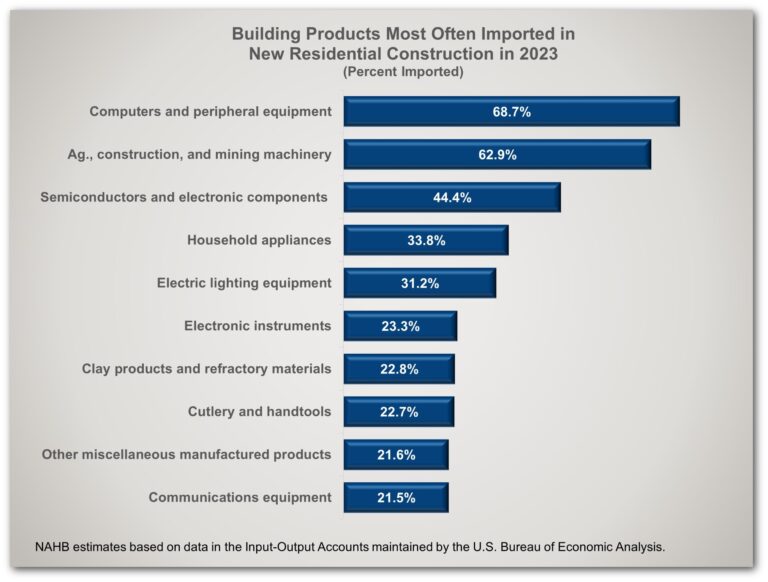
NAHB estimates that $184 billion worth of goods were used in the construction of both new multifamily and single-family housing in 2023. Additionally, we estimate that $13 billon of those goods were imported from outside of the U.S. These figures lead to 7% of all goods used in new residential construction originating from a foreign nation. This data come from the BEA input-output accounts, which reveals important details of numerous industries across the U.S. detailing what products they produce, use and import in the economy. The latest tables are from 2017 and the data is adjusted to 2023 dollar value.

Import use varies significantly by type of building product. Shown above are the ten most import reliant products that are used in new residential construction. These products are defined by North American Industry Classification System (NAICS).

The U.S Census Bureau reports data on international trade of goods by NAICS definitions. With this, we can locate which nations are responsible for importing products used in residential construction into the U.S. Using the commodities that are used in residential construction, a significant share comes from China, at 27%. Mexico was the second most important nation with around 11% followed by Canada at 8%. Shown below are the countries with the 10 highest shares along with the remaining 27% from countries outside the top 10.

Tariff Impact

During the election campaign, President Trump promised the enactment of a tariff plan ranging from 10%-20% on imported goods, with 60% tariffs on imports from China. A tariff is essentially a tax on an imported good, meaning the importer pays an additional tax for importing such an item from another country. For example, say a business in the United States needed to purchase a $100 worth of screws from China. With a 60% tariff, the business would then need to pay an additional $60 to the U.S. Government to receive the screws. The exporter in China would still receive the $100 from the business and not pay the added tariff costs. The tariff cost falls on the importer, who would absorb the higher costs through lower profit margins or raising their own prices for consumers.

Without additional detail for these tariff proposals, it is difficult to estimate the impact of these tariffs. Using our best estimate, a 10% tariff on all imports with a 60% tariff on imports directly from China would result in a $3.2 billion increase in the cost of imported building materials used in residential construction. By product, the largest increase in cost would be for household appliances, where 54% of imports come from China, this tariff adds $670 million for these imported products. Additionally, a 20% tariff coupled with 60% imports from China would result in $4.2 billion in added cost of imported residential building products.  

From Canada, the U.S. imports a significant amount of wood related products. In 2023, 70% of sawmill and wood product imports came from Canada. Many of these wood products from Canada are already subject to tariffs, with the current rate at 14.5%. Total imports of sawmill and wood products from Canada in 2023 was $5.8 billion. The highest valued import from Canada was nonferrous metals, totaling $17.6 billion in 2023.

Turning to Mexico, 71% of lime and gypsum products imported in 2023 originated from Mexico. While this share is particularly high, the total value of imports in 2023 of lime and gypsum was only $456 million. The highest valued import from Mexico at $28.6 billion in 2023 was computer equipment, where imports from Mexico made up 23% of total imports of computer equipment in 2023.

Discover more from Eye On Housing

Subscribe to get the latest posts sent to your email.


This article was originally published by a eyeonhousing.org . Read the Original article here. .

Pin It