This article was originally published by a www.houzz.com . Read the Original article here. .
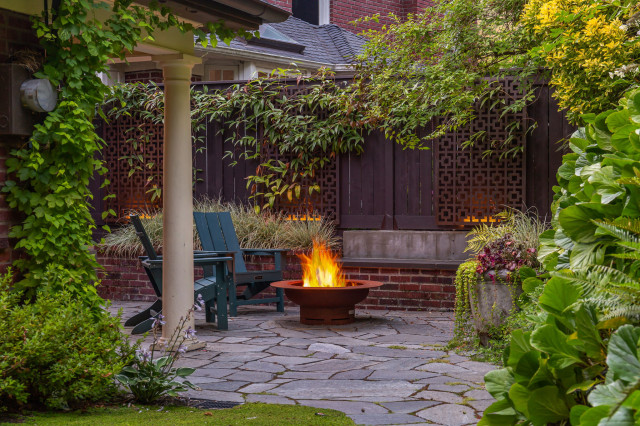
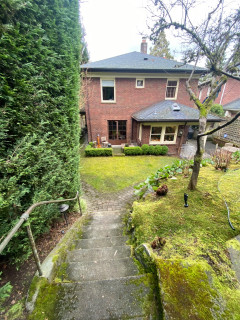
The vine growing up the corner of the house and along the entry overhang was another priority within the design. “This is a hop vine [Humulus lupulus, zones 4 to 8] that the homeowner has been growing for many years. He had trained it across the overhang, and it was important to him that we protect it,” Galante says.
Galante reports that the homeowners love their pots and planters. She filled the built-in brick planters around the patio with ‘EverColor Everest’ Japanese sedge (Carex oshimensis EverColor Everest ’Carfit01’, zones 5 to 9), which adds soft color and texture against the fence. The pot on the right has autumn fern (Dryopteris erythrosora, zones 5 to 8) and creeping jenny (Lysimachia nummularia, zones 3 to 9).
This article was originally published by a www.houzz.com . Read the Original article here. .
Highlights include: a bee-friendly, pink-flowering ornamental oregano (Origanum laevigatum ‘Herrenhausen’, USDA zones 5 to 9; find your zone); a low-growing rosemary (Rosmarinus officinalis ‘Prostratus’, zones 8 to 11); yellow-flowered yarrow (Achillea ‘Terracotta’, zones 3 to 8); thistle-like sea holly (Eryngium bourgatii, zones 5 to 8), and Latin American fleabane (Erigeron karvinskianus, Zone 6), which forms daisy-like flowers. “[Latin American] fleabanes are great filler plants and really help to pull a scheme together,” Clayton says. “They grow anywhere, bees love them and they flower nine months of the year, pretty much.”
Further back is purple-flowering ‘Rozanne’ cranesbill (Geranium ‘Rozanne’, zones 4 to 9) and Hart’s tongue fern (Asplenium scolopendrium, zones 5 to 9).
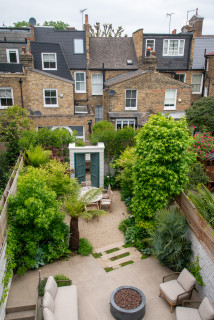
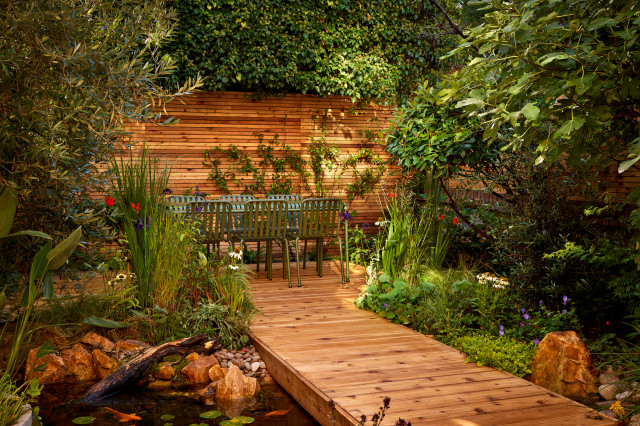
Amid the new foliage are existing shrubs and trees, including a large fig on the right and a Photinia that Clayton strategically reshaped. “The couple had quite a few large shrubs that were taking over the view and adding a lot of shade,” she says. “To be sustainable, we kept a lot of them but pruned them into multi-stems to make them lighter and also to let more daylight through. It’s nice, rather than just ripping everything out, and also gives you an opportunity to underplant them rather than just having dense shrubs,” the designer adds.
There was also an existing olive tree on the left. “The olive tree is massive,” Clayton says. “We love keeping bigger trees in the [landscape], and they give a sense of scale that helps to make a city garden feel more natural. I always think that going bigger with a couple of strong elements makes smaller spaces — weirdly — feel bigger.”
15 Ways to Create a Beautiful Water-Wise Landscape
This article was originally published by a www.houzz.com . Read the Original article here. .
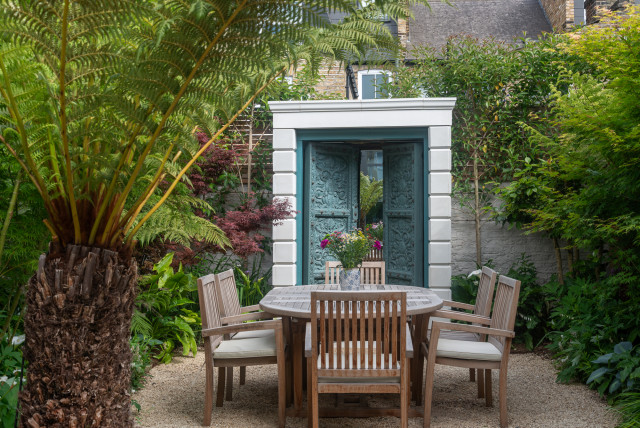
“Because it’s such a small space, the texture was incredibly important,” she says. “It’s all about the different greens and mix of shapes. The flowers come and go — they’re quite transient. Apart from an existing red rose and camellia, both of which I kept, the flowers are mostly white and surrounded by all these lush greens.” The sweet gum (Liquidambar sp.) on the right was existing; Boyle added a multistemmed one on the other side to match it, “so you frame that space,” she says.
“I planted quite heavily, but that was because we wanted to create this green haven,” she says. “I like to create a rhythm, so I have three [Japanese maples] in a triangle, and three Tasmanian tree ferns [Dicksonia antarctica, zones 9 to 10], which give a jungly feel and a lovely canopy while still allowing for stuff [to grow] underneath. Their trunks add nice texture, which is offset beautifully against the rest of the planting.” Boyle installed root barriers so the plants won’t spread to other yards.
See why you should hire a professional who uses Houzz Pro software