The U.S. housing market showed mixed but generally improving conditions in March, as new home sales strengthened and price pressures continued to ease. While inventory dynamics varied across segments, moderating home prices and increased availability at the lower end of the market provided some relief to buyers navigating ongoing affordability challenges.
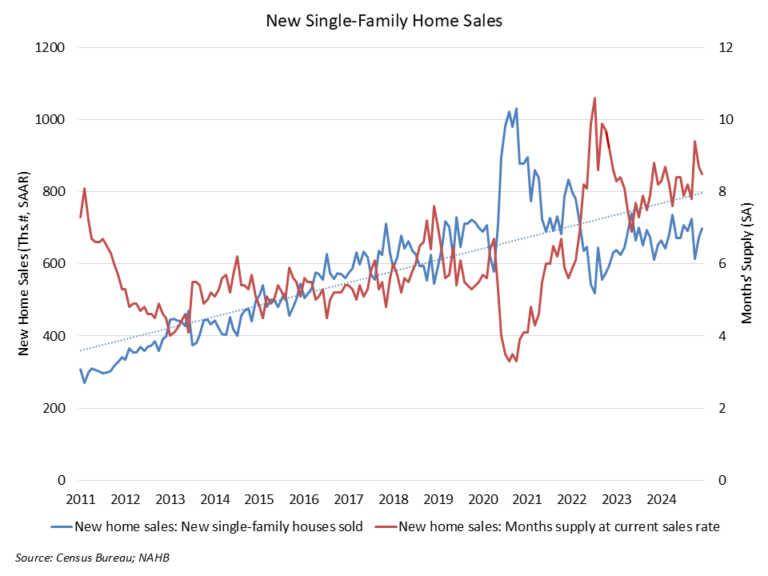
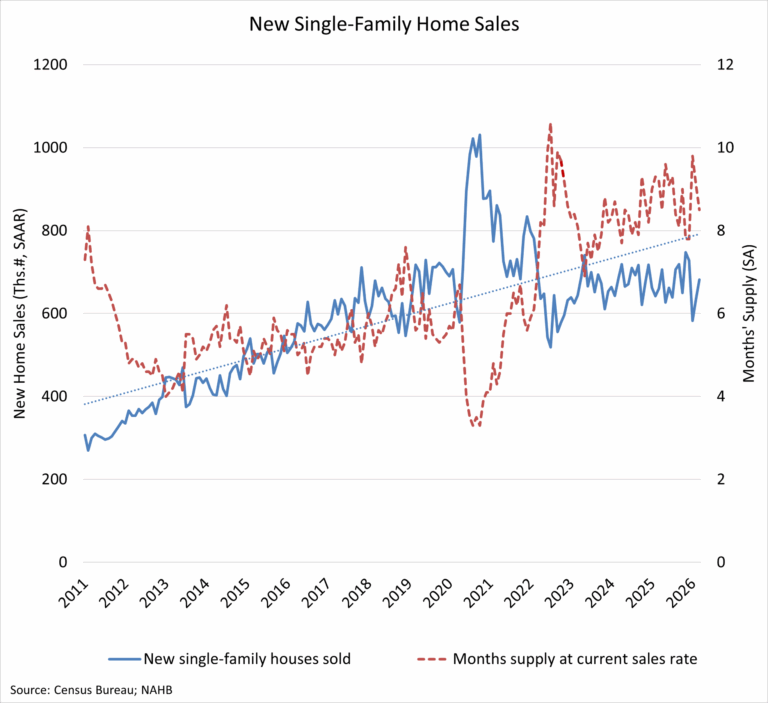
Sales of newly built single-family homes increased 7.4% month-over-month in March to a seasonally adjusted annual rate of 682,000 units, according to the U.S. Department of Housing and Urban Development and the U.S. Census Bureau. This represented a 3.3% increase compared to a year earlier. A new home sale is recorded when a contract is signed, or a deposit is accepted, regardless of the stage of construction. The seasonally adjusted annual rate reflects the pace of sales that would occur over a 12-month period if current conditions persist.
New single-family home inventory totaled 481,000 units in March, down 0.4% from the prior month and 4.6% from a year earlier. At the current sales pace, the months’ supply of new homes stood at 8.5 months, down from 9.2 months one year ago, though still above the six-month level generally considered to indicate a balanced market.
Combined new and existing home inventory has edged higher in recent months, with the total months’ supply reaching 4.8 months. Meanwhile, inventory conditions in the existing home market have retreated after showing gradual improvement in prior months. Moderating prices across both markets have helped support buyer demand amid ongoing affordability concerns.
At the end of March, there were 119,000 completed, ready-to-occupy homes available for sale on a non-seasonally adjusted basis, up 5.3% from a year earlier. Completed homes accounted for one-quarter of total inventory, while homes under construction made up 51%. The remaining 24% of homes sold in March had not yet started construction at the time the sales contract was signed.
Home prices showed further signs of cooling at the start of 2026. The median new home sale price was $387,400, down 6.2% from a year ago, and 9.7% below the recent peak of $429,100 reached in December 2025. Affordability improved at the lower end of the market, with 20 percent of new homes priced below $300,000. Over a quarter (28%) of homes were priced above $500,000, while the remaining share fell within the $300,000 to $500,000 range.
Regionally, year-over-year new home sales increased 8.0% in the Midwest, reflecting ongoing strength in residential construction across the Midwestern states. New home sales declined 17.6% in the Northeast, 14.0% in the West and 2.6% in the South.
This article was originally published by a eyeonhousing.org . Read the Original article here. .