Strong multifamily growth pushed overall housing starts higher in June, while single-family production remained sluggish as elevated mortgage rates, rising construction costs and persistent labor shortages continued to weigh on the market.
Overall housing starts increased 19.0% in June to a seasonally adjusted annual rate of 1.43 million units, according to a report from the U.S. Department of Housing and Urban Development (HUD) and the U.S. Census Bureau. This pace reflects the number of housing units builders would begin over the next 12 months if June’s activity were sustained.
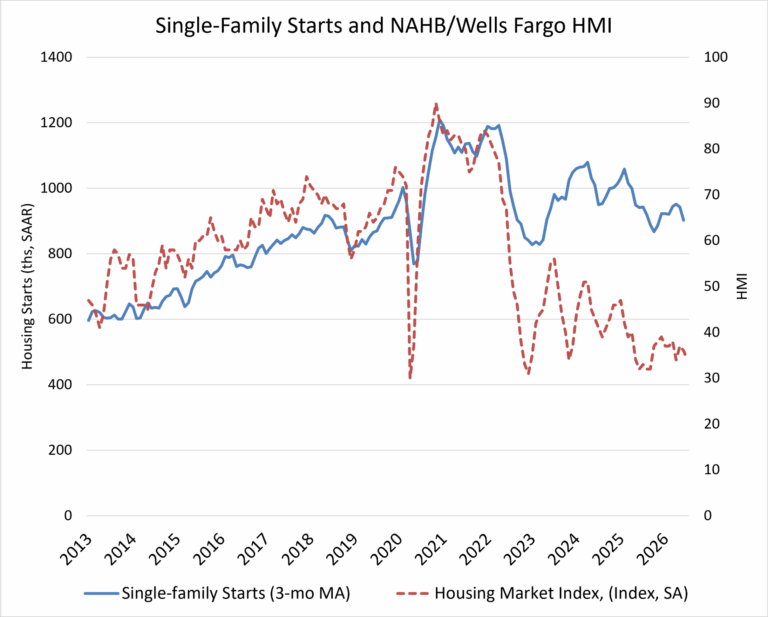
Within the total, single-family starts decreased 0.2% to an 895,000 seasonally adjusted annual rate and were down 3.2% compared to June 2025. On a year-to-date basis, single-family starts are down 5.3%. Given recent volatility, the three-month moving average provides a clearer signal, falling to 902,000 units.
Multifamily starts, which include apartment buildings and condominiums, rose 76.2% from May to June to an annualized 532,000 pace. The three-month moving average for multifamily construction has trended higher to 445,000 units, and activity is 17.2% higher compared to year-earlier levels.
Regionally, on a year-to-date basis, combined single-family and multifamily starts were 4.5% higher in the Northeast, 1.7% higher in the South, 1.2% higher in the Midwest, and 4.4% lower in the West. Single-family starts were down in all four regions.
The total number of housing units under construction stood at 1.26 million in June, down 6.2% from a year earlier. Single-family homes under construction stood at 582,000 units, a 6.9% year-over-year decline. Multifamily units under construction slowed down to 682,000, down from peaks above 1 million units in December 2023 and 5.7% lower than a year ago.
Completions of single-family homes have improved to an annual rate of about 964,000 units. This marks a 5.5% increase from a year earlier. However, multifamily completions for buildings with five or more units were down 5.1% year over year to a 413,000-unit pace. On a year-to-date basis, total completions across both sectors are down 9.5% reflecting ongoing challenges in the residential construction sector.
Overall permits declined 3.0% to a 1.37-million-unit annualized rate in June. Single-family permits decreased 2.4% to an 871,000-unit rate and are essentially flat compared to June 2025. Multifamily permits are down 4.2% to an annualized 496,000 pace and are down 5.7% compared to June 2025. Looking at regional permit data on a year-to-date basis, total permits were 15.2% higher in the Northeast, 1.4% higher in the Midwest, 0.7% higher in the West, but 6.3% lower in the South. For single-family permits, the Midwest was the only region to post an increase, rising 1.3% reflecting the residential construction strength in the region.
This article was originally published by a eyeonhousing.org . Read the Original article here. .