Tag

Lending

Browsing


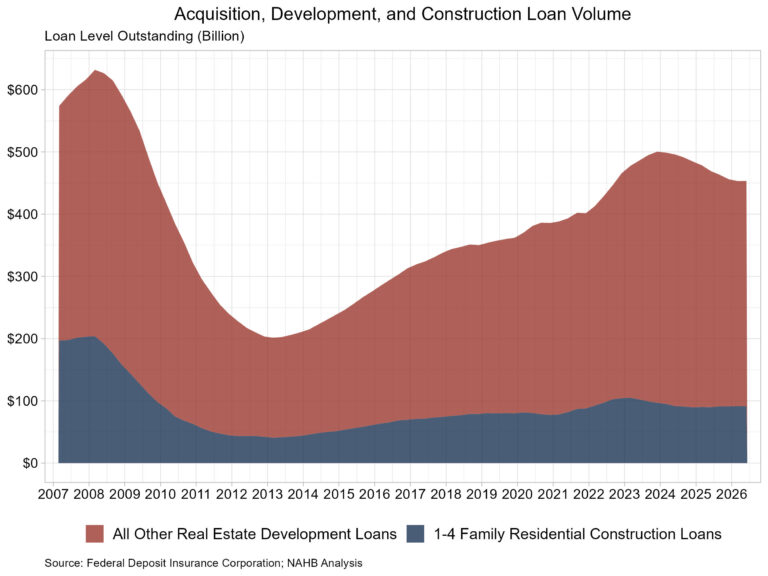
Single-family construction lending rose marginally in the first quarter, according to data released by the Federal Deposit Insurance Corporation. The volume of loans outstanding was up 0.8% from the fourth quarter. This increase comes at a time when NAHB’s AD&C Financing Survey indicates a slight tightening in credit conditions in the first quarter. The total volume of outstanding AD&C loans, which includes both nonresidential and residential construction loans, fell for the ninth consecutive quarter.

In the first quarter of 2026, the total level of outstanding AD&C loans fell to $453.3 billion, down 0.6% from the fourth quarter. The quarterly decline was led by a drop in other real estate development loans, which declined 1.8% to $361.5 billion. Meanwhile, the volume of 1-4 family residential construction and land development loans rose to $91.8 billion in the first quarter, up 0.8% from a quarter earlier. The volume of 1-4 family residential was up 1.9% from last year. This marked the third straight quarter showing a year-over-year increase.

It is worth noting that the FDIC data represents only the stock of loans, not changes in the underlying flows, so it is an imperfect data source. Nonetheless, lending remains much reduced compared with years past. The current amount of existing 1-4 family residential AD&C loans now stands 56% lower than the peak level of residential construction lending of $204 billion reached during the first quarter of 2008. Alternative sources of financing, including equity partners, have supplemented this capital market in recent years.

Quality Metrics of Construction Loans

The volume of loans that are 30+ days past due or nonaccrual status rose in the first quarter, to $989.8 million. As a share of the total 1-4 family residential construction loan volume, this accounts for 1.1%.

Breaking this out further, the level of loans 30-89 days past due was $451.3 million, while the volume in nonaccrual status was $495.2 million. The nonaccrual loan volume fell from $522.1 million in the fourth quarter, and the 30-89 past due volume rose from $414.2 million.

Loans are classified as nonaccrual when one or more of the following conditions apply: the loan is 90 days or more past due on principal or interest (unless it is well-secured and in the process of collection); the bank no longer expects full repayment of principal and interest; or the borrower’s financial condition has significantly deteriorated, warranting cash-basis accounting.


This article was originally published by a eyeonhousing.org . Read the Original article here. .

Lending standards and demand for most types of residential mortgages were essentially in the first quarter of 2026, according to the recent release of the Senior Loan Officer Opinion Survey (SLOOS). For commercial real estate (CRE) loans, lending standards for multifamily construction & development were essentially unchanged as well. Compared to the previous quarter, demand for construction & development loans was weaker, while demand for multifamily loans was essentially unchanged. 

The Federal Reserve has maintained its key short-term interest rate (i.e., Fed Funds) unchanged during the first three meetings of 2026. There has been growing division between FOMC participants on the appropriate trajectory of the Fed Funds rate that will satisfy their dual mandate of maximum employment and stable prices (i.e., inflation). Along with the arrival of a new Chair and the exogenous shocks to the global economy caused by the ongoing conflict in Iran, this has created a “wait-and-see” approach to monetary policy. As a result, NAHB does not forecast any changes to the Fed Funds rate until the end of the year.

Residential Mortgages

In the first quarter of 2026, three of seven residential mortgage loan categories: GSE-eligible, Qualified Mortgage (QM) non-jumbo non-GSE eligible, and Government saw a positive net easing index for lending conditions. An additional two (QM jumbo and non-QM jumbo) recording a neutral reading (i.e., 0). Subprime and non-QM non-jumbo loans continued to experience tighter lending conditions, as evidenced by a negative value, -6.3 and -2.0, respectively.

Four of the seven residential mortgage loan categories (GSE-eligible, QM Jumbo, non-QM jumbo, and Government) reported demand essentially unchanged in the first quarter of 2026. Two categories (non-QM non-jumbo and QM non-jumbo non-GSE eligible) experienced modestly weaker demand. However, the weakest demand continues to be for subprime loans, which has experienced weaker demand for 23 consecutive quarters.

Commercial Real Estate (CRE) Loans

For the CRE loan categories, multifamily registered a net easing index of 0.0, while the net easing index for construction & development loans was -4.8 in the first quarter of 2026. The Fed classifies changes between -5.0% and +5.0% as essentially unchanged.

The net percentage of banks reporting stronger demand was -11.7% for construction & development loans, with a negative number indicating weaker demand. This was a reversal for construction & development from last quarter, which saw stronger demand (+8.9%). For multifamily loans, demand was +3.3% in the first quarter of 2026, which is essentially unchanged according to the Fed’s classification scheme,  as it has been for six consecutive quarters.


This article was originally published by a eyeonhousing.org . Read the Original article here. .


Lending standards for most types of residential mortgages were essentially unchanged but overall demand was weaker in the fourth quarter of 2025, according to the recent release of the Senior Loan Officer Opinion Survey (SLOOS). However, for commercial real estate (CRE) loans, lending standards for multifamily were looser, while standards for construction & development were essentially unchanged. Demand for construction & development loans was stronger, while demand for multifamily loans was essentially unchanged for the quarter. 

After three consecutive 25 basis point cuts to finish 2025, the Federal Reserve decided to maintain its key short-term interest rate (i.e., Federal Funds) unchanged during its first meeting of 2026. Participants on the Federal Open Market Committee (FOMC) continue to assess how to weigh the components of its dual mandate, as inflation continues to be above the stated target of 2% (i.e., the case for higher rates) while the economy is experiencing further deceleration in job growth (i.e., the case for lower rates). Given the current macroeconomic landscape and a change in leadership at the Fed as Jerome Powell’s term as Chair ends in May, NAHB anticipates that any further rate cuts will occur in the latter half of this year.

Residential Mortgages

In the fourth quarter of 2025, three of seven residential mortgage loan categories; GSE-eligible, Qualified Mortgage (QM) non-jumbo non-GSE eligible, and Government, saw a positive net easing index for lending conditions with an additional two (non-QM non-jumbo and QM jumbo) recording a neutral reading (i.e., 0). Subprime and non-QM jumbo loans experienced tighter lending conditions, as evidenced by a negative value, -8.3 and -4.2 respectively.

All seven residential mortgage loan categories reported weaker demand in the fourth quarter of 2025, with the weakest demand coming from subprime loans. This category has experienced weaker demand for 22 consecutive quarters.

Commercial Real Estate (CRE) Loans

For the CRE loan categories, multifamily registered a net easing index of +5.5 for the fourth quarter of 2025, indicating looser credit conditions for the first time since Q1 2022. As a reminder, this was when the Federal Reserve began their aggressive rate hiking path, which saw the Federal Funds rate increase by 525 basis points over a year and a half period. For construction & development loans, the net easing index was -1.8, or essentially unchanged.

The net percentage of banks reporting stronger demand was 8.9% for construction & development loans, with a positive number indicating stronger demand. This is the first time construction & development has been positive since Q4 2021. For multifamily loans, demand was -1.9% in the fourth quarter of 2025, which is essentially unchanged according to the Fed’s classification scheme (i.e., between -5.0% and +5.0%).


This article was originally published by a eyeonhousing.org . Read the Original article here. .


Lending standards for most types of residential mortgages were essentially unchanged, according to the recent release of the Senior Loan Officer Opinion Survey (SLOOS). For commercial real estate (CRE) loans, lending standards for construction & development were modestly tighter, while multifamily was essentially unchanged.  Demand for both CRE categories was essentially unchanged for the quarter. 

Two weeks ago, the Federal Reserve eased its key short-term interest rate (i.e., Federal Funds) by 25 basis points for the second consecutive meeting, establishing an upper bound of 4.00%.  While the causal link between the Federal Funds rate and the 30-year fixed rate mortgage is minimal, these cuts will have a more tangible impact for private home builders through lower rates on acquisition, development, & construction (AD&C) loans.  Roughly 60% of single-family starts are built by private builders. With pressure from both sides of their dual mandate as the job market cools and inflation remains sticky, NAHB is forecasting a measured approach from the Fed when it comes to further rate cuts next year.

Residential Mortgages

In the third quarter of 2025, four of seven residential mortgage loan categories saw a positive net easing index for lending conditions with an additional two recording a neutral reading (i.e., 0).  Only subprime loans experienced tighter lending conditions, as evidenced by a negative value (-6.3).  Nevertheless, based on the Federal Reserve classification of any reading between -5.0 and +5.0 as “essentially unchanged,” all but subprime fell within this range.

Five of the seven residential mortgage loan categories reported stronger demand in the third quarter of 2025, with the strongest demand coming from Government, GSE-eligible, and Qualified Mortgage (QM) non-jumbo, non-GSE eligible loans.  Non-QM jumbo was essentially unchanged for the quarter, while subprime loans were the only category to experience weaker demand, which has been the case since Q3 of 2020.

Commercial Real Estate (CRE) Loans

For the CRE loan categories, construction & development loans registered a net easing index of -6.6 for the third quarter of 2025, indicating modestly tighter credit conditions.  For multifamily loans, the net easing index was -1.6, or essentially unchanged.  Both categories of CRE loans show tightening of lending conditions (i.e., net easing indexes below zero) since Q2 2022.  However, the tightening has become less defined recently for multifamily, with its net easing index essentially unchanged (i.e., between -5.0 and +5.0) for four consecutive quarters.

The net percentage of banks reporting stronger demand was -4.9% for construction & development loans, with a negative number indicating weaker demand.  For multifamily, demand was neutral (i.e., 0) in the third quarter of 2025, with the same number of banks that reported weaker demand as those who reported stronger demand.  However, demand for CRE loans within both categories has experienced unchanged conditions (i.e., between -5.0% and +5.0%).


This article was originally published by a eyeonhousing.org . Read the Original article here. .


Lending standards were essentially unchanged for all residential mortgage categories in the third quarter of 2024, except for Subprime loans, according to the Federal Reserve Board’s October 2024 Senior Loan Officer Opinion Survey (SLOOS).  Demand for most residential mortgage loans remained weaker across all categories in the quarter.  Lending conditions for commercial real estate (CRE) loans were moderately tight, amid modestly weak demand as well.  However, NAHB believes that financial conditions for the home building industry should improve next year as the Federal Reserve continues along their current rate cutting cycle.

Residential Mortgages

GSE-eligible and Qualified Mortgage (QM) non-jumbo non-GSE eligible mortgages recorded a neutral net easing index value (i.e., 0) while the other five residential mortgage loan types (Subprime, Non-QM jumbo, QM jumbo, Non-QM non-jumbo, Government) were negative for the third quarter of 2024, representing tightening conditions.

Besides GSE-eligible, which posted stronger demand (i.e., positive value) for the first time since Q2 2021, and QM non-jumbo non-GSE eligible (neutral demand), all other residential mortgage loan categories reported weaker demand in Q3 2024. Weakness is less widespread than in recent quarters, however. Among all residential mortgage loan categories, falling demand is best highlighted by Subprime loans which  experienced weaker demand for 17 consecutive quarters, or for over four years.

Commercial Real Estate (CRE) Loans

Banks reported moderately tightening lending conditions for both multifamily as well as all CRE construction & development loans in the third quarter of 2024.  However, the tightening was not as widespread as in recent quarters. Results show 10 consecutive quarters of tightening lending conditions for CRE loans.

For multifamily, the net percentage of banks reporting stronger demand was -8.2% while –14.8% for construction & development loans.  Although improving, weaker demand has continued for over two years for both CRE loan categories.

Discover more from Eye On Housing

Subscribe to get the latest posts sent to your email.


This article was originally published by a eyeonhousing.org . Read the Original article here. .


According to the Federal Reserve Board’s July 2024 Senior Loan Officer Opinion Survey (SLOOS), lending standards were essentially unchanged for all residential real estate (RRE) categories in the second quarter of 2024.  However, demand for RRE loans remained modestly weaker across all categories in the quarter.  Lending conditions were significantly tighter, and loan demand modestly was weaker across all commercial real estate (CRE) loan categories.  Nevertheless, language from the most recent Federal Open Market Committee (FOMC) suggest that cuts to the federal funds rate are imminent which will be welcomed relief for the real estate market and will help stimulate future loan activity.

Residential Real Estate (RRE)

Four of the seven RRE categories (GSE-eligible, non-Qualified Mortgage or QM jumbo, Non-QM non-jumbo, and Subprime)recorded a net share of banks reported tighter lending standards in Q2 2024 as neutral (i.e., 0%) . The other three categories, which included government (i.e., issued by FHFA, Department of Veteran Affairs, USDA, etc.), QM jumbo, and QM non-jumbo non-GSE eligible recorded a negative reading which means that more banks reported looser rather than tighter conditions.

Six of the seven categories of RRE loans showed a decrease in net tightening from Q1 2024 to Q2 2024, with the only exception being GSE-eligible which increased 1.8 percentage points.  The largest drop in the net tightening percentage occurred for Non-QM jumbo which fell 9.8 percentage points (pp) from 9.8% in Q1 2024 to 0% in Q2 2024.

All RRE categories reported net weaker demand in Q2 2024.  The survey has shown that banks have indicated weaker demand for at least 12 consecutive quarters for all RRE categories going back to Q2 2021 (Subprime leads all RRE categories at 16 consecutive quarters).

Commercial Real Estate (CRE)

Banks reported significantly tighter lending conditions for both multifamily as well as all CRE construction & development loans in Q2 2024.  However, both categories showed less net tightening than they did a quarter before, most noticeably multifamily falling 11.7 percentage points.  Nevertheless, it has been 10 consecutive quarters of tighter lending conditions for construction & development and 9 consecutive quarters for multifamily.

For multifamily, 17.5% of banks reported net weakening of demand for loans which is 16.4 percentage points lower compared to Q1 2024.  As for construction & development loans, 15.9% of banks reported net weakening of demand for loans which was little changed from the previous quarter.  Weaker demand has persisted for roughly the last two years for construction & development (10 consecutive quarters) and multifamily (8 consecutive quarters).

Special Questions

The Federal Reserve included a set of special questions this quarter which asked banks “to describe the current level of lending standards at your bank relative to the range of standards that has prevailed between 2005 and the present.”  Effectively, they are asking banks to think about the median lending standards over the last two decades and determine where do conditions today rank on this continuum.  On balance, banks indicated that the current level of lending standards is located at the tighter end of this range for all loan categories, including CRE and RRE loans.

Discover more from Eye On Housing

Subscribe to get the latest posts sent to your email.


This article was originally published by a eyeonhousing.org . Read the Original article here. .
Pin It