Tag

Labor

Browsing


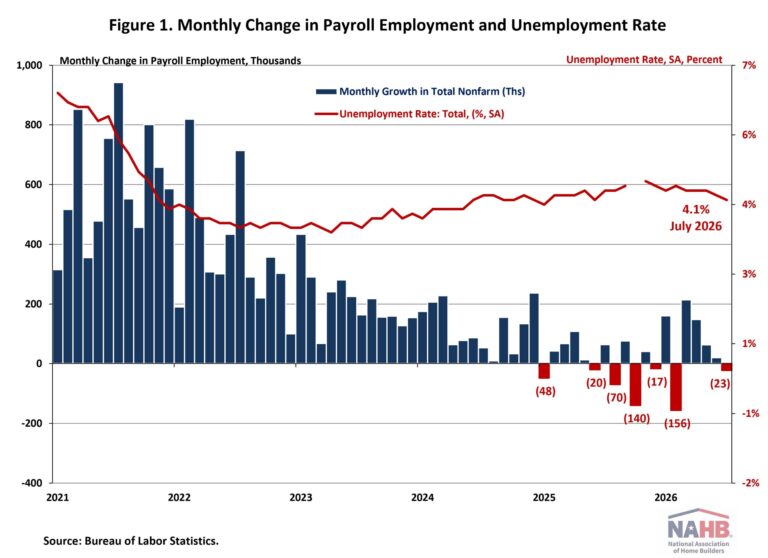
Despite rising inflation and ongoing economic uncertainty, the U.S. labor market remained resilient in May. Nonfarm payrolls increased for the third consecutive month, and the unemployment rate held steady at 4.3%. Job gains were concentrated in leisure and hospitality, local government, and health care, while financial activities experienced a decline in payroll employment.

Wage growth moderated in May, with average hourly earnings rising 3.4% year-over-year. This pace is 0.5 percentage points lower than a year ago. Importantly, wage growth has been outpacing inflation for nearly two years, which typically occurs as productivity increases.

National Employment

According to the Employment Situation Summary reported by the Bureau of Labor Statistics (BLS), total nonfarm payroll employment increased by 172,000 in May, following an upwardly revised gain of 179,000 jobs in April. This marked the third consecutive month of job gains following a period of volatile payroll growth.

Employment gains for the previous two months were revised higher. The monthly change in total nonfarm payroll employment for March was revised upward by 29,000 from +185,000 to +214,000, while the change for April was revised upward by 64,000 from +115,000 to +179,000. Combined, these revisions added 93,000 more jobs than previously reported.

Job growth in early 2026 has improved notably compared with 2025 but has yet to fully match the pace observed in 2024. Through May, monthly payroll gains have averaged 114,000, compared with 10,000 per month in 2025 and 122,000 per month in 2024.

The unemployment rate remained unchanged at 4.3% in May. Over the month, the number of persons unemployed declined by 66,000, while the number of persons employed rose by 149,000.

Meanwhile, the labor force participation rate—the proportion of the population either looking for a job or already holding a job—remained unchanged at 61.8%. This marks the lowest level since November 2021 and remains below its pre-pandemic level of 63.3% recorded at the beginning of 2020. Among prime working-age individuals (aged 25 to 54), the participation rate rose 0.1 percentage points to 83.9%.

Job gains in May were slightly more broad-based than in recent months. Employment increased by 70,000 in leisure and hospitality, 55,000 in local government, and 35,000 in health care. In contrast, employment in financial activities declined by 22,000 and has fallen by 107,000 since its recent peak in May 2025. Federal government employment, which experienced a sharp decline last fall, increased modestly by 1,000 jobs in May.

Construction Employment

Employment in the overall construction sector rose by 17,000 jobs in May, following a gain of 9,000 in April. Within the industry, residential construction added 900 jobs, while non-residential construction added 15,700 jobs.

Residential construction employment now stands at 3.3 million in May, including 925,000 workers employed by builders and remodelers and nearly 2.4 million residential specialty trade contractors.

Despite the monthly gain, residential construction employment continues to show signs of weakness. The six-month moving average of job gains for residential construction remains negative, reflecting an average monthly loss of 1,300 jobs and declines in three of the past six months. Meanwhile, over the last 12 months, residential construction has shed a net of 33,300 jobs, marking the fifteenth consecutive annual decline and the longest stretch of annual losses since the Great Recession. However, residential construction has gained 1,303,900 positions from its post-Great Recession low.

Meanwhile, the unemployment rate for construction workers rose to 5.2% in May on a seasonally adjusted basis, though it remains relatively low compared with historical norms.


This article was originally published by a eyeonhousing.org . Read the Original article here. .


The number of open positions in construction in February was down year-over-year, per the Bureau of Labor Statistics Job Openings and Labor Turnover Survey (JOLTS). The current level of open jobs is down measurably from three years ago due to declines in construction activity, particularly in housing. However, recent gains for nonresidential construction have not fully offset soft conditions for housing with respect to the demand for construction labor.

The number of open jobs for the overall economy declined in February, falling from 7.24 million in January to 6.88 million in February. The February reading was down from a year ago (7.24 million) due to a cooling labor market.

Previous NAHB analysis indicated that this number had to fall below eight million on a sustained basis for the Federal Reserve to move forward on interest rate reductions. With estimates remaining below eight million for national job openings, the Fed, in theory, should be able to cut further.

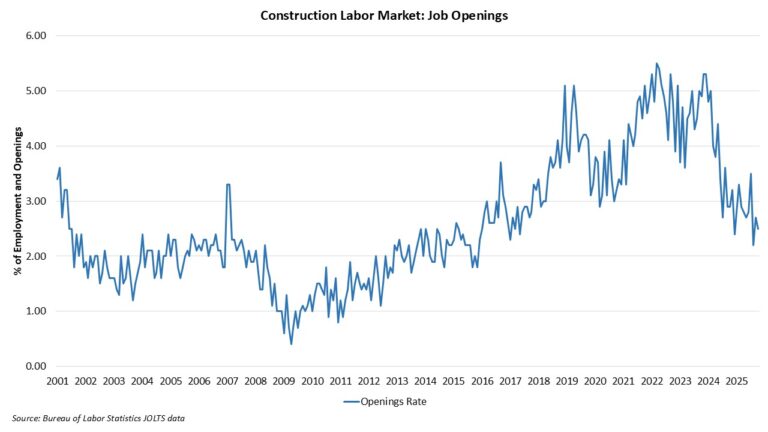
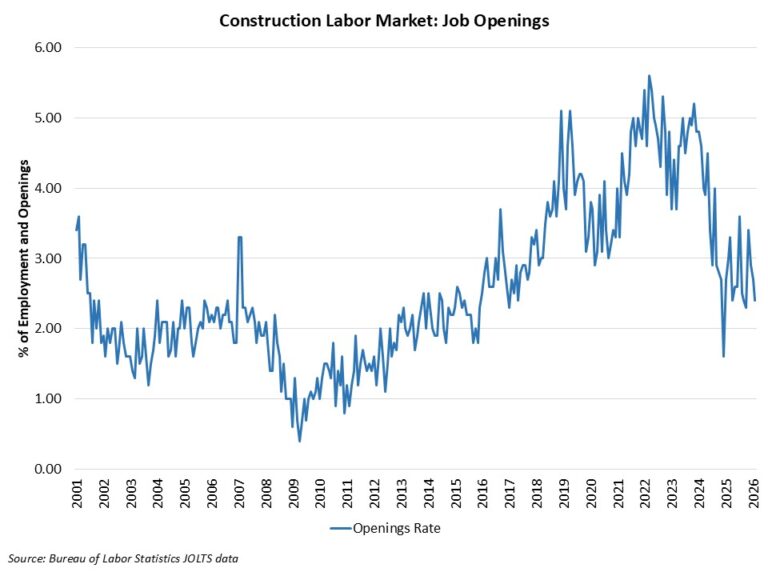
The number of open construction sector jobs fell, declining slightly from 230,000 in January to 202,000 in February. This total was down compared to a year ago (255,000). The chart below notes the declining trend that has been in place for unfilled construction jobs since the Fed raised the federal funds rate and home building weakened. While home building employment was declining during the second half of 2025, other subsectors of the construction industry have expanded (e.g. data centers). This has produced volatility within a reduced range in the series since 2024.

The construction job openings rate decreased to 2.4% in February, down from the 3% rate estimated a year ago.

The layoff rate in construction declined slightly to 1.8% in February. The quits rate decreased to 1.3% for the month.

The current data looks similar to the much discussed low-hire, low-fire labor market paradigm.


This article was originally published by a eyeonhousing.org . Read the Original article here. .


Running counter to the data for the full economy, the count of open, unfilled positions in the construction industry increased in December, per the delayed Bureau of Labor Statistics Job Openings and Labor Turnover Survey (JOLTS). The current level of open jobs is down measurably from two years ago due to declines in construction activity, particularly in housing.

The number of open jobs for the overall economy declined as the labor market weakened at the end of 2025, falling from 6.982 million in November to 6.542 million in December. The December reading was down from a year ago (7.508 million).

Previous NAHB analysis indicated that this number had to fall below eight million on a sustained basis for the Federal Reserve to move forward on interest rate reductions. With estimates remaining below eight million for national job openings, the Fed, in theory, should be able to cut further.

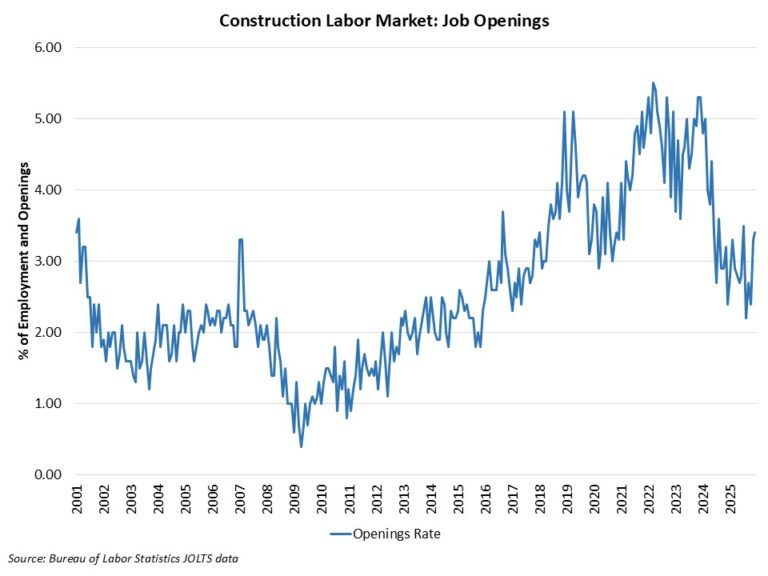
The number of open construction sector jobs increased from 284,000 in November to 292,000 in December. This total is higher compared to a year ago (205,000), although the reading is notably lower than two years ago. The chart below notes the declining trend that has been in place for unfilled construction jobs since the Fed raised the federal funds rate and home building weakened. While home building employment was declining during the second half of 2025, other subsectors of the construction industry have expanded (e.g. data centers).

The construction job openings rate increased to 3.4% in December, higher than the 3.2% rate estimated a year ago.

The layoff rate in construction declined to 1.5% in December. The quits increased to 1.5% for the month.


This article was originally published by a eyeonhousing.org . Read the Original article here. .


The count of open, unfilled positions in the construction industry was relatively unchanged in October, per the Bureau of Labor Statistics Job Openings and Labor Turnover Survey (JOLTS). The current level of open jobs is down measurably from two years ago due to declines in construction activity, particularly in housing.

The number of open jobs for the overall economy was effectively unchanged, increasing from 7.66 million in September to 7.67 million in October. The October reading was was relatively unchanged from the 7.62 million estimate from a year ago.

Previous NAHB analysis indicated that this number had to fall below 8 million on a sustained basis for the Federal Reserve to move forward on interest rate reductions. With estimates remaining below 8 million for national job openings, the Fed, in theory, should be able to cut further.

The number of open construction sector jobs decreased from 231,000 in September to 213,000 in October. This total is relatively stable compared to a year ago (249,000), although the reading is notably lower than two years ago. The chart below notes the declining trend that has been in place for unfilled construction jobs since the Fed raised the federal funds rate and home building weakened.

The construction job openings rate declined to 2.5% in October, lower than the 2.9% rate estimated a year ago.

The layoff rate in construction declined to 1.8% in October. The quits rate edged lower to 1.4% in October.


This article was originally published by a eyeonhousing.org . Read the Original article here. .


The long-delayed September jobs report revealed that the U.S. economy added 119,000 jobs while the unemployment rate climbed to its highest level in nearly four years. Combined with downward revisions to previous months, this month’s data indicates a slowing of the U.S. labor market, though one that is still expanding. With the October jobs report cancelled due to the government shutdown and November’s report not scheduled for release until December 16, this September report now stands as the Federal Reserve’s final look at labor market conditions before its December meeting.

In September, wages grew at a 3.8% pace year over year, matching August’s increase. Wage growth has been outpacing inflation for nearly two years, which typically occurs as productivity increases.

National Employment

The September jobs report was delayed by more than six weeks due to the federal government shutdown. According to the long-awaited Employment Situation Summary reported by the Bureau of Labor Statistics (BLS), total nonfarm payroll employment rose by 119,000 in September, following a downwardly revised loss of 4,000 jobs in August. August’s growth was revised down by 26,000, from an initial estimate of +22,000 to -4,000, marking the second month of negative job growth since January 2010. July’s job growth was revised down by 7,000, from +79,000 to +72,000. Combined, the revisions erased 33,000 jobs from previously reported figures.

Through September, monthly job growth in 2025 has averaged 76,000, a significant slowdown compared to the 168,000 monthly average gain for 2024.

The unemployment rate rose to 4.4% in September, its highest level in nearly four years. The number of persons unemployed rose by 219,000 and the number of persons employed increased by 251,000.

Meanwhile, the labor force participation rate—the proportion of the population either looking for a job or already holding a job—edged up by 0.1 percentage points to 62.4%. This remains below its pre-pandemic level of 63.3% recorded at the beginning of 2020. Among prime working-age individuals (aged 25 to 54), the participation rate remained steady at 83.7%, the highest level since October 2024.

In September, employment gains were seen in health care (+43,000), food services and drinking places (+37,000), and social assistance (+14,000), while the transportation and warehousing sector and the federal government experienced job losses. Federal government employment fell by 3,000 positions in September and has now shed a total of 97,000 positions since peaking in January 2025. The BLS notes that “employees on paid leave or receiving ongoing severance pay are counted as employed in the establishment survey.”

Construction Employment

Employment in the overall construction sector increased by 19,000 in September, after three consecutive months of job losses. Within the industry, residential construction added 3,100 jobs, while non-residential construction gained 16,300 positions.

Residential construction employment now stands at 3.3 million in September, including 954,000 workers employed by builders and remodelers and 2.4 million residential specialty trade contractors.

The six-month moving average of job gains for residential construction remains negative at -3,767 per month, reflecting losses in four of the past six months for May through August 2025. Over the last 12 months, residential construction has seen a net loss of 44,900 jobs, marking the fifth consecutive annual decline since September 2020. Since the low point following the Great Recession, residential construction has gained 1,340,000 positions.

In September, the unemployment rate for construction workers jumped to 5.1% on a seasonally adjusted basis. The unemployment rate for construction workers has remained at a relatively lower level, after reaching 15.3% in April 2020 due to the housing demand impact of the COVID-19 pandemic.


This article was originally published by a eyeonhousing.org . Read the Original article here. .


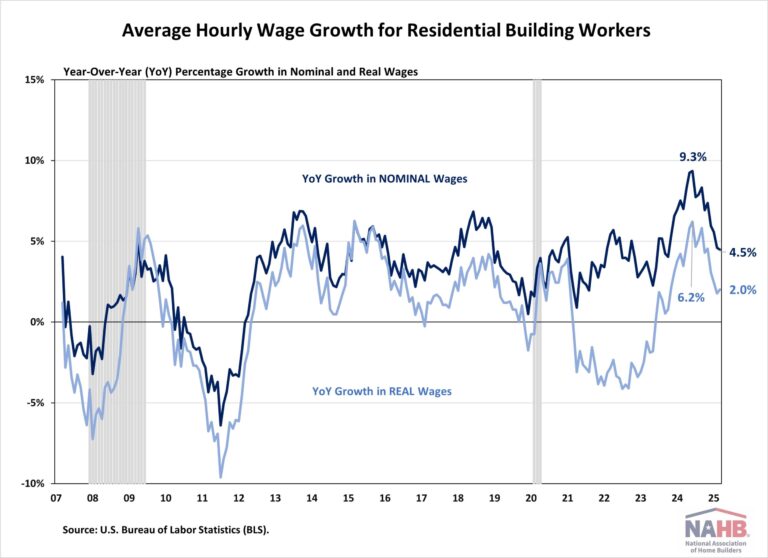
Wage growth for residential building workers continued to slow in March 2025, reflecting softening in the construction labor market, according to the latest report from the U.S. Bureau of Labor Statistics (BLS).

On a nominal basis, average hourly earnings (AHE) for residential building workers reached $38.76 in March 2025, up 4.5% from $37.10 a year ago. This marks a continued deceleration in the year-over-year wage growth, which peaked at 9.3% in June 2024. The recent slowdown reflects an easing of pandemic-related labor shortages and a softening labor demand in the construction sector. In March, the construction labor market saw a decline in job openings as employers slowed hiring plans amid ongoing economic uncertainty.

Despite the slowdown in wage growth, residential building workers’ wages remain competitive:

10.2% higher than the manufacturing sector ($35.17/hour)

24.0% higher than the transportation and warehousing sector ($31.25/hour)

3.7% lower than the mining and logging sector ($40.23/hour)

Note:

Data used in this post relate to all employees in the residential building industry. This group includes both new single-family housing construction (excluding for-sale builders) and residential remodelers but does not include specialty trade contractors.

Discover more from Eye On Housing

Subscribe to get the latest posts sent to your email.


This article was originally published by a eyeonhousing.org . Read the Original article here. .


According to the U.S. Bureau of Labor Statistics (BLS), people who are neither working nor looking for work are counted as “not in the labor force”. Understanding the size and characteristics of individuals not in the labor force is crucial for a comprehensive assessment of the job market and overall economic health, as it provides insights into potential labor supply and demand issues.

Size

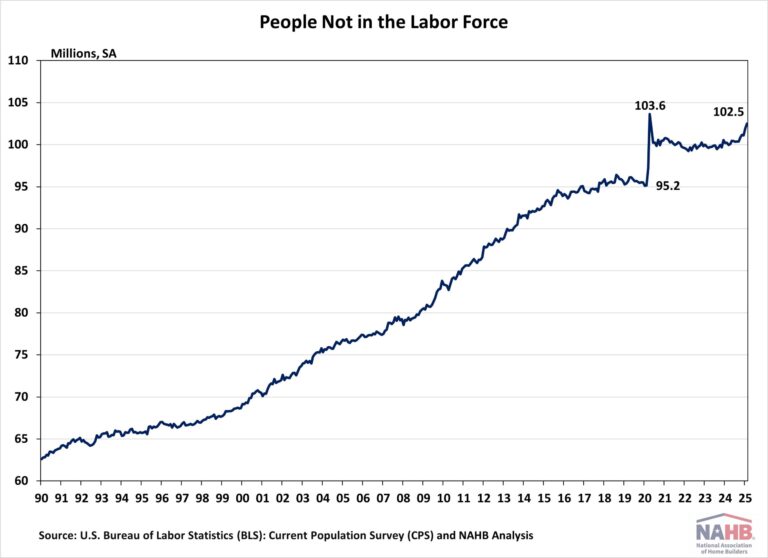
The number of people not in the labor force has been steadily increasing. As of February 2025, data from the BLS indicates that 102.5 million people, aged 16 or older, were not in the labor force. During the COVID-19 pandemic, this figure surged sharply, rising from 95.2 million in February 2020 to a historically high 103.6 million in April 2020. Since then, the number has remained around 100 million, with a noticeable upward trend over the past year.

Characteristics

Data from the 2024 Current Population Survey (CPS) and the Annual Social and Economic Supplement (ASEC) offer valuable insights into why individuals are not in the labor force. The ASEC gathers information on employment and unemployment experienced during the previous calendar year. The data used in this article focus on individuals aged 16 years and older who neither worked nor looked for a job in 2023.

According to the analysis of the data from the 2024 CPS and ASEC, approximately 93.6 million people aged 16 or older were not in the labor force in 2023. Among this group, nearly 39 million (42%) were men, and 54.6 million (58%) were women.

In terms of age distribution, about 49% of those not in the labor force were aged 65 years or older. Additionally, 13% were between the ages of 55 and 64, 21% were between the ages of 25 and 54, and the remaining 17% were aged 24 or younger. Intuitively, people aged 65 years and older represented the largest share of individuals who were not in the labor force.

Regarding educational attainment, 51% of individuals not in the labor force had a high school diploma or lower. Those with some college education made up 24%, while individuals with a bachelor’s degree or higher accounted for 25%.

The racial breakdown of those not in the labor force is as follows: 58.2 million were non-Hispanic white, 15.4 million were Hispanic, 11.7 million were Black, 5.9 million were Asian, and the remaining 2.5 million identified as other races.

Main Reason for Not Working

The group of people not in the labor force is diverse, and the reasons why individuals are not in the labor force vary widely.

In the CPS and ASEC data, the respondents were asked the main reason for not working. The reasons included: ill or disabled, retired, taking care of home or family, going to school, could not find work and other.

In 2023, a total of 93.6 million individuals aged 16 and older neither worked nor looked for work at any time during the year. Among this group, 48.6 million people reported retirement as their main reason for not working. Approximately 14.9 million individuals stated that they were attending school, while 14.7 million cited illness or disability as the main factor. Additionally, 12.7 million people indicated that taking care of home or family was the main reason for not working in 2023. Nearly 1.8 million individuals selected “other reasons,” and roughly 1.0 million cited “could not find work.”

Retirement is the main reason for not working for about half of the individuals not in the labor force in 2023. Among those aged 65 years and older, 91% of individuals in this group cited retirement as the main reason for not working. Overall, about 44% of individuals not in the labor force were due to the self-reported reason of retirement and aged 65 years and older. Individuals in this 44% share are unlikely to return to the labor force.

While an aging population is a major driver behind the growth of individuals not participating in the labor force, other reasons people give for not engaging in the workforce also play an important role.

For individuals aged 16 to 24, the majority cited going to school as the main reason not working in 2023. In other words, for those citing going to school, 87% were between the ages of 16 and 24. Overall, about 14% of the not-in-labor-force population was due to the self-reported reason of going to school and aged 16 to 24. This group is likely to enter the labor force after graduation, although younger individuals will likely replace them in education settings.

Prime-age workers, aged 25 to 54, historically represent a larger share of the labor force compared to other age groups. However, men and women in this age group have different reasons for not working in 2023. More than half of women (62%) reported taking care of home or family as the main reason for not working, while 48% of men cited illness or disability as their primary reason.

Among prime-age individuals, those with less education were more likely to be out of the labor force than their more educated counterparts. In 2023, 15% of prime-age men with a high school diploma or less were not in the labor force, compared to 10% of those with some college and 5% of those with a bachelor’s degree or higher. The trend was similar among prime-age women, with 33% of those with a high school diploma or less not in the labor force, compared to 20% of those with some college and 13% of those with a bachelor’s degree or more.

It is difficult to predict with certainty whether prime-age individuals currently not in the labor force will enter it. However, several factors could encourage individuals to enter or return to the labor market, including improved economic conditions, the availability of remote work, workplace policies, and retraining opportunities.

Last, based on the CPS and ASEC data, only a small proportion of the remaining population reported the main reasons for not working were that they could not find work and other reasons.

Conclusion

These numbers highlight both challenges and opportunities in expanding the labor force to support construction employment. According to the BLS’s monthly job report, approximately 6% of individuals currently not in the labor force and aged 16 to 64 could potentially be recruited into the workforce. Furthermore, the construction labor force is aging. The building industry must recruit the next generation of workers as industry activity grows in the years ahead, given the growth in population not in the labor force.

Discover more from Eye On Housing

Subscribe to get the latest posts sent to your email.



This article was originally published by a eyeonhousing.org . Read the Original article here. .


After a period of slowing associated with declines for some elements of the residential construction industry, the count of open construction sector jobs remained lower than a year ago, per the December Bureau of Labor Statistics Job Openings and Labor Turnover Survey (JOLTS).

The number of open jobs for the overall economy decreased from 8.16 million in November to 7.6 million in December. This is notably smaller than the 8.89 million estimate reported a year ago and reflects a softened aggregate labor market. Previous NAHB analysis indicated that this number had to fall below 8 million on a sustained basis for the Federal Reserve to feel more comfortable about labor market conditions and their potential impacts on inflation. With estimates remaining below 8 million for national job openings, the Fed in theory should be able to cut further despite a recent pause.

The number of open construction sector jobs decreased from a revised 272,000 in November to just 217,000 in December. This marks a significant reduction of open, unfilled construction jobs than that registered a year ago (434,000) due to a slowing of construction activity because of elevated interest rates.

The construction job openings rate moved lower to 2.5% in December, significantly down year-over-year from 5.1%. This is the lowest open rate for the construction sector since 2017.

The layoff rate in construction stayed low (1.8%) in December. The quits rate moved lower to 1.4% in December. This is the lowest quits rate for construction since the third quarter of 2020.

Discover more from Eye On Housing

Subscribe to get the latest posts sent to your email.


This article was originally published by a eyeonhousing.org . Read the Original article here. .


A key indicator of the labor market is the labor force participation rate. This rate is the percentage of working-age adults in a population who are working or looking for work. The rate is a critical measure connected to both housing demand and housing supply (via the construction labor force).

According to the Employment Situation Summary reported by the Bureau of Labor Statistics (BLS), the labor force participation rate remained at 62.5% for the third month in December 2024. After the labor force participation rate reached 67.3% at the beginning of 2000, it has been trending lower. When COVID-19 hit the labor market, the labor force participation rate dropped dramatically from 63.3% in February 2020 to 60.1% in April 2020. The latest labor force participation rate remains below its pre-pandemic levels of 63.3% at the beginning of 2020.

The participation rate is directly connected to the supply of labor. Labor supply varies across different demographic groups, such as age, gender, race, and educational attainment.

Gender

Over time, labor force participation changed dramatically by gender due to evolving societal norms around gender roles. Historically, women experienced a significant increase in labor force participation while men’s participation rates declined. However, over the past 20 years both genders’ labor force participation rates have moved in parallel and been trending downwards. Women’s labor force participation rate is 2.9 percentage points below the peak level in 2000 of 60.3%, while men’s labor force participation rate is 7.4 percentage points lower than the level in 2000 of 75.3%.

According to the latest data from the Current Population Survey (CPS), women currently make up roughly half of the U.S. labor force, representing about 47% of the labor force market. By industry, women accounted for more than half of all workers within several sectors in 2023, such as education and health services (74.4%), other services (53.3%), financial activities (51.1%), and leisure and hospitality (50.8%). Comparably, women were substantially underrepresented (relative to their share of total employment) in manufacturing (29.5%), agriculture (29.3%), transportation and utilities (24.3%), mining (15.3%), and construction (10.8%).

Men tend to have a higher labor force participation rate than women historically, even though this gap has narrowed from 54.7 percentage points in January 1948 to a difference of 10.5 percentage points in December 2024.

Age

The labor force participation rate differs across age groups as well. People ages 65 and older had the lowest labor force participation rate of 19.2%, followed by the youngest age group (16-19 years old) with a participation rate of 36.9%.

Among all age groups, workers aged 25-54, also known as prime-age workers, have the highest labor force participation rate of 83% in 2023. They form the core of the U.S. labor force, accounting for nearly two-thirds (63.8%) of the total labor force. Prime-age workers’ labor force participation rate has fully recovered from the COVID-19 pandemic, surpassing the prior peak of February 2020. The high labor force participation among prime-age men and the rapid increase in prime-age women’s labor force participation contributed to the increase in the labor force over time. By December 2024, prime-age women’s participation rate had hovered near its highest level of 78.1% on record, and 89.0% of prime-age men stayed in the labor force market.

Race and Ethnicity

Labor force participation varies among the largest race and ethnic groups living in the United States, and each group’s labor participation differs according to their gender as well.

Men had a higher labor force participation rate than women in each racial and ethnic group. Among men ages 16 years and over, Hispanic men were the most likely to be in the labor force, with a participation rate of 75.1%, followed by Asian men (76.8%), White men (68.2%), and Black men (65.6%). Among women ages 16 and over, Black women (61.0%) were most likely to participate in the labor force, followed by Hispanic women (58.7%), Asian women (58.1%), and White women (56.5%).

Educational Attainment

Higher levels of educational attainment are generally associated with higher labor force participation rates and lower unemployment rates. It is true for both men and women, and the four selected racial and ethnic groups that people with higher educational attainment tend to have greater employment opportunities and potentially later retirement ages.

With the same level of educational attainment, men are more likely to work than women. Among men with less than a high school diploma, the labor force participation rate was 59.4%, compared to a 34.3% participation rate for women with the same level of educational attainment. The gap of the labor force participation rate between men and women narrows as people achieve higher educational attainment. Women with the highest broad level of education (a bachelor’s degree or higher) have a 69.6% participation rate, a 7.3 percentage point difference from men with the same level of education (76.9%).

Discover more from Eye On Housing

Subscribe to get the latest posts sent to your email.


This article was originally published by a eyeonhousing.org . Read the Original article here. .


After a period of slowing associated with declines for some elements of the residential construction industry, the count of open construction sector jobs has remained lower than a year ago, per the November Bureau of Labor Statistics’ Job Openings and Labor Turnover Survey (JOLTS). However, the most recent data showed a slight gain for the number of open construction sector jobs.

The number of open jobs for the overall economy increased from 7.84 million to 8.10 million in November. Nonetheless, this is notably smaller than the 8.93 million estimate reported a year ago and reflects a softened aggregate labor market. Previous NAHB analysis indicated that this number had to fall below 8 million on a sustained basis for the Federal Reserve to feel more comfortable about labor market conditions and their potential impacts on inflation. With estimates remaining below 8 million for national job openings, the Fed is continuing a policy of interest rate cuts.

The number of open construction sector jobs increased from a revised 259,000 in October to 276,000 in November. Nonetheless, the November reading of opening, unfilled construction jobs is lower than that registered a year ago (454,000) due to a slowing of construction activity because of elevated interest rates.

The construction job openings rate edged higher to 3.2% in November but remains lower than a year ago, albeit with a fair amount of statistical month-to-month noise in the recent data.

The layoff rate in construction remained in the 2% range in November (2.1%). The quits rate in construction fell to 1.7% in November.

Discover more from Eye On Housing

Subscribe to get the latest posts sent to your email.


This article was originally published by a eyeonhousing.org . Read the Original article here. .

Pin It