Tag

Job

Browsing


Running counter to the data for the full economy, the count of open, unfilled positions in the construction industry increased in December, per the delayed Bureau of Labor Statistics Job Openings and Labor Turnover Survey (JOLTS). The current level of open jobs is down measurably from two years ago due to declines in construction activity, particularly in housing.

The number of open jobs for the overall economy declined as the labor market weakened at the end of 2025, falling from 6.982 million in November to 6.542 million in December. The December reading was down from a year ago (7.508 million).

Previous NAHB analysis indicated that this number had to fall below eight million on a sustained basis for the Federal Reserve to move forward on interest rate reductions. With estimates remaining below eight million for national job openings, the Fed, in theory, should be able to cut further.

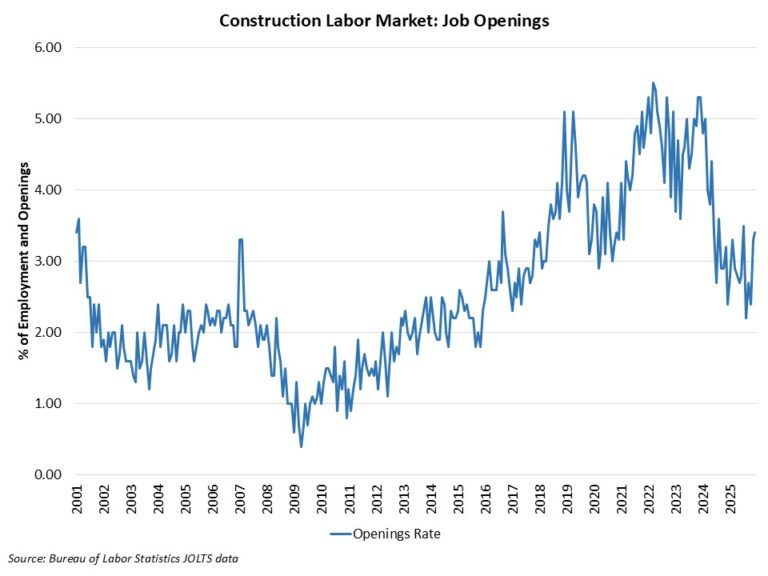
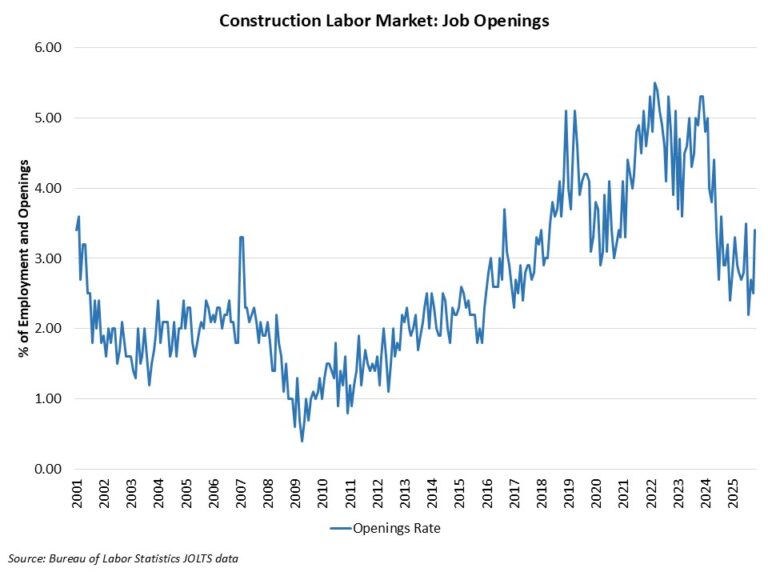
The number of open construction sector jobs increased from 284,000 in November to 292,000 in December. This total is higher compared to a year ago (205,000), although the reading is notably lower than two years ago. The chart below notes the declining trend that has been in place for unfilled construction jobs since the Fed raised the federal funds rate and home building weakened. While home building employment was declining during the second half of 2025, other subsectors of the construction industry have expanded (e.g. data centers).

The construction job openings rate increased to 3.4% in December, higher than the 3.2% rate estimated a year ago.

The layoff rate in construction declined to 1.5% in December. The quits increased to 1.5% for the month.


This article was originally published by a eyeonhousing.org . Read the Original article here. .


Job growth continued to slow at the end of the year, reinforcing signs of a cooling labor market. Nonfarm payrolls increased by 50,000 jobs in December, while the unemployment rate edged down slightly to 4.4%. With only 584,000 jobs added over the course of the year, 2025 marked the weakest annual job growth since 2003, excluding the recession years of 2008, 2009 and 2020. December’s job gains were led by food services, health care and social assistance, while retail trade and construction experienced job losses.

Wage growth accelerated in December, rising 3.8% year over year. This marked a 0.2 percentage point increase from the previous month, though it still remained 0.2 percentage points lower than a year ago. Wage growth has been outpacing inflation for nearly two years, which typically occurs as productivity increases.

National Employment

According to Employment Situation Summary reported by the Bureau of Labor Statistics (BLS), total nonfarm payroll employment rose by 50,000 in December, following a downwardly revised gain of 56,000 jobs in November. Through December, average monthly job growth in 2025 stood at just 49,000, well below the 168,000 monthly average recorded in 2024.

Payroll estimates for the previous two months were revised lower. October’s growth was revised down by 68,000, from -105,000 to -173,000. November job growth was revised down by 8,000, from +64,000 to +56,000. Combined, these revisions erased 76,000 jobs from previously reported figures.

The unemployment rate edged down slightly to 4.4% in December, following a downward revision of 4.5% in November. Over the month, the number of persons unemployed declined by 278,000, while the number of persons employed increased by 232,000.

Meanwhile, the labor force participation rate—the proportion of the population either looking for a job or already holding a job—decreased by 0.1 percentage points to 62.4%. This remains below its pre-pandemic level of 63.3% recorded at the beginning of 2020. Among prime working-age individuals (aged 25 to 54), the participation rate was unchanged at 83.8%, the highest level since September 2024.

Industry-level data further point to a cooling market. Leisure and hospitality added 47,000 jobs in December, while health care and social assistance employment increased by 38,500. In contrast, retail trade and construction posted job losses as well as several other major industries including manufacturing, trasportation and warehousing, and professional and business services, suggesting that hiring softness is broadening across the economy.

Construction Employment

Employment in the overall construction sector declined by 11,000 jobs in December, after a downwardly revised gain of 22,000 in November. Within the industry, residential construction shed 3,100 jobs, while non-residential construction lost 7,800 positions.

Residential construction employment now stands at 3.3 million in December, including 952,000 workers employed by builders and remodelers and approximately 2.4 million residential specialty trade contractors.

The six-month moving average of job gains for residential construction remains negative, at a loss of 3,017 per month, reflecting losses in four of the past six months. Over the last 12 months, residential construction has seen a net loss of 41,400 jobs, marking the eighth consecutive annual decline and the longest stretch of annual losses since the Great Recession. Since the low point following the Great Recession, residential construction has gained 1,336,100 positions.

In December, the unemployment rate for construction workers rose to 5.3% on a seasonally adjusted basis. While higher than in recent months, the rate remains relatively low compared with historical norms.


This article was originally published by a eyeonhousing.org . Read the Original article here. .

The count of open, unfilled positions in the construction industry increased in November, per the delayed Bureau of Labor Statistics Job Openings and Labor Turnover Survey (JOLTS). The current level of open jobs is down measurably from two years ago due to declines in construction activity, particularly in housing.

The number of open jobs for the overall economy declined as the labor market weakened at the end of 2025, falling from 7.449 million in October to 7.146 million in November. The November reading was down from a year ago (8.031 million).

Previous NAHB analysis indicated that this number had to fall below eight million on a sustained basis for the Federal Reserve to move forward on interest rate reductions. With estimates remaining below eight million for national job openings, the Fed, in theory, should be able to cut further.

The number of open construction sector jobs increased from 202,000 in October to 292,000 in November. This total is relatively stable compared to a year ago (272,000), although the reading is notably lower than two years ago. The chart below notes the declining trend that has been in place for unfilled construction jobs since the Fed raised the federal funds rate and home building weakened. While home building employment was declining during the second half of 2025, other subsectors of the construction industry have expanded (e.g. data centers).

The construction job openings rate increased to 3.4% in November, higher than the 3.2% rate estimated a year ago.

The layoff rate in construction declined to 1.7% in November. The quits increased to 1.5% for the month.


This article was originally published by a eyeonhousing.org . Read the Original article here. .
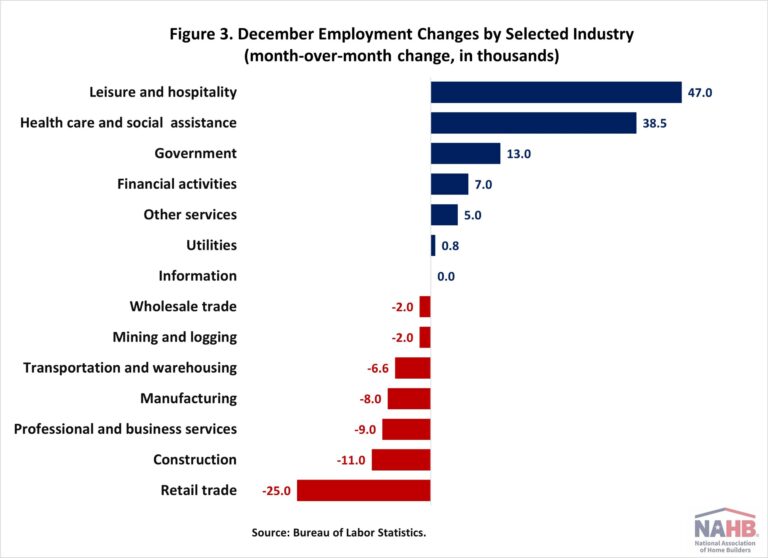

In November, job growth slowed, and the unemployment rate rose to 4.6%, its highest level in four years. At the same time, job gains for the previous two months (August and September) were revised downward. The November’s jobs report indicates a cooling labor market as the economy heads into the final month of the year.

In November, wage growth slowed, increasing 3.5% year over year, down 0.6 percentage points from a year ago. Wage growth has been outpacing inflation for nearly two years, which typically occurs as productivity increases.

National Employment

According to Employment Situation Summary reported by the Bureau of Labor Statistics (BLS), total nonfarm payroll employment rose by 64,000 in November. This represents a notable slowdown from September’s revised gain of 108,000 and reflects continued weakness in overall hiring.

August’s growth was revised downward for the second time, from last month’s estimate of -4,000 to -26,000. September job growth was revised down by 11,000, from +119,000 to +108,000. Combined, these revisions erased 33,000 jobs from previously reported figures. October data, published for the first time, was not revised.

Through November, average monthly job growth in 2025 stands at just 11,000, well below the 168,000 monthly average recorded in 2024.

The unemployment rate rose to 4.6% in November, its highest level since September 2021. Compared to September, the number of persons unemployed rose by 228,000, while the number of persons employed increased by 96,000.

Meanwhile, the labor force participation rate—the proportion of the population either looking for a job or already holding a job—remained unchanged at 62.4%. This remains below its pre-pandemic level of 63.3% recorded at the beginning of 2020. Among prime working-age individuals (aged 25 to 54), the participation rate edged up 0.1 percentage points to 83.8%, the highest level since September 2024.

In November, employment gains were seen in health care (+46,000) and construction (+28,000), while the federal government continued to shed jobs. Federal government employment fell by 6,000 positions in November, following a sharp decline of 162,000 in October. Since peaking in January 2025, federal government employment has fallen by a total of 271,000 jobs.

Construction Employment

Employment in the overall construction sector increased by 28,000 in November, after an upwardly revised 25,000 gain in September. Within the industry, residential construction shed 300 jobs, while non-residential construction gained 28,800 positions.

Residential construction employment now stands at 3.3 million in November, including 958,000 workers employed by builders and remodelers and approximately 2.4 million residential specialty trade contractors.

The six-month moving average of job gains for residential construction remains negative at -3,600 per month, reflecting losses in five of the past six months for June, July, August, October, and November. Over the last 12 months, residential construction has seen a net loss of 42,200 jobs, marking the sixth consecutive annual decline since September 2020. Since the low point following the Great Recession, residential construction has gained 1,334,100 positions.

In November, the unemployment rate for construction workers declined to 4.7% on a seasonally adjusted basis. The unemployment rate for construction workers has remained at a relatively lower level, after reaching 15.3% in April 2020 due to the housing demand impact of the COVID-19 pandemic.


This article was originally published by a eyeonhousing.org . Read the Original article here. .

The count of open, unfilled positions in the construction industry held steady amid a slowdown for housing, per the June Bureau of Labor Statistics Job Openings and Labor Turnover Survey (JOLTS).

The number of open jobs for the overall economy decreased slightly from 7.71 million in May to 7.44 million in June. This is about equal to the 7.41 million estimate reported a year ago but reflects a softened aggregate labor market.

Previous NAHB analysis indicated that this number had to fall below 8 million on a sustained basis for the Federal Reserve to move forward on interest rate reductions. With estimates remaining below 8 million for national job openings, the Fed, in theory, should be able to cut further despite a recent pause. There is growing pressure on the Fed to do so.

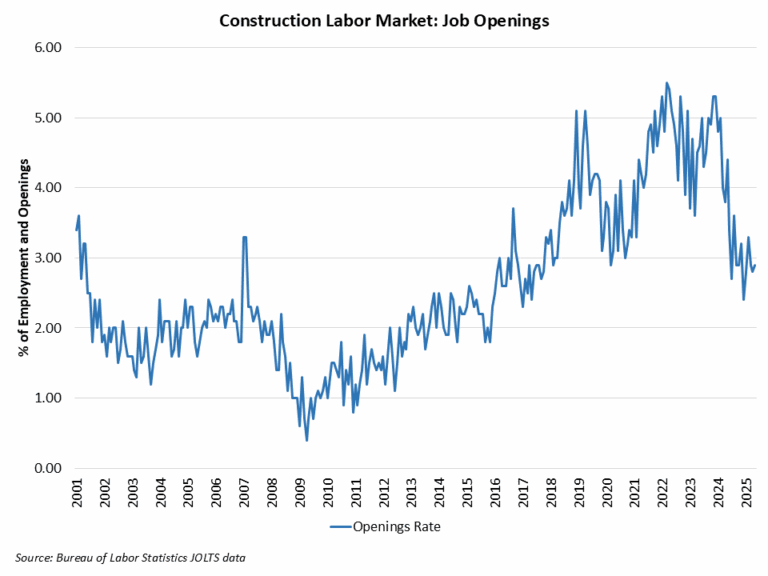
The number of open construction sector jobs was effectively unchanged from a revised 232,000 in May to 246,000 in June. This nonetheless marks a reduction of open, unfilled construction jobs than that registered a year ago (285,000) due to a slowing of construction/housing activity. The chart below notes the recent decline for the construction job openings rate, which is now near the lows of 2019.

The construction job openings rate ticked up to 2.9% in June, although it is significantly lower year-over-year from 3.4%.

The layoff rate in construction held at 2% in June. The quits rate declined to 1.9% in June, up from 1.6% from a year ago.

Discover more from Eye On Housing

Subscribe to get the latest posts sent to your email.


This article was originally published by a eyeonhousing.org . Read the Original article here. .


The U.S. labor market continued to show resilience in June, with steady job gains led by state/local government and health care sectors. The unemployment rate edged down to 4.1%, signaling ongoing strength in hiring despite persistent economic uncertainty. However, there were some indications that the headline number overstated the health of the labor market, including slowing wage growth and much of the job gains concentrated in state/local government.

In June, wage growth slowed. Year-over-year, wages grew at a 3.7% rate, down 0.1 percentage point from the previous month. Wage growth has been outpacing inflation for nearly two years, which typically occurs as productivity increases.

National Employment

According to the Employment Situation Summary reported by the Bureau of Labor Statistics (BLS), total nonfarm payroll employment rose by 147,000 in June, following an upwardly revised increase of 144,000 jobs in May. Since January 2021, the U.S. job market has seen 54 consecutive months of job growth, making the third-longest period of employment expansion on record. In 2025, monthly employment growth has averaged 124,000, compared with the 168,000 monthly average gain for 2024.

The estimates for the previous two months were revised upward. The monthly change in total nonfarm payroll employment for April was revised up by 11,000 from +147,000 to +158,000, while the change for May was revised up by 30,000 from +139,000 to +144,000. Combined, the revisions were 16,000 higher than previously reported.

The unemployment rate declined to 4.1% in June. The June decrease in the unemployment rate reflected the decrease in the number of persons unemployed (-222,000) and the increase in the number of persons employed (93,000).

Meanwhile, the labor force participation rate—the proportion of the population either looking for a job or already holding a job—decreased by one percentage point to 62.3%. This remains below its pre-pandemic level of 63.3% recorded at the beginning of 2020. Among individuals aged 25 to 54, the participation rate rose by one percentage point to 83.5%. However, the rate for the prime working-age group (25 to 54) has been trending downward since reaching a peak of 83.9% last summer.

In June, job gains occurred in state/local government and health care. State/local government posted a large 80,000 combined net job gain for June, while the health care sector added 39,000 jobs, with the largest increases occurring in hospitals and in nursing and residential care facilities. In contrast, the federal government continued to experience job losses, shedding 7,000 positions in June and a total of 69,000 since January 2025, reflecting the effects of government cutbacks. The BLS notes that “employees on paid leave or receiving ongoing severance pay are counted as employed in the establishment survey.”

Construction Employment

Employment in the overall construction sector rose by 15,000 in June, following an upwardly revised gain of 6,000 in May. While residential construction gained 5,500 jobs, non-residential construction employment added 9,200 jobs during the month.

Residential construction employment now stands at 3.3 million in June, broken down as 959,000 builders and 2.4 million residential specialty trade contractors. The six-month moving average of job gains for residential construction was -1,833 a month, reflecting the three months of job losses recorded over the past six months, specifically in January, March, and May of 2025. Over the last 12 months, home builders and remodelers experienced a net loss of 1,400 jobs, marking the second annual decline since September 2020. Since the low point following the Great Recession, residential construction has gained 1,360,600 positions.

In June, the unemployment rate for construction workers declined to 3.5% on a seasonally adjusted basis. The unemployment rate for construction workers has remained at a relatively lower level, after reaching 15.3% in April 2020 due to the housing demand impact of the COVID-19 pandemic.

Discover more from Eye On Housing

Subscribe to get the latest posts sent to your email.


This article was originally published by a eyeonhousing.org . Read the Original article here. .


The count of open, unfilled positions in the construction industry held steady amid a slowdown for housing, per the May Bureau of Labor Statistics Job Openings and Labor Turnover Survey (JOLTS).

The number of open jobs for the overall economy increased slightly from 7.40 million in April to 7.77 million in May. This is smaller than the 7.90 million estimate reported a year ago and reflects a softened aggregate labor market. However, the May estimate was a stronger number than expected and runs counter to some other, recent negative reporting of labor market data.

Previous NAHB analysis indicated that this number had to fall below 8 million on a sustained basis for the Federal Reserve to move forward on interest rate reductions. With estimates remaining below 8 million for national job openings, the Fed, in theory, should be able to cut further despite a recent pause. There is growing pressure on the Fed to do so.

The number of open construction sector jobs was effectively unchanged from a revised 242,000 in April to 245,000 in May. This nonetheless marks a significant reduction of open, unfilled construction jobs than that registered a year ago (375,000) due to a slowing of construction/housing activity. The chart below notes the recent decline for the construction job openings rate, which is now near the lows of 2019.

The construction job openings rate was steady at 2.8% in May, although significantly lower year-over-year from 4.4%.

The layoff rate in construction held at 2% in May. The quits rate increased on a monthly basis to 2.3%, the same as a year ago.

Discover more from Eye On Housing

Subscribe to get the latest posts sent to your email.


This article was originally published by a eyeonhousing.org . Read the Original article here. .


The count of open, unfilled positions in the construction industry held steady amid a slowdown for housing, per the April Bureau of Labor Statistics Job Openings and Labor Turnover Survey (JOLTS).

The number of open jobs for the overall economy increased slightly from 7.20 million in March to 7.39 million in April. This is notably smaller than the 7.62 million estimate reported a year ago and reflects a softened aggregate labor market. Previous NAHB analysis indicated that this number had to fall below 8 million on a sustained basis for the Federal Reserve to move forward on interest rate reductions. With estimates remaining below 8 million for national job openings, the Fed, in theory, should be able to cut further despite a recent pause. However, tariff proposals may keep the Fed on pause in the coming quarters.

The number of open construction sector jobs was effectively unchanged from a revised 251,000 in March to 248,000 in April. This nonetheless marks a significant reduction of open, unfilled construction jobs than that registered a year ago (326,000) due to a slowing of construction activity. The chart below notes the recent decline for the construction job openings rate, which is now back to the lows of 2019.

The construction job openings rate was unchanged at 2.9% in April, although significantly lower year-over-year from 3.8%.

The layoff rate in construction ticked higher to 1.9% in April. The quits rate dipped to 1.8% for the month.

Discover more from Eye On Housing

Subscribe to get the latest posts sent to your email.


This article was originally published by a eyeonhousing.org . Read the Original article here. .

The U.S. job market slowed slightly in April, with notable downward revisions to February and March figures. The unemployment rate held steady at 4.2%. The labor market remains resilient despite growing economic uncertainty, though early signs of softening are beginning to emerge.

In April, wage growth remained unchanged. Year-over-year, wages grew at a 3.8% rate. Wage growth has been outpacing inflation for nearly two years, which typically occurs as productivity increases.

National Employment

According to the Employment Situation Summary reported by the Bureau of Labor Statistics (BLS), total nonfarm payroll employment rose by 177,000 in April, following a downwardly revised increase of 185,000 jobs in March. Since January 2021, the U.S. job market has added jobs for 52 consecutive months, making it the third-longest period of employment expansion on record. Monthly employment growth has averaged 144,000 per month in 2025, compared with the 168,000 monthly average gain for 2024.

The estimates for the previous two months were revised down. The monthly change in total nonfarm payroll employment for February was revised down by 15,000 from +117,000 to +102,000, while the change for March was revised down by 43,000 from +228,000 to +185,000. Combined, the revisions were 58,000 lower than previously reported.

The unemployment rate remained unchanged at 4.2% in April. While the number of employed persons increased by 436,000, the number of unemployed persons increased by 82,000.

Meanwhile, the labor force participation rate—the proportion of the population either looking for a job or already holding a job—rose one percentage point to 62.6%. Among individuals aged 25 to 54, the participation rate rose three percentage points to 83.6%, marking the highest rate since September 2024. Despite these gains, the overall labor force participation rate remains below its pre-pandemic levels of 63.3% at the beginning of 2020. Additionally, the rate for the prime working-age group (25 to 54) has been trending downward since peaking at 83.9% last summer.

In April, industries like health care (+51,000), transportation and warehousing (+29,000), and financial activities (+14,000) continued to see gains. Meanwhile, federal government employment lost 9,000 jobs in April and has shed 26,000 since January 2025, reflecting the effects of government cutbacks. The BLS notes that “employees on paid leave or receiving ongoing severance pay are counted as employed in the establishment survey.”

Construction Employment

Employment in the overall construction sector increased by 11,000 in April, following a downwardly revised gain of 7,000 in March. While residential construction gained 3,400 jobs, non-residential construction employment added 8,000 jobs for the month.

Residential construction employment now stands at 3.3 million in April, broken down as 956,000 builders and 2.4 million residential specialty trade contractors. The six-month moving average of job gains for residential construction was -1,583 a month, mainly reflecting the three months’ job loss over the past six months (October 2024, January 2025, and March 2025). Over the last 12 months, home builders and remodelers added 5,000 jobs on a net basis. Since the low point following the Great Recession, residential construction has gained 1,367,000 positions.

In April, the unemployment rate for construction workers rose to 5.2% on a seasonally adjusted basis. The unemployment rate for construction workers has remained at a relatively lower level, after reaching 15.3% in April 2020 due to the housing demand impact of the COVID-19 pandemic.

Discover more from Eye On Housing

Subscribe to get the latest posts sent to your email.


This article was originally published by a eyeonhousing.org . Read the Original article here. .

After a period of slowing associated with declines for some elements of the residential construction industry, the count of open construction sector jobs remained lower than a year ago, per the February Bureau of Labor Statistics Job Openings and Labor Turnover Survey (JOLTS).

The number of open jobs for the overall economy declined from 7.76 million in January to 7.57 million in February. This is notably smaller than the 8.45 million estimate reported a year ago and reflects a softened aggregate labor market. Previous NAHB analysis indicated that this number had to fall below 8 million on a sustained basis for the Federal Reserve to feel more comfortable about labor market conditions and their potential impacts on inflation. With estimates remaining below 8 million for national job openings, the Fed, in theory, should be able to cut further despite a recent pause. However, tariff proposals may keep the Fed on pause in the coming quarters.

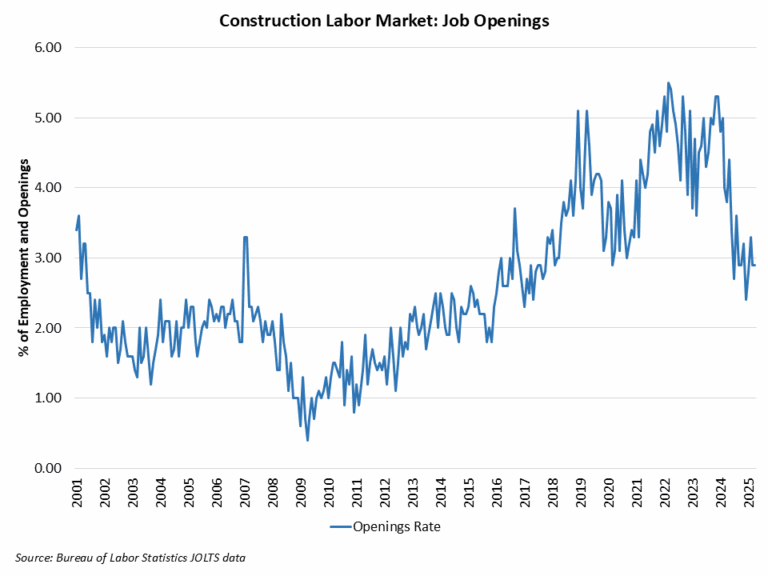
The number of open construction sector jobs increased from a revised 242,000 in January to 264,000 in February. This nonetheless marks a significant reduction of open, unfilled construction jobs than that registered a year ago (429,000) due to a slowing of construction activity because of ongoing elevated interest rates. The chart below notes the recent decline for the construction job openings rate, which is now back to 2019 levels.

The construction job openings rate edged higher to 3.1% in February, significantly down year-over-year from 5%.

The layoff rate in construction stayed low (1.8%) in February. The quits rate was flat at 2% in February.

Discover more from Eye On Housing

Subscribe to get the latest posts sent to your email.


This article was originally published by a eyeonhousing.org . Read the Original article here. .

Pin It