Tag

Inches

Browsing


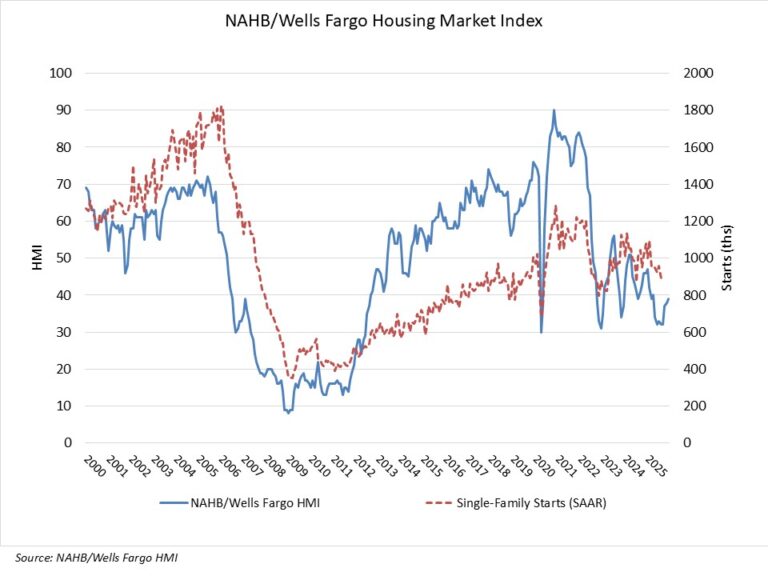
Builder confidence inched higher to end the year but still remains well into negative territory as builders continue to grapple with rising construction costs, tariff and economic uncertainty, and many potential buyers remaining on the sidelines due to affordability concerns.

Builder confidence in the market for newly built single-family homes rose one point to 39 in December, according to the National Association of Home Builders (NAHB)/Wells Fargo Housing Market Index (HMI). Sentiment levels were below the breakeven point of 50 every month in 2025 and ranged in the high 30s in the final quarter of the year.

Market conditions remain challenging with two-thirds of builders reporting they are offering incentives to move buyers off the fence.

In positive signs for the market, builders report that future sales expectations have been above the key breakeven level of 50 for the past three months and the recent easing of monetary policy should help builder loan conditions at the start of 2026. However, builders continue to face supply-side headwinds, as regulatory costs and material prices remain stubbornly high. Rising inventory also has increased competition for newly built homes.

In a further sign of ongoing challenges for the housing market, the latest HMI survey also revealed that 40% of builders reported cutting prices in December, marking the second consecutive month the share has been at 40% or higher since May 2020. It was 41% in November. Meanwhile, the average price reduction was 5% in December, down from the 6% rate in November. The use of sales incentives was 67% in December, the highest percentage in the post-Covid period.

Derived from a monthly survey that NAHB has been conducting for more than 40 years, the NAHB/Wells Fargo HMI gauges builder perceptions of current single-family home sales and sales expectations for the next six months as “good,” “fair” or “poor.” The survey also asks builders to rate traffic of prospective buyers as “high to very high,” “average” or “low to very low.” Scores for each component are then used to calculate a seasonally adjusted index where any number over 50 indicates that more builders view conditions as good than poor.

The HMI index gauging current sales conditions increased one point to 42, the index measuring future sales rose one point to 52 and the gauge charting traffic of prospective buyers held steady at 26.

Looking at the three-month moving averages for regional HMI scores, the Northeast fell one point to 47, the Midwest rose two points to 43, the South increased two points to 36 and the West gained four points to 34.

The HMI tables can be found at nahb.org/hmi.

Editor’s Note: With the official 2026 release schedule for the Survey of Construction still unavailable from the U.S. Census Bureau, NAHB confirms the HMI for January 2026 will be released on January 16.  A schedule for the rest of the year will be available as soon as possible.


This article was originally published by a eyeonhousing.org . Read the Original article here. .
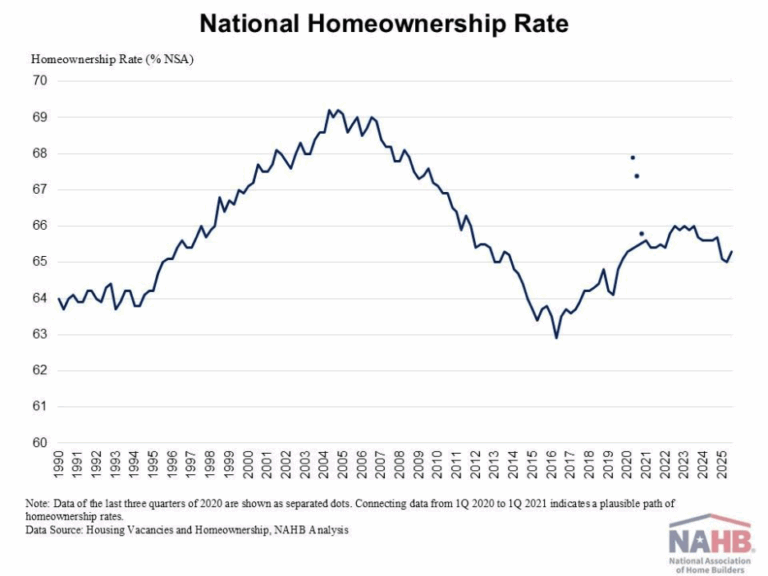

The latest homeownership rate rose to 65.3% in the third quarter of 2025, according to the Census’s Housing Vacancy Survey (HVS). Despite this quarterly increase, the trend continues to reflect significant affordability challenges. With mortgage interest rates remaining elevated, and housing supply still tight, housing affordability is at a multidecade low. Compared to the peak of 69.2% in 2004, the homeownership rate is currently 3.9 percentage points lower and remains below the 25-year average rate of 66.3%.  

Compared to the previous year, homeownership rates increased in three age groups. Among younger households, the homeownership rate for those under 35 increased 0.5 percentage points to 37.5% in the third quarter of 2025. This age group is particularly sensitive to mortgage rates and the inventory of entry-level homes. Householders ages 45-54 experienced a 0.3 percentage-point increase from 69.7% to 70%. Homeownership rates for householders aged 55-64 inched up by 0.1 percentage point over the same time. However, homeownership rates for householders aged 35-44 and those aged 65 years and over each declined 1.2 percentage points from a year ago. 

The national rental vacancy rate inched up to 7.1% for the third quarter of 2025, on steadily increasing trend since 2023. Meanwhile, the homeowner vacancy rate rose to 1.2%. These upticks in both the homeowner and rental vacancy rate signal an increase in the existing home supply. 

The housing stock-based HVS revealed that the number of total households increased to 133.1 million in the third quarter of 2025 from 132.0 million a year ago. This increase was driven by both owner and renter household growth. The number of renter households rose by 0.7 million, while owner-occupied households increased by 0.4 million over the same period.


This article was originally published by a eyeonhousing.org . Read the Original article here. .

Private residential construction spending edged up by 0.1% in November 2024, according to the latest U.S. Census Construction Spending data. Year-over-year, the November report showed a 3.1% increase.

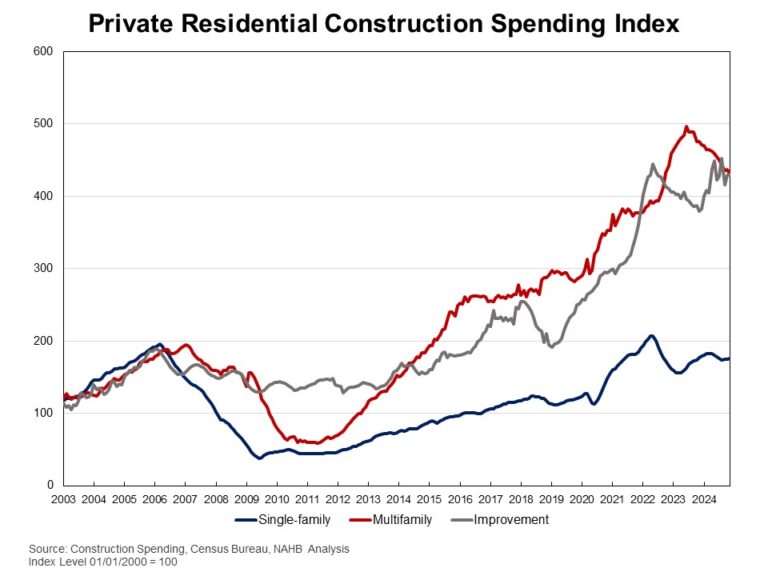
The monthly increase in total private construction spending was primarily driven by higher spending on single-family construction and residential improvements. Single-family construction spending inched up by 0.3% for the month. This marks a continuation of growth after a five-month decline from April to August, aligning with steady builder confidence seen in the Housing Market Index. However, single-family construction remained 0.7% lower than a year ago. Improvement spending rose by 0.4% in November and was 13.4% higher compared to the same period last year. In contrast, multifamily construction spending declined by 1.3% in November, following a 0.3% increase in October. Compared to a year ago, multifamily construction spending was still 9.5% lower.

The NAHB construction spending index is shown in the graph below. The index illustrates how   spending on single-family construction has slowed since early 2024 under the pressure of elevated interest rates. Multifamily construction spending growth has also slowed down after the peak in July 2023. Meanwhile, improvement spending has increased its pace since late 2023.

Spending on private nonresidential construction was up 1.7% over a year ago. The annual private nonresidential spending increase was mainly due to higher spending for the class of manufacturing ($23.4 billion), followed by the power category ($6.1 billion).

Discover more from Eye On Housing

Subscribe to get the latest posts sent to your email.


This article was originally published by a eyeonhousing.org . Read the Original article here. .
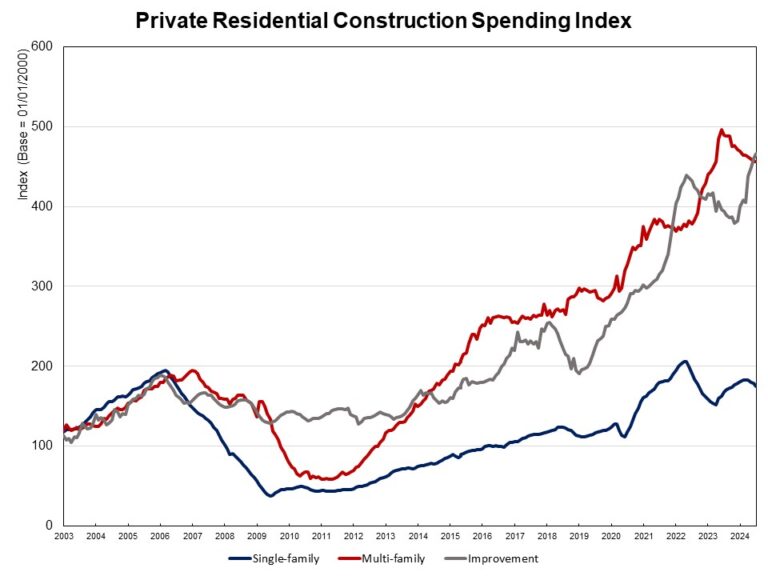

Private residential construction spending fell 0.4% in July, according to the Census Construction Spending data. Nevertheless, spending remained 7.7% higher compared to a year ago. The monthly decline in total private construction spending for July was largely due to reduced spending on single-family construction. Spending on single-family construction plunged by 1.9% in July, following a dip of 1.1% in June. This marks the fourth consecutive monthly decrease. Elevated mortgage interest rates have cooled the housing market, dampening home builder confidence and new home starts. Despite these challenges, spending on single-family construction was still 4% higher than it was a year earlier.

Multifamily construction spending stayed flat in July after a dip of 0.6% in June. Year-over-year, spending on multifamily construction declined 6.7%, as an elevated level of apartments under construction is being completed. Private residential improvement spending increased 1.2% in July and was 18.3% higher compared to a year ago.

The NAHB construction spending index is shown in the graph below (the base is January 2000). The index illustrates how spending on single-family construction has slowed down the pace since early 2024 under the pressure of elevated interest rates. Multifamily construction spending growth slowed down after the peak in July 2023, while improvement spending increased its pace since late 2023.

Spending on private nonresidential construction was up 4.5% over a year ago. The annual private nonresidential spending increase was mainly due to higher spending for the class of manufacturing ($39.7 billion), followed by the power category ($1 billion).

Discover more from Eye On Housing

Subscribe to get the latest posts sent to your email.


This article was originally published by a eyeonhousing.org . Read the Original article here. .
Pin It