Tag

Improvement

Browsing


Home improvement activity has remained elevated in the post-pandemic period, but both the volume of loan applications and the age profile of borrowers have shifted in notable ways. Data from the Home Mortgage Disclosure Act (HMDA), analyzed by NAHB, show that total home improvement loan applications have eased from their recent post-pandemic peak, and the distribution of borrowers across age groups has gradually tilted older.

The number of home improvement loan applications increased sharply during the housing boom and the remodeling surge that followed the onset of the pandemic. After totaling 1.15 million loans in 2019, activity fell 20% to 0.92 million in 2020 as uncertainty and lockdowns disrupted markets. Applications then rebounded to 1.07 million in 2021 and climbed to a cycle high of 1.49 million in 2022, reflecting strong demand for renovations. Since then, activity has moderated but remains historically solid, edging down to 1.25 million loans in 2023 and 1.20 million in 2024. Despite cooling from the pandemic-era surge, the 2024 total stands above pre-pandemic levels, supported by an aging housing stock and limited inventory of existing homes for sale.

Alongside these changes in loan volume, the age composition of borrowers has gradually shifted, revealing notable changes across age groups.

In 2019, applicants ages 45-54 accounted for the largest share of home improvement loans at 26.0%. By 2024, their share slipped slightly to 25.2% but remained the largest cohort. The 55-64 age group experienced a more noticeable decline, falling from 23.2% in 2019 to 21.7% in 2024.

In contrast, both younger and older segments expanded their presence in the remodeling market. Borrowers ages 35-44 increased their share from 22.0% to 22.9%, while those ages 25-34 rose from 8.7% to 9.1%. Although, still representing a small portion of total applications, applicants under age 25 edged up from 0.4% to 0.5%. More notably, the share of older loan applicants increased. The 65-74 cohort ticked up from 13.1% to 13.2%, and applicants over age 74 rose from 4.7% to 5.4%.

Overall, the data indicate a gradual aging of home improvement activity. Borrowers aged 65 and older accounted for 17.8% of loan applications in 2019, increasing to 18.6% in 2024. This shift likely reflects both the aging of the homeowner population and a growing preference among older homeowners to undertake aging-in-place renovation and maintain homes they have owned for many years. Meanwhile, the modest gains among borrowers in their mid-30s to early 40s suggest continued renovation demand from trade-up buyers and households choosing to remodel rather than buy a new home amid high interest rates.


This article was originally published by a eyeonhousing.org . Read the Original article here. .

Residential improvement spending softened in 2023 due to elevated interest rates, high inflation, and sluggish home sales. According to the Bureau of Economic Analysis’ National Income and Product Accounts (NIPA), expenditures for residential home improvements rose 2% to $363 billion in 2023, from $356 billion in 2022. The 2% year-over-year (YOY) gain in 2023 marks the smallest YOY gain since 2011. This annual data indicates that the YOY gain in residential improvement spending slowed, but the remodeling market remained solid.

In this article, NAHB’s analysis of the 2023 Home Mortgage Disclosure Act (HMDA) data provides insight into remodeling activity in 2023 by age group, and by U.S. states and counties. The 2023 HMDA data, published by the Consumer Financial Protection Bureau (CFPB), covers detailed information on residential mortgage lending in 2023, including the type, purpose, and characteristics of home mortgage applications or purchased loans, and demographic and other information about loan applicants.

According to the 2023 HMDA data, the number of home improvement loan applications declined by 17% in 2023, compared to the previous year. Moreover, the total amount of home improvement loans was about 44 billion (24%) less than the total amount in 2022.

Age Group Analysis:

Figure 1 below presents the number of home improvement loan applications by applicants’ age from 2018 to 2023. Among all age groups, the number of home improvement loan applications surged in 2022 and declined in 2023. Compared to 2022, the number of home improvement loan applications decreased by 23% in 2023 for applicants aged between 25 and 34 and between 35 and 40. Applicants between the ages of 45 and 54 remained the largest age group to apply for home improvement loan applications, even though the number of loan applications for this age group reduced by 18% in 2023.

For applicants under 55 years old and above 74 years old, the number of loan applications in 2023 was higher than the pre-pandemic level in 2018 and 2019. Meanwhile, applicants aged between 55 and 74 had a lower number of loan applications in 2023 than in 2018 and 2019. As interest rates reached historically high levels in 2023, homeowners used savings to pay for home improvements, avoiding the extra expense of interest on loans.

State-Level Analysis:

While remodeling activity changed among different age groups, remodeling has also varied across geographic locations due to the cost of living, local economic conditions, and house prices.

With respect to total home improvement loan applications, California had the highest number of home improvement loan applications in 2023, with 118,649 applications. Florida came in second with 102,746 home improvement loan applications. Wyoming and Alaska had the lowest total numbers of home improvement loan applications with 1,312 and 1,358, respectively.

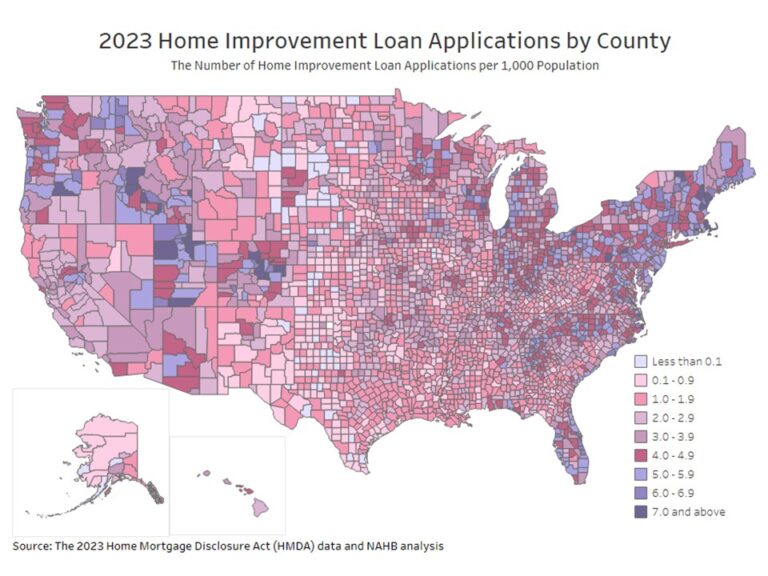
When we look at home improvement loan applications per 1,000 population, two states in New England, Rhode Island and New Hampshire, had the highest number of home improvement loan applications, with a rate of 6.4 and 6.0 applications per 1,000 population, respectively. Louisiana had the lowest number of home improvement loan applications, with a rate of 1.6 applications per 1,000 population.

In total, there were 3.7 loan applications for home improvements for every 1,000 population in the United States. California, the most populous state of the United States, reported 3.0 applications per 1,000 population, which is lower than the national average rate.

County-Level Analysis:

The analysis of county-level home improvement loan applications per 1,000 population reveals that the aggregate market population is not significantly related to the number of per capita home improvement loan applications. In 2023, the top 10 most populated counties in the United States had an average rate of 2.6 loan applications per 1,000 population. Los Angeles County in California, one of the most populous counties, reported a rate of 2.8 loan applications per 1,000 population in 2023.  Meanwhile, some counties with a lower population had a higher loan application rate (that is, the number of home improvement loan applications per 1,000 population). For example, Nantucket County in Massachusetts, with a population of about 14,000, had the highest loan application rate of 11.1 among all the counties in the United States. Camas County in Idaho, with roughly one thousand population, had a loan application rate of 8.9, higher than about 99.7% of the counties in the United States.

Additionally, the analysis finds that home improvement loan applications are relatively more common in the Mountain and New England Divisions. In total, there were 43 counties that reported 7 or higher home improvement loan applications per 1,000 population, and more than 72% of these counties were in the Mountain and New England Divisions. None of these 43 counties were in the West South Central, East South Central, or West North Central Divisions. The top five counties with the highest home improvement loan application rate were: Nantucket County (MA), Grand Isle County (VT), Dare County (NC), Boise County (ID), and Barnstable County (MA).

Discover more from Eye On Housing

Subscribe to get the latest posts sent to your email.


This article was originally published by a eyeonhousing.org . Read the Original article here. .



For millions of Americans, a pet makes a house a home. Now, a new study by Houzz shows that when remodeling their homes, pet owners keep their furry — and hairy, feathery and scaly — friends in mind.

Houzz surveyed more than 1,000 pet owners and found that nearly half (48%) prioritize pets in their decision-making process when upgrading their home. Considerations include pet-friendly products and materials (34%) and choosing design or functionality specific to their pet, such as incorporating space for an animal’s bed or feeding station (22%). More than three-quarters (77%) of those surveyed are in the midst of, are planning or recently completed a home renovation.

Read on for paws-itively enlightening insights revealed in the 2024 U.S. Houzz Pets & the Home Study.


This article was originally published by a www.houzz.com . Read the Original article here. .

Pin It