Tag

housing

Browsing


The new home sector has played an increasingly important role in meeting housing demand as resale inventory remains constrained in many regions. The latest data released today (and delayed because of the government shutdown in fall of 2025) indicate that new single-family home sales continue to reflect a stabilizing market after a period of heightened volatility. While month-to-month activity shows some variability, sales remain stronger than a year ago, signaling that buyer interest in newly built homes has improved.

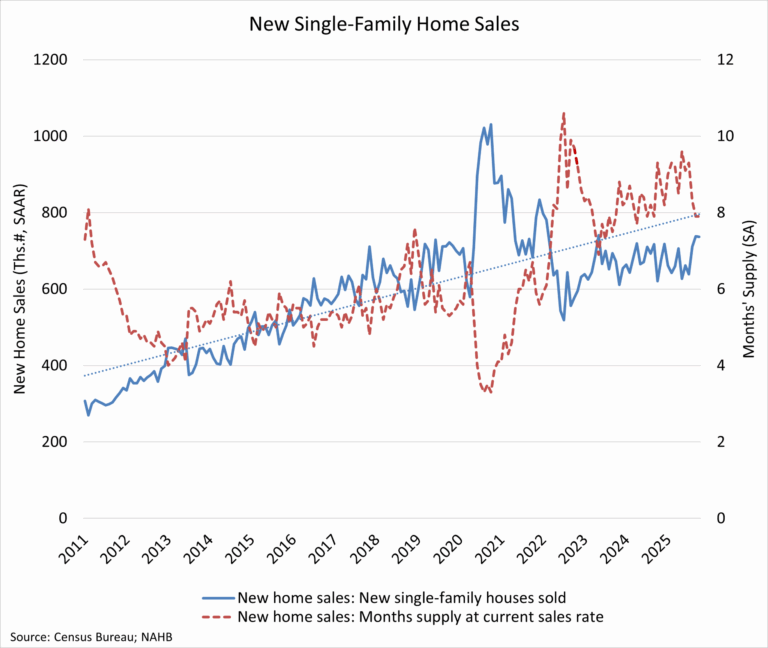
Sales of newly built single-family homes increased 18.7 percent year over year in October to a seasonally adjusted annual rate of 737,000 units, according to the U.S. Department of Housing and Urban Development and the U.S. Census Bureau. This represented a modest 0.1 percent decline from September and a 1.2 percent decrease on a year-to-date basis. A new home sale is recorded when a contract is signed or a deposit is accepted, regardless of the stage of construction. The seasonally adjusted annual rate reflects the pace of sales that would occur over a 12-month period if current conditions persisted.

New single-family home inventory totaled 488,000 units in October, unchanged from the prior month and 1.7 percent higher than a year earlier. At the current sales pace, the months’ supply of new homes stood at 7.9, down from 9.3 months one year ago, though still above the six-month level that is generally considered balanced.

Combined new and existing home inventory has edged lower in recent months, with total months’ supply declining to 4.9, reflecting slower construction activity. Meanwhile, inventory conditions in the existing home market have shown gradual improvement, and moderating prices across both markets have helped support buyer demand amid ongoing affordability concerns.

By the end of October 2025, there were 124,000 completed, ready-to-occupy homes available for sale on a not seasonally adjusted basis, up 10.7 percent from a year earlier. Completed homes accounted for roughly one-quarter of total inventory, while homes under construction made up 51 percent. The remaining 24 percent of homes sold in October had not yet started construction at the time the sales contract was signed.

Home prices showed further signs of easing in October. The median new home sale price declined 3.3 percent to $392,300, marking an 8.0 percent decrease from a year ago. Affordability improved at the lower end of the market, with 25 percent of new homes priced below $300,000, the highest share in recent months. Thirty percent of homes were priced above $500,000, while the remaining 45 percent fell within the $300,000 to $500,000 range.

Regionally, year-to-date new home sales declined in three of the four regions, falling 0.1 percent in the Midwest, 7.2 percent in the West, and 22.9 percent in the Northeast. The South was the only region to post growth, with sales up 2.9 percent.


This article was originally published by a eyeonhousing.org . Read the Original article here. .


Inflation held steady in December, matching November’s reading, according to the Bureau of Labor Statistics (BLS) latest report. This December report was the first report to include a month-to-month figure since the government shutdown. However, the report should be read with caution as data distortions from the shutdown continue to affect key inflation measures, particularly housing.

First looking at annual data, on a non-seasonally adjusted basis, the Consumer Price Index (CPI) rose by 2.7% in December compared to the year prior. Excluding the volatile food and energy components, the “core” CPI increased by 2.6% over the past twelve months. A large portion of the “core” CPI is the housing shelter index, which increased 3.2% over the year. Meanwhile, the component index of food rose by 3.1%, and the energy component index increased by 2.3%.

Before noting monthly changes in the CPI, it is important to mention that the November’s CPI report was artificially depressed due to incomplete data collection and the imputation method used for key components including housing prices. BLS used ‘carry-forward imputation’ to calculate some of November’s data after the shutdown disrupted data collection. This method uses data from a previous month to estimate the missing figure, which potentially underestimates housing inflation.

Housing was one of the most impacted categories. Shelter accounts for 36.7 percent of the CPI and contributed approximately 58 percent of total inflation in 2024, making it the largest single component. Rent changes were unusually low due to BLS carrying forward imputation. This distortion is likely to cause housing inflation to look lower than reality for the next few months, with a catch-up effect expected in April.

On a monthly basis, the CPI rose by 0.3% in December (seasonally adjusted), and the “core” CPI increased by 0.2%.

The price index for a broad set of energy sources rose by 0.3% in December, with declines in fuel oil (-1.5%), gasoline (-0.5%) and electricity (-0.1%) were offset by increases in natural gas (+4.4%). Meanwhile, the food at home index and the food away from home index both increased by 0.7% in December.

The index for shelter was the largest contributor to the overall monthly increase in all items index. Other top contributors that rose in December included indexes for recreation (+1.2%), airline fares (+5.2%), medical care (+0.4%), apparel (+0.6%), personal care (+0.4%) as well as education (+0.2%). Meanwhile, the index for communication (-1.9%), used cars and trucks (-1.1%) and household furnishings and operations (-0.5%) were among the few major indexes that decreased over the month.

The index for shelter, which makes up more than 40% of the “core” CPI, rising rose by 0.4% in December. The index for owners’ equivalent rent (OER) and the index for rent of primary residence (RPR) both increased by 0.3% over the month.

NAHB constructs a “real” rent index to indicate whether inflation in rents is faster or slower than core inflation. It provides insight into the supply and demand conditions for rental housing. When inflation in rents is rising faster than core inflation, the real rent index rises and vice versa. The real rent index is calculated by dividing the price index for rent by the core CPI (to exclude the volatile food and energy components).

In December, the Real Rent Index remained unchanged. Due to the missing October data, the average monthly growth rate for 2025 cannot be directly compared to prior years.


This article was originally published by a eyeonhousing.org . Read the Original article here. .


The market value of household real estate assets fell to $48.0 trillion in the third quarter of 2025, according to the most recent release of U.S. Federal Reserve Z.1 Financial Accounts. The third quarter value is 0.7% lower than the second quarter but is 1.5% higher than a year ago.

This measure of market value estimates the value of all owner-occupied real estate nationwide. The calculation combines both repeat-home sales data with estimates of additions to the housing stock, essential measuring both price changes and the change in quantity of housing assets. This approach explains why household real estate wealth can continue to rise even as other measures may show a slowing in home price growth.

Real estate secured liabilities of households’ balance sheets, i.e. mortgages, home equity loans, and HELOCs, increased 0.8% in the third quarter to $13.6 trillion. This level is 2.8% higher compared to the third quarter of 2024.

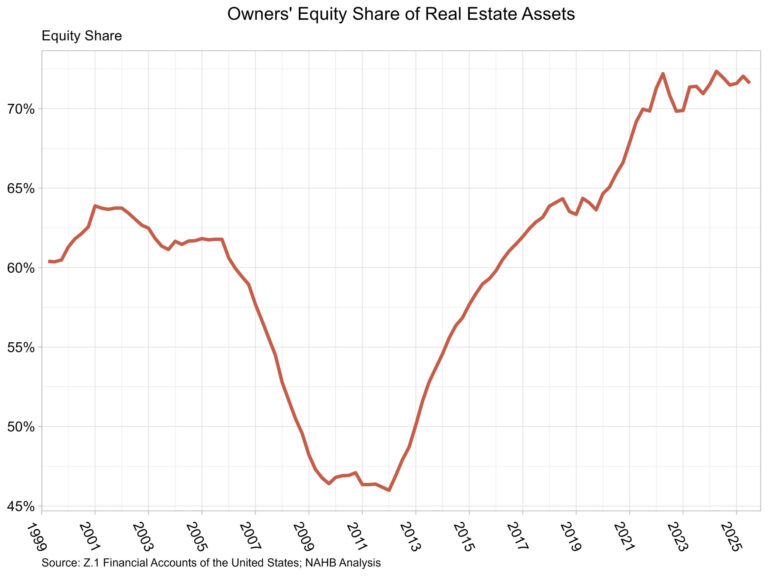
Owners’ equity share of real estate assets was 71.6% in the third quarter, slightly lower than the second quarter due to the decline in real estate asset values. The share in the third quarter of 2024 was 72.0% and has been above 70% for 15 consecutive quarters, the longest stretch since the 1950s. Owners’ equity in real estate was $34.4 trillion in the third quarter.


This article was originally published by a eyeonhousing.org . Read the Original article here. .


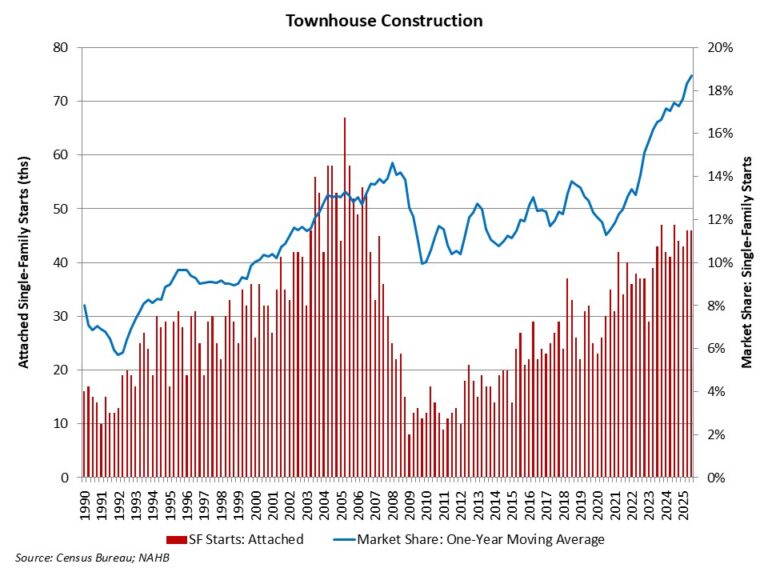
Townhouse construction gained single-family construction market share during the third quarter of 2025.

According to NAHB analysis of the most recent Census data of Starts and Completions by Purpose and Design, during the third quarter of 2025, single-family attached starts totaled 46,000. Over the last four quarters, townhouse construction starts totaled a strong 179,000 homes, which is 1% higher than the prior four-quarter period (177,000). Townhouses made almost 20% all of single-family housing starts for the third quarter of the year.

Using a one-year moving average, the market share of newly-built townhouses stood at 18.7% of all single-family starts for the third quarter. With gains over the last year, the four-quarter moving average market share is the highest on record, for data going back to 1985.

Prior to the current cycle, the peak market share of the last two decades for townhouse construction was set during the first quarter of 2008, when the percentage reached 14.6% on a one-year moving average basis. This high point was set after a fairly consistent increase in the share beginning in the early 1990s.

The long-run prospects for townhouse construction are positive given growing numbers of homebuyers looking for medium-density residential neighborhoods, such as urban villages that offer walkable environments and other amenities. Where it can be zoned, it can be built.


This article was originally published by a eyeonhousing.org . Read the Original article here. .

Job growth continued to slow at the end of the year, reinforcing signs of a cooling labor market. Nonfarm payrolls increased by 50,000 jobs in December, while the unemployment rate edged down slightly to 4.4%. With only 584,000 jobs added over the course of the year, 2025 marked the weakest annual job growth since 2003, excluding the recession years of 2008, 2009 and 2020. December’s job gains were led by food services, health care and social assistance, while retail trade and construction experienced job losses.

Wage growth accelerated in December, rising 3.8% year over year. This marked a 0.2 percentage point increase from the previous month, though it still remained 0.2 percentage points lower than a year ago. Wage growth has been outpacing inflation for nearly two years, which typically occurs as productivity increases.

National Employment

According to Employment Situation Summary reported by the Bureau of Labor Statistics (BLS), total nonfarm payroll employment rose by 50,000 in December, following a downwardly revised gain of 56,000 jobs in November. Through December, average monthly job growth in 2025 stood at just 49,000, well below the 168,000 monthly average recorded in 2024.

Payroll estimates for the previous two months were revised lower. October’s growth was revised down by 68,000, from -105,000 to -173,000. November job growth was revised down by 8,000, from +64,000 to +56,000. Combined, these revisions erased 76,000 jobs from previously reported figures.

The unemployment rate edged down slightly to 4.4% in December, following a downward revision of 4.5% in November. Over the month, the number of persons unemployed declined by 278,000, while the number of persons employed increased by 232,000.

Meanwhile, the labor force participation rate—the proportion of the population either looking for a job or already holding a job—decreased by 0.1 percentage points to 62.4%. This remains below its pre-pandemic level of 63.3% recorded at the beginning of 2020. Among prime working-age individuals (aged 25 to 54), the participation rate was unchanged at 83.8%, the highest level since September 2024.

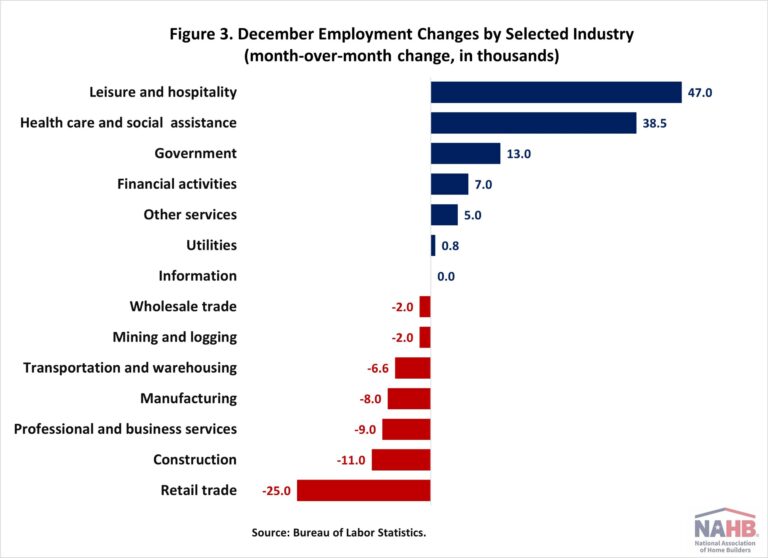
Industry-level data further point to a cooling market. Leisure and hospitality added 47,000 jobs in December, while health care and social assistance employment increased by 38,500. In contrast, retail trade and construction posted job losses as well as several other major industries including manufacturing, trasportation and warehousing, and professional and business services, suggesting that hiring softness is broadening across the economy.

Construction Employment

Employment in the overall construction sector declined by 11,000 jobs in December, after a downwardly revised gain of 22,000 in November. Within the industry, residential construction shed 3,100 jobs, while non-residential construction lost 7,800 positions.

Residential construction employment now stands at 3.3 million in December, including 952,000 workers employed by builders and remodelers and approximately 2.4 million residential specialty trade contractors.

The six-month moving average of job gains for residential construction remains negative, at a loss of 3,017 per month, reflecting losses in four of the past six months. Over the last 12 months, residential construction has seen a net loss of 41,400 jobs, marking the eighth consecutive annual decline and the longest stretch of annual losses since the Great Recession. Since the low point following the Great Recession, residential construction has gained 1,336,100 positions.

In December, the unemployment rate for construction workers rose to 5.3% on a seasonally adjusted basis. While higher than in recent months, the rate remains relatively low compared with historical norms.


This article was originally published by a eyeonhousing.org . Read the Original article here. .

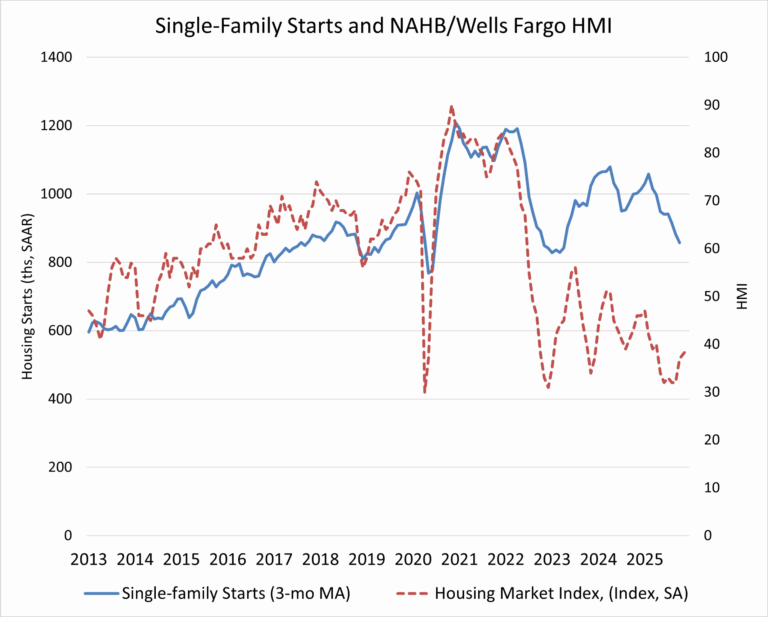
The latest residential housing market report, delayed by the federal government shutdown last fall, indicates that builders have faced significant headwinds in recent months. Elevated mortgage rates earlier in the year have restrained buyer demand and weighed on home building activity, alongside persistently high construction costs.

Overall housing starts declined 4.6 percent in October to a seasonally adjusted annual rate of 1.25 million units, according to the U.S. Department of Housing and Urban Development and the U.S. Census Bureau. This pace reflects the number of housing units builders would begin over the next 12 months if October’s activity were sustained.

Within the total, single-family starts rose 5.4 percent to a seasonally adjusted annual rate of 874,000 units but remain 7.8 percent lower than a year earlier. On a year-to-date basis, single-family starts are down 7.0 percent. Given recent volatility, the three-month moving average provides a clearer signal, declining to 857,000 units.

In contrast, multifamily starts, which include apartment buildings and condominiums, fell sharply, down 22.0 percent to an annualized pace of 372,000 units. The three-month moving average for multifamily construction has trended lower to 424,000 units, and activity is 7.9 percent below year-ago levels.

Regionally and on a year-to-date basis, combined single-family and multifamily starts increased 9.1 percent in the Midwest and 8.5 percent in the Northeast, while declining 1.9 percent in the West and 4.1 percent in the South.

The total number of housing units under construction stood at 1.3 million in October, down 10.1 percent from a year earlier. Single-family homes under construction fell to 596,000 units, a 7.0 percent year-over-year decline and the lowest level since November 2020. Multifamily units under construction declined to 790,000, down from peaks above 1 million units in December 2023 and 4.0 percent lower than a year ago.

Completions of single-family homes remained relatively strong at an annual rate of about 1 million units, reflecting continued progress in finishing projects already underway and marking a 2.0 percent increase from a year earlier. Multifamily completions, however, dropped sharply, down 41.7 percent year over year to a 377,000-unit pace. On a year-to-date basis, total completions across both sectors are down 9.2 percent.

Overall building permits edged down 0.2 percent in October to a 1.41-million-unit annualized rate. Single-family permits declined 0.5 percent to 876,000 units and are 9.4 percent lower than a year ago, with year-to-date permits down 7.0 percent. Multifamily permits were essentially unchanged at a 536,000-unit pace compared to the previous month and are up 16.3 percent compared to October 2024. Regionally, year-to-date total permits increased 5.9 percent in the Midwest, while declining 3.3 percent in the West, 4.0 percent in the South, and 9.3 percent in the Northeast.


This article was originally published by a eyeonhousing.org . Read the Original article here. .

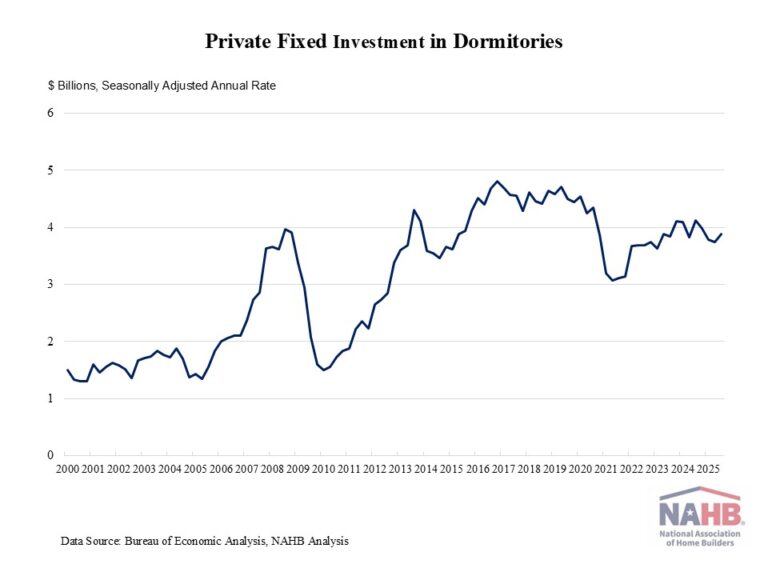
Private fixed investment for student dormitories was up 3.8% in the third quarter of 2025, reaching a seasonally adjusted annual rate (SAAR) of $3.9 billion. This gain followed three consecutive quarterly declines, as elevated interest rates continued to weigh on student housing construction. Despite the quarterly gain, private fixed investment in dorms was 5.5% lower than a year ago 

Private fixed investment in student housing experienced a surge after the Great Recession, as college enrollment increased from 17.2 million in 2006 to 20.4 million in 2011. However, during the pandemic, private fixed investment in student housing declined drastically from $4.4 billion (SAAR) in the last quarter of 2019 to $3 billion in the second quarter of 2021.. According to the National Student Clearinghouse Research Center, college enrollment fell by 3.6% in the fall of 2020 and by 3.1% in the fall of 2021.  

Since then, private fixed investment in dorms has rebounded, as college enrollments show a gradual recovery from pandemic-driven declines. Effective in-person learning requires college students to return to campuses, boosting the student housing sector. Still, demographic trends are reshaping the outlook for student housing. The U.S. faces slower growth in the college-age population as birth rates declined following the Great Recession. As a result, total enrollment in postsecondary institutions is projected to only increase 8% from 2020 to 2030, according to the National Center for Education Statistics, well below the 37% increase between 2000 and 2010. 

Despite recent fluctuations, the student housing construction shows signs of recovery and future growth is expected in response to increasing student enrollment projections. 


This article was originally published by a eyeonhousing.org . Read the Original article here. .

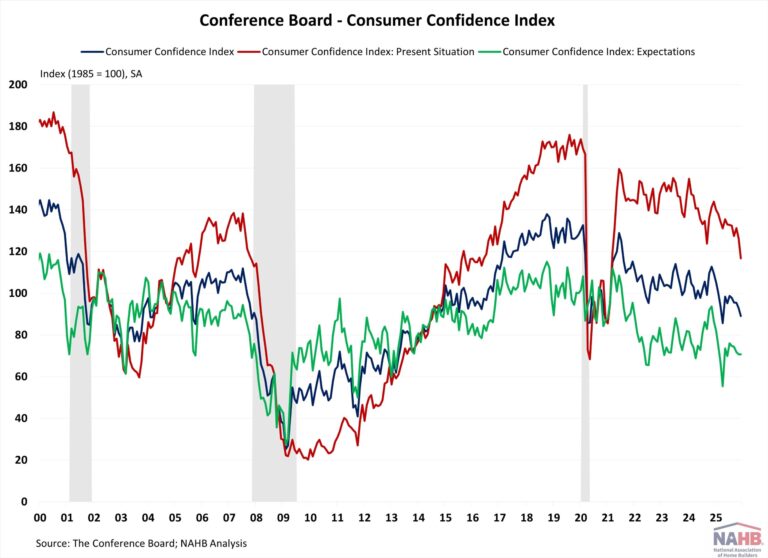
Consumer confidence in December fell to the lowest level since April’s tariff implementation, reflective of growing concerns about reignited inflation and a weakening labor market affecting personal finances. The labor market differential, which measures the gap between consumers viewing job as plentiful and hard-to-get, continued to narrow and is now at its lowest level since February 2021. This is consistent with recent job reports showing fewer job openings and slower hiring. The decline in confidence stands in contrast to the recent solid GDP report for the third quarter.

The Consumer Confidence Index, reported by the Conference Board, is a survey measuring how optimistic or pessimistic consumers feel about their financial situation. This index fell from 92.9 to 89.1 in December, the lowest level since April. The Consumer Confidence Index consists of two components: how consumers feel about their present situation and their expected situation. In September, the Present Situation Index decreased 9.5 points from 126.3 to 116.8, the largest monthly decline since September 2024; the Expectation Situation Index dropped remained unchanged at 70.7. This is the eleventh consecutive month that the Expectation Index has been below 80, a threshold that often signals a recession within a year.

Consumers’ assessment of current business conditions deteriorated in December. The share of respondents rating business conditions “good” decreased by 2.3 percentage points to 18.7%, while those claiming business conditions as “bad” rose by 3.3 percentage points to 19.1%. Meanwhile, consumers’ assessments of the labor market cooled further in December. The share of respondents reporting that jobs were “plentiful” fell by 1.5 percentage points to 26.7%, the lowest level since March 2021; meanwhile, those who saw jobs as “hard to get” rose by 0.7 percentage points to 20.8%, the highest since February 2021.

Consumers were more pessimistic about the short-term outlook. The share of respondents expecting business conditions to improve fell from 18.1% to 18.0%, while those expecting business conditions to deteriorate declined from 25.1% to 21.8%. Similarly, expectations of employment over the next six months were more negative. The share of respondents expecting “more jobs” remained unchanged at 16.5%, and those anticipating “fewer jobs” rose by 0.6 percentage points to 27.4%.

The Conference Board also reported the share of respondents planning to buy a home within six months. The share of respondents planning to buy a home fell slightly to 5.7% in December, the lowest level since August. Of those, respondents planning to buy a newly constructed home fell to 0.5%, and those planning to buy an existing home was unchanged at 2.4%. The remaining 2.8% were planning to buy a home but were undecided between new or existing homes.


This article was originally published by a eyeonhousing.org . Read the Original article here. .

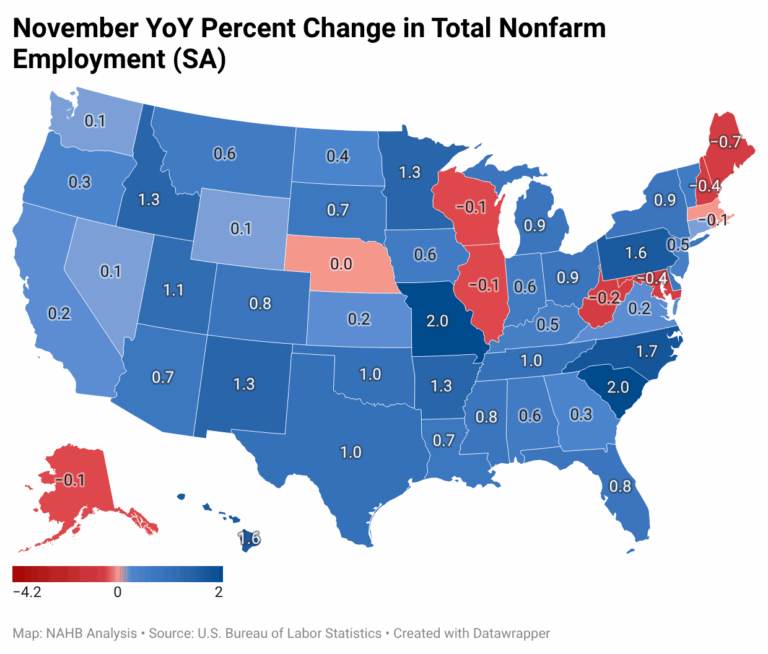
In November 2025, employment levels were largely unchanged across all states, with year-over-year growth holding near 2%. In contrast, construction employment showed greater variation, with some states experiencing declines of up to 7.5% while others posted gains approaching 10%.

The recent federal government shutdown provides important context for this Bureau of Labor Statistics release, as it disrupted the regular collection of survey data and delayed some statistical reporting. Because of this interruption, the November release focuses on year-over-year comparisons rather than the typical month-to-month changes.

Year-over-year ending in November, 933,000 jobs have been added to the labor market, which is a 0.6% increase compared to the November 2024 level. The range of job gains spanned from 200 jobs in Wyoming to 146,300 jobs in Texas. Nine states and the District of Columbia lost a total of 58,900 jobs in the past 12 months, with the District of Columbia reporting the steepest job losses at 32,800. In percentage terms, the range of job growth spanned 0.1% in Nevada, Connecticut, Wyoming, and Washington to 2.0% in South Carolina. The range of job losses across states spanned 0.1%-0.7%. However, the District of Colombia posted a decline of 4.2%.

Construction Employment

Across the nation, construction sector jobs data 1—which includes both residential and non-residential construction—showed an increase of 58,000 jobs over the year. This is a 0.7% increase compared to the November 2024 level. Texas added 24,000 jobs, which was the largest gain of any state, while New York lost 18,100 construction sector jobs. In percentage terms, Iowa had the highest annual growth rate in the construction sector at 9.9%. During this period, New Jersey reported the largest decline of 7.5%.

For this analysis, BLS combined employment totals for mining, logging, and construction are treated as construction employment for the District of Columbia, Delaware, and Hawaii.


This article was originally published by a
eyeonhousing.org . Read the Original article here. .

The count of open, unfilled positions in the construction industry increased in November, per the delayed Bureau of Labor Statistics Job Openings and Labor Turnover Survey (JOLTS). The current level of open jobs is down measurably from two years ago due to declines in construction activity, particularly in housing.

The number of open jobs for the overall economy declined as the labor market weakened at the end of 2025, falling from 7.449 million in October to 7.146 million in November. The November reading was down from a year ago (8.031 million).

Previous NAHB analysis indicated that this number had to fall below eight million on a sustained basis for the Federal Reserve to move forward on interest rate reductions. With estimates remaining below eight million for national job openings, the Fed, in theory, should be able to cut further.

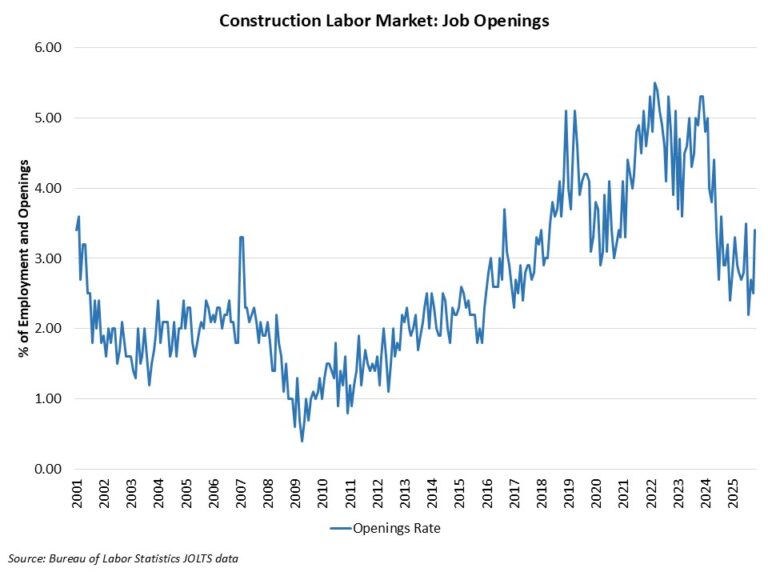
The number of open construction sector jobs increased from 202,000 in October to 292,000 in November. This total is relatively stable compared to a year ago (272,000), although the reading is notably lower than two years ago. The chart below notes the declining trend that has been in place for unfilled construction jobs since the Fed raised the federal funds rate and home building weakened. While home building employment was declining during the second half of 2025, other subsectors of the construction industry have expanded (e.g. data centers).

The construction job openings rate increased to 3.4% in November, higher than the 3.2% rate estimated a year ago.

The layoff rate in construction declined to 1.7% in November. The quits increased to 1.5% for the month.


This article was originally published by a eyeonhousing.org . Read the Original article here. .
Pin It