Tag

housing

Browsing


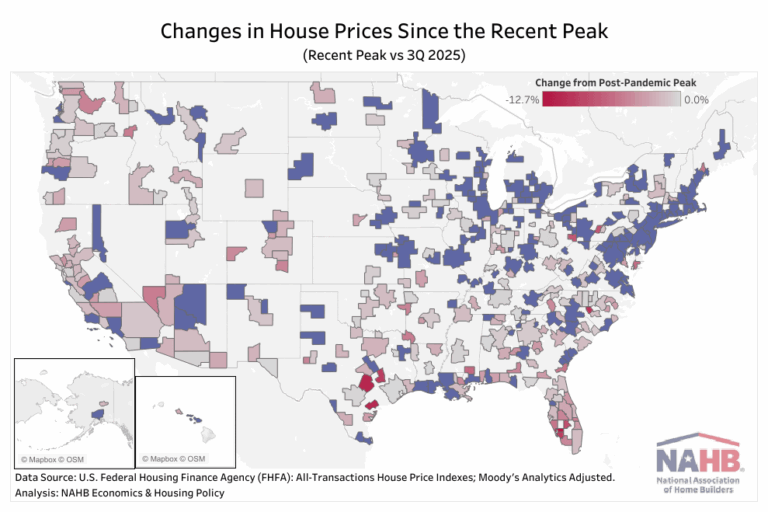
Nationally, house prices continued to rise at a modest pace in the third quarter of 2025, as mentioned in our previous quarterly house prices post. However, this national trend masks significant variation across local markets. While many metro areas continued to see house price appreciation, others experienced notable declines following several years of rapid growth.

Since the onset of the COVID-19 pandemic, house prices have surged nationwide. Between the first quarter of 2020 and the third quarter of 2025, national house prices climbed 54.9%. Local markets saw broad gains as well, with cumulative appreciation ranging from 18.3% to 88.4%, and 159 metro areas reached their highest recorded house prices in the third quarter of 2025.

Yet despite these increases, more than half of metro areas have now experienced at least some decline from their recent price peak. These declines range from a slight 0.1% dip to a more substantial 12.7% decline, with most of the downward trends beginning in last 2024 or early 2025.

House price declines have been most widespread in the West and South, regions that saw some of the fastest appreciation during the pandemic boom.  Several markets stand out for their significant corrections:

Punta Gorda, FL has experienced the sharpest decline, with prices falling 12.7% since its peak in the fourth quarter of 2022.

Austin–Round Rock–San Marcos, TX, one of the nation’s hottest markets during the pandemic, has seen prices drop 11.3% since reaching a peak in the second quarter of 2022.

Victoria, TX reached its peak more recently in the fourth quarter of 2024 and has since seen prices decline 11.0% over the past three quarters.

In contrast, many metro areas in the Midwest and Northeast have avoided significant price declines. These regions continue to see slower but steady price growth, supported by persistent inventory shortages and solid demand. Their more moderate appreciation during the pandemic has also helped limit the risk of sharp price corrections. Here are some examples (listed in no particular order):

York–Hanover, PA recorded a 6.0% year-over-year increase in house prices in the third quarter of 2025, reflecting stable demand and limited housing supply.

Worcester, MA continues to experience price growth, slowing from the rapid 18.0% growth in the third quarter of 2021 to a still-solid 4.4% year-over-year gain in the third quarter of 2025.

Wausau, WI experienced a robust 9.5% year-over-year increase in home prices, standing out as one of the strongest and most resilient housing markets in the region.

Milwaukee-Waukesha, WI continue to see rising house prices, with growth easing from a peak of 16.7% growth in the second quarter of 2022 to a more sustainable 5.6% year-over-year increase in the third quarter of 2025.


This article was originally published by a eyeonhousing.org . Read the Original article here. .
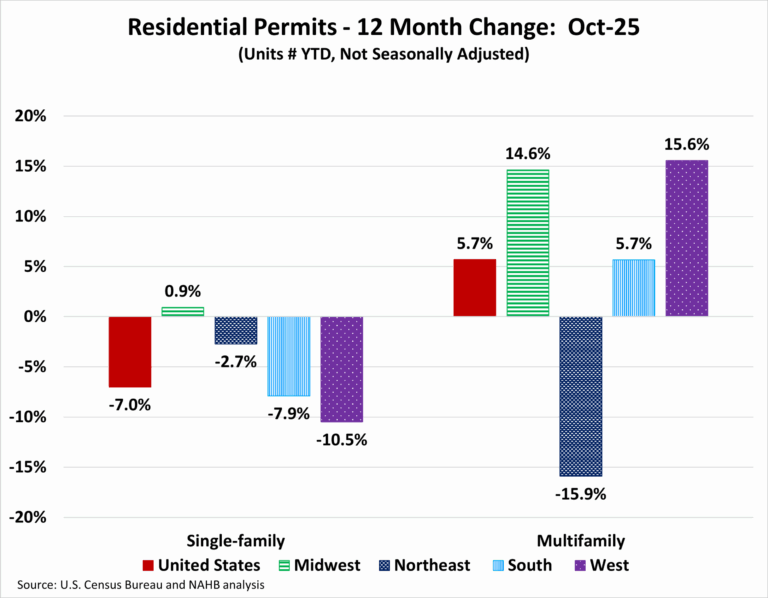

In October, single-family building permits weakened, reflecting continued caution among builders amid affordability constraints and financing challenges. In contrast, multifamily permit activity remained steady and continued to perform relatively well. Together, these trends suggest that while demand for new housing persists, builders are adjusting residential construction activity in response to evolving market conditions. Because permits typically precede construction starts, these patterns offer insight into the near-term outlook for residential building activity.

Over the first ten months of 2025, the number of single-family permits issued nationwide reached 787,122. On a year-over-year basis, this represents a 7.0 percent decline compared with the October 2024 year-to-date total of 846,446. Multifamily permitting activity was stronger, with 426,352 permits issued nationwide, marking a 5.7 percent increase from the same period last year.

Regionally, year-to-date single-family permitting increased in only one of the four regions through October. The Midwest posted a modest gain of 0.9 percent, while activity declined in the Northeast (down 2.7 percent), the South (down 7.9 percent), and the West (down 10.5 percent). Multifamily permits increased in three of the four regions, led by gains in the West (up 15.6 percent), followed by the Midwest (up 14.6 percent), and then the South (up 5.7 percent). The Northeast saw a sharp decline of 15.9 percent, driven largely by a 28.0 percent drop in the New York–Newark–Jersey City metropolitan area.

At the state level, 15 states recorded year-over-year increases in single-family permits between October 2025 year-to-date and October 2024 year-to-date, with gains ranging from 12.6 percent in New Hampshire to 0.8 percent in West Virginia. The remaining 35 states and the District of Columbia reported declines, led by Nevada, which posted the steepest drop at 22.4 percent.

The ten states issuing the highest number of single-family permits accounted for 62.0 percent of all single-family permits issued nationwide. Texas continued to lead the country, with 122,293 permits issued over the first ten months of 2025, although this represented a 10.3 percent decline compared with the same period last year. Florida, the second-highest state, saw permits fall by 9.8 percent, while North Carolina, ranked third, experienced a decline of 5.8 percent.

Between October 2025 year-to-date and October 2024 year-to-date, 29 states and the District of Columbia recorded increases in multifamily building permits, while 21 states experienced declines. Mississippi posted the largest percentage increase, with multifamily permits surging 142.6 percent, rising from 289 to 701 units. In contrast, Maryland recorded the steepest decline, with permits falling 44.5 percent, from 5,265 to 2,922 units.

The ten states issuing the highest number of multifamily permits accounted for 60.2 percent of all multifamily permits issued nationwide. Over the first ten months of 2025, Texas, which issued the most multifamily permits, recorded a modest increase of 2.9 percent. Florida, the second-highest state, posted a stronger gain of 27.8 percent, while California, ranking third, saw multifamily permits rise by 19.8 percent.

At the local level, the following are the ten metropolitan areas with the highest number of single-family permits issued.

Below are the ten local areas with the highest levels of multifamily permitting activity.


This article was originally published by a eyeonhousing.org . Read the Original article here. .
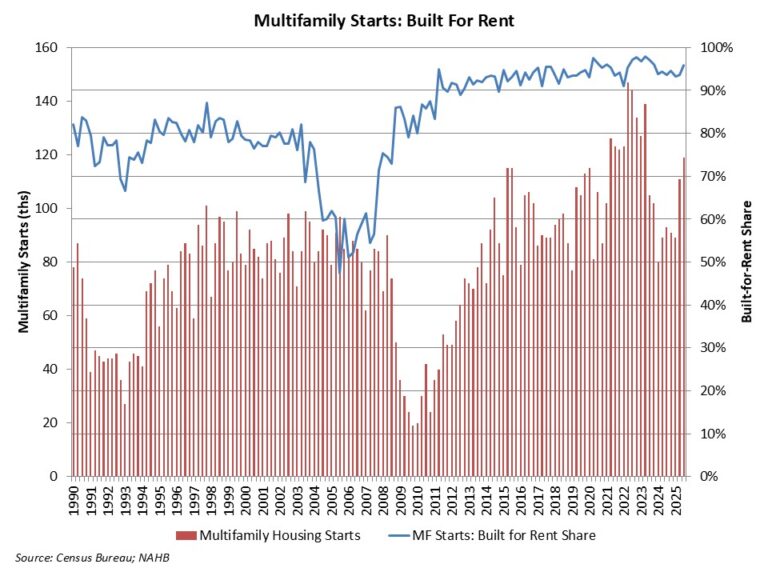

According to NAHB analysis of quarterly Census data, the count of multifamily, for-rent housing starts increased during the third quarter of 2025. For the quarter, 119,000 multifamily residences started construction. Of this total, 114,000 were built-for-rent. This built-for-rent total was 31% higher than the third quarter of 2024. This marks a significant increase, and it is possible these numbers will be revised lower in future Census data given other multifamily data reporting.

The market share of rental units of multifamily construction starts was 95% for the third quarter. A historical low market share of 47% for built-for-rent multifamily construction was set during the third quarter of 2005, during the condo building boom. An average share of 80% was registered during the 1980-2002 period.

For the third quarter, there were 5,000 multifamily condo unit construction starts, a decrease from a year ago.

An elevated rental share of multifamily construction is holding the typical apartment size below levels seen during the pre-Great Recession period. According to the third quarter 2025 data, the average square footage of multifamily construction starts decreased to 1,052 square feet. The median declined to 1,006 square feet. These measures are consistent with the elevated share of multifamily built-for-rent construction.


This article was originally published by a eyeonhousing.org . Read the Original article here. .


Single-family built-for-rent construction fell back in the third quarter of 2025, as a higher cost of financing and increased multifamily supply crowded out development.

According to NAHB’s analysis of data from the Census Bureau’s Quarterly Starts and Completions by Purpose and Design, there were approximately 18,000 single-family built-for-rent (SFBFR) starts during the third quarter of 2025. This is down significantly relative to the third quarter of 2024 (24,000 starts). Over the last four quarters, 69,000 such homes began construction, which is a 25% decrease compared to the 92,000 estimated SFBFR starts in the four quarters prior to that period.

The SFBFR market is a source of inventory amid challenges over housing affordability and downpayment requirements in the for-sale market, particularly during a period when a growing number of people want more space and a single-family structure. Single-family built-for-rent construction differs in terms of structural characteristics compared to other newly-built single-family homes, particularly with respect to home size. However, investor demand for single-family homes, both existing and new, has cooled with higher interest rates.

Given the relatively small size of this market segment, the quarter-to-quarter movements typically are not statistically significant. The current four-quarter moving average of market share (7%) is nonetheless higher than the historical average of 2.7% (1992-2012).

Importantly, as measured for this analysis, the estimates noted above include only homes built and held by the builder for rental purposes. The estimates exclude homes that are sold to another party for rental purposes, which NAHB estimates may represent another three to five percent of single-family starts based on industry surveys.

The Census data notes an elevated share of single-family homes built as condos (non-fee simple), with this share averaging more than 4% over recent quarters. Some, but certainly not all, of these homes will be used for rental purposes. Additionally, it is theoretically possible some single-family built-for-rent units are being counted in multifamily starts, as a form of “horizontal multifamily,” given these units are often built on a single plat of land. However, spot checks by NAHB with permitting offices indicate no evidence of this data issue occurring.

With the onset of the Great Recession and declines for the homeownership rate, the share of built-for-rent homes increased in the years after the recession. While the market share of SFBFR homes is small, it has clearly expanded. Given affordability challenges in the for-sale market, the SFBFR market will likely retain an elevated market share. However, in the near-term, SFBFR construction is likely to slow until the return on new deals improves.


This article was originally published by a eyeonhousing.org . Read the Original article here. .
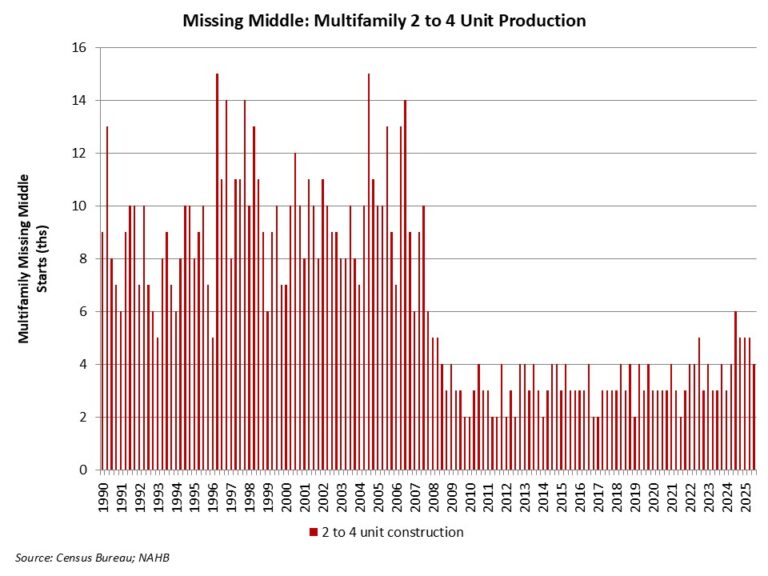

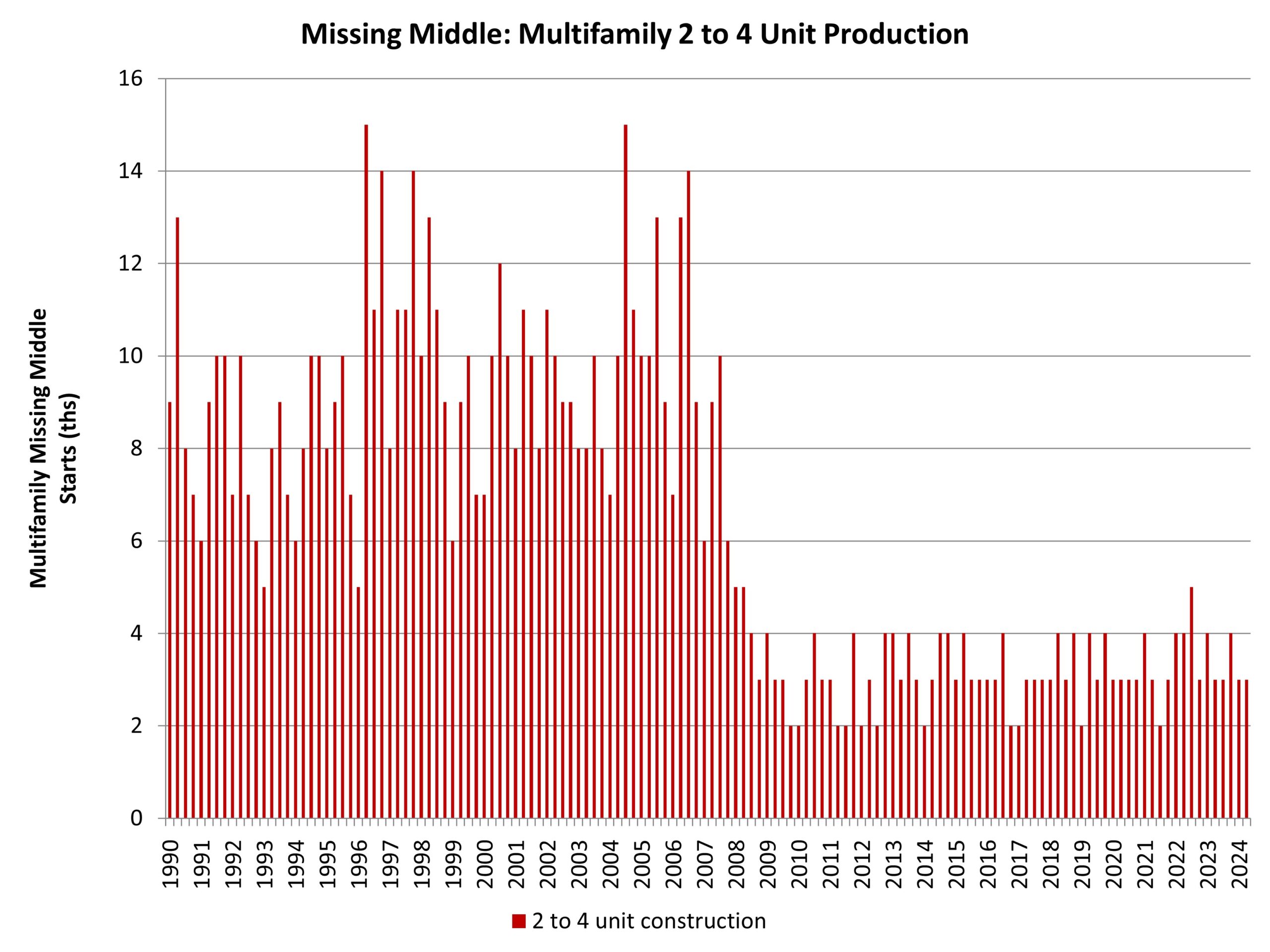
The missing middle construction sector includes development of medium-density housing, such as townhouses, duplexes and other small multifamily properties.

The multifamily segment of the missing middle (apartments in 2- to 4-unit properties) has generally disappointed since the Great Recession. For the third quarter of 2025, there were 4,000 2- to 4-unit housing unit construction starts. This represents a small decrease relative to the third quarter of 2024.

Over the last four quarters this type of construction totaled 19,000 units, up 12% over the four quarters prior to that period (17,000). Nonetheless, this subsector of residential construction continues to underperform relative to its potential, due in part to zoning restrictions.

As a share of all multifamily production, 2- to 4-unit development was just 3% of total multifamily development for the third quarter. This remains lower than recent historic trends. From 2000 to 2010, such home construction made up a little less than 11% of total multifamily construction.

Construction of the missing middle has clearly lagged during the post-Great Recession period and will continue to do so without zoning reform focused on light-touch density. Despite some acceleration in late 2024 and early 2025, the sector continues to lag.


This article was originally published by a eyeonhousing.org . Read the Original article here. .
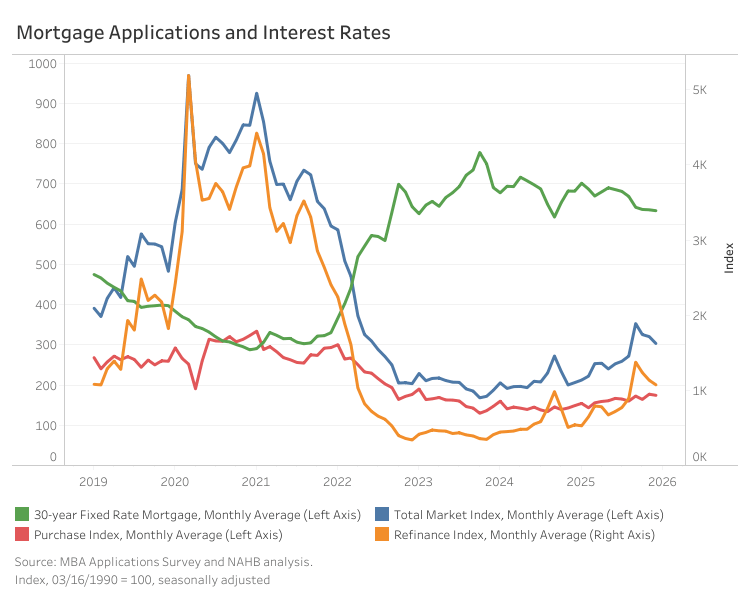

Mortgage application activity declined in December despite a modest easing in mortgage rates. The Mortgage Bankers Association’s (MBA) Market Composite Index, a measure of total mortgage application volume, fell 5.3% from November on a seasonally adjusted basis, though it remained 47.1% higher than a year ago.

The average contract interest rate for 30-year fixed mortgages edged down 2 basis points to 6.3%, the lowest level of 2025. Nonetheless, both purchase and refinance applications declined month-over-month, down 1.6% and 5.3%, respectively. Relative to December 2024, purchase activity increased 16.8%, while refinance applications were up 98.6%.

By loan type, applications for both fixed-rate mortgages (FRMs) and adjustable-rate mortgages (ARMs) declined from November, decreasing 4.8% and 13.6%, respectively. On a year-over-year basis, FRM applications were up by 43.9%, while ARM applications have more than doubled, rising 105.1%. As of December 2025, ARMs accounted for an average 7.5% of total applications on a non-seasonally adjusted basis, down 0.3 percentage points from November but 2.2 percentage points higher than a year earlier.

For loan sizes, the average loan amount across all loan types increased marginally by 0.6% to $397,500. Average purchase loan sizes declined 0.8% to $424,800, while the refinance loan size increased 2.5% to $377,300. The average size of ARM loans edged down 0.1% to $968,000.


This article was originally published by a eyeonhousing.org . Read the Original article here. .
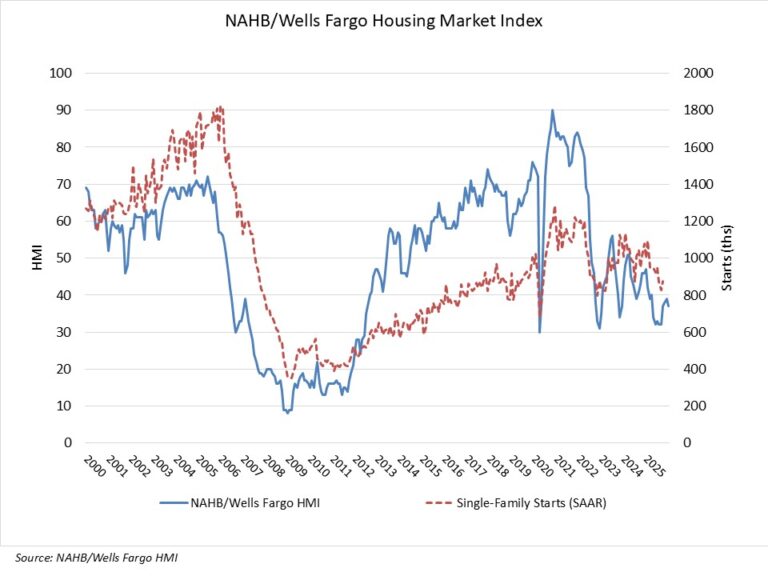

Builder confidence moved lower to start the year as affordability concerns continue to weigh heavily with buyers, and builders continue to contend with rising construction costs.

Builder confidence in the market for newly built single-family homes fell two points to 37 in January, according to the National Association of Home Builders (NAHB)/Wells Fargo Housing Market Index (HMI).

While the upper end of the housing market is holding steady, affordability conditions are taking a toll on the lower and mid-range sectors. Buyers are concerned about high home prices and mortgage rates, with downpayments particularly challenging given elevated price to income ratios.

In a positive development, Freddie Mac reported that the average mortgage rate fell to 6.06% as of Jan. 15, the lowest rate in three years and nearly 100 basis points below the same period last year.

Most responses to the January HMI survey were received prior to the announcement that Fannie Mae and Freddie Mac would be purchasing $200 billion in mortgage-backed securities in an effort to bring down mortgage interest rates. And while this latest policy action on the interest rate front was largely not factored in the HMI survey, builders continue to report several supply-side headwinds. 

The future sales component of the HMI dipped below 50 for the first time since September, indicating that builders continue to face several issues that include labor and lot shortages as well as elevated regulatory and material costs.

In a further sign of ongoing challenges for the housing market, the latest HMI survey also revealed that 40% of builders reported cutting prices in January, unchanged from December but the third consecutive month the share has been at 40% or higher since May 2020. Meanwhile, the average price reduction was 6% in January, up from the 5% rate in December. The use of sales incentives was 65% in January, marking the 10th consecutive month this share has exceeded 60%.

Derived from a monthly survey that NAHB has been conducting for more than 40 years, the NAHB/Wells Fargo HMI gauges builder perceptions of current single-family home sales and sales expectations for the next six months as “good,” “fair” or “poor.” The survey also asks builders to rate traffic of prospective buyers as “high to very high,” “average” or “low to very low.” Scores for each component are then used to calculate a seasonally adjusted index where any number over 50 indicates that more builders view conditions as good than poor.

All of the HMI subindices fell in January. The HMI index gauging current sales conditions declined one point to 41 and the gauge charting traffic of prospective buyers dropped three points to 23. The index measuring future sales fell three points to 49, marking the first time this component fell below the breakeven point of 50 since September.

Looking at the three-month moving averages for regional HMI scores, the Northeast fell two points to 45, the Midwest held steady at 43, the South dropped one point to 35 and the West gained one point to 35.

The HMI tables can be found at nahb.org/hmi.


This article was originally published by a eyeonhousing.org . Read the Original article here. .

In the third quarter of 2025, the NAHB/Westlake Royal Remodeling Market Index (RMI) posted a reading of 64, increasing four points compared to the previous quarter.

Most remodelers are finding reasonably strong market conditions, even with the normal seasonal slowdown during the holidays.  The major headwinds the industry is experiencing continue to be rising costs and potential customers hesitating due to policy and economic uncertainty.  Demand for remodeling is being supported by an aging housing stock, strong homeowner equity and increasing need for aging-in-place improvements.

The RMI is based on a survey that asks remodelers to rate various aspects of the residential remodeling market “good”, “fair” or “poor.”  Responses from each question are converted to an index that lies on a scale from 0 to 100. An index number above 50 indicates a higher proportion of respondents view conditions as good rather than poor.

Current Conditions

The Remodeling Market Index (RMI) is an average of two major component indices: the Current Conditions Index and the Future Indicators Index. 

The Current Conditions Index is an average of three subcomponents: the current market for large remodeling projects ($50,000 or more), moderately-sized projects ($20,000 to $49,999), and small projects (under $20,000).  In the fourth quarter of 2025, the Current Conditions Index averaged 71, increasing three points from the previous quarter.  All three components increased quarter-over-quarter and remained above the break-even point of 50.  Large remodeling projects saw the largest increase, rising five points to 69, followed by small remodeling projects adding two points to 73, and moderately-sized projects, inching up one point to 70.

Future Indicators

The Future Indicators Index is an average of two subcomponents: the current rate at which leads and inquiries are coming in, and the current backlog of remodeling projects. 

In the fourth quarter of 2025, the Future Indicators Index averaged 56, up four points from the previous quarter.  Both components increased quarter-over-quarter and are above the break-even point of 50.  The component measuring the current rate at which leads and inquiries are coming in rose five points to 54 while the component measuring backlog of remodeling jobs added two points to 58.

For the full set of RMI tables, including regional indices and a complete history for each RMI component, please visit NAHB’s RMI web page.


This article was originally published by a eyeonhousing.org . Read the Original article here. .
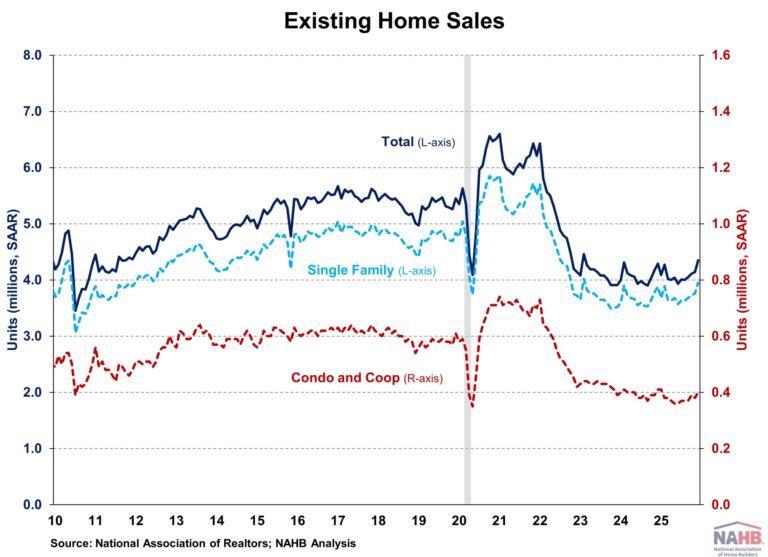

Existing home sales rose in December to the fastest pace in nearly three years, but annual sales for 2025 remained at a 30-year low as elevated home prices and mortgage rates kept buyers on the sidelines, according to the National Association of Realtors (NAR). While mortgage rates have eased from 7% seen at the start of 2025 to near 6% by year-end, tight inventory continued to push home prices higher as more homeowners took listings off the market. Resale inventory dropped to its lowest level since January 2025. Though home price appreciation has been slowed in recent months, housing affordability remains a challenge.

Total existing home sales, including single-family homes, townhomes, condominiums, and co-ops, rose 5.1% to a seasonally adjusted annual rate of 4.35 million in December, the highest level for 2025 and highest since February 2023. On a year-over-year basis, sales were 1.4% higher than a year ago. For the year 2025, existing home sales totaled 4.06 million, unchanged from 2024 and matching the lowest level since 1995.

The existing home inventory level was 1.18 million units in December, down 18.1% from November but up 3.5% from a year ago. At the current sales rate, December unsold inventory sits at a 3.3-months’ supply, down from 4.2-months in November but up from 3.2-months in December 2024. Inventory between 4.5 to 6 months’ supply is generally considered a balanced market.

The December median sales price of all existing homes was $405,400, up 0.4% from last year. This marks the 30th consecutive month of year-over-year increases. The median condominium/co-op price in December was up 1.5% from a year ago at $364,400.  Recent gains for home inventory will put downward pressure on resale home prices in most markets in 2026. All four major regions saw an increase in sales in December, with gains ranging from 2.0% in the Northeast and Midwest to 6.9% in the South. However, sales were mixed on a year-over-year basis. Sales remained unchanged in the Midwest and West, rose 3.6% in the South, and fell 1.9% in the Northeast.

The Pending Home Sales Index (PHSI) is a forward-looking indicator based on signed contracts. The PHSI rose from 76.7 to 79.2 in November due to lower mortgage rates. On a year-over-year basis, pending sales were 2.6% higher than a year ago, according to the National Association of Realtors’ data.


This article was originally published by a eyeonhousing.org . Read the Original article here. .
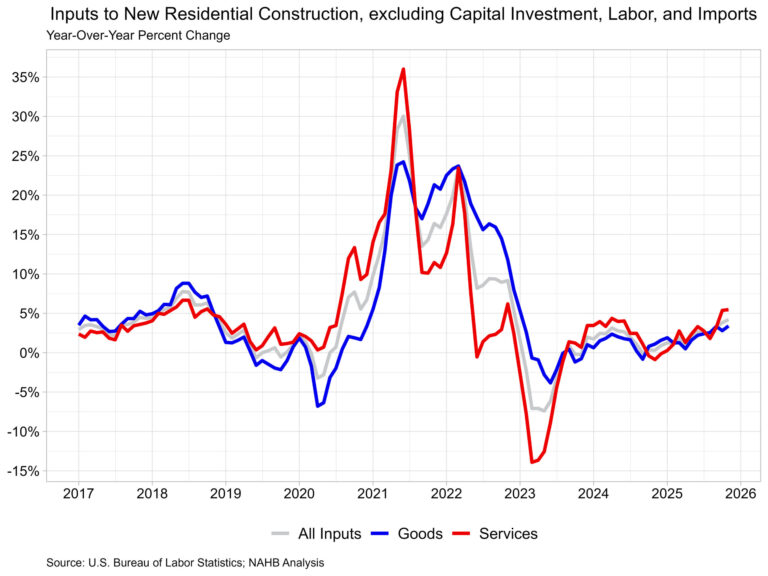

Residential building material prices continued to experience elevated growth, according to the latest Producer Price Index release from the Bureau of Labor Statistics. Price growth has been above 3.0% since June this year, despite continued weakness in the new residential construction market. Across building materials, metal products continue to experience price increases, while ready-mix concrete and softwood lumber have experienced price declines over the past year.

The Producer Price Index for final demand increased 0.2% in November, after rising 0.1% in October. The index for final demand goods increased 0.9% in November. Over 80% of the November increase is due to prices for final demand energy, which was up 4.6% in November. This index for final demand for services was unchanged in November.

The price index for inputs to new residential construction rose 0.1% in November and was up 4.2% from last year. The price of goods used in new residential construction was up 0.4% over the month and 3.4% from last year. Meanwhile, the price for services was down 0.4% over the month and up 5.5% from last year.

Input Goods

The goods component has a larger importance to the inputs to residential construction price index, representing around 60%. On a monthly basis, the price of input goods to new residential construction was up 0.4% in November.

The input goods to residential construction index can be further broken down into two separate components, one measuring energy inputs with the other measuring remaining goods. The latter of these two components simply represents building materials used in residential construction, which makes up around 93% of the goods index.

Energy input prices rose 3.8% in November and were 2.0% higher than one year ago. Building material prices were up 0.2% in September and up 3.5% compared to one year ago. The 3.5% year-over-year increase is the largest increase since the 4.9% experienced back in January of 2023.

The largest year-over-year price increases continue to show in metal products. Topping the list in November was metal molding and trim, with prices up 48.2% from last year. Two key inputs, ready-mix concrete and softwood lumber, experienced price decreases from last year. Ready-mix concrete prices are down 0.7% compared to a year ago, likely a result of the recent stagnation in construction spending. Softwood lumber prices were down 8.0% in November from last year as prices continue to remain low.

Input Services

Prices for service inputs to residential construction reported a decline of 0.4% in November. On a year-over-year basis, service input prices were up 5.6%. The price index for service inputs to residential construction can be broken out into three separate components: a trade services component, a transportation and warehousing services component, and a services excluding trade, transportation and warehousing component (other services).

The most significant component is trade services (around 60%), followed by other services (around 29%), and finally transportation and warehousing services (around 11%). The largest component, trade services, was up 7.7% from a year ago. The transportation and warehousing services rose 4.2% while prices for other services were up 1.5% over the year.

Expanded Inputs to New Construction Data

Within the PPI that BLS publishes, new experimental data was recently published regarding inputs to new construction. The data expands existing inputs to industry indexes by incorporating import prices with prices for domestically produced goods and services. With this additional data, users can track how industry input costs are changing among domestically produced products and imported products. This data focuses on new construction, but the complete dataset includes indices across numerous industries that can be found here on BLS website. 

New construction input prices are primarily influenced by domestically produced goods and services, with domestic products accounting for 90% of the weight of the industry index for new construction. Imported goods make up the remaining 10% of the index.  

The latest available data, for August 2025, showed that domestically produced goods continue to have faster price growth compared to imported goods used in new construction. On a year-over-year basis, the index for domestic goods increased 2.5%, while prices for imported goods fell 0.7% over the same period.


This article was originally published by a eyeonhousing.org . Read the Original article here. .
Pin It