Tag

housing

Browsing


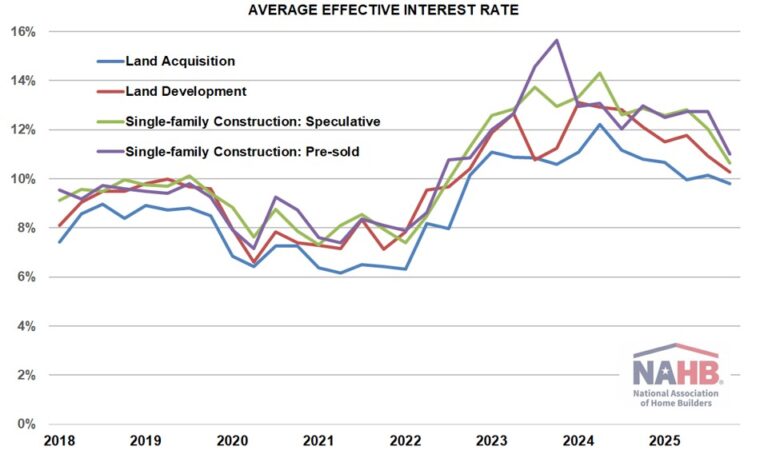
The cost of credit for residential construction and development declined in the fourth quarter of 2025,  according to NAHB’s quarterly survey on Land Acquisition, Development & Construction (AD&C) Financing. In particular, the average contract rate declined on all four categories of loans tracked in the survey: from 7.95% in the third quarter to 7.61% on loans for land acquisition, from 7.68% to 7.44% on loans for land development, from 7.89% to 7.47% on loans for speculative single-family construction, and from 7.90% to 7.16% on loans for pre-sold single-family construction.   

Meanwhile, the average initial points paid by builders and developers fell on three of the four types of AD&C loans: from 0.83% to 0.44% on loans for land development, from 0.75% to 0.34% on loans for speculative single-family construction, and from 0.67% to 0.37% on loans for pre-sold single-family construction. The only exception was loans specifically for land acquisition, on which the average initial points increased slightly—from 0.66% to 0.70%.

The small increase in points on land acquisition loans was not enough to offset the drop in the contract interest rate, however, so the average effective interest rate (which takes both the contract rate and initial points into account) declined across the board: from 10.15% to 9.81% on loans for land acquisition, from 10.92% to 10.28% on loans for land development, from 12.04% to 10.64% on loans for speculative single-family construction, and from 12.74% to 11.01%  on loans for pre-sold single-family construction.

In all four cases, this was the lowest the average effective rate has been since the period of generally rising interest rates in 2022.

Notwithstanding the drop in rates, builders and developers continued to report tightening credit conditions in the fourth quarter of 2025. The net easing index derived from NAHB’s AD&C survey posted a reading of -9.3 (the negative number indicating that credit has tightened since the previous quarter). This is quite similar to the results from the perspective of lenders reported in the Federal Reserve’s survey of senior loan officers. The net easing index derived from the Fed survey posted a reading of -1.8 in the fourth quarter. Both the NAHB and Fed survey have now reported consistently tightening credit conditions for 16 consecutive quarters. In both cases, however, the net easing index in Q4 2025  came closer to the break-even point of zero (between tightening and easing) than it has at any time since the first quarter of 2022. 

More details from the Fed’s survey of lenders—including measures of demand and net easing for residential mortgages—appeared in a previous post.

Also, in the NAHB AD&C survey, 35% of respondents who built single-family homes during the fourth quarter of 2025 reported financing some of the construction with a construction-to-permanent (one-time-close) loan made to the ultimate home buyer. On average, 59% of the homes these respondents built were financed in this manner.

More detail on credit conditions for residential builders and developers is available on NAHB’s AD&C Financing Survey web page.


This article was originally published by a eyeonhousing.org . Read the Original article here. .

Inflation eased to an eight-month low in January, confirming a continued downward trend. Though most Consumer Price Index (CPI) components have resolved shutdown-related distortions from last fall, the shelter index will remain affected through April due to the imputation method used for housing costs. The shelter index is likely to show larger increases in the coming months.

While headline inflation moderated, underlying cost pressures from trade policy persist. In 2025, the average U.S. tariff rate rose from 2.6% to 13%. A recent New York Fed study found that 94% of tariff costs were passed through to U.S. companies and consumers during the first eight months of 2025. Households still face elevated costs for consumer goods even as the pace of price growth slows.

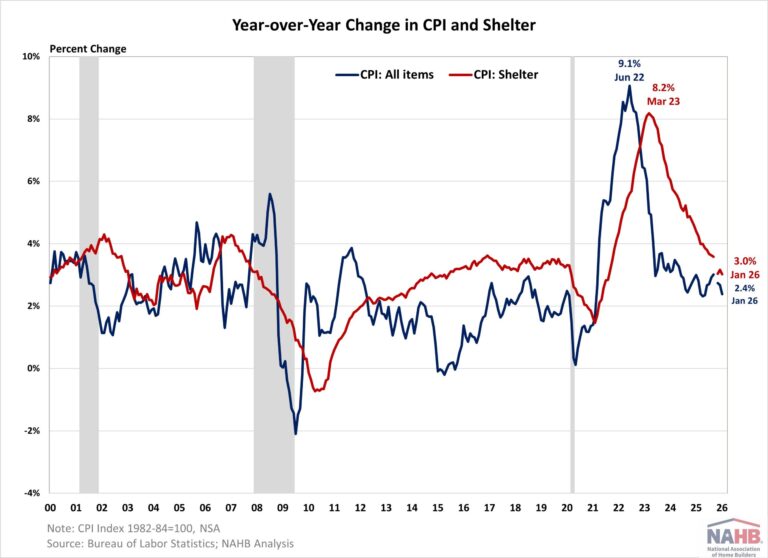
On a non-seasonally adjusted basis, the Consumer Price Index (CPI) rose by 2.4% in January compared to the year prior, according to the Bureau of Labor Statistics (BLS) latest report. That was the lowest level since May 2025. Excluding the volatile food and energy components, the “core” CPI increased by 2.5% over the past twelve months. A large portion of the “core” CPI is the housing shelter index, which increased 3.0% over the year. Meanwhile, the component index of food rose by 2.9%, and the energy component index fell by 0.1%.

On a monthly basis, the CPI rose by 0.2% in January (seasonally adjusted), and the “core” CPI increased by 0.3%.

The price index for a broad set of energy sources fell by 1.5% in January, with the increase in natural gas (+1.0%) offset by decreases in fuel oil (-5.7%), gasoline (-3.2%) and electricity (-0.1%). Meanwhile, the food at home index rose by 0.2%, while the food away from home index increased by 0.1% in January.

The index for shelter continued to be the largest contributor to the overall monthly increase in all items index. Other top contributors that rose in January included indexes for airline fares (+6.5%), personal care (+1.2%), recreation (+0.5%), medical care (+0.3%), and communication (+0.5%). Meanwhile, the index for used cars and trucks (-1.8%), household furnishings and operations (-0.1%), and motor vehicle insurance (-0.4%) were among the few major indexes that decreased over the month.

The index for shelter, which makes up more than 40% of the “core” CPI, rose by 0.2% in January. The index for owners’ equivalent rent (OER) and the index for rent of primary residence (RPR) both increased by 0.2% over the month. NAHB constructs a “real” rent index to indicate whether inflation in rents is faster or slower than core inflation. It provides insight into the supply and demand conditions for rental housing. When inflation in rents is rising faster than core inflation, the real rent index rises and vice versa. The real rent index is calculated by dividing the price index for rent by the core CPI (to exclude the volatile food and energy components).

In January, the Real Rent Index remained unchanged. The index has remained virtually flat since August 2025, except for data quality issues in October and November.


This article was originally published by a eyeonhousing.org . Read the Original article here. .
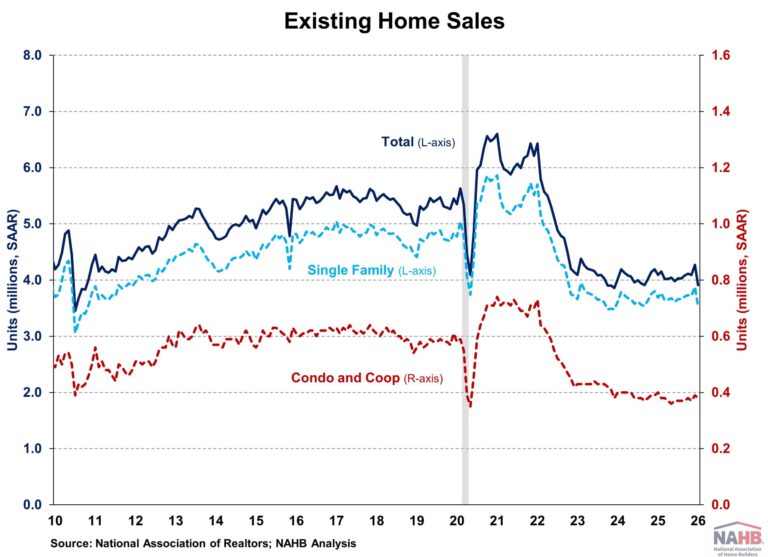

Existing home sales fell in January to a more than two-year low after December’s strong rebound, as tight inventory continued to push home prices higher and winter storms weighed on activity. Despite mortgage rates trending lower and wage growth outpacing price gains, limited resale supply kept many buyers on the sidelines. Resale inventory remained at lowest level since January 2025. Though home price appreciation has slowed in recent months, affordability remains a challenge.

Total existing home sales, including single-family homes, townhomes, condominiums, and co-ops, fell 8.4% to a seasonally adjusted annual rate of 3.91 million in January, according to the National Association of Realtors (NAR). This marks the lowest level since August 2024. On a year-over-year basis, sales were 4.4% lower than a year ago.

The existing home inventory level was 1.2 million units in January, down 0.8% from December but up 3.4% from a year ago. At the current sales rate, January unsold inventory sits at a 3.7-months’ supply, up from 3.5-months in December and January 2024. Inventory between 4.5 to 6 months’ supply is generally considered a balanced market.

Homes stayed on the market for a median of 46 days in January, up from 39 days in the previous month and 41 days in January 2025.

The first-time buyer share was 31% in January, up from 29% in December and 28% from a year ago.

The January all-cash sales share was 27% of transactions, down from 28% in December and 29% a year ago. All-cash buyers are less affected by changes in interest rates.

The January median sales price of all existing homes was $396,800, up 0.9% from last year. This marks the new high for the month of January and the 31st consecutive month of year-over-year increases. The median condominium/co-op price in January was up 3.8% from a year ago at $364,600. Recent gains for home inventory will put downward pressure on resale home prices in most markets in 2026.

Sales declined in all four major regions in January, ranging from 5.9% in the Northeast to 10.3% in the West. On a year-over-year basis, sales also fell across all regions, from 1.6% in the South to 7.9% in the West.

The Pending Home Sales Index (PHSI) is a forward-looking indicator based on signed contracts. The PHSI fell from 79.2 to 71.8 in December after four months of increases. On a year-over-year basis, pending sales were 3.0% lower than a year ago, according to the National Association of Realtors’ data. The decline suggests buyers are holding back due to limited inventory choices.


This article was originally published by a eyeonhousing.org . Read the Original article here. .
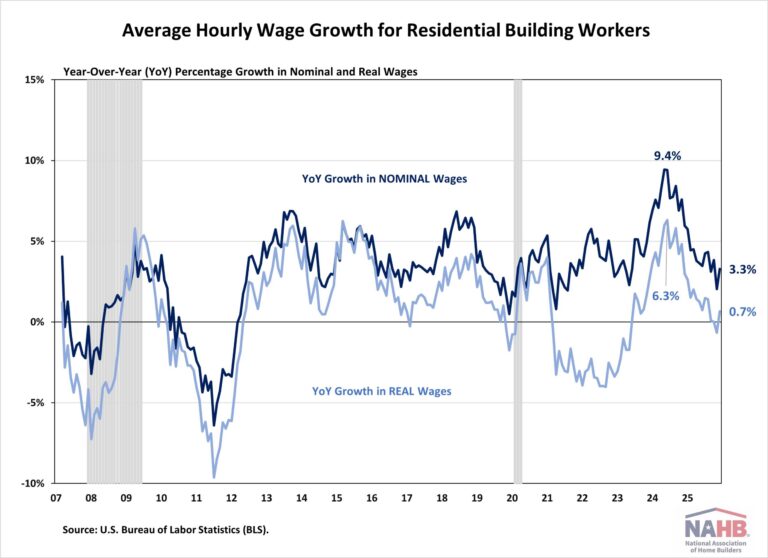

Wage growth for residential building workers moderated notably in 2025, reflecting a broader cooling in housing activity and construction labor demand. According to the latest data from the U.S. Bureau of Labor Statistics (BLS), both nominal and real wages remained modest during the fourth quarter, signaling a shift from the rapid post-pandemic expansion to a slower-growth phase.

In nominal terms, average hourly earnings (AHE) for residential building workers rose to $39.63 in December 2025, up 3.3% from $38.37 a year ago. While this marked a modest acceleration from November’s 2.0% year-over-year gain, wage growth has slowed considerably from the peak of 9.4% recorded in June 2024. Elevated mortgage rates, ongoing affordability challenges, and persistently high construction costs constrained home building activity over the past year. As a result, labor demand eased accordingly. Meanwhile, the number of open, and unfilled construction sector jobs continued to trend downward, consistent with the overall slowdown in housing activity.

Despite the slowdown in wage growth, residential building workers’ wages remain competitive relative to other industries:

9.9% higher than the manufacturing sector ($36.07 per hour)

23.3% higher than the transportation and warehousing sector ($32.14 per hour)

2.6% lower than the mining and logging sector ($40.69 per hour)

Note:

Data used in this post relate to all employees in the residential building industry. This group includes both new single-family housing construction (excluding for-sale builders) and residential remodelers but does not include specialty trade contractors.


This article was originally published by a eyeonhousing.org . Read the Original article here. .


Even though garden/low-rise continues to be strong, overall confidence in the market for new multifamily housing decreased year-over-year in the fourth quarter, according to the Multifamily Market Survey (MMS) released today by the National Association of Home Builders (NAHB). The MMS produces two separate indices. The Multifamily Production Index (MPI) had a reading of 45, down three points year-over-year, while the Multifamily Occupancy Index (MOI) had a reading of 74, down seven point year-over-year.

Multifamily developers are somewhat less optimistic than they were at this time last year, except in the market segment for garden/low-rise apartments. This suggests that the 2025 trend of gains in multifamily market share for outlying metro and non-metro counties—where garden and low-rise structures are more common—is likely to continue in 2026.

Elevated construction costs and the local regulatory environment continue to be major headwinds to faster growth. While interest rates eased slightly in 2025, they still need to come down further to significantly spur new construction.

Multifamily Production Index (MPI)

The MMS asks multifamily developers to rate the current conditions as “good”, “fair”, or “poor” for multifamily starts in markets where they are active.  The index and all its components are scaled so that a number above 50 indicates that more respondents report conditions as good rather than poor. The MPI is a weighted average of four key market segments: three in the built-for-rent market (garden/low-rise, mid/high-rise, and subsidized) and the built-for-sale (or condominium) market.

The component measuring garden/low-rise was the only one to experience an increase year-over-year in the fourth quarter of 2025, rising two points to 54. This component has been above 50 every quarter in 2025. The other three components experienced year-over-year declines during the quarter. The component measuring mid/high-rise fell eight points to 31, the component measuring built-for-sale units dropped six points to 36, and the component measuring subsidized units decreased five points to 47.

Multifamily Occupancy Index (MOI)

The survey also asks multifamily property owners to rate the current conditions for occupancy of existing rental apartments in markets where they are active as “good”, “fair”, or “poor”.  Like the MPI, the MOI and all its components are scaled so that a number above 50 indicates more respondents report that occupancy is good than poor.  The MOI is a weighted average of three built-for-rent market segments (garden/low-rise, mid/high-rise, and subsidized). 

All three MOI components experienced year-over-year decreases in the fourth quarter of 2025; the mid/high-rise component plummeted 12 points to 62, the garden/low-rise component decreased five points to 76, and the subsidized component dipped three points to 88. Nevertheless, all three MOI components remain well above the break-even point of 50.

The MMS was re-designed in 2023 to produce results that are easier to interpret and consistent with the proven format of other NAHB industry sentiment surveys. Until there is enough data to seasonally adjust the series, changes in the MMS indices should only be evaluated on a year-over-year basis.

Please visit NAHB’s MMS web page for the full report.


This article was originally published by a eyeonhousing.org . Read the Original article here. .
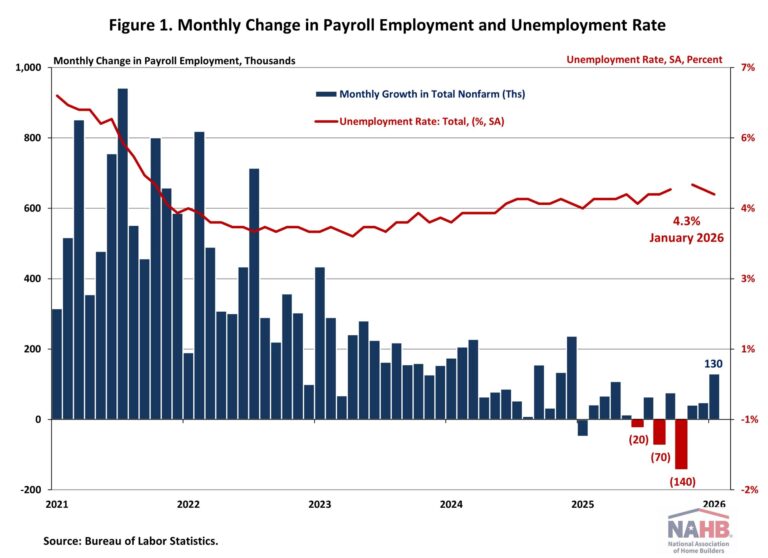

The U.S. labor market began 2026 at a surprisingly strong pace, while newly released benchmark revisions show that job growth in 2025 was considerably weaker than previously reported. Nonfarm payrolls increased by 130,000 jobs in January, and the unemployment rate edged down to 4.3%. January’s job gains were concentrated on health care, social assistance, and construction, while federal government and financial activities experienced job losses.

The establishment survey data released today were benchmarked to reflect comprehensive counts of payroll jobs for March 2025. This annual benchmark process results in revisions to seasonally adjusted data from January 2021 forward. The updated figures show the labor market added only 181,000 jobs in 2025, down sharply from the previously reported 584,000. The revised job gains for 2025 are far fewer than the 1.46 million jobs added in 2024. Excluding recession years (2008, 2009, and 2020), 2025 now stands as the weakest year of employment growth since 2003.

Wage growth was unchanged in January, with average hourly earnings rising 3.7% year-over-year. This pace is 0.3 percentage points lower than a year ago. Importantly, wage growth has been outpacing inflation for nearly two years, which typically occurs as productivity increases.

National Employment

According to Employment Situation Summary reported by the Bureau of Labor Statistics (BLS), total nonfarm payroll employment rose by 130,000 in January, marking the strongest monthly gain since December 2024.

The unemployment rate edged down to 4.3% in January, following 4.4% in December. Over the month, the number of persons unemployed declined by 141,000, while the number of persons employed increased by 528,000.

Meanwhile, the labor force participation rate—the proportion of the population either looking for a job or already holding a job—edged up 0.1 percentage points to 62.5%. This remains below its pre-pandemic level of 63.3% recorded at the beginning of 2020. Among prime working-age individuals (aged 25 to 54), the participation rate rose to 84.1%, the highest level since 2001, reflecting strong engagement in the core workforce.

In January, industry trends remained mixed. Health care added 82,000 jobs in January, and social assistance increased by 42,000. In contrast, federal government jobs declined by 34,000 and financial activities shed 22,000 jobs.

Construction Employment

Employment in the overall construction sector increased by 33,000 jobs in January, after an upwardly revised loss of 4,000 in December. Within the industry, residential construction added 5,900 jobs, while non-residential construction added 27,900 positions. Overall construction employment was essentially flat in 2025, compared with a gain of 176,000 jobs in 2024.

Residential construction employment now stands at 3.3 million in January, including 952,000 workers employed by builders and remodelers and nearly 2.4 million residential specialty trade contractors.

The six-month moving average of job gains for residential construction remains negative, at a loss of 2,083 per month, reflecting losses in three of the past six months. Over the last 12 months, residential construction has seen a net loss of 43,600 jobs, marking the eleventh consecutive annual decline and the longest stretch of annual losses since the Great Recession. Since the low point following the Great Recession, residential construction has gained 1,312,900 positions.


This article was originally published by a eyeonhousing.org . Read the Original article here. .
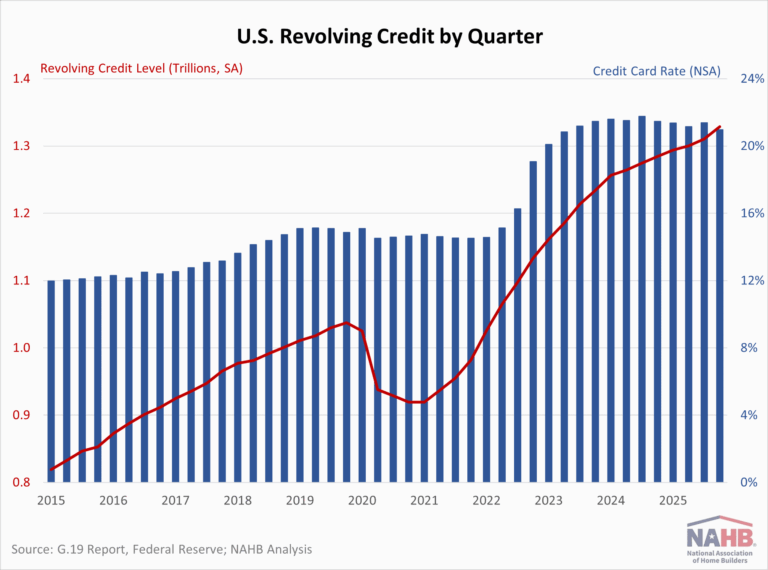

Overall consumer credit continued to expand in the fourth quarter of 2025, with growth in both nonrevolving and revolving credit. Nonrevolving credit, primarily student and auto loans, accounts for 74% of total outstanding consumer credit, while revolving credit, largely credit card balances, makes up the remaining 26%. Student loan and credit card balances continued to rise year-over-year, while auto loan balances declined. Although interest rates remain elevated, both credit card and auto loan rates edged slightly lower.

Total outstanding U.S. consumer credit reached $5.11 trillion for the fourth quarter of 2025, according to the Federal Reserve’s G.19 Consumer Credit Report. This is an increase of 3.04% at a seasonally adjusted annual rate (SAAR) compared to the previous quarter, and a 2.34% increase compared to last year.

Nonrevolving Credit

Nonrevolving credit, largely driven by student and auto loans (the G.19 report excludes mortgage loans), reached $3.78 trillion (SA) in the fourth quarter of 2025. This marks a 2.15% increase (SAAR) from the previous quarter, and a 1.96% increase from last year.

Student loan debt stood at $1.84 trillion (NSA) for the fourth quarter of 2025, marking a 3.22% increase from a year ago. The end of the COVID-19 Emergency Relief—which allowed 0% interest and halted payments until September 1, 2023—led year-over-year growth to decline for four consecutive quarters, from Q3 2023 through Q2 2024 as borrowers resumed payments and took on less new debt. The past six quarters have shown a return to growth.

Auto loans reached a level of $1.56 trillion (NSA), showing a year-over-year decrease of 0.17%, marking one of the first declines since 2010. The deceleration in growth can be attributed to several factors, including stricter lending standards, elevated interest rates, and overall inflation. Auto loan rates for a 60-month new car stood at 7.22% (NSA) for the fourth quarter of 2025, falling 60 basis points from a year ago.

Revolving Credit

Revolving credit, primarily made up of credit card balances, rose to $1.33 trillion (SA) in the fourth quarter of 2025. This represents a 5.61% increase (SAAR) from the previous quarter and a 3.43% increase year-over-year, both representing an acceleration compared to recent quarters. Although credit card rates have hovered near historic highs since Q4 2022, the past five quarters have shown modest year-over-year declines. The average credit card rate held by commercial banks (NSA) stood at 20.97% in the fourth quarter of 2025, a drop of 50 basis points from a year earlier.


This article was originally published by a eyeonhousing.org . Read the Original article here. .
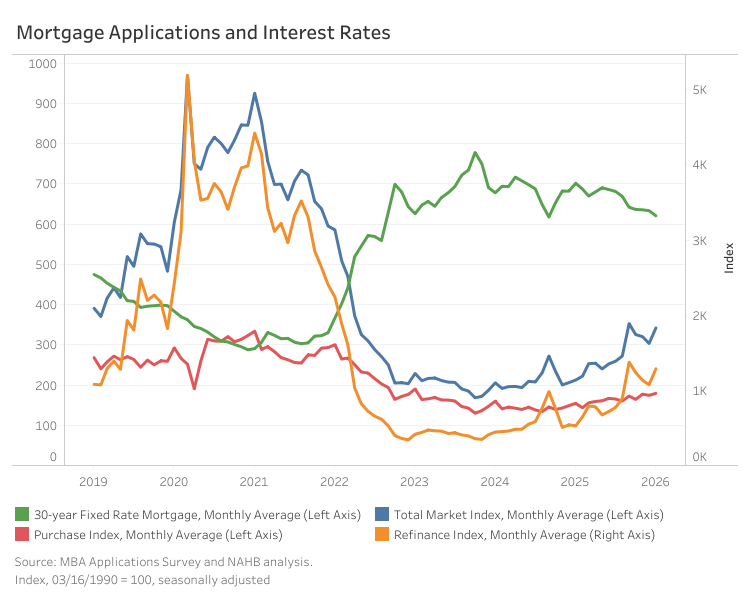

Mortgage application activity rose sharply in January, driven primarily by a surge in refinancing activity as mortgage rates declined to a new low. The Mortgage Bankers Association’s (MBA) Market Composite Index, a measure of total mortgage application volume, increased 12.9% from December on a seasonally adjusted basis and was 61.3% higher than a year earlier.

The average contract interest rate for 30-year fixed mortgages dropped 13 basis points (bps) to 6.2% following the announcement of $200 billion in mortgage-backed securities (MBS) buybacks by the GSEs. Compared with January 2025, the 30-year fixed mortgage rate was 81 bps lower. The decline in rates supported month-over-month gains in both purchase and refinance activity. Purchase applications increased 2.9%, while refinance applications surged 19.8%. Relative to January 2025, purchase activity increased 16.2%, while refinance applications jumped 143.8%.

By loan type, applications for fixed-rate mortgages (FRMs) and adjustable-rate mortgages (ARMs) increased 12.9% and 7.9% month-over-month, respectively. On a year-over-year basis, FRM applications were up 57.8%, while ARM applications more than doubled, rising 113.1%. As of January 2026, ARMs accounted for an average of 7.1% of total applications on a non-seasonally adjusted basis, down 0.4 percentage points from December but 1.7 percentage points higher than a year earlier.

For loan sizes, the average loan amount across the total market increased by 1.1% to $402,000. Average purchase loan sizes increased 2.5% to $435,400, while the refinance loan size increased modestly by 0.2% to $378,000. In contrast, the average ARM loan size continued to decline, falling 4.4% to $925,600.


This article was originally published by a eyeonhousing.org . Read the Original article here. .
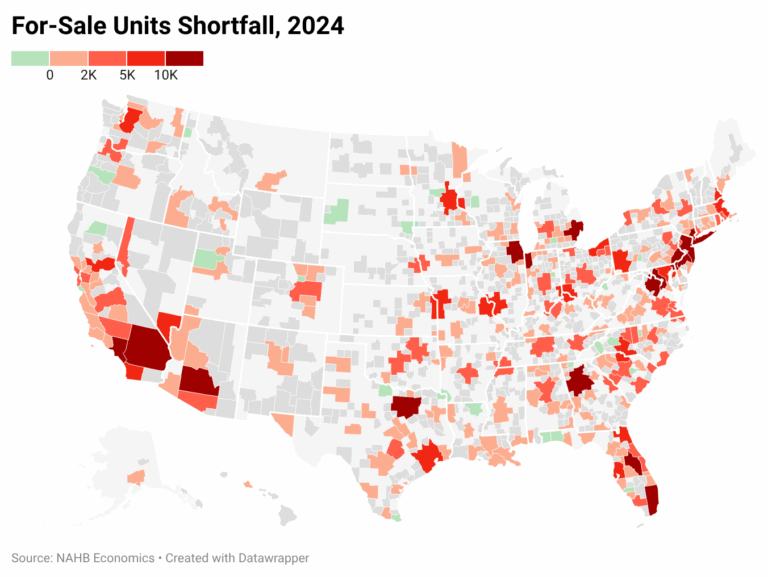

Persistently low homeowner and rental vacancy rates indicate that the U.S. housing market remains structurally undersupplied.

Comparing 2024 abnormally low vacancy rates with long-run equilibrium levels across U.S. metropolitan markets, NAHB estimates that approximately 1.2 million additional housing units are required to close the gap and restore vacancy rates to historical norms. This figure represents NAHB’s updated estimate of the structural housing deficit, defined as the cumulative amount of above-equilibrium construction needed to rebalance the market. NAHB’s baseline forecast suggests this adjustment could occur between 2026 and 2030, contingent on sustained home building activity.

Homeowner and rental vacancy rates are key indicators of housing market tightness and future price dynamics. In 2022, U.S. rental vacancy rates fell to 5.1%, the lowest level in decades, underscoring the severity of the post-pandemic housing shortage. By comparison, rental vacancy rates have averaged 6.6% since 2005, when the American Community Survey (ACS) began reporting these data. A surge in multifamily construction in 2024 led to improved rental availability across many metropolitan areas, with the national vacancy rate rising to 5.7% but remaining below the historic norm.

In contrast, single-family construction remains significantly constrained by structural barriers, including restrictive zoning regulations, limited land availability, and persistent labor shortages. As a result, owner vacancy rates continued to decline through 2023, reaching a record low of 0.8%, the lowest level observed in the ACS series. While showing a modest improvement in 2024, owner vacancy rates remain below 1%, compared with the post-2005 average of 1.8%, indicating that for-sale housing shortages persist nationally.

ACS data provide a granular view of vacancy rates across metropolitan areas and allow geographic identification of structural imbalances. The “long run” average vacancy rates can serve as a proxy for normal, or natural, vacancy rates. There are numerous reasons why normal vacancy rates may differ across metropolitan areas. For example, areas with mobile labor markets and higher population turnover will consistently experience higher vacancy rates. Vacation destination housing markets also naturally have higher vacancy rates, reflecting more volatile seasonal housing demand.

For example, according to NAHB’s estimates, the rental vacancy rates in Panama City, FL, and Sebastian-Vero Beach, FL, have hovered around 20% since 2005. The averages were even higher in Myrtle Beach, SC, fluctuating around 28%. In sharp contrast, many areas in California, including Santa Maria-Santa Barbara, Santa Cruz-Watsonville, San Jose-Sunnyvale-Santa Clara, Oxnard-Thousand Oaks-Ventura, and Los Angeles-Long Beach-Anaheim, registered long-term rental vacancy rates below 4%.

In the case of homeowner properties, natural vacancy rates are usually lower, reflecting slower housing turnover, with owners moving in and out less often compared to renters. It is important to remember that owned seasonal (occasional use) properties do not affect the homeowner vacancy rate. In this context, the vacancy rate is the proportion of vacant units for sale within the combined stock of homeowner-occupied, sold but not yet occupied, and for-sale units. Therefore, vacation or other seasonal properties are excluded from this analysis.

Nevertheless, long-term homeowner vacancy rates tend to be higher in resort areas. Consistent with this pattern, several metro areas along the coast of Florida report some of the highest long-term owner vacancy rates. In Sebastian-Vero Beach, FL, and Naples-Immokalee-Marco Island, FL, owner vacancy rates have fluctuated around 4% since 2005. By contrast, San Jose-Sunnyvale-Santa Clara, CA, experienced owner vacancy rates below 1% most of the time.

The gap between the “natural” or long-run average vacancy rate and the current vacancy rate helps estimate the number of rental and for-sale units needed to restore vacancy rates to their long-run equilibrium. Unsurprisingly, large metro markets have the greatest shortage of vacant rental and for-sale units, mainly due to their size. In these areas, even a small percentage decrease below the long-run average vacancy rates can lead to a shortage of thousands of vacant units.

As of 2024, the Chicago-Naperville-Elgin, IL-IN-WI metro area needed close to 40,000 rental units to bring the rental vacancy rate back to normal levels.  The rental shortages in the New York-Newark-Jersey City, NY-NJ, and Philadelphia-Camden-Wilmington, PA-NJ-DE-MD metro areas were around 20,000 units.

Similarly, the largest shortages of vacant units for sale were observed in major metropolitan areas, including Chicago-Naperville-Elgin, IL-IN-W; Atlanta-Sandy Springs-Roswell, GA; New York-Newark-Jersey City, NY-NJ-PA; Phoenix-Mesa-Scottsdale, AZ.

Adding vacancy shortages across metro areas with unusually low vacancy rates, there is a total shortage of about 1.2 million vacant units nationwide (almost equally split between rental and for-sale units).

NAHB’s estimates focus narrowly on the number of vacant units required to return current vacancy rates to their long-run equilibrium levels. They do not incorporate additional sources of housing shortfall, such as pent-up demand from suppressed household formation or the need to replace aging and obsolete housing stock. As a result, NAHB’s estimates should be interpreted as lower-bound estimates of the overall housing shortage and are smaller than estimates that explicitly attribute elevated rates of shared living arrangements and the unusually high share of young adults residing with parents to the U.S. housing shortage. While we admit we do not have definitive answers, we believe the estimates presented here provide a reasonable updated national assessment of the current structural housing deficit.


This article was originally published by a eyeonhousing.org . Read the Original article here. .
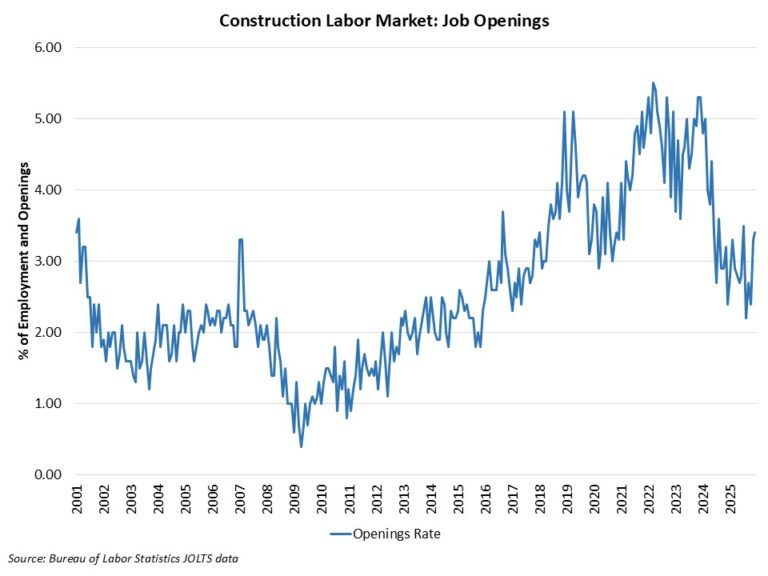

Running counter to the data for the full economy, the count of open, unfilled positions in the construction industry increased in December, per the delayed Bureau of Labor Statistics Job Openings and Labor Turnover Survey (JOLTS). The current level of open jobs is down measurably from two years ago due to declines in construction activity, particularly in housing.

The number of open jobs for the overall economy declined as the labor market weakened at the end of 2025, falling from 6.982 million in November to 6.542 million in December. The December reading was down from a year ago (7.508 million).

Previous NAHB analysis indicated that this number had to fall below eight million on a sustained basis for the Federal Reserve to move forward on interest rate reductions. With estimates remaining below eight million for national job openings, the Fed, in theory, should be able to cut further.

The number of open construction sector jobs increased from 284,000 in November to 292,000 in December. This total is higher compared to a year ago (205,000), although the reading is notably lower than two years ago. The chart below notes the declining trend that has been in place for unfilled construction jobs since the Fed raised the federal funds rate and home building weakened. While home building employment was declining during the second half of 2025, other subsectors of the construction industry have expanded (e.g. data centers).

The construction job openings rate increased to 3.4% in December, higher than the 3.2% rate estimated a year ago.

The layoff rate in construction declined to 1.5% in December. The quits increased to 1.5% for the month.


This article was originally published by a eyeonhousing.org . Read the Original article here. .
Pin It