Tag

housing

Browsing


Affordability Impacts: Young Adults Are Once Again Moving Back Home – Eye On Housing

The share of young adults living with parents increased in 2024, interrupting the post-pandemic trend of moving out of parental homes. Nearly a third (32.5%) of adults ages 18-34 lived with their parents according to the latest 2024 American Community Survey (ACS). This is up from 31.8% in 2023, although it remains below the pre-pandemic peak of 34.5% in 2017. Geospatial analysis of the 2024 ACS data shows significant differences across states, with the Southern and Northeastern states having some of the highest shares of young adults living in parental homes.

While the national average share increased to 31.8%, over 40% of young adults ages 18-34 lived in parental homes in New Jersey (44%) and Connecticut (41%). California and Maryland register the nation’s third and fourth-highest shares of 39% and 38%, respectively. At the opposite end of the spectrum are states with less than a fifth of young adults living with parents. The fast-growing North Dakota records the nation’s lowest share of 12%, while the neighboring South Dakota registers 18%. In the District of Columbia, where the job market was relatively stable in 2024, less than 13% of young adults lived with their parents. The cluster of north-central U.S. states completes the nation’s list with the lowest percentages of young adults remaining in parental homes.

The elevated shares of young adults living with parents in high-cost coastal areas underscore the role of housing affordability in driving this trend. Statistical analysis confirms a clear link between prohibitively expensive housing, especially rentals, and the high prevalence of young adults residing with their parents. The states with higher shares of renters paying 30 percent or more of their income on housing, and therefore considered cost-burdened, tend to register higher shares of young adults living with parents.

The reported shares come from the ACS Summary files that do not separate college-age adults (ages 18-24) from the older subset (ages 25-34). Once the ACS public microdata becomes available, it will be worth understanding whether the younger and older subgroups experienced divergent trends over the last year.


This article was originally published by a eyeonhousing.org . Read the Original article here. .


The value of a single-family home depends not only on its physical features but also on its location and neighborhood context. In this second part of our two-part series, we examine how geography and neighborhood quality further influence single-family detached home values across the United States. Not surprisingly, location remains one of the strongest drivers of home values (Figure 2). Homes in a big metropolitan area are valued 60% higher than comparable homes in non-metro areas, while those in smaller or midsized metro areas are 22% more.

Home values also vary significantly across Census Divisions. Using New England as the baseline, homes in the Pacific Divisions, including Alaska, California, Hawaii, Oregon, and Washington, are valued around 35% higher values on average. By contrast, homes in the rest of the divisions show substantially lower values relative to New England. Homes in the East South Central and West South Central divisions are more than 60% lower in value, while those in the Middle Atlantic are about 30% lower. In the East North Central and West North Central Divisions, home values are roughly 47% and 46% lower, respectively. Homes in the South Atlantic are 39% lower, and those in the Mountain Division are about 19% lower.

People are willing to pay a premium for a better neighborhood. This analysis shows that a higher overall neighborhood quality rating, measured on a 1 to 10 scale, contributes about a 2% increase in home value for every 1-point rise (Figure 3). For example, moving from a neighborhood rated 5 to one rated 7 could increase your home value by 4%.

On the other end, the impact of specific negative conditions is substantial (Figure 4). Homes located near abandoned or vandalized buildings have 17% lower values. Additionally, the presence of visible trash nearby reduces home values by 8%. Improving the broader neighborhood environment could have as much impact on the final home value as upgrades inside the home.

Please click here to be redirected to the full special study.


This article was originally published by a eyeonhousing.org . Read the Original article here. .


Market uncertainty exacerbated by the government shutdown along with economic uncertainty stemming from tariffs and rising construction costs kept builder confidence firmly in negative territory in November.

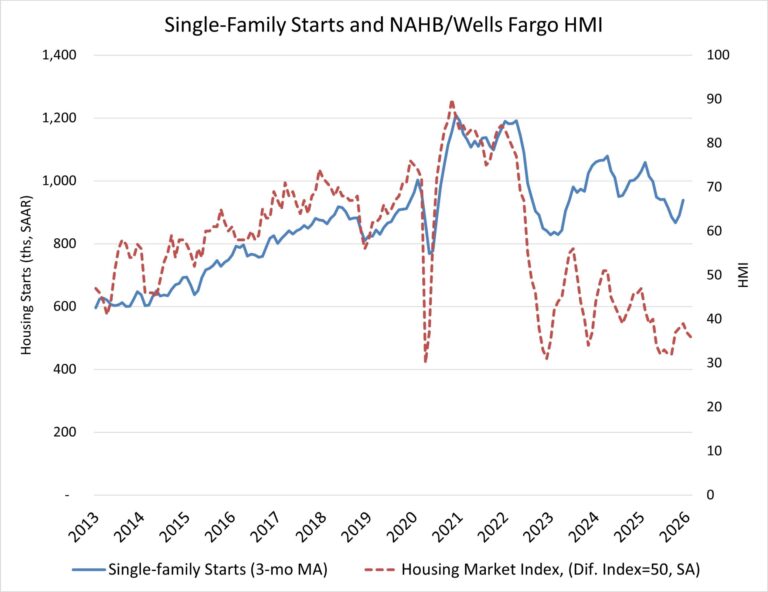
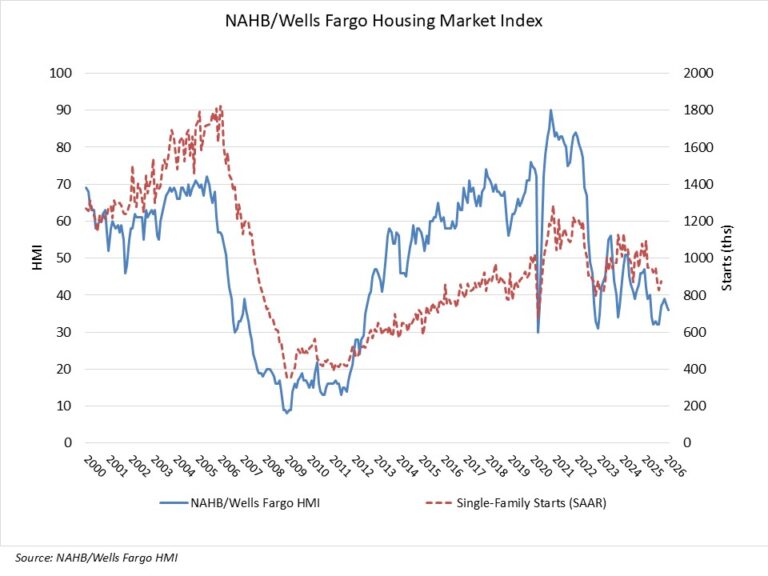
Builder confidence in the market for newly built single-family homes rose one point to 38 in November, according to the National Association of Home Builders (NAHB)/Wells Fargo Housing Market Index (HMI).

While lower mortgage rates are a positive development for affordability conditions, many buyers remain hesitant because of the recent record-long government shutdown and concerns over job security and inflation. We continue to see demand-side weakness as a softening labor market and stretched consumer finances are contributing to a difficult sales environment. After a decline for single-family housing starts in 2025, NAHB is forecasting a slight gain in 2026 as builders continue to report future sales conditions  in marginally positive territory.

In a further sign of ongoing challenges for the housing market, the latest HMI survey also revealed that 41% of builders reported cutting prices in November, a record high in the post-Covid period and the first time this measure has passed 40%. Meanwhile, the average price reduction was 6% in November, the same rate as the previous month. The use of sales incentives was 65% in November, tying the share in September and October.

Derived from a monthly survey that NAHB has been conducting for more than 40 years, the NAHB/Wells Fargo HMI gauges builder perceptions of current single-family home sales and sales expectations for the next six months as “good,” “fair” or “poor.” The survey also asks builders to rate traffic of prospective buyers as “high to very high,” “average” or “low to very low.” Scores for each component are then used to calculate a seasonally adjusted index where any number over 50 indicates that more builders view conditions as good than poor.

The HMI index gauging current sales conditions increased two points to 41, the index measuring future sales fell three points to 51 and the gauge charting traffic of prospective buyers posted a one-point gain to 26.

Looking at the three-month moving averages for regional HMI scores, the Northeast rose two points to 48, the Midwest fell one point to 41, the South increased three points to 34 and the West gained two points to 30. HMI tables can be found at nahb.org/hmi.


This article was originally published by a eyeonhousing.org . Read the Original article here. .


Private residential construction spending inched up 0.8% in August, continuing steady growth since June 2025. This modest increase was primarily driven by more spending on multifamily construction and home improvements. However, total spending was 2% lower than a year ago, as the housing sector continues to navigate the economic uncertainty stemming from ongoing tariff concerns and elevated mortgage rates. 

According to the latest U.S. Census construction spending data, single-family construction spending slipped 0.4% in August, in line with the soft builder sentiment reflected in the August NAHB/Wells Fargo Housing Market Index (HMI). Compared to a year ago, single-family construction spending decreased by 1.1%. Improvement spending (remodeling) posted a solid 8.2% gain for the month, but it remained 1.3% lower than in August 2024. The remodeling sector continues to show resilience, supported by strong homeowner equity and persistent demand for home improvements. Meanwhile, multifamily construction spending rose 0.2% in August, marking a pause in the downward trend that began in mid-2023. Compared to a year earlier, multifamily spending was down 7.1%.  

The NAHB construction spending index is shown in the graph below. The index illustrates how   spending on single-family construction has slowed since early 2024 under the pressure of elevated interest rates and concerns over building material tariffs. Multifamily construction spending growth has also slowed down after the peak in July 2023. Improvement spending has also been weakening since the beginning of 2025. 

Spending on private nonresidential construction was down 4% over a year ago. The annual private nonresidential spending decrease was primarily driven by a $20 billion drop in manufacturing construction spending, followed by a $11 billion decrease in commercial construction spending.


This article was originally published by a eyeonhousing.org . Read the Original article here. .


The value of a single-family home is shaped by many factors, but its physical features remain among one of the most influential. Using the latest 2023 American Housing Survey (AHS), this study focuses on which home features genuinely boost single-family detached home values and by how much. Key findings show that the overall square footage of the home and the number of bathrooms stand out as especially strong value drivers, while other features such as the number of bedrooms and the presence of amenities also play a role.

In this first part of our two-part blog series, we focus on the physical features of single-family homes. The second part will explore how location and neighborhood quality further influence home values across the United States.

Home size is one of the strongest value drivers in today’s housing market, as shown in Figure 1. Compared with smaller homes under 1,000 sq. ft., homes between 1,000 and 2,000 sq. ft. are valued about 17% higher. Moving up to homes between 2,000-3,000 sq. ft. increases value by around 30%, while homes with 3,000 sq. ft. or more adds 55% more to the market value.  These effects are measured after accounting for differences in region, age of structure, and other key features.

While both the number of bathrooms and bedrooms contribute to single-family home values, the number of bathrooms has a larger impact. Each additional full bathroom increases home value by approximately 32%, compared to about 5% for an additional bedroom, holding the square footage and other features constant. Even a half bathroom brings meaningful returns, adding an estimated 15%.

The age of the home is also a contributing factor to the final market value, even after accounting for other features and neighborhood conditions. Compared to homes built before 2010, homes built between 2010 and 2019 have 13% higher values, and homes built after 2020 are valued 19% higher. These premiums likely reflect improvements in energy efficiency, insulation, and modern building systems that are appealing to more buyers.

Other amenities also bring solid returns, like garages, fireplaces, and centralized air conditioning. Garages add around 10% to home value; Besides a protected parking space, garages offer the flexibility for additional storage or turning it into a workshop/hobby space.  Having a fireplace can add value to a home, increasing its value by around 10%. It is appealing to some home buyers, as it not only provides a cozy ambiance, but also could reduce heating costs in some regions. Centralized AC adds about 7% to home value nationwide, but its impact varies across the divisions. In the South, including the South Atlantic, East South Central, and West South divisions, centralized AC adds 23%, 40%, and 48% more values, respectively.

Please click here to be redirected to the full special study.


This article was originally published by a eyeonhousing.org . Read the Original article here. .


Credit conditions on loans for residential Land Acquisition, Development & Construction (AD&C) were still tightening in the third quarter of 2025, according to NAHB’s quarterly survey on AD&C Financing.  The net easing index derived from the survey posted a reading of -11.0 (the negative number indicating that credit tightened since the previous quarter). This is in reasonably close agreement with the third quarter reading of -6.6 for the similar net easing index produced from the Federal Reserve’s survey of senior loan officers—marking fifteen consecutive quarters of tightening credit conditions reported by both builders and lenders.

More details from the Fed’s survey of lenders—including measures of demand and net easing for residential mortgages—appeared in a previous post.

According to the NAHB survey, the most common way lenders tightened in the third quarter was by lowering the maximum allowable loan-to-value or loan-to-cost ratio on the loans (cited by 60% of the builders and developers who reported tighter credit). Tied for second place were reducing the amount they are willing to lend, requiring out-of-pocket payment of interest or borrower funding of an interest reserve, and  requiring personal guarantees (cited by 47% each).

Results on the cost of credit in the third quarter were mixed. The average contract rate increased from 7.82% to 7.95% on loans specifically for residential land acquisition—but declined on the other three categories of loans tracked in NAHB’s AD&C survey: from 8.04% to 7.68% on loans for land development, from 8.17% to 7.90% on loans for speculative single-family construction, and from 7.95% to 7.90% on loans for pre-sold single-family construction.   

Meanwhile, the average initial points charged on the loans increased across the board: from 0.56% to 0.66% on loans for land acquisition, from 0.74% to 0.83% on loans for land development, from 0.72% to 0.74% on loans for speculative single-family construction, and from 0.58% to 0.67% on loans for pre-sold single-family construction.

Those combinations of quarter-to-quarter changes caused the effective interest rate (which takes both the contract rate and initial points into account) to increase from 9.95% to 10.15% on loans for land acquisition, but to decline from 11.77% to 10.92% on loans for land development and from 12.82% to 12.04% on loans for speculative single-family construction. The average effective rate on loans for pre-sold single-family construction remained essentially unchanged at 12.74%, compared to 12.73% in the second quarter.

Although results on the average effective interest rate were mixed on a quarter-to-quarter basis, the  rate on each of the four types of AD&C loans has declined significantly since peaking somewhere in the period between 2023 Q3 and 2024 Q2.

Also in the NAHB AD&C survey, 37% of respondents who built single-family homes during the third quarter of 2025 reported financing some of the construction with a construction-to-permanent (one-time-close) loan made to the ultimate home buyer. On average, 63% of the homes these respondents built were financed this way.

More detail on credit conditions for residential builders and developers is available on NAHB’s AD&C Financing Survey web page.


This article was originally published by a eyeonhousing.org . Read the Original article here. .


Lending standards for most types of residential mortgages were essentially unchanged, according to the recent release of the Senior Loan Officer Opinion Survey (SLOOS). For commercial real estate (CRE) loans, lending standards for construction & development were modestly tighter, while multifamily was essentially unchanged.  Demand for both CRE categories was essentially unchanged for the quarter. 

Two weeks ago, the Federal Reserve eased its key short-term interest rate (i.e., Federal Funds) by 25 basis points for the second consecutive meeting, establishing an upper bound of 4.00%.  While the causal link between the Federal Funds rate and the 30-year fixed rate mortgage is minimal, these cuts will have a more tangible impact for private home builders through lower rates on acquisition, development, & construction (AD&C) loans.  Roughly 60% of single-family starts are built by private builders. With pressure from both sides of their dual mandate as the job market cools and inflation remains sticky, NAHB is forecasting a measured approach from the Fed when it comes to further rate cuts next year.

Residential Mortgages

In the third quarter of 2025, four of seven residential mortgage loan categories saw a positive net easing index for lending conditions with an additional two recording a neutral reading (i.e., 0).  Only subprime loans experienced tighter lending conditions, as evidenced by a negative value (-6.3).  Nevertheless, based on the Federal Reserve classification of any reading between -5.0 and +5.0 as “essentially unchanged,” all but subprime fell within this range.

Five of the seven residential mortgage loan categories reported stronger demand in the third quarter of 2025, with the strongest demand coming from Government, GSE-eligible, and Qualified Mortgage (QM) non-jumbo, non-GSE eligible loans.  Non-QM jumbo was essentially unchanged for the quarter, while subprime loans were the only category to experience weaker demand, which has been the case since Q3 of 2020.

Commercial Real Estate (CRE) Loans

For the CRE loan categories, construction & development loans registered a net easing index of -6.6 for the third quarter of 2025, indicating modestly tighter credit conditions.  For multifamily loans, the net easing index was -1.6, or essentially unchanged.  Both categories of CRE loans show tightening of lending conditions (i.e., net easing indexes below zero) since Q2 2022.  However, the tightening has become less defined recently for multifamily, with its net easing index essentially unchanged (i.e., between -5.0 and +5.0) for four consecutive quarters.

The net percentage of banks reporting stronger demand was -4.9% for construction & development loans, with a negative number indicating weaker demand.  For multifamily, demand was neutral (i.e., 0) in the third quarter of 2025, with the same number of banks that reported weaker demand as those who reported stronger demand.  However, demand for CRE loans within both categories has experienced unchanged conditions (i.e., between -5.0% and +5.0%).


This article was originally published by a eyeonhousing.org . Read the Original article here. .


All types of mortgage activity rose on a year-over-year basis in October, supported by recent declines in interest rates. Notably, adjustable-rate mortgage (ARM) applications more than doubled from a year ago, and refinancing activity continued to strengthen. 

The Mortgage Bankers Association’s (MBA) Market Composite Index, a measure of total mortgage application volume, fell 7.7% from September on a seasonally adjusted basis but was 39.0% higher than a year ago. 

The average contract interest rate for 30-year fixed mortgages fell 5.4 basis points to 6.37%, the lowest in over a year. Following a strong increase in September, refinancing activity in October dropped 10% month over month, while purchase applications decreased 4.8%. Compared to a year ago, purchase and refinance applications were up 18.1% and 63.0%, respectively. 

By loan type, fixed-rate mortgage applications decreased 7% from September but were 34% higher year-over-year. Adjustable-rate mortgage applications dropped 13% month-over-month, yet surged 116.5% from a year earlier, following a 124% annual gain in September. As a result, ARMs accounted for 9.44% of total applications in October, one of the highest shares in the past three years. 

The average loan size across all mortgages was $408,000, down 3% from the previous month. The average purchase loan size remained steady at $437,000, while the average refinance loan size declined 6% to $385,000. For adjustable-rate mortgages, the average loan size fell 5% to $938,000, compared to a 2% decline for fixed-rate mortgages to $353,000. 


This article was originally published by a eyeonhousing.org . Read the Original article here. .

In April 2020, total payroll employment in the United States fell by an unprecedented 20.5 million, following a loss of 1.4 million in March, as the COVID-19 pandemic brought the economy to a sudden halt. The unemployment rate surged by 10.4 percentage points to 14.8% in April. It was the highest rate effectively since the Great Depression. Tracking the labor market impact is critical for understanding the follow-on effect on home building activity during the last five years.

As people stayed at home and businesses shut down under government directives, millions of Americans lost their jobs. Initial unemployment insurance claims soared to 2.9 million during the week of March 21, 2020. For the following 19 consecutive weeks, more than one million Americans filed for unemployment each week, totaling roughly 50.9 million claims over just five months.

While the national labor market suffered an unprecedented collapse in both speed and depth, the effects varied significantly across U.S. metro areas. Local economies experience dramatically different outcomes depending on their industrial composition, the feasibility of remote work, and the strictness of local public health restrictions. A map of metro areas across the United States reveals striking variations in employment losses from February 2020 to the pandemic’s employment trough. Nonfarm employment payrolls declined by anywhere from 5% to 35% across 393 metro areas.

Kahului-Wailuku, Hawaii, experienced the steepest job losses, with employment plummeting by 35%. This metro area’s deep dependence on tourism and hospitality, particularly in accommodation and food services, left it vulnerable to travel restrictions and widespread shutdown. Similarly, Atlantic City-Hammonton, New Jersey, as a prime tourism destination, was devastated by pandemic-related closures. By May 2020, its total employment dropped 34% from the February 2020 level.

Some metro areas experienced major setbacks tied to their dominant industries. In Elkhart-Goshen, Indiana, as the heart of the U.S. RV manufacturing industry, employment plunged 34% as production ground to a halt.

At the other end of the spectrum, Logan, UT-ID, recorded the mildest downturn, with a relatively modest 5% employment drop, reflecting a more resilient local economy.

In sheer numbers, New York-Newark-Jersey City, New York-New Jersey saw the largest employment losses in the nation, shedding nearly 2 million jobs, or about 20% of its pre-pandemic workforce. Los Angeles–Long Beach–Anaheim, California, followed closely, losing 1.1 million jobs, about 17% of its February 2020 level.

Despite the historic scale of these losses, the U.S. labor market rebounded faster than many anticipated. Within just 26 months, overall employment had fully recovered, surpassing its February 2020 level to reach 152.4 million by June 2022. Yet, as with the initial losses, the recovery varied widely across metro areas. By August 2025, 93 of the 393 metro areas had still not regained their pre-pandemic employment levels.

Lake Charles, Louisiana, remains the slowest to recover, with employment at only 87% of its February 2020 level. The region’s setbacks have been compounded by multiple disasters—COVID-19, followed by Hurricanes Laura and Delta in 2020—that disrupted both infrastructure and labor markets. Kankakee, Illinois (92% recovered), and Weirton–Steubenville, West Virginia–Ohio (93%), also lagged, highlighting how recovery can be delayed by structural and regional challenges.

In contrast, many other metro areas have not only recovered but expanded beyond their pre-pandemic employment levels. As of August 2025, 300 metro areas have fully rebounded, with some even booming. Wildwood–The Villages, Florida, leads the nation with employment reaching 127% of its February 2020 level, followed by St. George, Utah, at 125%.

Notably, the areas that suffered the sharpest employment declines in 2020 did not necessarily experience the slowest recoveries. Las Vegas–Henderson–North Las Vegas, Nevada, for instance, lost 277,900 jobs, about 26% of its workforce, but has rebounded strongly, reaching 109% of its pre-pandemic employment. By contrast, Enid, Oklahoma, which lost just 1,600 jobs, remains slightly below its February 2020 level, still 2% short of full recovery.

The story of employment loss and recovery across U.S. metro areas underscores the uneven geography of the COVID-19 economy. The resilience of local economies has since reshaped the post-pandemic landscape, revealing not only where recovery has taken root but also where it remains incomplete. And of course, the health of local labor markets has important impacts on the status of local home building and remodeling conditions.


This article was originally published by a eyeonhousing.org . Read the Original article here. .

Overall consumer credit continued to rise for the third quarter of 2025, but the pace of growth remains slow. Student loan balances continue to rise as well, slowly returning to pre-COVID growth. Furthermore, credit card and auto loan balances continue to grow but at historically low rates. Although interest rates are still elevated, credit card and auto loan rates continue to decrease slightly. 

Total outstanding U.S. consumer credit reached $5.08 trillion for the third quarter of 2025, according to the Federal Reserve’s G.19 Consumer Credit Report. This is an increase of 2.72% at a seasonally adjusted annual rate (SAAR) compared to the previous quarter, and a 2.25% increase compared to last year.  

Nonrevolving Credit  

Nonrevolving credit, largely driven by student and auto loans (the G.19 report excludes mortgage loans), reached $3.77 trillion (SA) in the third quarter of 2025. This marks a 2.95% increase (SAAR) from the previous quarter, and a 2.14% increase from last year. 

Student loan debt stood at $1.84 trillion (NSA) for the third quarter of 2025, marking a 3.84% increase from a year ago. The end of the COVID-19 Emergency Relief—which allowed 0% interest and halted payments until September 1, 2023—led year-over-year growth to decline for four consecutive quarters, from Q3 2023 through Q2 2024 as borrowers resumed payments and took on less new debt. The past five quarters have shown a return to growth, nearly matching pre-pandemic growth rates.  

Auto loans reached a level of $1.57 trillion (NSA), showing a year-over-year increase of only 0.30%, marking one of the slowest growth rates since 2010. The deceleration in growth can be attributed to several factors, including stricter lending standards, elevated interest rates, and overall inflation. Auto loan rates for a 60-month new car stood at 7.64% (NSA) for the third quarter of 2025, a historically elevated level. However, auto rates have slowed modestly, decreasing by 0.76 percentage points compared to a year ago.  

Revolving Credit 

Revolving credit, primarily made up of credit card debt, rose to $1.31 trillion (SA) in the third quarter of 2025. This represents a 2.04% increase (SAAR) from the previous quarter and a 2.55% increase year-over-year. Both measures reflect a notable slowdown, marking some of the weakest growth in revolving credit in several years. This deceleration comes as credit card interest rates remain elevated, with the average rate held by commercial banks (NSA) at 21.39%. Although rates have hovered near historic highs since Q4 2022, the past three quarters have shown modest year-over-year declines, reflecting the impact of rate cuts that began in 2024. 


This article was originally published by a eyeonhousing.org . Read the Original article here. .
Pin It