Tag

housing

Browsing


Single-family homes started in 2024 typically had two full bathrooms, according to the U.S. Census Bureau’s Annual Survey of Construction. Homes with three full bathrooms continued to have the second largest share of starts at around 23%. Meanwhile, both homes with four full bathrooms or more and homes with one bathroom or less made up under ten percent of homes started.

A full bathroom, as defined by the Bureau, is one that has a washbasin, a toilet and either a bathtub or shower, or a combination of a bathtub and shower. In 2024, 65.0% of new single-family homes started in 2024 had two full bathrooms, marking  the second consecutive year that this share has increased.  The share of single-family starts with three full bathrooms fell for the third straight year, down to 23.3%, while the share of single-family starts with four or more bathrooms increased to 7.2%. For starts with one full bathroom or less, the share fell to 4.5%.

Across the U.S., the East South Central division had the highest share, 71.6%, of new single-family starts having two full bathrooms. No other division had above a 70% share. The Census division with the lowest share was the Middle Atlantic, with 52.0% of new single-family starts reporting two full bathrooms. Starts in Middle Atlantic division were far more likely to have 4 full bathrooms or more, at 20.2%, more than double any other division in terms of share.

Half-Bathrooms

Most new single-family homes started in 2024 had no half-bathrooms at 53.7%. Following closely is the share of new single-family homes with one half-bathroom at 44.9%. New single-family starts with two or more half-bathrooms had a small share of 1.4% in 2024.  A half bathroom contains a toilet, bathtub, or shower, but not all facilities to be classified as a full bathroom.

Half-bathrooms are historically more prevalent in the New England Census division as compared to the other eight divisions. In 2024, 64.0% of new single-family homes started in the New England division had at least one half-bathroom. The lowest share occurred in the Pacific division, where only 38.3% of starts had at least one half-bathroom.


This article was originally published by a eyeonhousing.org . Read the Original article here. .


House prices continued to rise in the third quarter of 2025, though the pace of growth slowed as elevated mortgage rates, affordability challenges, and persistent economic uncertainty weighed on consumer demand. After several years of rapid growth, Hawaii and 38 metro areas saw house price declines this quarter, highlighting significant regional variations in market conditions.

Nationally, according to the quarterly all-transactions House Price Index (HPI) released by the Federal Housing Finance Agency (FHFA), U.S. house prices rose 3.3% in the third quarter of 2025, compared to the same period in 2024. This represents the slowest year-over-year price appreciation since 2013, indicating a cooling in the housing market following a decade of robust price growth.

The FHFA’s all-transactions HPI tracks average price changes based on repeat sales and refinancings of the same single-family properties. It offers insights not only at the national level but also across states and metropolitan areas.

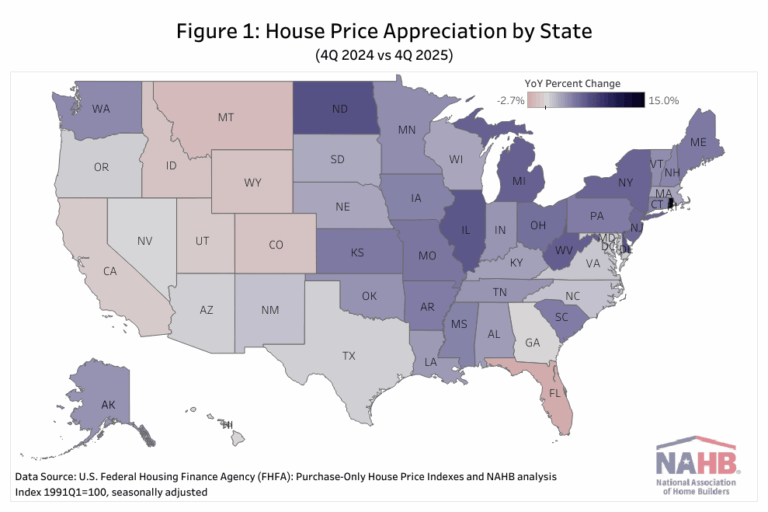
Between the third quarter of 2024 and the third quarter of 2025, 48 states and the District of Columbia experienced positive year-over-year (YoY) house price appreciation, with gains ranging from 0.6% to 6.8%. Hawaii was the only state to record a decline, while Florida posted no growth. New York led all states with a 6.8% gain, followed by Connecticut with a 6.5% gain and Illinois with a 6.2% gain. On the opposite end, Colorado posted the lowest house price appreciation at 0.6%. Notably, out of all 50 states and the District of Columbia, 29 states exceeded the national YoY growth rate of 3.3%. However, on a quarterly basis, home price appreciation decelerated in 45 states compared to the second quarter of 2025, highlighting a broad-based deceleration in the housing market.

House price growth also varied widely across U.S. metro areas, ranging from a 7.8% decline to a 16.0% increase year-over-year. Punta Gorda, FL recorded the steepest drop, while Farmington, NM posted the strongest gains over the previous four quarters. In the third quarter of 2025, 34 metro areas, in reddish color on the map above, experienced negative house price growth, while 351 metro areas posted increases.

Since the onset of the COVID-19 pandemic, house prices have surged nationally. Between the first quarter of 2020 and the third quarter of 2025, house prices climbed 54.9% nationwide, with more than half of metro areas exceeding this rate. However, 226 metro areas have seen varying degrees of decline from their post-COVID peaks, ranging from -0.1% to -12.7%.

The map below presents the top ten and bottom ten markets for house price appreciation over the past five years. Among all the metro areas, house price appreciation ranged from 18.3% to 88.4%. Knoxville, TN topped the list with the highest house price appreciation, while Odessa, TX posted the lowest appreciation, ending Lake Charles, LA’s five-quarter run at the bottom.


This article was originally published by a eyeonhousing.org . Read the Original article here. .


Single-family construction lending picked up in the third quarter, amidst the overall cooling lending environment. Loan balances for 1-4 family construction grew to $91.2 billion in the third quarter, registering the first annual increase in over two years. However, across all acquisition, development and construction (AD&C) loans, the total volume fell for the seventh straight quarter.

According to data from the Federal Deposit Insurance Corporation (FDIC), the total level of outstanding AD&C loans fell to $463.0 billion in the third quarter of 2025, down 5.6% from one year ago. This year-over-year decrease was led by a drop in other real estate development loans, which decreased 7% over the year to $371.8 billion. Meanwhile, the volume of 1-4 family residential construction and land development loans rose to $91.2 billion in the third quarter, up 0.5% from one year ago.

It is worth noting, the FDIC data represent only the stock of loans, not changes in the underlying flows, so it is an imperfect data source. Nonetheless, lending remains much reduced from years past. The current amount of existing 1-4 family residential AD&C loans now stands 56% lower than the peak level of residential construction lending of $204 billion reached during the first quarter of 2008. Alternative sources of financing, including equity partners, have supplemented this capital market in recent years.

Quality Metrics of Construction Loans

While the total volume of 1-4 family residential construction loans rose, the volume of loans 30+ days past due or nonaccrual status fell slightly to $1.1 billion over the quarter. As a share of the total 1-4 family residential construction loan volume, this accounts for 1.2%.

Breaking this out further, the level of loans 30-89 days past due was $418.1 million, while the volume in nonaccrual status was $593.4 million. The nonaccrual loan status volume increased from $572.4 million in the second quarter and the 30-89 past due fell from $469.2 million.

Loans are classified as nonaccrual when one or more of the following conditions apply: the loan is 90 days or more past due on principal or interest (unless it is well-secured and in the process of collection); the bank no longer expects full repayment of principal and interest; or the borrower’s financial condition has significantly deteriorated, warranting cash-basis accounting.


This article was originally published by a eyeonhousing.org . Read the Original article here. .


In 2024, 6.9% of new single-family detached homes were teardowns (structures torn down and rebuilt in older neighborhoods), and another 20.1% were built on infill lots in older neighborhoods, according to the latest Builder Practices Survey (BPS) conducted by Home Innovation Research Labs. The BPS places new homes in one of four development categories. In addition to teardown and infill, the categories include “new residential development” and ”not in a residential development.” Homes built in a new residential development (i.e., subdivisions) are by far the most common type. 

There is a moderate amount of geographic variation in the teardown share. At the high end, over one in ten single-family homes were built on a lot where a structure had to be torn down in three of the nine Census Divisions: 15.0% in New England, 13.2% in the Pacific, and 10.1% in the East South Central. At the low end, the teardown share was only 4.8% in the South Atlantic.  

Nationally, homes built in older neighborhoods, but without tearing down another structure first, were nearly three times as common as teardowns. Again, however, there is geographic variation. Infill development accounted for over 30% of single-family homes in New England (38.0%) and the Middle Atlantic states (32.4%) but accounted for under 10% in the West South Central (9.7%) and Mountain (9.3%) divisions.


This article was originally published by a eyeonhousing.org . Read the Original article here. .


Nationally, across the 87 million owner-occupied homes in the U.S., the average amount of annual real estate taxes paid in 2024 was $4,271, according to NAHB analysis of the 2024 American Community Survey. Homeowners in New Jersey continued to pay the highest real estate taxes, paying an average of $9,767, $2,194 more than the next closest state, New York, at $7,573. On the other end of the distribution, homeowners in West Virginia paid the lowest average amount of real estate taxes at $1,044. The map below shows the geographic variation of average annual real estate taxes (RETs) paid.

The 2024 data indicate that there is no state where real estate taxes paid were on average less than $1,000, the first time in the ACS data. There continues to be noticeable differences in the average amount of taxes paid based on geographic location. States in the Northeast, where home values tend to be higher, pay more on average in real estate taxes compared to states in other parts of the nation.

Average Effective Property Tax Rates

While average annual real estate taxes paid is important, it provides an incomplete picture. Property values vary across states, which explains some, if not most, of the variation across the nation in average annual real estate taxes. To control for property values and create a more informative state-by-state analysis, NAHB calculates the average effective property tax rates by dividing aggregate real estate taxes paid by aggregate value of owner-occupied housing within each state. For example, the aggregate real estate taxes paid across the U.S. was $370.0 billion with an aggregate value of owner-occupied real estate totaling $41.7 trillion in 2024. Using these two amounts, the average effective property tax rate nationally was $8.88 ($370.0 billion/$41.7 trillion) per $1,000 in home value. This effective rate can be expressed as a percentage of home value or as a dollar amount taxed per $1,000 of a home’s value. The map below displays the effective rate by state.

Illinois, for the second consecutive year, had the highest effective property tax rate at $17.93 per $1,000 of home value. Hawaii continued to have the lowest effective property tax rate at $3.08 per $1,000 of home value. Hawaii also had the highest average home value, at $1.05 million in 2024. Notably, the average effective property tax rate tends to be higher in the Northeast, in addition to the presence of higher home values.


This article was originally published by a eyeonhousing.org . Read the Original article here. .


The share of new homes with decks edged down from 17.6% in 2023 to a new all-time low of 17.4% in 2024, according to NAHB tabulation of data from the HUD/Census Bureau Survey of Construction (SOC).

Over the longer term, the share of new homes with decks has been declining steadily since reaching a peak of 27.0% in 2007 and 2008. Amidst that decline, the share of new homes with patios has been trending upward, from under 50% to over 60% (despite a minor reversal of the upward trend in 2024). From the re-design of the SOC in 2005 through 2024, the correlation between the percentages of new homes with patios and decks is -0.85, indicating that patios and decks are functioning as substitutes over time—i.e., as patios become more common, they are crowding out decks.

Decks and patios appear to be substitutes across the U.S. On the single-family homes started in 2024, decks tended to be more common where patios were comparatively rare. For example, only 14% of the homes in the New England Census Division included patios, while a high of 69% included decks. Conversely, 82% of new homes included patios in the West South Central, while only 3% included decks. Across all nine divisions, the correlation between the percentages of new homes with decks and patios was -0.77.

Even so, decks remain relatively popular on new homes in some parts of the country. In addition to New England, over 30% of new homes came with decks in the West North Central (46%), Middle Atlantic (34%) and East South Central (31%) divisions. Moreover, in the latest edition of  What Home Buyers Really Want, 79% of recent and prospective home buyers rated a deck as an essential or desirable feature.

Additional detail on the characteristics of new-home decks is available from the Annual Builder Practices Survey (BPS) conducted by Home Innovation Research Labs.

Nationally, the 2025 BPS report (based on homes built in 2024) shows that the average size of a deck on a new single-family home is 278 square feet. Across Census Divisions, the average ranges from a low of 163 square feet in the West South Central to a high of 422 square feet in the Mountain division.

Beyond size, there continue to be strong geographic differences in builders’ choice of deck materials. On a square foot basis, treated wood is the most popular choice in the New England, South Atlantic, East South Central, and Mountain divisions. In the Middle Atlantic, East North Central, and West North Central, composite material predominates. In the Pacific Division, builders use concrete more than any other material, while in the West South Central there is a roughly even split between treated wood and concrete.

Of course, decks can be—and often are—added after the home itself is built. In the fourth-quarter 2024 survey for the NAHB/Westlake Royal Remodeling Market Index, decks ranked seventh among 22 listed remodeling projects, cited as a common job by 23% of the professional remodelers who responded to the survey.


This article was originally published by a eyeonhousing.org . Read the Original article here. .


Aggregate residential building material prices rose at their fastest pace since January 2023 in the latest Producer Price Index release from the Bureau of Labor Statistics. Input energy prices increased for the first time in over a year, while service price growth remained lower than goods.

The Producer Price Index for final demand increased 0.3% in September, after falling 0.1% in August. The index for final demand goods increased 0.9% in September, the largest monthly increase since February 2024. Final demand energy prices were responsible for most of the goods index increase, as they rose 3.5% in September. This index for final demand for services was unchanged in September.

The price index for inputs to new residential construction rose 0.2% in September and was up 3.1% from last year. The price of goods inputs was up 0.1% over the month and 3.5% from last year, while prices for services were up 0.3% over the month and 2.5% from last year.

Input Goods

The goods component has a larger importance to the inputs to residential construction price index, representing around 60%. On a monthly basis, the price of input goods to new residential construction was up 0.1% in September.

The input goods to residential construction index can be further broken down into two separate components, one measuring energy inputs with the other measuring remaining goods. The latter of these two components simply represents building materials used in residential construction, which makes up around 93% of the goods index.

Energy input prices rose 1.0% in September and were 3.0% higher than one year ago. Building material prices were up 0.1% in September and up 3.5% compared to one year ago. The 3.5% year-over-year increase is the largest increase since the 4.9% experienced back in January 2023. Residential building material price inflation slowly accelerated over the year, after starting around 2.0%.

The largest year-over-year price changes continue to be parts for construction machinery and equipment, sold separately, up 41.3% compared to September of last year. Metal molding and trim prices are up 31.0% from last year. Ready-mix concrete, a key input to new residential construction, has shown little price growth in 2025, up only 0.4% from last year. Additionally, softwood lumber prices were down 2.3% in September from last year. Lumber prices have experienced declines over the past few months despite higher tariffs now in place. Ongoing weaknesses during 2025 in new residential construction have led to an acute oversupply of lumber on the market, with demand below expectations.

Input Services

Prices for service inputs to residential construction reported an increase of 0.3% in September. On a year-over-year basis, service input prices were up 2.5%. The price index for service inputs to residential construction can be broken out into three separate components: a trade services component, a transportation and warehousing services component, and a services excluding trade, transportation and warehousing component (other services).

 The most significant component is trade services (around 60%), followed by other services (around 29%), and finally transportation and warehousing services (around 11%). The largest component, trade services, was up 3.1% from a year ago. The other services component was up 1.3% over the year.  Lastly, prices for transportation and warehousing services rose 2.6% compared to August of last year.


This article was originally published by a eyeonhousing.org . Read the Original article here. .

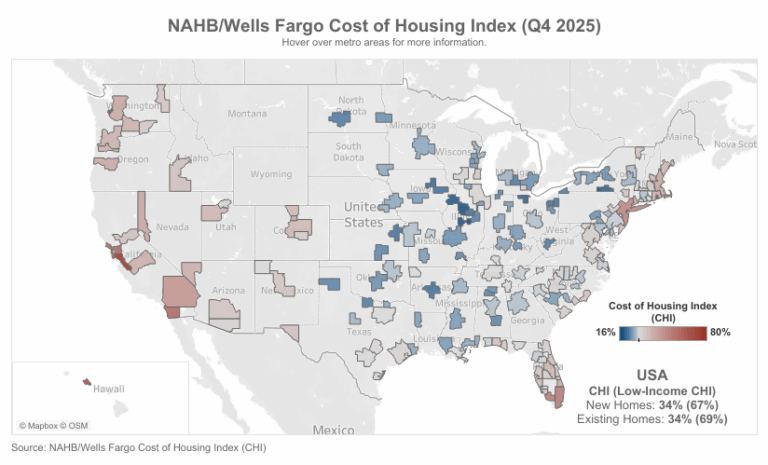
The housing affordability crisis continues to disproportionately affect renters, with more than half of renter households experiencing high-cost burdens — i.e., paying 30% or more of their income on rent and utilities. At the same time, current home owners, buoyed by significant home equity gains and locked in by below-market mortgage rates, are in a more advantageous financial position to weather the growing affordability crisis. According to the latest 2024 American Community Survey (ACS), more than half of all renter households (50.3%), or 23.2 million, are burdened by housing costs. Among home owners, this share is less than a quarter (24.3%) representing 21 million households. As a result, states and counties with higher shares of renters in their housing markets are more likely to have higher overall shares of households with cost burdens.

Geographically, Florida, Nevada, and California have the largest concentration of cost-burdened renters. In Florida, 60% of all renters pay more than 30% of their income on rent and utilities. In Nevada, the share is 57%, and in California, 55% of renters experience housing cost burdens. Even in states with comparatively low renter cost-burden rates—such as South Dakota, Alaska, and North Dakota—more than one-third of renters still spend 30% or more of their income on housing.

For home owners, cost-burden rates are generally lower, but the geographic pattern mirrors that of renters. California, Florida, and several Northeastern states report the highest shares of cost-burdened home owners. California faces the most severe affordability challenges, with one in three owners paying more than 30% of their income for housing. Florida and Hawaii follow closely, with 31% of existing home owners struggling to afford their homes.

At the opposite end of the spectrum, nine states in the Midwest and South report that fewer than 20% of homeowners are cost-burdened. West Virginia and North Dakota have the lowest rates, at just 16%.


This article was originally published by a eyeonhousing.org . Read the Original article here. .

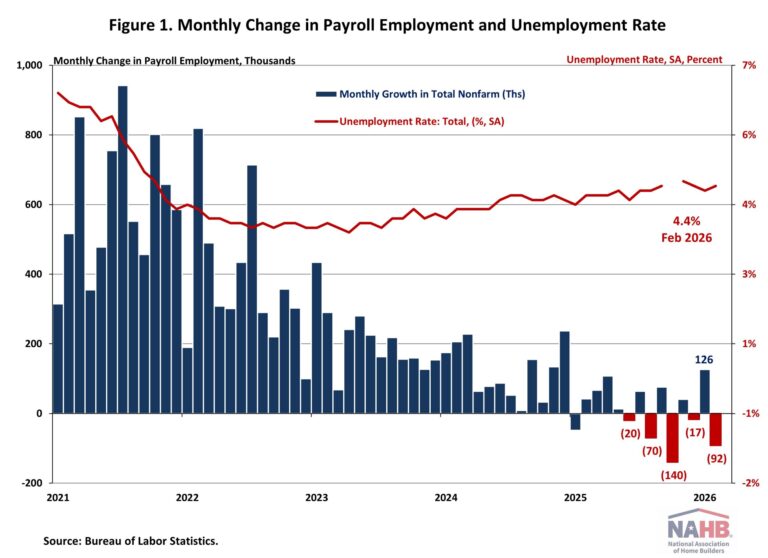
The long-delayed September jobs report revealed that the U.S. economy added 119,000 jobs while the unemployment rate climbed to its highest level in nearly four years. Combined with downward revisions to previous months, this month’s data indicates a slowing of the U.S. labor market, though one that is still expanding. With the October jobs report cancelled due to the government shutdown and November’s report not scheduled for release until December 16, this September report now stands as the Federal Reserve’s final look at labor market conditions before its December meeting.

In September, wages grew at a 3.8% pace year over year, matching August’s increase. Wage growth has been outpacing inflation for nearly two years, which typically occurs as productivity increases.

National Employment

The September jobs report was delayed by more than six weeks due to the federal government shutdown. According to the long-awaited Employment Situation Summary reported by the Bureau of Labor Statistics (BLS), total nonfarm payroll employment rose by 119,000 in September, following a downwardly revised loss of 4,000 jobs in August. August’s growth was revised down by 26,000, from an initial estimate of +22,000 to -4,000, marking the second month of negative job growth since January 2010. July’s job growth was revised down by 7,000, from +79,000 to +72,000. Combined, the revisions erased 33,000 jobs from previously reported figures.

Through September, monthly job growth in 2025 has averaged 76,000, a significant slowdown compared to the 168,000 monthly average gain for 2024.

The unemployment rate rose to 4.4% in September, its highest level in nearly four years. The number of persons unemployed rose by 219,000 and the number of persons employed increased by 251,000.

Meanwhile, the labor force participation rate—the proportion of the population either looking for a job or already holding a job—edged up by 0.1 percentage points to 62.4%. This remains below its pre-pandemic level of 63.3% recorded at the beginning of 2020. Among prime working-age individuals (aged 25 to 54), the participation rate remained steady at 83.7%, the highest level since October 2024.

In September, employment gains were seen in health care (+43,000), food services and drinking places (+37,000), and social assistance (+14,000), while the transportation and warehousing sector and the federal government experienced job losses. Federal government employment fell by 3,000 positions in September and has now shed a total of 97,000 positions since peaking in January 2025. The BLS notes that “employees on paid leave or receiving ongoing severance pay are counted as employed in the establishment survey.”

Construction Employment

Employment in the overall construction sector increased by 19,000 in September, after three consecutive months of job losses. Within the industry, residential construction added 3,100 jobs, while non-residential construction gained 16,300 positions.

Residential construction employment now stands at 3.3 million in September, including 954,000 workers employed by builders and remodelers and 2.4 million residential specialty trade contractors.

The six-month moving average of job gains for residential construction remains negative at -3,767 per month, reflecting losses in four of the past six months for May through August 2025. Over the last 12 months, residential construction has seen a net loss of 44,900 jobs, marking the fifth consecutive annual decline since September 2020. Since the low point following the Great Recession, residential construction has gained 1,340,000 positions.

In September, the unemployment rate for construction workers jumped to 5.1% on a seasonally adjusted basis. The unemployment rate for construction workers has remained at a relatively lower level, after reaching 15.3% in April 2020 due to the housing demand impact of the COVID-19 pandemic.


This article was originally published by a eyeonhousing.org . Read the Original article here. .

Existing home sales rose to an eight-month high in October as buyers took advantage of lower mortgage rates, according to the National Association of Realtors (NAR). Resale inventory improved from a year ago but remained below pre-pandemic levels. Relatively tight supply continued to push home prices higher and challenge housing affordability. These affordability pressures vary by region, with first-time buyers in the Northeast facing limited inventory, while buyers in the West struggle with elevated home prices.

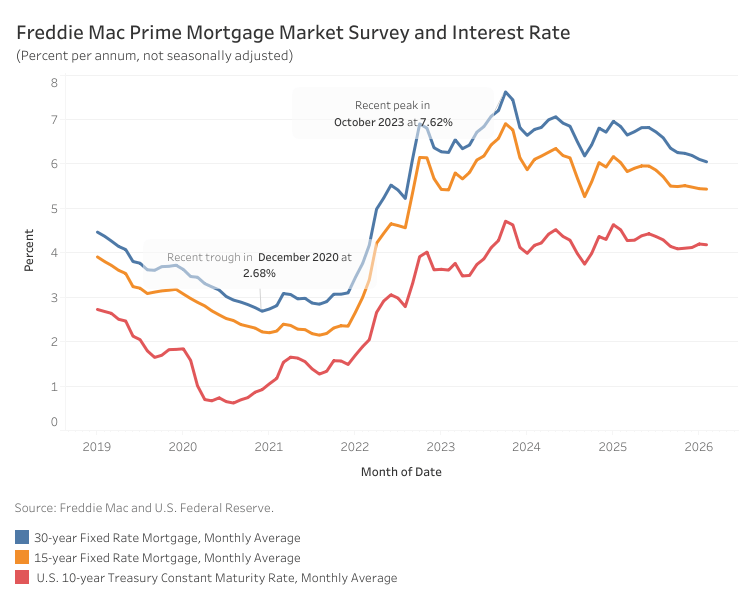
Mortgage rates hovered between 6.5% and 7% earlier this year due to economic and tariff uncertainty. However, with the Fed resuming rate cuts in September, mortgage rates have fallen gradually. As of October 30th, the average mortgage rate decreased to 6.17%, the lowest in over a year. With additional rate cuts expected in coming months, lower mortgage rates and improved inventory should bring more buyers and sellers into the market.

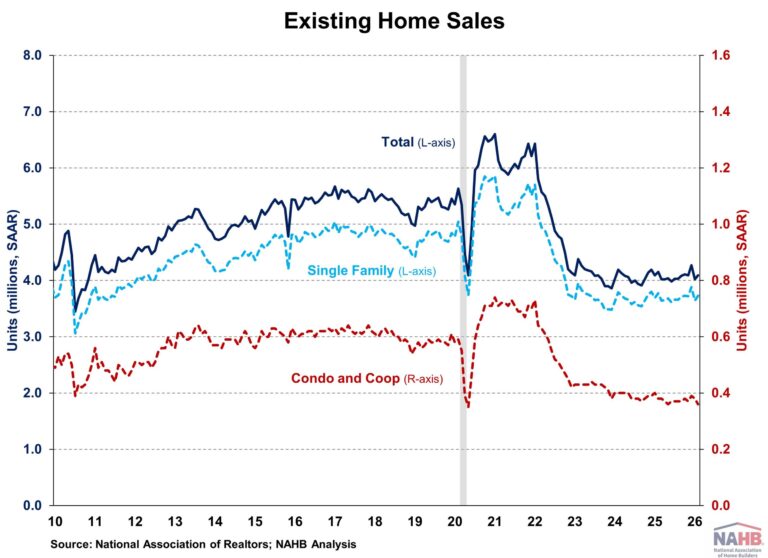
Total existing home sales, including single-family homes, townhomes, condominiums, and co-ops, rose 1.2% to a seasonally adjusted annual rate of 4.10 million in October, the highest level since February. On a year-over-year basis, sales were 1.7% higher than a year ago.

The existing home inventory level was 1.52 million units in October, down 0.7% from September but up 10.9% from a year ago. At the current sales rate, October unsold inventory sits at a 4.4-months’ supply, down from 4.5-months in September but up from 4.1-months in October 2024. Inventory between 4.5 to 6 months’ supply is generally considered a balanced market.

Homes stayed on the market for a median of 34 days in October, up from 33 days last month and 29 days in October 2024.

The first-time buyer share was 32% in October, up from 30% in September and 27% from a year ago.

The October all-cash sales share was 29% of transactions, down from 30% in September but up from 27% a year ago. All-cash buyers are less affected by changes in interest rates.

The October median sales price of all existing homes was $415,200, up 2.1% from last year. This marks the 28th consecutive month of year-over-year increases. The median condominium/co-op price in October was up 0.9% from a year ago at $363,700.  Recent gains for home inventory will put downward pressure on resale home prices in most markets in 2025.

Existing home sales in October were mixed across the four major regions. Sales rose in the Midwest (5.3%) and South (0.5%), fell in the West (-1.3%), and remained unchanged in the Northeast. On a year-over-year basis, sales were up in the Northeast (4.3%), South (2.8%) and Midwest (2.1%), while down in the West (-2.6%).

The Pending Home Sales Index (PHSI) is a forward-looking indicator based on signed contracts. The PHSI remained unchanged at 74.8 in September, suggesting job market concerns kept buyers on the sideline despite mortgage rates near one-year lows. On a year-over-year basis, pending sales were 0.9% lower than a year ago, according to the National Association of Realtors’ data.


This article was originally published by a eyeonhousing.org . Read the Original article here. .
Pin It