Tag

housing

Browsing


Inflation unexpectedly eased in November, according to the Bureau of Labor Statistics (BLS) latest report. This data release was originally scheduled for December 10 but was delayed due to the recent government shutdown. While most indexes showed deceleration, this report does not necessarily prove a downward trend in inflation due to missing October data and incomplete November collection. December’s report may be more pivotal for markets and the Fed.

The recent record-long government shutdown disrupted data collection for many macroeconomic indicators including the CPI. About two-thirds of price data is collected through personal visits to brick-and-mortar stores, with the remaining third collected online or via telephone. Since the government remained shut down throughout October, BLS cannot retroactively collect survey data for the month. While data collection resumed on November 14 following the November 13 reopening, this month’s report potentially has downward bias due to lower collection rates and holiday sales promotions. This also suggests higher likelihood for monthly volatility in the near term.

Though inflation is expected to peak in the first quarter of 2026, the Fed is likely to continue easing given signs of labor market weakening. The housing market’s sensitivity to interest rates suggests rate cuts could help ease the affordability crisis and support housing supply even as builders continue to face supply-side challenges.

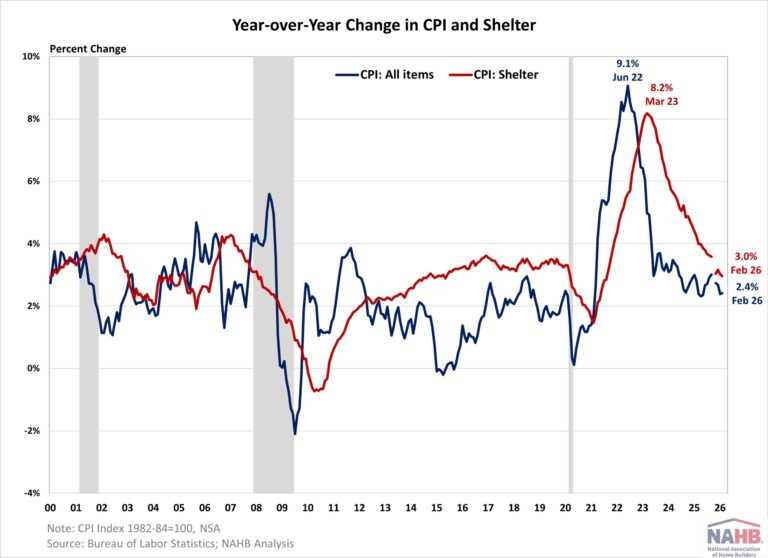
During the past twelve months, on a non-seasonally adjusted basis, the Consumer Price Index (CPI) rose by 2.7% in November. Excluding the volatile food and energy components, the “core” CPI increased by 2.6% over the past twelve months, the lowest reading since April 2021. A large portion of the “core” CPI is the housing shelter index, which increased 3.0% over the year, the lowest reading since August 2021. Meanwhile, the component index of food rose by 2.6%, and the energy component index increased by 4.2%.

Given the notable shift in the November data, especially for the shelter inflation component, the November data are shown with data dot points (red for shelter, blue for overall CPI respectively) in the chart below. The December report will identify whether these data points are confirmed positive trends.

Due to the gap in data collection during the government shutdown, this report covers a two-month period instead of the standard one month. From September to November, the CPI rose by 0.2% (seasonally adjusted), down from a 0.7% increase over the two-month period ending in September. The “core” CPI increased by 0.2% over the two months ending in November, compared to 0.6% in the prior two-month period.

From September to November, the price index for a broad set of energy sources rose by 1.1% and the food index rose by 0.1%. The index for shelter, which makes up more than 40% of the “core” CPI, rose by 0.2% over the two-month period, down from 0.6% in the previous period. Other contributors that increased included indexes for household furnishings and operations, communication, as well as personal care.

NAHB constructs a “real” rent index to indicate whether inflation in rents is faster or slower than core inflation. It provides insight into the supply and demand conditions for rental housing. When inflation in rents is rising faster than core inflation, the real rent index rises and vice versa. The real rent index is calculated by dividing the price index for rent by the core CPI (to exclude the volatile food and energy components).

From September to November, the Real Rent Index remained unchanged over the two-month period. Due to the missing October data, the average monthly growth rate for 2025 cannot be directly compared to prior years.


This article was originally published by a eyeonhousing.org . Read the Original article here. .


In 2024, the number of people experiencing homelessness increased to the highest estimate in the history of HUD’s Annual Point-in-Time (PIT) Count. Approximately 771,500 people were recorded as living in an emergency shelter, a transitional housing program, or in unsheltered locations across the country. This count increased 18% compared to 2023, a notable increase compared to previous years as shown in graph below. 

Demographics

Nearly every demographic increased to record levels of homelessness in 2024. Individuals, who represent about two-thirds of people experiencing homelessness, increased 10% from 2023. Meanwhile, families with children experienced the largest jump, rising 39% to over 259,000 people. Unaccompanied youth (those under 24) also increased 10% to roughly 38,000 people.  

Other special populations, such as people experiencing chronic homelessness, increased 7% to 153,000, accounting for one in five people experiencing homelessness nationwide. Veterans, however, were the only population to decrease, declining by 8% to 33,000. 

Notably, nearly all populations have increased since 2007, with people experiencing chronic patterns of homelessness increasing the most by 27%. However, veterans remain the only group to post a long-term decline of 55% since 2009.

By State

Geographically, California had the highest number of people experiencing homelessness in 2024 at 187,000 people, nearly a quarter of the national total. New York followed at 158,000 people or 20% of the total. However, when adjusted to account for population size, Hawaii, and New York were the states with the highest homelessness rate at around 80 per 10,000 people. Twelve states and territories, including D.C. and Guam, exceeded the national rate of 23 per 10,000 people.  

Compared to 2023, only seven states and Puerto Rico showed declines in the number of people experiencing homelessness including Maine (-36.5%), Tennessee (-10.1%), New Hampshire (-8.0%), Montana (-7.8%), Puerto Rico (-6.5%), Wyoming (-5.8%), Iowa (-0.8%), and Georgia (-.03%). Every other state and D.C. experienced increases, led by Illinois (116.2%), Hawaii (87.0%), Massachusetts (53.4%), and New York (53.2%).  

In terms of market area, more than half (54%) of people experiencing homelessness live in major cities. This is followed by 24% in suburban areas, 16% in rural areas, and 6% in other urban areas

Shelter vs. Unsheltered 

It is important to note that the point-in-time count for this report is recorded at the end of January, one of the coldest times of the year. In 2024, 64% of the 771,500 people were considered sheltered. Sheltered homelessness rose by 25% compared to 2023, while unsheltered increased by 7%.  

Sheltered people are counted in two main types of programs, emergency shelters (shorter-term) and transitional housing (longer and more intensive care). People on other types of housing assistance considered permanent housing such as rapid rehousing (short-term subsidy) and permanent supportive housing (long-term subsidy) are not included in this count.  

In 2024, there were an estimated 510,000 shelter beds (including emergency shelters and transitional housing), representing 43% of the total inventory of all housing assistance. Since 2007, shelter beds have increased by 21%, whereas the number of permanent housings has increased by 261%.  

Housing Affordability

Homelessness is a complex issue with various factors, but the steep increase in 2024 coincides with the broader housing affordability challenges the entire market is facing. More than half of renter households are cost-burdened, paying 30% or more of their income on rent and utilities. At the same time, three-quarters of Americans are unable to afford a median-priced home, reflecting high demand, high mortgage rates, as well as limited supply following a decade of underbuilding after The Great Recession.  

Over the long-term, supply side growth is essential to taming housing costs. In a well-functioning housing market, as multifamily completions increase, vacancy rates should rise and rent growth should slow. However, because new units are typically delivered at higher price points, households on the lower end of the income distribution rely on the ‘trickle-down’ effect. As new single-family and multifamily homes are built, some renters become first-time buyers, freeing up older, and more affordable rental units in the process.  

In the short-term, expanding the supply of affordable units is essential for serving the needs of people currently experiencing homelessness. This means making it easier and less costly to build. Eliminating excessive regulations, overturning inefficient local zoning rules, supporting federal tax legislation such as the Low-Income Housing Tax Credit will make it more feasible for builders to deliver units at lower price points. 

Ultimately, homelessness is both an economic and humanitarian challenge, and there is no single solution. What remains clear is that building homes is essential to easing cost burdens and a step toward the American dream of housing opportunities for all


This article was originally published by a eyeonhousing.org . Read the Original article here. .


In November, job growth slowed, and the unemployment rate rose to 4.6%, its highest level in four years. At the same time, job gains for the previous two months (August and September) were revised downward. The November’s jobs report indicates a cooling labor market as the economy heads into the final month of the year.

In November, wage growth slowed, increasing 3.5% year over year, down 0.6 percentage points from a year ago. Wage growth has been outpacing inflation for nearly two years, which typically occurs as productivity increases.

National Employment

According to Employment Situation Summary reported by the Bureau of Labor Statistics (BLS), total nonfarm payroll employment rose by 64,000 in November. This represents a notable slowdown from September’s revised gain of 108,000 and reflects continued weakness in overall hiring.

August’s growth was revised downward for the second time, from last month’s estimate of -4,000 to -26,000. September job growth was revised down by 11,000, from +119,000 to +108,000. Combined, these revisions erased 33,000 jobs from previously reported figures. October data, published for the first time, was not revised.

Through November, average monthly job growth in 2025 stands at just 11,000, well below the 168,000 monthly average recorded in 2024.

The unemployment rate rose to 4.6% in November, its highest level since September 2021. Compared to September, the number of persons unemployed rose by 228,000, while the number of persons employed increased by 96,000.

Meanwhile, the labor force participation rate—the proportion of the population either looking for a job or already holding a job—remained unchanged at 62.4%. This remains below its pre-pandemic level of 63.3% recorded at the beginning of 2020. Among prime working-age individuals (aged 25 to 54), the participation rate edged up 0.1 percentage points to 83.8%, the highest level since September 2024.

In November, employment gains were seen in health care (+46,000) and construction (+28,000), while the federal government continued to shed jobs. Federal government employment fell by 6,000 positions in November, following a sharp decline of 162,000 in October. Since peaking in January 2025, federal government employment has fallen by a total of 271,000 jobs.

Construction Employment

Employment in the overall construction sector increased by 28,000 in November, after an upwardly revised 25,000 gain in September. Within the industry, residential construction shed 300 jobs, while non-residential construction gained 28,800 positions.

Residential construction employment now stands at 3.3 million in November, including 958,000 workers employed by builders and remodelers and approximately 2.4 million residential specialty trade contractors.

The six-month moving average of job gains for residential construction remains negative at -3,600 per month, reflecting losses in five of the past six months for June, July, August, October, and November. Over the last 12 months, residential construction has seen a net loss of 42,200 jobs, marking the sixth consecutive annual decline since September 2020. Since the low point following the Great Recession, residential construction has gained 1,334,100 positions.

In November, the unemployment rate for construction workers declined to 4.7% on a seasonally adjusted basis. The unemployment rate for construction workers has remained at a relatively lower level, after reaching 15.3% in April 2020 due to the housing demand impact of the COVID-19 pandemic.


This article was originally published by a eyeonhousing.org . Read the Original article here. .


Builder confidence inched higher to end the year but still remains well into negative territory as builders continue to grapple with rising construction costs, tariff and economic uncertainty, and many potential buyers remaining on the sidelines due to affordability concerns.

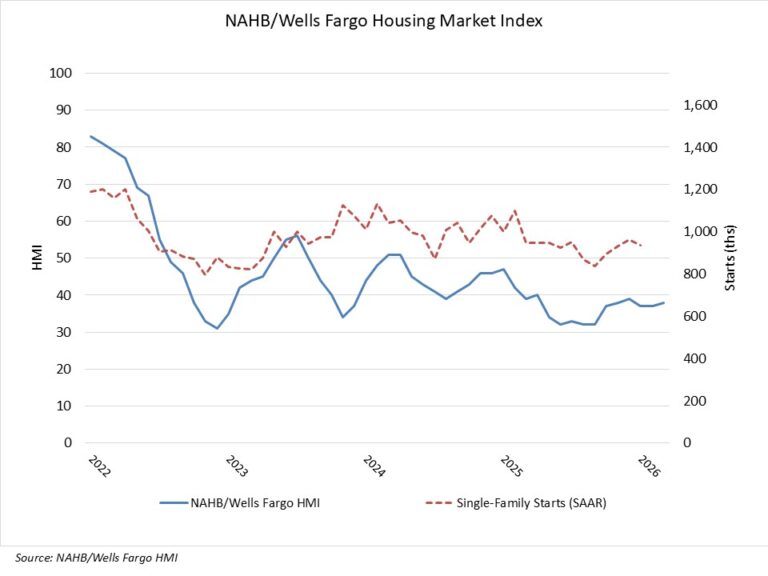
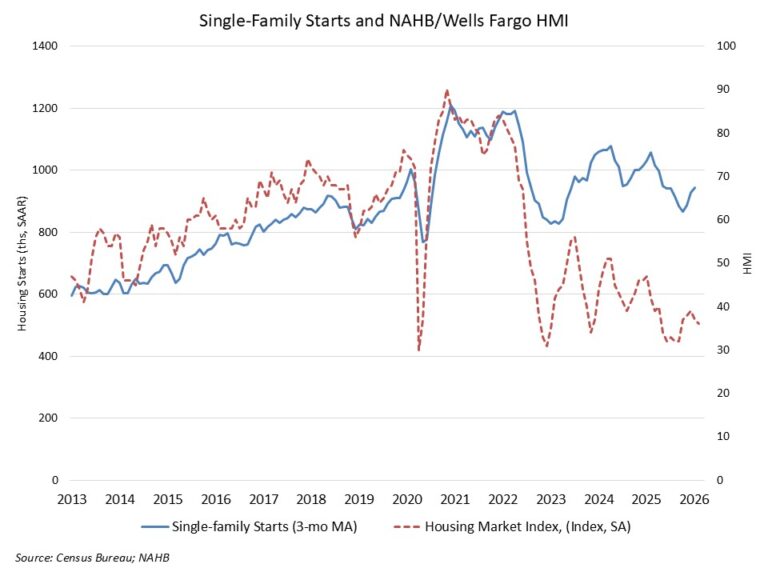
Builder confidence in the market for newly built single-family homes rose one point to 39 in December, according to the National Association of Home Builders (NAHB)/Wells Fargo Housing Market Index (HMI). Sentiment levels were below the breakeven point of 50 every month in 2025 and ranged in the high 30s in the final quarter of the year.

Market conditions remain challenging with two-thirds of builders reporting they are offering incentives to move buyers off the fence.

In positive signs for the market, builders report that future sales expectations have been above the key breakeven level of 50 for the past three months and the recent easing of monetary policy should help builder loan conditions at the start of 2026. However, builders continue to face supply-side headwinds, as regulatory costs and material prices remain stubbornly high. Rising inventory also has increased competition for newly built homes.

In a further sign of ongoing challenges for the housing market, the latest HMI survey also revealed that 40% of builders reported cutting prices in December, marking the second consecutive month the share has been at 40% or higher since May 2020. It was 41% in November. Meanwhile, the average price reduction was 5% in December, down from the 6% rate in November. The use of sales incentives was 67% in December, the highest percentage in the post-Covid period.

Derived from a monthly survey that NAHB has been conducting for more than 40 years, the NAHB/Wells Fargo HMI gauges builder perceptions of current single-family home sales and sales expectations for the next six months as “good,” “fair” or “poor.” The survey also asks builders to rate traffic of prospective buyers as “high to very high,” “average” or “low to very low.” Scores for each component are then used to calculate a seasonally adjusted index where any number over 50 indicates that more builders view conditions as good than poor.

The HMI index gauging current sales conditions increased one point to 42, the index measuring future sales rose one point to 52 and the gauge charting traffic of prospective buyers held steady at 26.

Looking at the three-month moving averages for regional HMI scores, the Northeast fell one point to 47, the Midwest rose two points to 43, the South increased two points to 36 and the West gained four points to 34.

The HMI tables can be found at nahb.org/hmi.

Editor’s Note: With the official 2026 release schedule for the Survey of Construction still unavailable from the U.S. Census Bureau, NAHB confirms the HMI for January 2026 will be released on January 16.  A schedule for the rest of the year will be available as soon as possible.


This article was originally published by a eyeonhousing.org . Read the Original article here. .


The latest homeownership rate rose to 65.3% in the third quarter of 2025, according to the Census’s Housing Vacancy Survey (HVS). Despite this quarterly increase, the trend continues to reflect significant affordability challenges. With mortgage interest rates remaining elevated, and housing supply still tight, housing affordability is at a multidecade low. Compared to the peak of 69.2% in 2004, the homeownership rate is currently 3.9 percentage points lower and remains below the 25-year average rate of 66.3%.  

Compared to the previous year, homeownership rates increased in three age groups. Among younger households, the homeownership rate for those under 35 increased 0.5 percentage points to 37.5% in the third quarter of 2025. This age group is particularly sensitive to mortgage rates and the inventory of entry-level homes. Householders ages 45-54 experienced a 0.3 percentage-point increase from 69.7% to 70%. Homeownership rates for householders aged 55-64 inched up by 0.1 percentage point over the same time. However, homeownership rates for householders aged 35-44 and those aged 65 years and over each declined 1.2 percentage points from a year ago. 

The national rental vacancy rate inched up to 7.1% for the third quarter of 2025, on steadily increasing trend since 2023. Meanwhile, the homeowner vacancy rate rose to 1.2%. These upticks in both the homeowner and rental vacancy rate signal an increase in the existing home supply. 

The housing stock-based HVS revealed that the number of total households increased to 133.1 million in the third quarter of 2025 from 132.0 million a year ago. This increase was driven by both owner and renter household growth. The number of renter households rose by 0.7 million, while owner-occupied households increased by 0.4 million over the same period.


This article was originally published by a eyeonhousing.org . Read the Original article here. .


The central bank’s Federal Open Market Committee (FOMC) cut rates a third and final time in 2025, reducing the target range for the federal funds rate by 25 basis points to a 3.5% to 3.75% range. This reduction will help reduce financing costs of builder and developer loans.

Furthermore, and explicitly noted by Fed Chair Powell as separate from policy considerations, to maintain an appropriate level of reserves as a means of monetary policy implementation and to enable smooth market functioning, the Fed will initiate purchases of short-term Treasury securities on December 12th.

The tone of today’s meeting was more dovish than investors expected. Overall, the Fed faces a complicated outlook with risks on both sides of its dual mandate: supporting the labor market and maintaining stable prices. Interest rate-sensitive sectors such as housing continue to face restrictive conditions. The slightly dovish stance of today’s announcement suggests the FOMC perceives greater near-term downside risk for the labor market component of its mandate, despite an improving outlook for GDP growth.

There was a notable level of dissent at the December meeting. Two voting members of the FOMC (Goolsbee and Schmid) preferred no change to the target rate. In contrast, Governor Miran supported a 50-basis-point reduction. This marks the largest level of dissent since September 2019.

The Fed’s statement noted that job gains have slowed, and the unemployment rate has edged higher through September. In contrast to recent policy statements, the Fed did not note unemployment as “low.”  The slowing of the labor market is due to both a decline in immigration and a pullback in hiring by firms. The December view of the economy was somewhat obscured by missing or delayed government data due to the now-ended government shutdown.

Chair Powell noted in his press conference that activity in the housing sector remains “weak.” Powell also noted that supply remains low, and homeowners remain locked-in due to low-rate mortgages. Finally, the Fed Chair indicated that the U.S. has not built enough housing, leading to affordability challenges due to a structural housing shortage.

Chair Powell also noted that inflation has been lowered but remains “elevated,” because of recent monetary policy actions. Inflation expectations have declined, and long-term expectations remain anchored to the central bank’s 2% target.

This framing of the economic situation is consistent with the December rate cut as being an insurance policy of easing given weakening of the labor market due to policy uncertainty and tariffs. That is, the Fed’s cut biases policy to responding to future weakening of economic growth rather than to concerns about inflation reaccelerating (some FOMC members have argued, for example, that markets can look through any tariff effects, which will be one-off impacts).

Looking forward, the Fed’s outlook for the economy and monetary policy is mixed. Estimates from the central bank’s Summary of Economic Projections (SEP) indicate an expectation of stronger economic growth next year, with a 2026 2.3% fourth quarter year-over-year growth rate. This is an upward revision compared to the 1.8% estimate from September. The SEP estimates also reveal an expectation of a 4.4% unemployment rate in 2026 and decline for inflation (core PCE) of 2.4%, relative to 2.9% in 2025. The revised SEP does not anticipate the economy reaching the Fed’s target inflation rate of 2% until 2028.

With respect to policy, the SEP outlook suggests one rate cut in 2026 and one final rate cut in 2027. The “dot plot” of individual responses suggests one respondent, presumably Governor Miran, foresees approximately five rate cuts in 2026. The policy outlook is clouded by the fact that the Fed will have new leadership next year, with a new Chair taking office in May 2026.


This article was originally published by a eyeonhousing.org . Read the Original article here. .


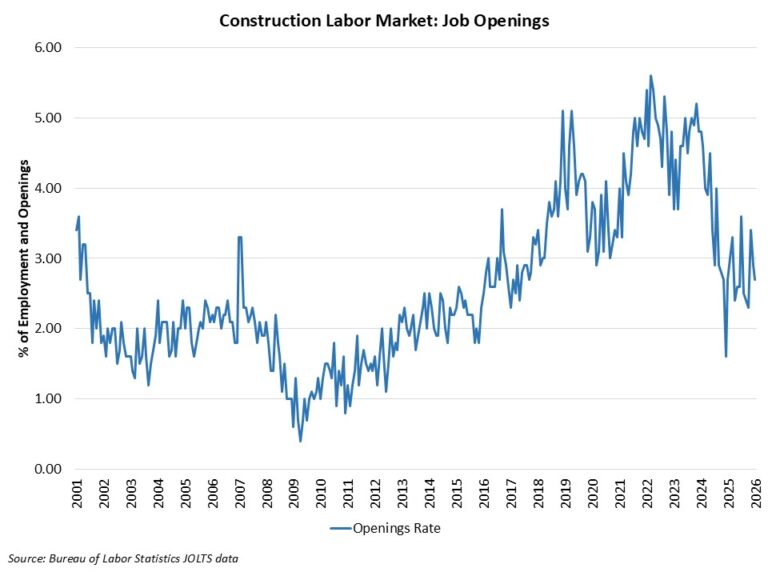
The count of open, unfilled positions in the construction industry was relatively unchanged in October, per the Bureau of Labor Statistics Job Openings and Labor Turnover Survey (JOLTS). The current level of open jobs is down measurably from two years ago due to declines in construction activity, particularly in housing.

The number of open jobs for the overall economy was effectively unchanged, increasing from 7.66 million in September to 7.67 million in October. The October reading was was relatively unchanged from the 7.62 million estimate from a year ago.

Previous NAHB analysis indicated that this number had to fall below 8 million on a sustained basis for the Federal Reserve to move forward on interest rate reductions. With estimates remaining below 8 million for national job openings, the Fed, in theory, should be able to cut further.

The number of open construction sector jobs decreased from 231,000 in September to 213,000 in October. This total is relatively stable compared to a year ago (249,000), although the reading is notably lower than two years ago. The chart below notes the declining trend that has been in place for unfilled construction jobs since the Fed raised the federal funds rate and home building weakened.

The construction job openings rate declined to 2.5% in October, lower than the 2.9% rate estimated a year ago.

The layoff rate in construction declined to 1.8% in October. The quits rate edged lower to 1.4% in October.


This article was originally published by a eyeonhousing.org . Read the Original article here. .


Mortgage activity continued to climb in November, posting the largest year-over-year increase in more than five years. Every major category increased on a year-over-year basis as mortgage rates continue to trend lower, led by strong increases in refinancing and adjustable-rate mortgage activity. 

The Mortgage Bankers Association’s (MBA) Market Composite Index, a measure of total mortgage application volume, fell 1.6% from October on a seasonally adjusted basis but was 60% higher than a year ago.  

The average contract interest rate for 30-year fixed mortgages basis continued to fall for the sixth month in a row to 6.36%, the lowest in over a year. After a strong jump in September, refinancing activity in November decreased 8.3% month-over-month. However, refinancing increased 123.7% on an annual basis, the largest gain in over a year. Meanwhile, purchase applications increased 7.9% over the month and rose 34.1% compared to a year ago, the highest increase since 2021.  

By loan type, fixed-rate mortgage applications were unchanged from October but were 57.6% higher year-over-year. Adjustable-rate mortgage applications dropped 19% month-over-month, yet surged 94.9% from a year earlier, following an 116% annual gain in October.  

The average loan size across all mortgages was $396,000, down 3% from the previous month. The average purchase loan size was $429,000, down 2% from last month, while the average refinance loan size declined 4% to $369,000. For adjustable-rate mortgages, the average loan size increased 3% to $969,000, compared to a 2% decline for fixed-rate mortgages to $348,000.


This article was originally published by a eyeonhousing.org . Read the Original article here. .


In 2024, 65.7% of all new single-family homes started were built within a community or homeowner’s association. This share increased from the 64.8% recorded in 2023, according to data tabulated from the Census Bureau’s Survey of Construction (SOC). This marks the second highest share since the beginning of the series in 2009, after a high point of 67.1% in 2020. Prior to 2021, the share had been on a decade-long upward trend.  In absolute numbers, a total of 651,873 homes were started in community associations in 2024.

The Census Bureau defines community or homeowner’s associations as “formal legal entities created to maintain common areas of a development and to enforce private deed restrictions; these organizations are usually created when the development is built, and membership is mandatory.”

A recent NAHB study, What Home Buyers Really Want, asked recent and prospective home buyers to rate the influence that 29 community features would have on their purchase decision. For more than 65% of buyers, being near retail space and park areas, and having walking/jogging trails are the most influential community features. In contrast, only 39% feel the same way about a homeowner’s association.

When analyzed by the nine census divisions, the highest share of new homes started within a homeowner’s association was in the Mountain Division, where 81.6% of new homes were in such communities. In the Middle Atlantic Division, on the other hand, the share was only 32.5%. The share of new homes started within a community across U.S. divisions are shown in the map below.


This article was originally published by a eyeonhousing.org . Read the Original article here. .


The average mortgage rate in November continued to trend lower to its lowest level in over a year. According to Freddie Mac, the 30-year fixed-rate mortgage averaged 6.24% in November, 2 basis points (bps) lower than in October. Meanwhile, the 15-year rate increased 3 bps to 5.51%. Both the 30-year and 15-year rates remain lower than a year ago, dropping by 57 bps and 52 bps year-over-year, respectively.

The 10-year Treasury yield, a key benchmark for long-term borrowing, averaged 4.09% in November– a 3-basis point increase from the previous month. The spread between the 30-year fixed mortgage rate and the 10-year Treasury remains somewhat elevated at 215 basis points, well above the roughly 150-180 basis points seen in a stable market. While the spread has narrowed from the wide gap in 2023, it continues to reflect ongoing market uncertainty, keeping mortgage rates higher than their historical relationship to 10-year Treasury yields.

Falling mortgage rates have shown some impact on housing activity. Mortgage application activity continues to strengthen, led by increases in adjustable-rate mortgages and refinancing applications. Additionally, existing home sales rose to an eight-month high in October. There is no data available for new home sales in October due to the government shutdown.


This article was originally published by a eyeonhousing.org . Read the Original article here. .

Pin It