Tag

housing

Browsing


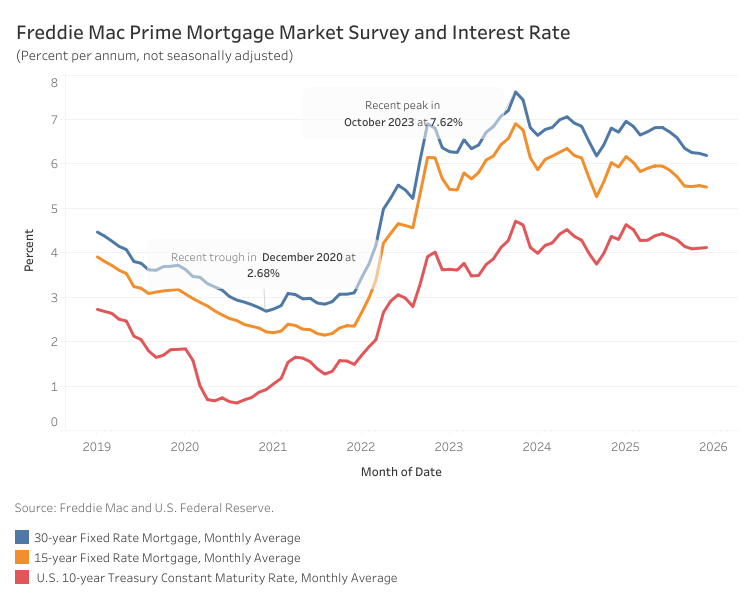
Long-term mortgage rates have been declining since mid- 2025 and ended the year at their lowest level since September 2024. According to Freddie Mac, the 30-year fixed-rate mortgage averaged 6.19% in December, 5 basis points (bps) lower than November. Meanwhile, the 15-year rate declined 3 bps to 5.48%. Compared to a year ago, the 30-year rate is lower by about half a percentage point, or 53 basis points (bps). The 15-year rate is also lower by 45 bps.

The 10-year Treasury yield, a key benchmark for long-term borrowing, averaged 4.12% in December – a modest increase of 2 bps from the previous month. Given forward-looking markets, the 10-year Treasury yield declined during the week preceding the Federal Reserve’s third rate cut of the year. However, compared to the prior month, yields ended slightly higher, rising 2 bps, as labor market data released shortly thereafter pointed to slowing job gains and rising unemployment rate.

Falling lower mortgage rates have started to translate into gains as existing home sales edged up slightly in November. However, this increase remains limited as mortgage rates above 6% are still considered elevated. Nonetheless, as financing costs continue decline, more households are likely to reenter the housing market. An NAHB analysis shows that a 25 bps reduction in the 30-year mortgage rate, from 6.25% to 6.00%, could bring approximately 1.1 million additional households back into the buyer pool.

NAHB expects the 30-year mortgage rate to average 6.17% in 2026 and would reach 6% by 2027.


This article was originally published by a eyeonhousing.org . Read the Original article here. .


A belated GDP report shows that the U.S. economy expanded at a strong pace in the third quarter–July through September–before signs of cooling appeared in the labor market and consumer confidence weakened.

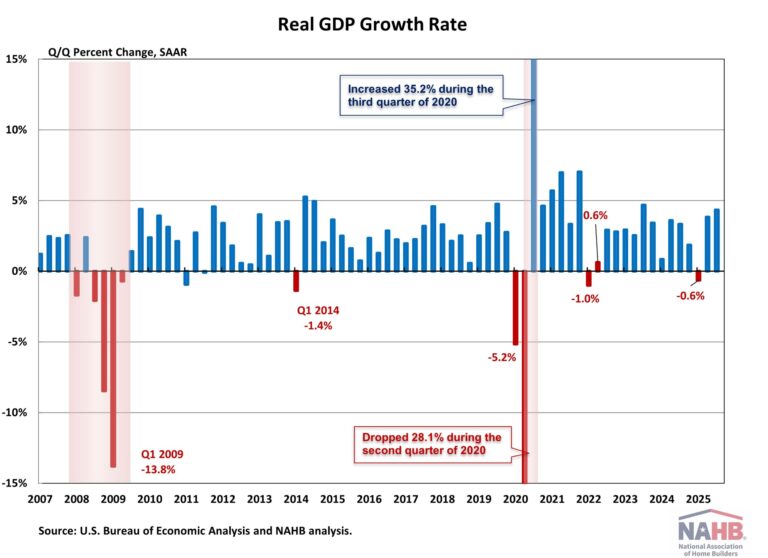
According to the “advance” estimate released by the Bureau of Economic Analysis (BEA), real gross domestic product (GDP) expanded at an annual rate of 4.3% in the third quarter of 2025, accelerating from a 3.5% increase in the second quarter. This marks the strongest pace of annual economic growth in the past two years. This growth rate was above the NAHB forecast for the quarter as well.

Furthermore, the latest data from the GDP report indicates that inflationary pressures intensified over the quarter. The GDP price index rose 3.8% for the third quarter, up from a 2.1% increase in the second quarter of 2025. The Personal Consumption Expenditures Price (PCE) Index, which measures inflation (or deflation) across various consumer expenses and reflects changes in consumer behavior, increased 2.8% during the quarter. This is higher than a 2.1% rise in the previous quarter.

This quarter’s increase in real GDP primarily reflected stronger consumer spending, exports, and government spending, which were partially offset by a decrease in investment. Imports, which are a subtraction in the calculation of GDP, decreased during the quarter as tariffs had measurable effects.

Consumer spending, the backbone of the U.S. economy, rose at an annual rate of 3.5% in the third quarter, its strongest rate since the fourth quarter of 2024. Both goods and services contributed to the gain, with spending on goods rising at a 3.1% annual rate and spending on services increasing 3.7%.

Government spending also added to economic growth, reflecting increases in both state and local government spending (led by higher consumption expenditures) as well as increased federal government spending, driven by defense consumption expenditures. 

Nonresidential fixed investment increased 2.8% in the third quarter. The increases in equipment (+5.4%) and intellectual property products (+5.4%) offset the decrease in structures (-6.3%). Meanwhile, residential fixed investment (RFI) continued to contract, declining 5.1% for the second consecutive quarter. Within the residential category, single-family structures fell 8.9% at an annual rate, multifamily structures declined 2.9%, and spending on home improvements dropped 7.6%.

For the common BEA terms and definitions, please access bea.gov/Help/Glossary.


This article was originally published by a eyeonhousing.org . Read the Original article here. .


As housing affordability remains a critical challenge across the country, mortgage rates continue to play a central role in shaping homebuying power. Mortgage rates stayed elevated throughout 2023 and early 2024. Recent data, however, shows a modest decline in mortgage rates. Even slight declines can have a significant impact on housing affordability, pricing more households back into the market. New NAHB Priced-Out Estimates show how home price increases affect housing affordability in 2025. This post presents details regarding how interest rates affect the number of households that can afford a median priced new home.

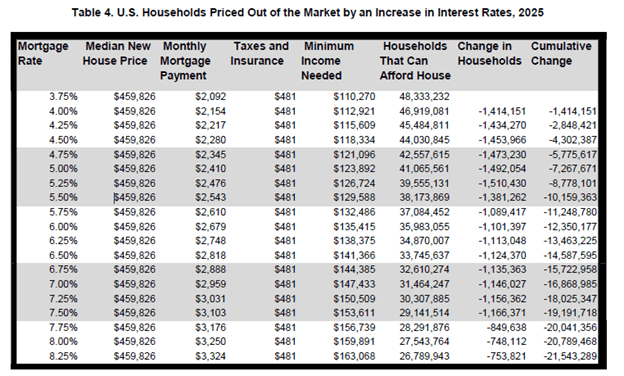
At the beginning of 2025, with the average 30-year fixed mortgage rate at 7%, around 31.5 million households could afford a median-priced home at $459,826. This requires a household income of $147,433 by the front-end underwriting standards[1]. In contrast, if the average mortgage rates had remained at the recent peak of 7.62% in October 2023, only 28.7 million households would have qualified. This 62-basis point decline has effectively priced 2.8 million additional households into the market, expanding homeownership opportunities.

The table below shows how affordability changes with each 25 basis-point increase in interest rates, from 3.75% to 8.25% for a median-priced home at $459,826. The minimum required income with a 3.75% mortgage rate is $110,270. In contrast, a mortgage rate of 8.25%, increases the required income to $163,068, pushing millions of households out of the market.

As rates climb higher, the priced-out effect diminishes. When interest rates increase from 6.5% to 6.75%, around 1.13 million households are priced out of the market, unable to meet the higher income threshold required to afford the increased monthly payments. However, an increase from 7.75% to 8% would squeeze about 850,000 households out of the market.

This exemplifies that when interest rates are relatively low, a 25 basis-point increase has a much larger impact. It is because it affects a broader portion of households in the middle of the income distribution. For example, if the mortgage interest rate decreases from 5.25% to 5%, around 1.5 million more households will qualify the mortgage for the new homes at the median price of $459,826. This indicates lower interest rates can unlock homeownership opportunities for a substantial number of households.

[1] . The sum of monthly payment, including the principal amount, loan interest, property tax, homeowners’ property and private mortgage insurance premiums (PITI), is no more than 28 percent of monthly gross household income.


This article was originally published by a eyeonhousing.org . Read the Original article here. .


Over the past 125 years, women have played a crucial and multifaceted role in the labor force. Increasing women’s participation in the workforce is not only essential for individual and family well-being, but also contributes significantly to overall labor force participation rates and economic growth by adding more workers and enhancing overall productivity1.   

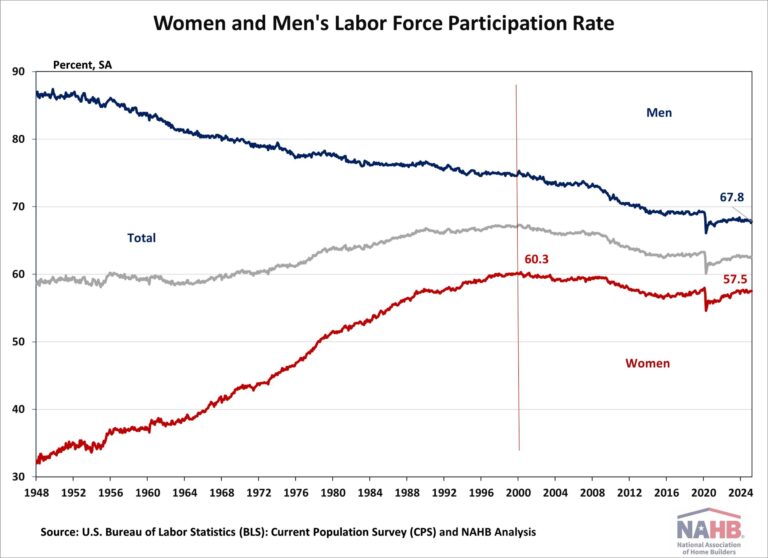
Historically, women’s labor force participation rate rose rapidly between 1948 and 2000, peaking around 60% in 1999. During the same period, men’s participation rates declined. However, since 2000, the growth in women’s labor force participation has flattened and then declined.

According to the March 2025 Employment Situation Summary reported by the Bureau of Labor Statistics (BLS), women’s labor force participation rate held steady at 57.5%, and women now represent nearly half (47%) of the total U.S. labor force.

Selected Categories

Prime-age women (ages 25-54) represent a significant and growing segment of the U.S. labor force. As of 2024, they accounted for nearly 30% of the civilian labor force, compared to 34% for prime-age men. According to the latest data from the Current Population Survey (CPS), prime-age women had a labor force participation rate of 78%, the highest among all female age groups. This rate has fully recovered from the COVID-19 pandemic, surpassing its previous peak recorded in February 2020.

As discussed in the previous blog, higher levels of educational attainment are strongly associated with higher labor force participation and lower unemployment. Women with a bachelor’s degree or higher have played a vital role in shaping the labor market. In 2024, about 70% of women with this level of educational attainment were active in the labor force, compared to only 34% of women who had not completed high school.

The CPS data also reveals notable differences in women’s labor force participation based on parental status.  Women with older children (ages 6 to 17) and no children under 6 years old had a higher labor force participation rate than those with younger children. Interestingly, women without children had a relatively lower labor force participation rate compared to those with children. Further research from the Brookings Institution and The Hamilton Project2 highlights a significant shift: women with young children (under 5 years), especially those who are highly educated, married, or foreign-born, are more likely to be in the labor force now than they were before the pandemic.

Women’s labor force participation also varies by race and ethnicity. Among women ages 16 and over, Black women had the highest participation rate at 61%, followed by Hispanic women (59%), Asian women (59%), and White women (57%).

The figure below reflects the diversity and complexity of women’s roles in the workforce.

Women in Industry

As more women enter the labor force, they are increasingly shaping a broad range of industries–from healthcare and education to leisure and hospitality, retail, technology, and construction.

In 1964, women were primarily employed in a narrower set of sectors. The top four industries employing the most women at that time were: manufacturing; trade, transportation, and utilities; local government; and education and health services3.

By 2024, however, women’s participation in the workforce has expanded significantly, both in scope and impact. According to the latest CPS data, women dominated the education and health services sector, where they hold approximately 27.6 million jobs. That means seven in every ten workers in this field are women. Moreover, women now make up more than half of the workforce in several other key industries, including other services, leisure and hospitality, and financial activities.

Despite their growing role in the workforce, they remain underrepresented in certain sectors, most notably, construction. Although women now make up a significant portion of the overall labor force, they account for just 11% of total employment in the construction industry. Of those, only 2.8% of women work in actual trade roles, while most women in the industry are employed in:

Office and administrative support

Management

Business

Financial operations

Gender Pay Gap by Occupation

While the gender pay gap in the U.S. has narrowed significantly over the past few decades, it remains a persistent issue in the labor market. According to a study4 by the Pew Research Center, women earned about 65 cents for every dollar earned by men in 1982. By 2023, that figure had risen to approximately 82 cents on the dollar—a clear sign of progress. However, the pace of change has slowed considerably in recent years.

In 2024, the CPS data shows that women working full time earned a median weekly wage of $1,043, compared to $1,261 for men. This means women earned 83 cents for every dollar earned by men—a 17% gender wage gap.

At the occupational level, women earn less than men across all major occupational groups, even ones dominated by women. The smallest gender pay gap was found in community and social services occupations. In contrast, occupations in legal, sales and related, protective services, and production display larger disparities in earnings between women and men.

The Future of Women in the Workforce

Looking ahead to 2033, the number of women in the labor force is expected to continue growing, driven primarily by the prime-age women (ages 25 to 54). BLS employment projections estimate that roughly 3.2 million prime-age women will join the workforce between 2023 and 2033. During this period, their participation rate is projected to increase slightly, reflecting continued momentum in women’s economic engagement.

Meanwhile, the U.S. labor market is experiencing a critical shortage of skilled workers, especially in fields like STEM (science, technology, engineering, and math) and skilled trades. As the NAHB Chief Economist stated, “The ultimate solution for the persistent, national labor shortage will be found…by recruiting, training and retaining skilled workers.” This applies equally to the women’s labor force.

Women’s participation is closely tied to their access to education and skills development. As more women pursue higher education and specialized training, their career opportunities expand, particularly in fields previously dominated by men. This progress can help narrow the gender pay gap over time.

However, women often shoulder disproportionate family and caregiving responsibilities, not only during their reproductive years, but throughout their lives. According to the American Time Use Survey (ATUS), on a typical weekday, prime-age working women spent about four hours on caregiving and household tasks, such as household activities, caring for and helping household members, and purchasing goods and services. This is nearly twice the time men spent on the same activities. Many women face a tough decision between career advancement and family caregiving responsibilities, often leading to reduced work hours or even complete withdrawal from the labor force.

To support and increase women’s labor force participation, it may be beneficial to consider a range of policies and workplace reforms. For example, promoting flexible work arrangements can help women better balance professional and personal responsibilities. Narrowing the gender pay gap would also play a critical role in ensuring fair compensation and financial security. Furthermore, expanding access to affordable and high-quality childcare could remove a major barrier for many working mothers. In addition, continued investment in education and training programs would enable women to advance in their careers and contribute to broader, long-term economic growth.

To conclude, empowering women to succeed in the workforce not only improves individual and family well-being, but also strengthens the entire economy.

Note:


This article was originally published by a eyeonhousing.org . Read the Original article here. .


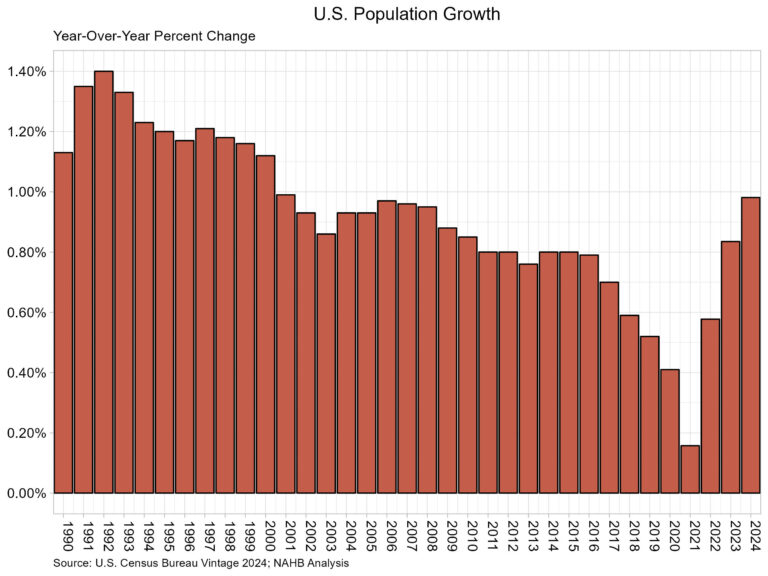
According to the U.S. Census Bureau’s latest estimates, the U.S. resident population grew by 3,304,757 to a total population of 340,110,988. The population grew at a rate of 0.98%, the highest rate since 0.99% in 2001. This also marked the third straight increase in the growth rate of the U.S. population. The vintage population estimates are released annually and represent the change in the U.S. population between July 1st of 2023 and 2024.

The Census Bureau reports that the primary source of population growth was net international migration (immigration), as international migration levels once again were higher than the previous year. The level of net international migration between 2023 and 2024 was 2,786,119. The second component of population growth is natural growth, which represents births minus deaths. Births totaled 3,605,563, down slightly from last year, while the number of deaths was reported at 3,086,925, also a decrease from last year. The natural growth, therefore, between 2023 and 2024 was 518,638.

Each region in the U.S. experienced population growth for the 2023-2024 period. The South led in population growth at 1.34% followed by the West at 0.85%. Meanwhile, the Midwest population grew 0.75%, while the Northeast grew the least at 0.59%.  

At the State level, 47 States and the District of Columbia had a population increase over the year. Of note, D.C. had the highest growth rate at 2.13%. Florida was second with population growth at 2.00% followed by Texas at 1.80%. Numerically, Texas experienced the largest population increase gaining 562,941. This was followed by Florida at 467,347 and California at 232,570.

Only three states lost population or remained level according to Census estimates. Vermont and West Virginia tied with a decline of 0.03%. Meanwhile Mississippi saw no population change.

California remained the most populous state by a healthy margin. California’s population was at 39,198,693, while the next most populous state was Texas at 31,290,831. To round out the top five States by total population the proceeding highest were Florida (23,372,215), New York (19,867,248), and Pennsylvania (13,078,751).


This article was originally published by a eyeonhousing.org . Read the Original article here. .


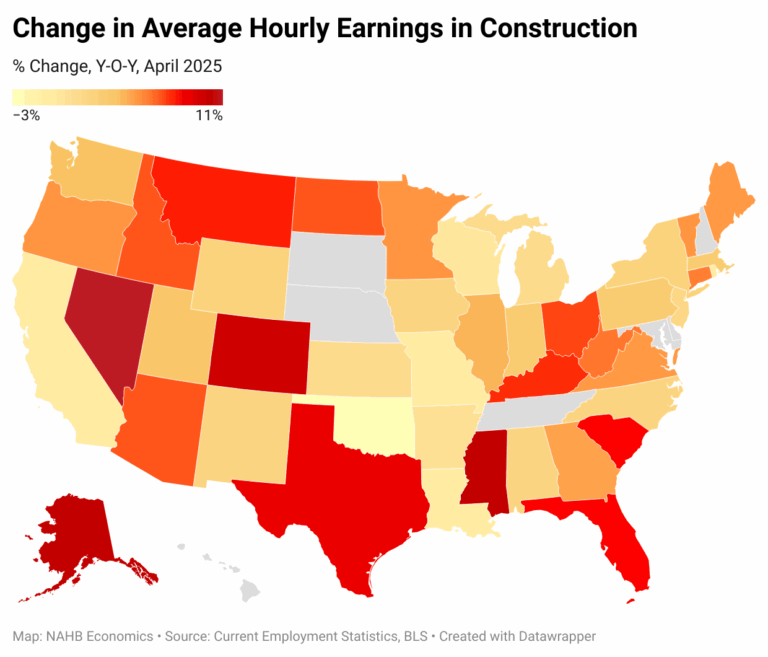
Wage growth in construction continued to decelerate in April on a national basis, but the differences across regional markets remain stark. Nationally, average hourly earnings (AHE) in construction increased 3.6% year-over-year and crossed the $39.3 mark when averaged across all payroll employees (non-seasonally adjusted, NSA). Meanwhile, average earnings in construction in Alaska and Massachusetts exceeded $50 per hour (NSA). Across states, the annual growth rate in AHE ranged from 10.6% in Nevada to a decline of 3% in Oklahoma. This is according to the latest Current Employment Statistics (CES) report from the Bureau of Labor Statistics (BLS).   

Average hourly earnings (AHE) in construction vary greatly across 43 states that report these data. Alaska, states along the Pacific coast, Illinois, Minnesota, and the majority of states in Northeast record the highest AHE. As of April 2025, fourteen states report average earnings (NSA) exceeding $40 per hour.

At the other end of the spectrum, nine states report NSA average hourly earnings in construction under $34. The states with the lowest AHE are mostly in the South, with Arkansas reporting the lowest rate of $29.3 per hour.

While differences in regional hourly rates reflect variation in the cost of living across states among other things, the faster growing wages are more likely to indicate specific labor markets that are particularly tight. Year-over-year, Nevada, Mississippi, Alaska, Colorado, Texas, Florida, South Carolina, and Montana reported fastest growing hourly wages in construction, more than doubling the national average growth of 3.6%. Nevada reported the largest annual increase of 10.6%, while the growth rate in Mississippi and Alaska was just under 10%.

In sharp contrast, Oklahoma registered a decline in hourly wages of 3%. Five other states reported modestly declining hourly rates in construction, compared to a year ago – Louisiana, Missouri, Rhode Island, California, and Wisconsin.


This article was originally published by a eyeonhousing.org . Read the Original article here. .


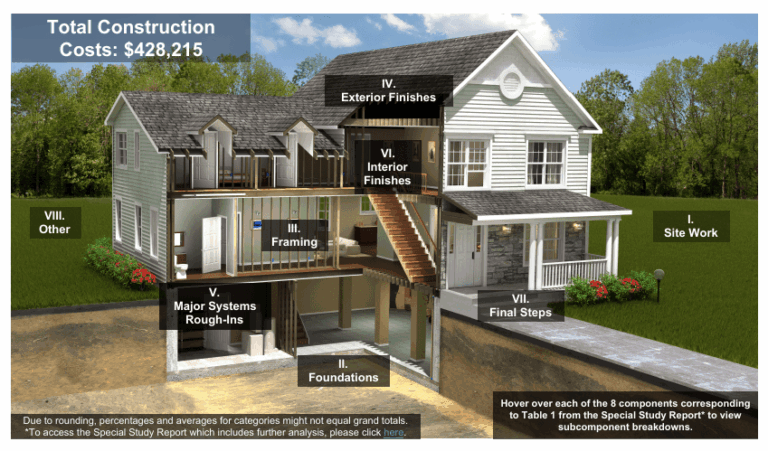
Construction costs account for 64.4% of the average price of a home, according to NAHB’s most recent Cost of Construction Survey.  In 2022, the share was 3.6 points lower, at 60.8%.  The latest finding marks a record high for construction costs since the inception of the series in 1998 and the fifth instance where construction costs represented over 60% of the total sales price.

The finished lot was the second largest cost at 13.7% of the sales price, down more than four percentage points from 17.8% in 2022.  The share of finished lot to the total sales price has fallen consecutively in the last three surveys, reaching a series low in 2024.

The average builder profit margin was 11.0% in 2024, up less than a percentage point from 10.1% in 2022.  

At 5.7% in 2024, overhead and general expenses rose when compared to 2022 (5.1%).  The remainder of the average home sale price consisted of sales commission (2.8%), financing costs (1.5%), and marketing costs (0.8%).  Marketing costs were essentially unchanged while sales commission and financing costs decreased compared to their 2022 breakdowns.

Construction costs were broken down into eight major stages of construction. Interior finishes, at 24.1%, accounted for the largest share of construction costs, followed by major system rough-ins (19.2%), framing (16.6%), exterior finishes (13.4%), foundations (10.5%), site work (7.6%), final steps (6.5%), and other costs (2.1%).

Explore the interactive dashboard below to view the costs and percentage of construction costs for the eight stages and their 36 components.

Table 1 shows the same results as the dashboard above in table format.  Please click here to be redirected to the full report (which includes historical results back to 1998).


This article was originally published by a
eyeonhousing.org . Read the Original article here. .


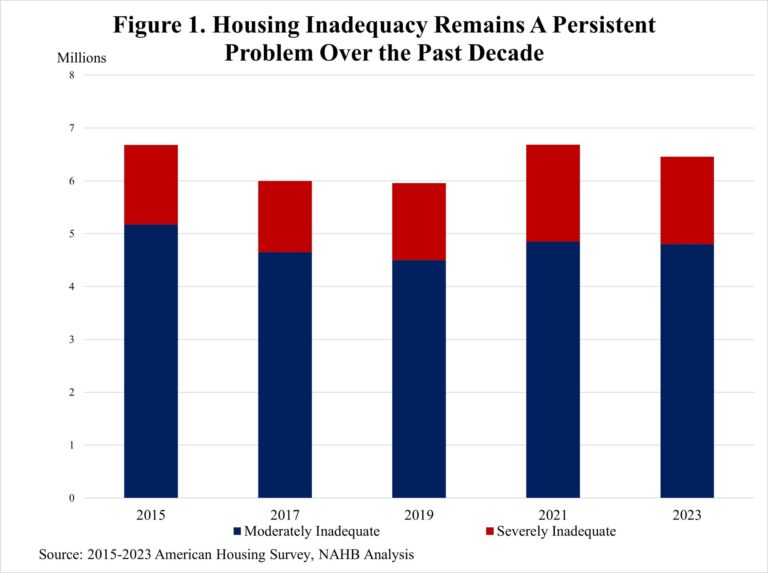
In 2023, nearly 6.45 million homes, around 5% of U.S housing stock, were classified as inadequate according to the American Housing Survey (AHS). Of these, 1.65 million homes were classified as severely inadequate, showing significant concerns over housing quality. While this reveals ongoing issues in nation’s housing conditions, it signals probable market growth for remodeling and home improvements in the year ahead.

The U.S. Department of Housing and Urban Development (HUD) defines physical adequacy based on whether a home meets the basic standard of “a decent home and a suitable living environment”. Homes are severely inadequate if they exhibit major deficiencies, such as exposed wiring, lack of electricity, missing hot or cold running water, or the absence of heating or cooling systems. Additionally, homes with at least five significant structural problems such as water leaks, large open cracks or holes in the floor also belong to this category.  Moderately inadequate homes have three or four significant structural issues, or have problems such as incomplete kitchen facilities, lack of vented heating equipment, or prolonged toilet breakdowns.

Housing inadequacy has remained a persistent issue over the past decade, shown in Figure 1.  In 2023, around 6.5 million households lived in moderately or severely inadequate housing. While the total number of inadequate homes declined slightly from 6.9 million in 2015 to 6.0 million in 2019, it rebounded to 6.7 million in 2021 and remained elevated in 2023.  The majority, around 4.8 million, of inadequate homes were moderately inadequate, while 1.65 million households lived in severely inadequate conditions in 2023.

The share of inadequate homes varies significantly by the age of the home (Figure 2). Older homes have higher rates of inadequacy. Homes built before 1940 have the highest inadequacy rate at 9%, followed by those built between 1940 and 1959 at 7%. While housing units from 1960 to 1979 show a moderate inadequacy rate of 5%, they account for the largest number of inadequate homes, with 1.2 million classified as moderately inadequate and 465,000 as severely inadequate in 2023. In contrast, newer homes (1980-Present) have lower inadequacy rates with the share steadily declining from 4% for homes built between 1980 and 1999 to 3% for those constructed from 2000 to the present.

Geographically, inadequate housing is most concentrated in smaller metro areas. Around 50.4% of moderately inadequate homes (2.4 million units) and 43.6% of severely inadequate homes (720,000 units) are in these areas in 2023. This trend is likely driven by aging housing stock and lower household income compared to major metro areas. However, major metro areas still have a substantial share of inadequate homes, with 29.7% of moderately inadequate (1.4 million) and 38.2% of severely inadequate units (631,000). Non-metro areas have the lowest total numbers, (953,000 moderately inadequate and 720,000 severely inadequate homes), though challenges persist.

In 2023, around 6.45 million households lived in inadequate housing, with more renters (3.5 million) than owners (2.8 million). Housing cost burdens varied greatly among these two groups: Among those households in inadequate homes, 1.9 million owners spent less than 30% of their income on housing, compared to 1.6 million renters. It suggests that many homeowners living in inadequate housing may indeed have the financial capacity to improve their housing conditions if they choose to do so. In contrast, renters in inadequate housing face greater financial constraints, with 1.1 million spending more than 50% of their income on housing, more than double the 480,000 cost-burdened owners. This disparity highlights the challenges renters are facing, including limited affordable housing options and a lack of control over property conditions.


This article was originally published by a eyeonhousing.org . Read the Original article here. .


Manufactured homes play a measurable role in the U.S. housing market by providing an affordable supply option for millions of households. According to the American Housing Survey (AHS), there are 7.2 million occupied manufactured homes in the U.S., representing 5.4% of total occupied housing and a source of affordable housing, in particular, for rural and lower income households.

Often thought of as synonymous to “mobile homes” or “trailers”, manufactured homes are a specific type of factory-built housing that adheres to the U.S. Department of Housing and Urban Development’s (HUD’s) Manufactured Home Construction and Safety Standards code. To qualify, a manufactured home must be a “movable dwelling, 8 feet or more wide and 40 feet or more long”, constructed on a permanent chassis.

The East South Central division (Alabama, Kentucky, Mississippi and Tennessee) have the highest concentration of manufactured homes, representing 9.3% of total occupied housing. The Mountain region follows with 8.5%, while the South Atlantic region holds 7.7%.

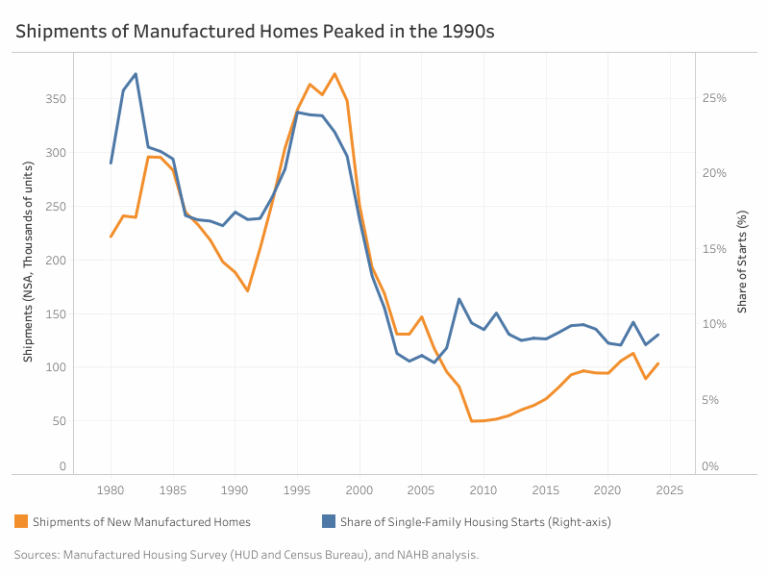
The 1990s saw a surge in manufactured home shipments, peaking in 1998. During this period, manufactured homes constituted 17% to 24% of new single-family homes.  However, shipments declined in the early 2000s, coinciding with a rapid increase in site-built housing construction leading up to the 2008 housing crisis. Since then, manufactured homes have stabilized at around 9% to 10% of new housing.

Characteristics of the 2023 Manufactured Home Stock

Given that most manufactured homes were produced in the 1990s, a significant portion of the existing manufactured home stock — approximately 72.2% — was built before 2000. Consequently, 7.7% of these homes are classified as inadequate compared to 5% of all homes nationwide. About 2% are considered severely inadequate and exhibit “major deficiencies, such as exposed wiring, lack of electricity, missing hot or cold running water, or the absence of heating or cooling systems”. However, with proper maintenance, manufactured homes can be as durable as site-built homes.

Currently, 57% of the occupied manufactured homes stock are single-section units, while 43% are multi-sections, according to the AHS. Single-section homes are manufactured homes that can be transported from factory to placement in a single piece while multi-sections are transported in multiple pieces and are joined on site. However, data from the Census show that newer shipments indicate a shift toward multi-section homes.

Most single-section homes are less than 1,000 square feet and contain five total rooms in the house — typically two bedrooms and three bathrooms. In contrast, multi-section homes usually range from 1,000 to 2,000 square feet and have six rooms, comprising three bedrooms and three bathrooms.

Demographics of Manufactured Homes Residents

Manufactured homes serve as a crucial housing option, particularly for those living in rural or non-metro areas. AHS data highlight a stark contrast between the locations of single-family and manufactured home residents. While most manufactured home residents (53%) live in rural areas, single-family residents are mostly concentrated (67%) in urbanized areas — defined as territories with a population of 50,000 or more. In comparison, only 33% of manufactured home residents reside in urbanized areas. Residents of both manufactured and single-family homes are less common in urban clusters — areas with populations between 2,500 and 50,000 — comprising just 13% and 9%, respectively.

The median age of a manufactured home householder is 55, the same as single-family householders. However, most manufactured home householders (37.8%) have an education attainment level of high school completion compared to single-family householders whose largest group (24.8%) have completed a bachelor’s degree.

Income disparities are also significant. The median household income for manufactured home residents is $40,000, far below the $85,000 median income for single-family householders. The gap widens among homeowners, with manufactured homeowners earning a median of $41,500 versus $93,000 for single-family homeowners.

Household CharacteristicManufactured Homes HouseholdSingle-Family HouseholdAge (Median)5555Majority Education Attainment LevelHigh school or equivalency (37.8%)Bachelor’s degree (24.8%)Annual Household Income (Median)$40,000$85,000Annual Household Income of Homeowners (Median)$41,500$93,000Sources: 2023 American Housing Survey (AHS) and NAHB analysis.

Cost of Buying and Owning Manufactured Homes

One of the key advantages of manufactured homes is affordability. The average cost per square foot for a new manufactured home in 2023 was $86.62, compared to $165.94 for a site-built home (excluding land costs) — a difference of $79.32 per square foot. This difference in cost has only grown over the decade from $51.84 per square foot in 2014. For a 1,500-square-foot home, this translates to a savings of approximately $118,980, and this savings has grown despite the average cost of manufactured homes increasing at a higher growth rate of 7.4% CAGR versus 6.1% CAGR for new single-family homes.

Owning a manufactured home is also more affordable in total housing cost, which includes mortgage payments, insurance, taxes, utilities and lot rent. According to the AHS, owners of a single-section manufactured home have a median total monthly housing cost of $563, while the cost for a multi-section home is $805. In contrast, the median monthly cost of owning a single-family home is $1,410.

Despite the lower costs associated with manufactured homes, affordability remains a challenge for many owners. Among single-section manufactured homeowners, 36.6% are considered cost-burdened, meaning they spend 30% or more of their income on housing. This is slightly higher than the 28.4% of multi-section manufactured homeowners and the 27.6% of single-family homeowners facing similar financial strain. This disparity underscores the reality that even though manufactured homes are a more affordable option, lower-income households are still disproportionately burdened by housing costs.

Manufactured Home Pricing

Data on manufactured home appreciation is limited. However, the Federal Housing Finance Agency (FHFA) publishes a quarterly house price index for manufactured homes. Comparing the indices for manufactured and site-built homes, manufactured homes have closely followed the appreciation trends of their site-built counterparts. Between the first quarter of 2000 and the last quarter of 2024, the index value for manufactured homes increased by a cumulative 203.7%, slightly surpassing the 200.2% increase for site-built homes. This indicates that the manufactured home markets face much of the same demand opportunities and supply challenges of the broader housing market.

It is important to note that this data reflects only manufactured homes financed through conventional mortgages as real property, acquired by Fannie Mae and Freddie Mac (the Enterprises). In contrast, the majority of new manufactured homes are titled as personal property, which is not eligible for conventional mortgage financing because the Enterprises do not acquire chattel loans. Nonetheless, it is common for manufactured homes to be placed on private land even though the unit is under a personal property title — a title that applies to movable assets, such as vehicles, tools or equipment, and furniture, whereas a real estate property title includes land and any structures permanently attached to it.

Despite this distinction, there has been a steady increase in the share of manufactured homes titled as real estate. Since 2014, the percentage of real estate-titled manufactured homes has grown from 13% to 20% in 2023, indicating a positive trend toward greater financial recognition and stability for these homes.

Zoning Restrictions and the Future of Manufactured Homes

Manufactured homes provide a cost-effective housing solution, particularly in rural areas where the transportation and material costs for site-built homes can be significantly higher. However, restrictive zoning laws often limit their placement in urban areas. Regulations such as bans on manufactured home communities and large lot size requirements can substantially increase costs, making it difficult to establish manufactured housing in cities. Reducing these zoning barriers could not only expand affordable housing options in high-cost urban areas but also improve access to essential services such as healthcare and economic opportunities for lower-income communities.

A successful example of zoning reform comes from Jackson, Mississippi, where city officials partnered with the Mississippi Manufactured Housing Association (MMHA) to launch a pilot program highlighting the potential of prefabricated and manufactured homes as affordable housing solutions. As part of the initiative, the city revised its zoning regulations to distinguish manufactured and modular housing from pre-1976 “mobile homes,” which had long been banned. Previously, manufactured homes were classified under the same category, restricting their placement. The new ordinance now permits manufactured housing within city limits, albeit with a discretionary use permit, paving the way for greater affordability and accessibility in urban housing.

Conclusion

Manufactured homes make up only 5% of the total housing stock but provide an alternative form of housing that meets the needs of various households, particularly in rural areas. Although they offer a lower-cost option compared with site-built homes, factors such as an aging housing stock, financing limitations and zoning restrictions could influence their accessibility and long-term viability.

Trends such as the increasing prevalence of multi-section homes and a growing share of units titled as real estate suggest a gradual shift in consumer preferences toward housing options that more closely resemble site-built homes in size, functionality and financing. As housing affordability remains a key concern, manufactured homes continue to play a role as an affordable supply in the broader housing landscape, and expanding their use through education, innovation and zoning reform could improve access to cost-effective housing.

Footnotes:


This article was originally published by a eyeonhousing.org . Read the Original article here. .


Despite historically low self-employment rates and the rising market share of top ten builders, residential construction remains an industry dominated by independent entrepreneurs, with nearly 80% of home builders and specialty trade contractor firms being self-employed independent contractors. Even among firms with paid employees, the industry continues to be dominated by small businesses, with 63% of homebuilders and two out of three specialty trade contractors generating less than one million dollars in total business receipts. The new estimates are based on the 2022 Economic Census and Nonemployer Statistics data.

The Economic Census covers several construction subsectors within the home building industry:

 Residential Building Construction (RBC)

Single-family general contractors (excluding for-sale builders)

Multifamily general contractors (excluding for-sale builders)

For-sale new housing builders

Residential remodelers

Land Subdivision (or land developers)

Specialty Trade Contractors (STC)

The 2022 statistics show that the majority of residential construction businesses are self-employed independent contractors.  There are over 813,000 nonemployer firms in residential building construction (RBC), accounting for close to 80% of all establishments. In land subdivision, more than 9,000 independent contractors account for 68% of land subdivision firms.  Over 1.9 million specialty trade independent contractors make up 79% of all STC establishments. These nonemployer firms also account for almost half of the full-time employees (FTE) in residential building construction, 26% in land subdivision, and 28% in STC. 

Most of these self-employed mom-and-pop firms are very small, with annual receipts averaging under $103,000 for residential building construction, and under $70,000 for specialty trade contractors. Self-employed independent contractors in land subdivision average around $288,000 in annual business receipts. As a result, these nonemployer firms make up only 12% of all sales and receipts generated by residential building construction and land subdivision, and 9% of specialty trade contractors’ revenue.

Among residential construction businesses with paid employees, remodeling, land subdivision, and specialty trade subcontractors (STC) companies tend to be smaller.  Three out of four remodeling establishments, 63% of land developers, and 59% of STC companies generate under $1 million in receipts.  

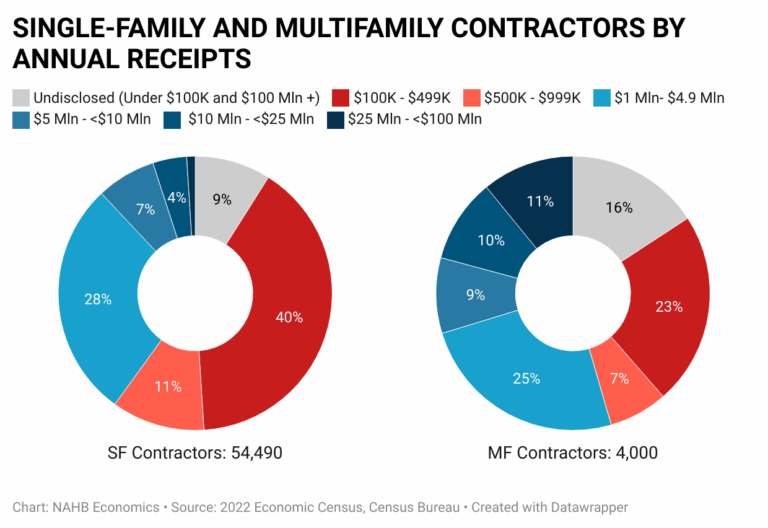
Home builders are typically somewhat larger, with about 45% of companies reporting annual sales over $1 million. Among homebuilders, multifamily general contractors tend to be the largest. However, the Census Bureau did not disclose the number of the largest (with revenue over $100 million) and smallest (with revenue under $100K) multifamily and single-family custom builders in 2022. As a result, the revenue spectrum for MF and SF contractors is incomplete and is presented in a separate chart. 

Multifamily contractors are typically larger compared to single-family contractors and for-sale builders (who build on land they own and control). Ten percent of multifamily contractors reported annual sales between $10 million and 25 million, and an additional 11% earned between $25 million and $100 million in 2022.  

Under the most recent U.S. Small Business Administration (SBA) size standards, the vast majority of residential construction companies qualify as small businesses. The most recent small business size limits for all types of builders are $45 million, $34 million for land subdivision, and $19 million for specialty trade contractors. By these standards, almost all remodelers and single-family contractors, and at least 98% of land developers, and 96% of specialty trade contractors, easily qualify as small businesses. 


This article was originally published by a eyeonhousing.org . Read the Original article here. .

Pin It