This article was originally published by a www.houzz.com . Read the Original article here. .
This article was originally published by a www.houzz.com . Read the Original article here. .
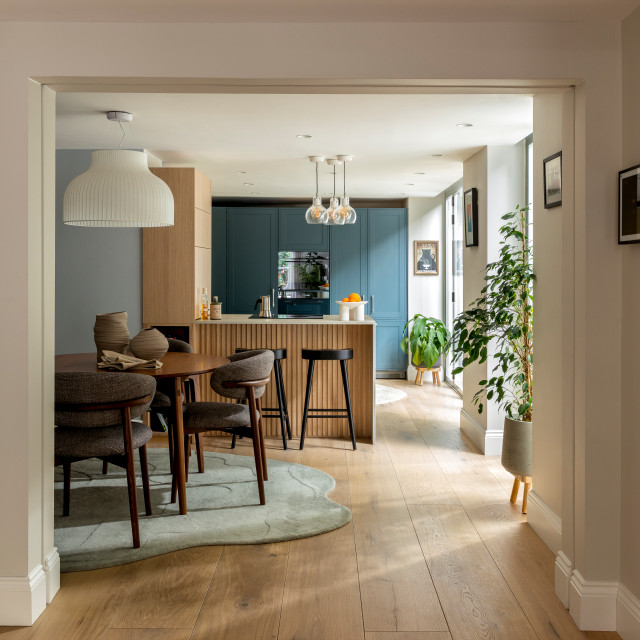
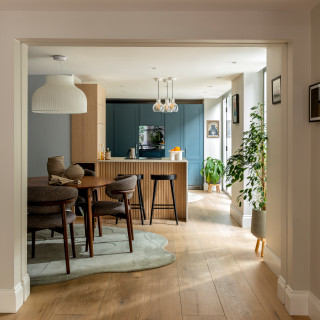
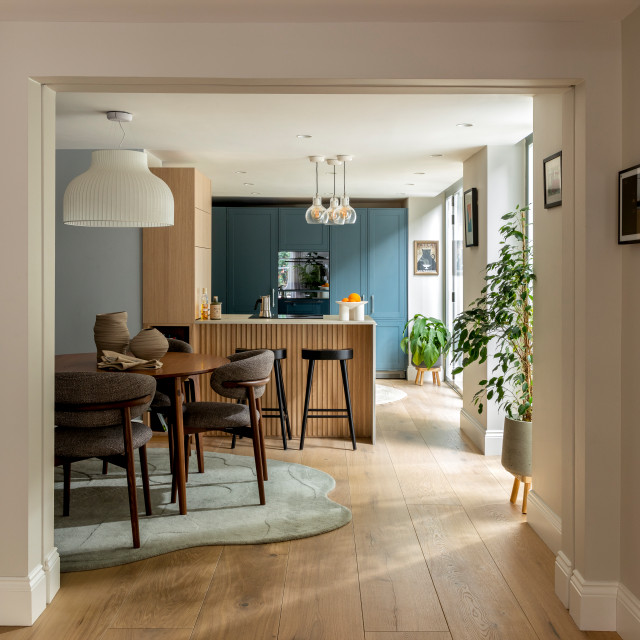
A soft pendant lamp over the table provides a warm glow in the evening.
The team used Houzz Pro tools to share the design with their clients, as well as the products they specified.
“We use Houzz to manage all our projects and, in particular, the Selections boards, where clients can see all the items we’ve proposed,” Matthews says.
The Selections boards allow professionals to present items they’re considering for the project in a simple format that helps clients feel in control. They can see an image of each product and all of the information at a glance, then quickly press Approve or Decline.
Wall paint: Slate ll and Lead IV, both Paint & Paper Library
See why you should hire a professional who uses Houzz Pro software
This article was originally published by a www.houzz.com . Read the Original article here. .

A lawn and garden care service can take care of mowing, to be sure, but even if you prefer to cut your own grass, there may be some tasks worth hiring a pro to take care of. A gardener can help set up and maintain a drip irrigation and sprinkler system, trim hedges, prune rosebushes, and even handle seasonal leaf and snow removal. Or you may want to look for a gardener who designs gardens from scratch or has a specialty, like creating drought-tolerant landscapes or edible gardens.
Not sure where to start on your home project? Learn the basics
This article was originally published by a www.houzz.com . Read the Original article here. .
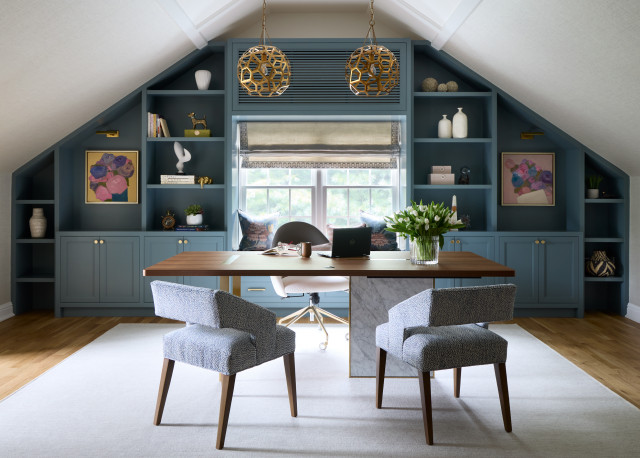
Designer: Mark Ciano Home
Location: Westport, Connecticut
Homeowner’s request. “My client approached me with a vision to transform her third-floor storage and kids play space into a stunning but functional home office suite,” designer Mark Ciano says. “Her vision was a multipurpose space that not only represented her style and looked fantastic but also solved many of her home office needs, including a sitting area for informal meetings, a desk area with tons of storage and a window seat she could take calls on and look at the treetops.”
Built-in storage. “I designed a full wall of built-in cabinetry, including closed storage below for supplies and any other typical office items and open shelves above for decorative items and books and panels to hang art,” Ciano says. “The built-in unit was painted just the right tone of blue, Farrow and Ball De Nimes, a muted midtones blue that denotes tranquillity. Printer space is hidden inside the built-ins, and all computer laptop cords run through the top of the desk and are neatly tacked behind the leg of the desk.”
Other special features. The desk is walnut and marble. “The walls are wallpapered in Cowtan & Tout Tabor in a neutral weave to create a layered texture but not close in the space or hit you in the face with color,” Ciano says. “We commissioned two pieces of art that sit in the built-ins behind the desk area off to the sides. My client’s dear friend is an artist on the West Coast and I worked with her on the concept, color and execution of the pieces. The lighting details were quite important. Instead of a desk lamp or recessed spots, I opted for hanging pendants over the desk.
“To separate the space and create a divider between the sitting area and desk area, I designed open custom shelving units that followed the slope of the ceiling. It creates a separation but doesn’t close spaces in. The divider bookcases are in rift-cut oak and stained with a medium-toned walnut finish. A full coffee station with refrigeration was a must because of the time she spends working.”
Designer tip. “People spend so many hours at their desk these days, I wanted my client to have a cozy window seat with treetop views if she’s reviewing contracts or just needs to take a few minutes’ break between Zoom calls,” Ciano says.
Desk: Rove Concepts; commissioned art: Reggie Stone
Find a local interior designer on Houzz
This article was originally published by a www.houzz.com . Read the Original article here. .
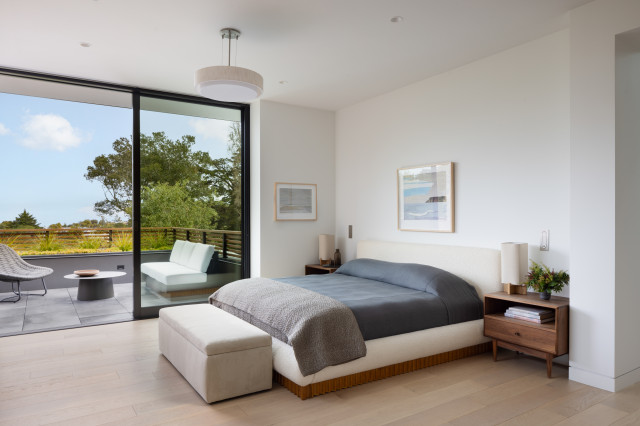

When you hear the word “retreat,” what comes to mind — writing in a cabin by a lonesome lake, engaging in spiritual study or practicing yoga on the beach? How about doing a retreat in your own home? It may at first seem like an improbable idea (although that yoga-on-the-beach thing sounds pretty good), but there are some surprising positives to crafting your own retreat at home. For one thing, it’s free. For another, you can decide exactly the sort of activities you want to focus on, including things that may not be combined in most retreats (novel writing and cupcake baking, anyone?). Check out these 10 steps to designing your own retreat in the comfort of your home.
Are you craving a spiritual retreat? Time to work on your craft, write, do yoga or meditate? Make a short list of the things you want to incorporate into your retreat so you can start planning.
Need a pro for your custom home project?
Let Houzz find the best pros for you
If you live with others, and especially if you have children, going on a retreat at home can be a challenge. Try to plan the retreat for a time when your family or housemates will be away, particularly during the day. At the very least, try to get everyone to agree to respect what you are doing. This includes not speaking to you too much if you decide to maintain silence (see No. 8) during your retreat. If you have children, it can be worthwhile to do a shorter (even a one-day) retreat when you know the kids will be out of the house.
An intention is different from a goal. A goal might be, “I will meditate two hours each day,” whereas an intention could be, “I will be mindful and appreciate each moment.”
To set an intention for your retreat, answer these two questions:
What do you hope to gain from your retreat?
What do you hope your experience will be?Setting intentions before your retreat can help keep you focused on the experience you want to have.
Retreats you travel to, no matter what the focus, tend to offer fresh, healthful food — so try to offer yourself the same. Get the main work out of the way before your retreat begins, so you can focus on the good stuff.
Depending on what sort of activities you will be focusing on, you may want to pick up books, instructional videos, craft supplies, notebooks and pens, a yoga mat or meditation cushions.
6. Create a Schedule
Any proper retreat has a schedule mapped out in advance, and there’s no reason you can’t do the same. Decide what time you would like to rise, eat, work on your project, read, have downtime and go to sleep each day. Of course, the beauty of having an at-home retreat is that you are free to leave your schedule as open or as structured as you like.
There’s no need to go overboard cleaning and scrubbing, but beginning your retreat in a neat, clean home will help set a positive tone. Plan to spend a few hours getting rid of clutter and cleaning up before you begin your retreat.
Pay special attention to clearing away clutter and electronic devices in the bedroom so you can sleep restfully. And elsewhere in the house, put away anything that reminds you of work or things you may be feeling stressed about.
Consider going without speaking during some or all of your retreat — you may be surprised how refreshing it can feel to get a break from constant chatter.
Of course, the more people in your household, the more difficult it will be. Perhaps someone else would like to participate in silence with you, or you can enjoy a silent break during the times you have the house to yourself. And, of course, talk if you really need to!
10 Tips for a More Peaceful Home
If there is one thing that seems to be a given at a retreat, it’s that you disconnect your devices. No going online and no checking your phone or tablet. If you are used to being on your devices frequently, it can be hard to do, but it’s worth trying!
In addition to what you might be used to seeing online, consider taking a break from the things you usually read. Be intentional about the material you choose to read or watch during your retreat. If you want to read a book or watch a film, pick one that meshes with the intention you set for the retreat.
This article was originally published by a www.houzz.com . Read the Original article here. .

Challenging affordability conditions, elevated interest rates and economic uncertainty continue to act as headwinds on the housing sector as many potential buyers continue to stay on the sidelines.
Sales of newly built single-family homes edged 0.6% higher in June, rising to a seasonally adjusted annual rate of 627,000, according to newly released data from the U.S. Department of Housing and Urban Development and the U.S. Census Bureau. This marks a 0.6% increase from May’s unrevised figures. However, this is 6.6% below the June 2024 level. June new home sales are down 4.3% on a year-to-date basis. The past two months have been the slowest sales pace since October of last year, as mortgage rates averaged above 6.8% in June.
A new home sale occurs when a sales contract is signed, or a deposit is accepted. The home can be at any stage of construction: not yet started, under construction or completed. In addition to adjusting for seasonal effects, the June reading of 627,000 units is the number of homes that would sell if this pace continued for the next 12 months.
New single-family home inventory continued to rise with 511,000 residences marketed for sale as of June. This is 1.2% higher than the previous month, and 8.5% higher than a year ago. At the current sales pace, the months’ supply for new homes remained elevated at 9.8 compared to 8.4 a year ago. A measure near a six months’ supply is considered balanced.
As expected, the combined new and existing total months’ supply has risen over the last few months to a balanced 5.4 months due to continued buyer hesitation in both new and existing home sales markets. Elevated mortgage rates and sustained price levels continue to limit purchasing power, particularly among first-time and middle-income buyers.
A year ago, there were 94,000 completed, ready-to-occupy homes available for sale (not seasonally adjusted). By the end of June 2025, that number increased 21.3% to 114,000. However, completed, ready-to-occupy inventory remains just 22% of total inventory, while homes under construction account for 54%. The remaining 24% of new homes sold in June were homes that had not started construction when the sales contract was signed.
The median new home sale price edged down 4.9% in June to $401,800. This is down 2.9% compared to a year ago. In terms of affordability, the share of entry-level homes priced below $300,000 has been steadily falling in recent years. Only 14% of the homes were priced in this entry-level affordable range, while 28% of the homes were priced above $500,000. Most of the homes were priced between $300,000-$500,000.
Regionally, on a year-to-date basis, new home sales are down in all four regions, falling 1.6% in the South, 4.0% in the West, 8.5% in the Midwest, and 25.6% in the Northeast.
Discover more from Eye On Housing
Subscribe to get the latest posts sent to your email.
This article was originally published by a eyeonhousing.org . Read the Original article here. .
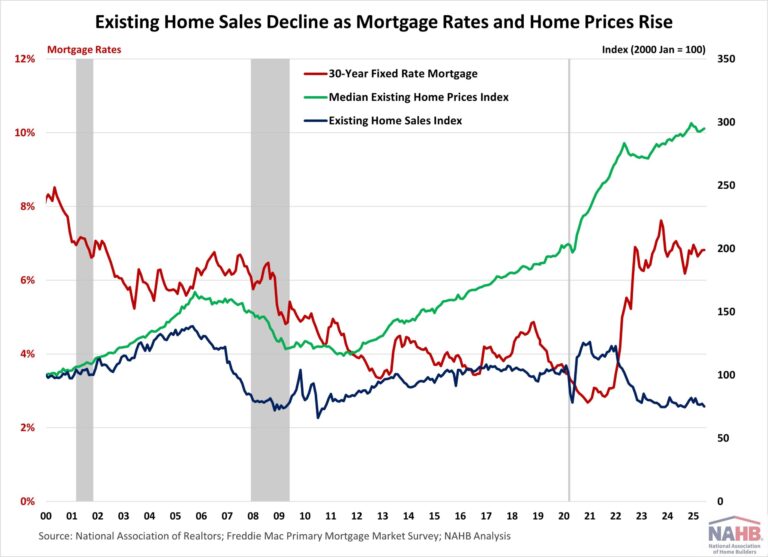
Existing home sales fell to 9-month low in June as home prices hit another monthly record high, according to the National Association of Realtors (NAR). Sluggish pace of sales suggest that higher mortgage rates and elevated home prices are continuing to sideline buyers, despite improved inventory conditions.
Mortgage rates have hovered between 6.5% and 7% due to ongoing economic and tariff uncertainty this year, prompting the Fed to pause interest rate cuts. With mortgage rates expected to stay above 6% for longer due to an anticipated slower easing pace in 2025, these prolonged higher rates and high home prices would continue to weigh on the market. As such, sales are likely to remain limited in the coming months.
Total existing home sales, including single-family homes, townhomes, condominiums, and co-ops, fell 2.7% to a seasonally adjusted annual rate of 3.93 million in June, the lowest level since October 2024. On a year-over-year basis, sales were unchanged from a year ago.
The existing home inventory level was 1.53 million units in June, down 0.6% from May, but up 15.9% from a year ago. At the current sales rate, June unsold inventory sits at a 4.7-months’ supply, up from 4.6-months in May and 4.0-months in June 2024. Inventory between 4.5 to 6 month’s supply is generally considered a balanced market.
Homes stayed on the market for a median of 27 days in June, unchanged from May but up from 22 days in June 2024.
The first-time buyer share was 30% in June, unchanged from May but up 29% from a year ago.
The June all-cash sales share was 29% of transactions, up from 27% in May and 28% a year ago. All-cash buyers are less affected by changes in interest rates.
The June median sales price of all existing homes was $453,300, up 2.0% from last year. This marked an all-time high for the month of June and the 24th consecutive month of year-over-year increases. The median condominium/co-op price in June was up 0.8% from a year ago at $374,500. Recent gains for home inventory will put downward pressure on resale home prices in most markets in 2025.
Geographically, three of the four regions experienced a decline in existing home sales in June, with a decrease of 2.2% in the South, 4.0% in the Midwest, and 8.0% in the Northeast. Meanwhile, sales in the West rose 1.4%. On a year-over-year basis, sales were up in the Midwest (2.2%) and the South (1.7%) but were down in the West (-4.1%) and the Northeast (-4.2%).
The Pending Home Sales Index (PHSI) is a forward-looking indicator based on signed contracts. The PHSI rose from 71.3 to 72.6 in May, suggesting a solid labor market is supporting the market despite the elevated mortgage rates. On a year-over-year basis, pending sales were 1.1% higher than a year ago, per National Association of Realtors data.
Discover more from Eye On Housing
Subscribe to get the latest posts sent to your email.
This article was originally published by a eyeonhousing.org . Read the Original article here. .

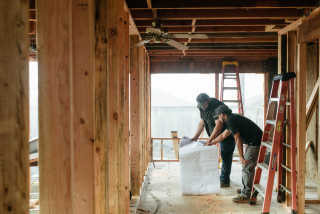
The just-released report reveals that the vast majority of firms across the industry expect these factors to negatively impact business in Q3. This is consistent with reduced optimism industrywide as business activity slows, though more pros still expect business performance to improve overall this quarter than anticipate a decline.
Here are more insights into construction and design businesses’ outlooks in the face of ongoing economic uncertainty.
This article was originally published by a www.houzz.com . Read the Original article here. .
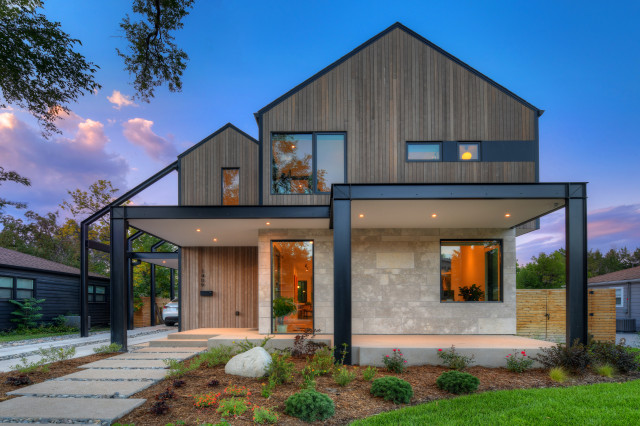
The recently released Barometer report provides timely insights into the residential renovation industry, including expectations, project backlogs and recent activity among businesses in the construction sector and the architectural and design services sector.
“Expectations have become increasingly cautious among construction and design professionals as they navigate ongoing economic challenges and reduced business activity,” Houzz staff economist Marine Sargsyan says. “That said, stable backlogs and gradual adjustments in response to market conditions indicate some resilience. Most are hopeful for improved momentum through the second half of the year.”
This article was originally published by a www.houzz.com . Read the Original article here. .
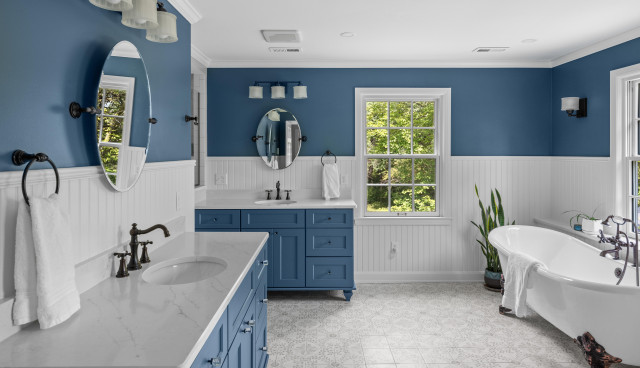
The transformation includes two vanities, a freestanding claw-foot tub, a walk-in shower and a water closet — all in a welcoming blue-and-white palette with classic details that honor the home’s roots. The update also added a walk-in closet and an adjacent laundry room, creating a highly functional layout tailored for comfort and ease.
This article was originally published by a www.houzz.com . Read the Original article here. .
A soft pendant lamp over the table provides a warm glow in the evening.
The team used Houzz Pro tools to share the design with their clients, as well as the products they specified.
“We use Houzz to manage all our projects and, in particular, the Selections boards, where clients can see all the items we’ve proposed,” Matthews says.
The Selections boards allow professionals to present items they’re considering for the project in a simple format that helps clients feel in control. They can see an image of each product and all of the information at a glance, then quickly press Approve or Decline.
Wall paint: Slate ll and Lead IV, both Paint & Paper Library
See why you should hire a professional who uses Houzz Pro software