Tag

home sales and prices

Browsing


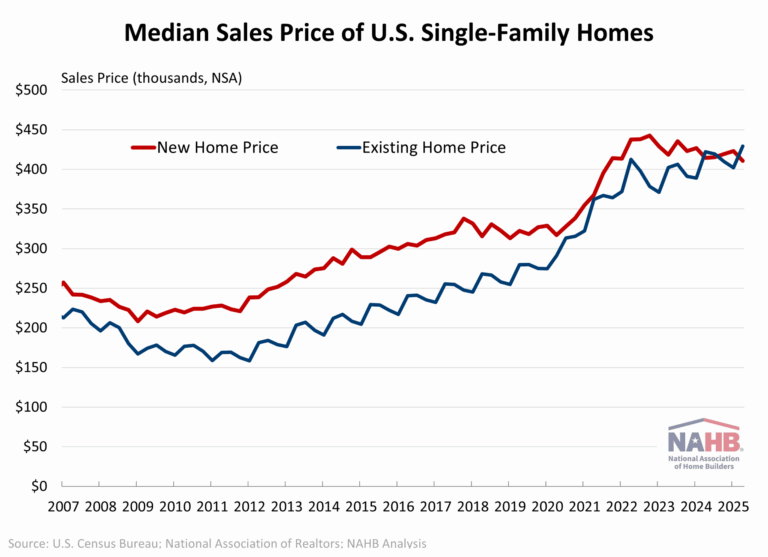
In the second quarter of 2025, the median price for a new single-family home was $410,800, which was $18,600 lower than the median price of existing homes, which stood at $429,400. This marks the largest historical gap where existing home prices exceeded those of new homes, according to U.S. Census Bureau and National Association of Realtors data (not seasonally adjusted – NSA) 

Typically, new homes carry a price premium over existing homes. From 2010 to 2019, this pattern held steady, with an average difference of $66,000. However, over the past five years, the gap has narrowed significantly, averaging just $24,800. Notably, this trend reversed in 2024. In both the second and third quarters, the median price of existing homes surpassed that of new homes. 

Both new and existing homes saw dramatic increases in prices post-pandemic due to higher construction costs and limited supply. While overall home prices remain elevated compared to historical norms, new homes prices have moderated due to tactical builder business decisions, whereas existing homes prices continue to increase because of lean supply and perhaps a lack of price discovery for existing homeowners. 

Indeed, the median price for a new single-family home sold in the second quarter of 2025 decreased 0.9% from the previous year. New home prices have continued to experience year-over-year declines for nine consecutive quarters.  

Meanwhile, the median price for existing single-family homes increased 1.7% from one year ago. Existing home prices have continued to experience year-over-year increases for eight consecutive quarters. 

There are several factors as to why new and existing homes are selling at similar price points. Tight inventory continues to push up prices for existing homes, as many homeowners who secured low mortgage rates during the pandemic are hesitant to sell due to current high interest rates.  

Meanwhile, new home pricing is more volatile – prices change due to the types and locations of homes being built. Despite various challenges facing the industry, home builders are adapting to affordability challenges by building on smaller lots, constructing smaller homes, and offering incentives. Additionally, there has been a shift in home building toward the South, associated with less expensive homes because of policy effects.  

Moreover, the least expensive region for new homes in the first quarter was the South, with a median price of $372,100. The Midwest followed closely behind at $385,300. For existing homes, the Midwest was the most affordably region at $328,800, followed by the South at $376,300. 

New homes were most expensive in the Northeast with a median price of $796,700, while the West sold at $531,100. For existing homes, the West led as the most expensive region at $646,100 homes, followed by Northeast at $646,100.  

The new home price premium was most pronounced in the Northeast, where new homes sold for $269,500 more than existing homes. The West and South followed the national trend, with existing homes priced $4,200 more than new homes in the West and $115,000 more in the South. 

Discover more from Eye On Housing

Subscribe to get the latest posts sent to your email.


This article was originally published by a eyeonhousing.org . Read the Original article here. .


Challenging affordability conditions, elevated interest rates and economic uncertainty continue to act as headwinds on the housing sector as many potential buyers continue to stay on the sidelines.

Sales of newly built single-family homes edged 0.6% higher in June, rising to a seasonally adjusted annual rate of 627,000, according to newly released data from the U.S. Department of Housing and Urban Development and the U.S. Census Bureau. This marks a 0.6% increase from May’s unrevised figures. However, this is 6.6% below the June 2024 level. June new home sales are down 4.3% on a year-to-date basis. The past two months have been the slowest sales pace since October of last year, as mortgage rates averaged above 6.8% in June.

A new home sale occurs when a sales contract is signed, or a deposit is accepted. The home can be at any stage of construction: not yet started, under construction or completed. In addition to adjusting for seasonal effects, the June reading of 627,000 units is the number of homes that would sell if this pace continued for the next 12 months.

New single-family home inventory continued to rise with 511,000 residences marketed for sale as of June. This is 1.2% higher than the previous month, and 8.5% higher than a year ago. At the current sales pace, the months’ supply for new homes remained elevated at 9.8 compared to 8.4 a year ago. A measure near a six months’ supply is considered balanced.

As expected, the combined new and existing total months’ supply has risen over the last few months to a balanced 5.4 months due to continued buyer hesitation in both new and existing home sales markets. Elevated mortgage rates and sustained price levels continue to limit purchasing power, particularly among first-time and middle-income buyers.

A year ago, there were 94,000 completed, ready-to-occupy homes available for sale (not seasonally adjusted). By the end of June 2025, that number increased 21.3% to 114,000. However, completed, ready-to-occupy inventory remains just 22% of total inventory, while homes under construction account for 54%. The remaining 24% of new homes sold in June were homes that had not started construction when the sales contract was signed.

The median new home sale price edged down 4.9% in June to $401,800. This is down 2.9% compared to a year ago. In terms of affordability, the share of entry-level homes priced below $300,000 has been steadily falling in recent years. Only 14% of the homes were priced in this entry-level affordable range, while 28% of the homes were priced above $500,000. Most of the homes were priced between $300,000-$500,000.

Regionally, on a year-to-date basis, new home sales are down in all four regions, falling 1.6% in the South, 4.0% in the West, 8.5% in the Midwest, and 25.6% in the Northeast.

Discover more from Eye On Housing

Subscribe to get the latest posts sent to your email.


This article was originally published by a eyeonhousing.org . Read the Original article here. .
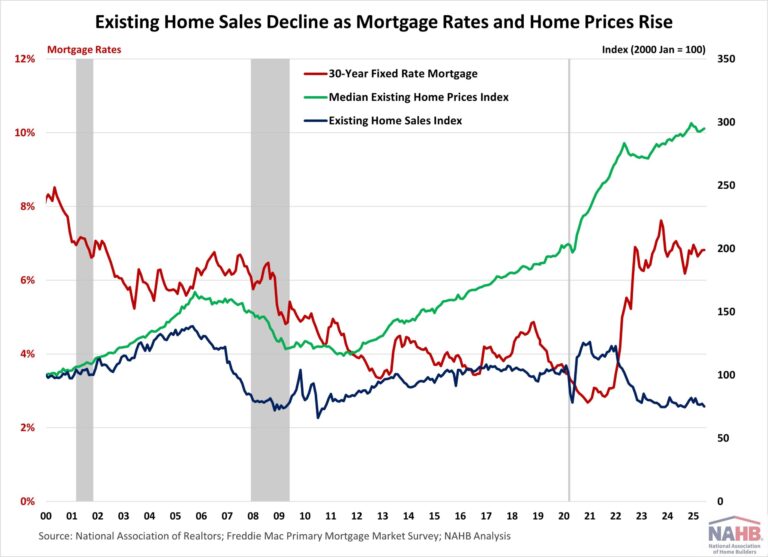

Existing home sales fell to 9-month low in June as home prices hit another monthly record high, according to the National Association of Realtors (NAR). Sluggish pace of sales suggest that higher mortgage rates and elevated home prices are continuing to sideline buyers, despite improved inventory conditions.

Mortgage rates have hovered between 6.5% and 7% due to ongoing economic and tariff uncertainty this year, prompting the Fed to pause interest rate cuts. With mortgage rates expected to stay above 6% for longer due to an anticipated slower easing pace in 2025, these prolonged higher rates and high home prices would continue to weigh on the market. As such, sales are likely to remain limited in the coming months.

Total existing home sales, including single-family homes, townhomes, condominiums, and co-ops, fell 2.7% to a seasonally adjusted annual rate of 3.93 million in June, the lowest level since October 2024. On a year-over-year basis, sales were unchanged from a year ago.

The existing home inventory level was 1.53 million units in June, down 0.6% from May, but up 15.9% from a year ago. At the current sales rate, June unsold inventory sits at a 4.7-months’ supply, up from 4.6-months in May and 4.0-months in June 2024. Inventory between 4.5 to 6 month’s supply is generally considered a balanced market.

Homes stayed on the market for a median of 27 days in June, unchanged from May but up from 22 days in June 2024.

The first-time buyer share was 30% in June, unchanged from May but up 29% from a year ago.

The June all-cash sales share was 29% of transactions, up from 27% in May and 28% a year ago. All-cash buyers are less affected by changes in interest rates.

The June median sales price of all existing homes was $453,300, up 2.0% from last year. This marked an all-time high for the month of June and the 24th consecutive month of year-over-year increases. The median condominium/co-op price in June was up 0.8% from a year ago at $374,500.  Recent gains for home inventory will put downward pressure on resale home prices in most markets in 2025.

Geographically, three of the four regions experienced a decline in existing home sales in June, with a decrease of 2.2% in the South, 4.0% in the Midwest, and 8.0% in the Northeast. Meanwhile, sales in the West rose 1.4%. On a year-over-year basis, sales were up in the Midwest (2.2%) and the South (1.7%) but were down in the West (-4.1%) and the Northeast (-4.2%).

The Pending Home Sales Index (PHSI) is a forward-looking indicator based on signed contracts. The PHSI rose from 71.3 to 72.6 in May, suggesting a solid labor market is supporting the market despite the elevated mortgage rates. On a year-over-year basis, pending sales were 1.1% higher than a year ago, per National Association of Realtors data.

Discover more from Eye On Housing

Subscribe to get the latest posts sent to your email.


This article was originally published by a eyeonhousing.org . Read the Original article here. .
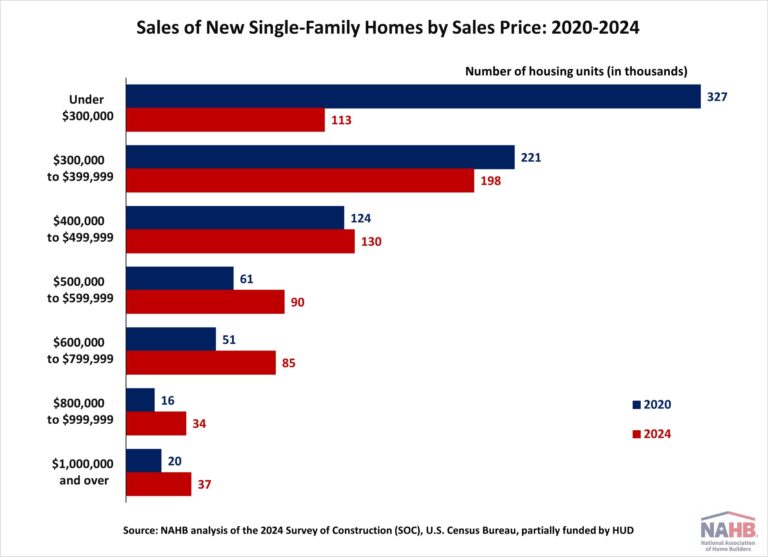

From 2020 to 2024, sales of lower-priced new homes declined significantly as the market moved toward higher-priced segments. Rising construction costs—driven by inflation, supply chain disruptions, and labor shortages—as well as higher regulatory costs, made it increasingly difficult for builders to construct affordable homes. On the other hand, low levels of inventory pushed up the price of new single-family homes, deepening the housing affordability crisis for first-time and middle-income buyers.

National New Home Sales by Sales Price

Data from the U.S. Census’s Survey of Construction (SOC) shows that total sales of new single-family homes declined by 17% during the 2020—2024 period. Meanwhile, the median sales price of new single-family homes increased significantly, rising from $330,900 in 2020 to $420,300 in 2024. This steep rise in sales price has placed additional pressure on prospective home buyers, particularly those seeking homes in the lower-priced segments.

Between 2020 and 2024, the market for new single-family homes experienced significant shifts in the distribution of sales by price range. Most notably, there was a sharp decline in sales of lower-priced homes. Homes priced under $300,000 experienced a 65% decline in sales, while sales of homes priced between $300,000 and $399,999 fell by 10%. In contrast, higher-end segments saw substantial growth, with sales of homes priced between $800,000 and $999,999 more than doubling and those priced at $1,000,000 or more increasing by 85%.

The market share of lower-priced homes declined dramatically. In 2020, homes priced under $300,000 accounted for 40% of the total new single-family home sales, making them a dominant category. By 2024, this category had dropped to the third largest, overtaken by homes in the $300,000—$399,999 and $400,000—$499,999 ranges. Meanwhile, the share of higher-priced homes expanded, reflecting a broader shift toward more expensive construction and away from affordability.

Regional New Home Sales by Sales Price

The regional picture mirrors these national trends, though the magnitude and affected price category vary by geography. Between 2020 and 2024, all four regions—the Northeast, Midwest, South, and West—saw declines in new home sales. The West experienced the steepest drop at 28%, followed by the Midwest at 14%, the South at 13%, and the Northeast at 8%. The declines mainly reflect significant declines in lower-priced home sales.

In the Midwest and South, the declines in new home sales were limited to homes priced under $300,000. In the Northeast and West, where the regions tend to have higher median home prices, sales declines occurred in multiple price categories. The Northeast saw a broader decline in new homes sold under $600,000, while new home sales in the West reported declines in three price categories under $500,000.

Furthermore, all four regions also experienced a decline in the market share of lower-priced homes. In 2020, more than half of the new homes sold in the Midwest and South were priced under $300,000. By 2024, that share had plummeted to just 16% in the Midwest and 23% in the South. The Northeast and West also saw notable shifts, with the share of homes priced between $300,000 and $499,999 dropping sharply over the same period.

Discover more from Eye On Housing

Subscribe to get the latest posts sent to your email.


This article was originally published by a eyeonhousing.org . Read the Original article here. .


Existing home sales rose 0.8% in May but remained near historical lows, according to the National Association of Realtors (NAR). Despite the modest increase, this marks the slowest pace for May since 2009. The sluggish sales suggest higher mortgage rates and elevated home prices continue to sideline buyers even with improved inventory conditions.

Mortgage rates have hovered between 6.5% and 7% due to ongoing economic and tariff uncertainty this year, prompting the Fed to pause interest rate cuts. With mortgage rates expected to stay above 6% for longer due to an anticipated slower easing pace in 2025, these prolonged higher rates and high home prices would continue to weigh on the market. As such, sales are likely to remain limited in the coming months.

Total existing home sales, including single-family homes, townhomes, condominiums, and co-ops, rose 0.8% to a seasonally adjusted annual rate of 4.03 million in May. On a year-over-year basis, sales were 0.7% lower than a year ago.

The first-time buyer share was 30% in May, down from 34% in April and 31% from a year ago.

The existing home inventory level was 1.54 million units in May, up 6.2% from April, and up 20.3% from a year ago. At the current sales rate, May unsold inventory sits at a 4.6-months’ supply, up from 4.4-months in April and 3.8-months in May 2024. Inventory between 4.5 to 6 month’s supply is generally considered a balanced market.

Homes stayed on the market for an average of 27 days in May, down from 29 days in April but up from 24 days in May 2024.

The May all-cash sales share was 27% of transactions, up from 25% in April but down from 28% a year ago. All-cash buyers are less affected by changes in interest rates.

The May median sales price of all existing homes was $422,800, up 1.3% from last year. This marked an all-time high for the month of May and the 23rd consecutive month of year-over-year increases. The median condominium/co-op price in May was up 0.7% from a year ago at $371,300.  Recent gains for home inventory will put downward pressure on resale home prices in most markets in 2025.

Geographically, three of the four regions saw an increase in existing home sales in May, with an increase of 1.7% in the South, 1.0% in the Midwest, and 4.2% in the Northeast. Meanwhile, sales in the West fell 5.4%. On a year-over-year basis, sales were up in the Northeast (4.2%) and the Midwest (1.0%), while sales were down in the South (-0.5%) and the West (-6.7%).

The Pending Home Sales Index (PHSI) is a forward-looking indicator based on signed contracts. The PHSI fell from 76.1 to 71.3 in April, suggesting buyers remained constrained by higher mortgage rates. On a year-over-year basis, pending sales were 2.5% lower than a year ago, per National Association of Realtors data.

Discover more from Eye On Housing

Subscribe to get the latest posts sent to your email.


This article was originally published by a eyeonhousing.org . Read the Original article here. .

House price growth slowed in the first quarter of 2025, partly due to a decline in demand and an increase in supply. Persistent high mortgage rates and increased inventory combined to ease upward pressure on house prices. These factors signaled a cooling market, following rapid gains seen in previous years.

Nationally, according to the quarterly all-transactions House Price Index (HPI) released by the Federal Housing Finance Agency (FHFA), U.S. house prices rose 4.7% in the first quarter of 2025, compared to the first quarter of 2024. This year-over-year (YoY) rate was lower than the previous quarter’s rate of 5.5%. The FHFA’s all-transactions HPI tracks average price changes based on repeat sales and refinancings of the same single-family properties. It offers insights not only at the national level but also across states and metropolitan areas.

Between the first quarter of 2024 and the first quarter of 2025, all 50 states and the District of Columbia experienced positive house price appreciation, ranging from 1.0% to 8.4%. Connecticut and Rhode Island topped the house price appreciation list with an 8.4% gain each, followed by New Jersey with a 7.8% gain. On the opposite end, Louisiana recorded the lowest house price appreciation at 1.0%. Out of all 50 states and the District of Columbia, 26 states exceeded the national YoY growth rate of 4.7%. However, on a quarterly basis, home price appreciation slowed in 39 states compared to the fourth quarter of 2024, highlighting a broad-based deceleration in the housing market.

House price growth widely varied across U.S. metro areas year-over-year, ranging from -7.0% to +23.0%. Rome, GA recorded the largest decline in house prices, whereas Johnstown, PA posted the highest increase over the previous four quarters. In the first quarter of 2025, 28 metro areas, in reddish color on the map above, experienced negative house price appreciation. Meanwhile, 356 metro areas experienced price increases.

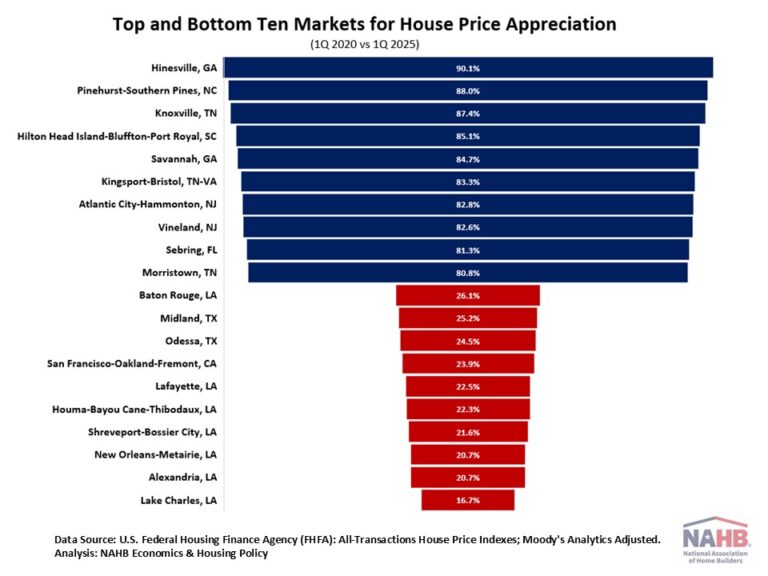
Since the onset of the COVID-19 pandemic, house prices have surged nationally. Between the first quarter of 2020 and the first quarter of 2025, house prices rose by 54.9% nationwide. More than half of metro areas outpaced this national price growth rate of 54.9%.

The table below highlights the top ten and bottom ten markets for house price appreciation during this five-year period. Among all the metro areas, house price appreciation ranged from 16.7% to 90.1%. Hinesville, GA led the nation with the highest house price appreciation. Lake Charles, LA recorded the lowest appreciation, marking its fourth consecutive quarter at the bottom.

Discover more from Eye On Housing

Subscribe to get the latest posts sent to your email.


This article was originally published by a eyeonhousing.org . Read the Original article here. .
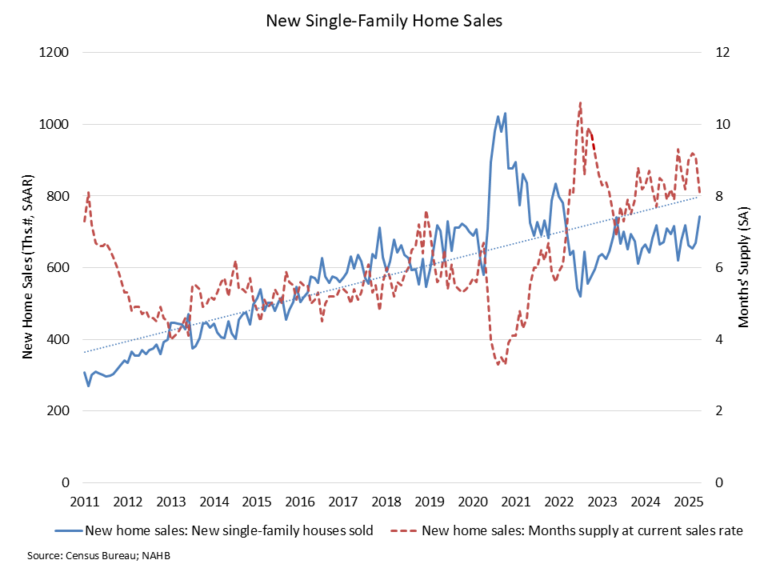

The Census estimate of new home sales posted an unexpected gain in April even as builders and consumers continue to deal with economic uncertainty, elevated interest rates and rising building material costs.

Sales of newly built, single-family homes in April increased 10.9% to a 743,000 seasonally adjusted annual rate from a downwardly revised March number, according to newly released data from the U.S. Department of Housing and Urban Development and the U.S. Census Bureau. The pace of new home sales in April was up 3.3% compared to a year earlier.

The April new home sales figure may be revised as it runs counter to market commentary and the fact that builder sentiment moved markedly lower in May. A less volatile look at the market would be the year-to-date figures, which show new home sales are down 1.2% thus far in 2025 on elevated interest rates, ongoing policy uncertainty and rising construction costs.

Rising inventory in the resale market is likely to place pressure on both pricing and sales activity for home builders during the second half of the year. The April new home data reflects this as new home inventory is leveling off near a half million of residences marketed for sale, up just 1.6% from January.

In April, new home inventory totaled 504,000 residences marketed for sale. While this is 8.6% higher than a year ago, it is only 1.6% higher from January. At the current sales pace, the months’ supply for new home stands at 8.1 compared to 7.7 a year ago.

To further illustrate the challenges builders are facing during the spring home buying season, 61% of home builders are using various kinds of sales incentives, including mortgage rate buydowns, to facilitate sales due to lackluster demand.

A new home sale occurs when a sales contract is signed, or a deposit is accepted. The home can be in any stage of construction: not yet started, under construction or completed. In addition to adjusting for seasonal effects, the April reading of 743,000 units is the number of homes that would sell if this pace continued for the next 12 months. This estimate may be revised lower next month.

Further, when accounting for existing, single-family home sales (a market which is showing rising inventory levels), total home inventory (new plus existing homes) is at a 4.8 months’ supply as of April. This is up from 4.6 from March and up from 4.1 from a year ago. The current reading is the highest since late 2015. Prior analysis indicates that the market will face notable inventory impacts on production as this measure approaches 5.5.

The median new home sale price in April was $407,200, compared to $415,300 a year ago.

Regionally, on a year-to-date basis, new home sales are down 32.5% in the Northeast, 14.8% in the Midwest and 2.4% in the West. Sales are up 5.7% in the South.

Discover more from Eye On Housing

Subscribe to get the latest posts sent to your email.


This article was originally published by a eyeonhousing.org . Read the Original article here. .
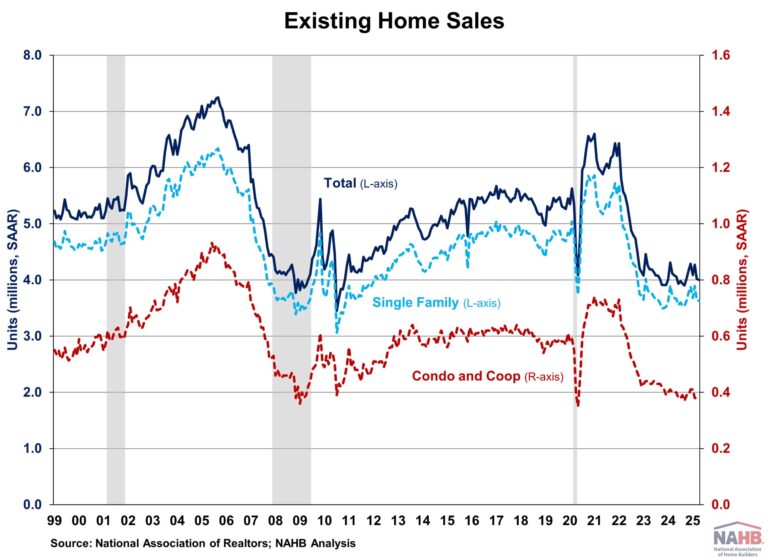

Despite the brief retreat in mortgage rates and increased supply, existing home sales dropped to 7-month low in April, according to the National Association of Realtors (NAR). This unexpected decline suggests buyers’ activity continues to be constrained by economic uncertainty and ongoing affordability challenges even with improved market conditions.

While existing home inventory improved , the market faces headwinds as mortgage rates are expected to stay above 6% for longer due to an anticipated slower easing pace in 2025. These prolonged higher rates may continue to discourage homeowners from trading existing mortgages for new ones with higher rates, keeping supply tight and prices elevated. As such, sales are likely to remain limited in the coming months due to elevated mortgage rates and home prices.

Total existing home sales, including single-family homes, townhomes, condominiums, and co-ops, fell 0.5% to a seasonally adjusted annual rate of 4.00 million in April. On a year-over-year basis, sales were 2.0% lower than a year ago.

The first-time buyer share was 34% in April, up from 32% in March and 33% from a year ago.

The existing home inventory level was 1.45 million units in April, up 9.0% from March, and up 20.8% from a year ago. At the current sales rate, April unsold inventory sits at a 4.4-months’ supply, up from 4.0-months in March and 3.5-months in April 2024. This inventory level remains low compared to balanced market conditions (4.5 to 6 months’ supply), but it increases growing competition for home builders.

Homes stayed on the market for an average of 29 days in April, down from 36 days in March but up from 26 days in April 2024.

The April all-cash sales share was 25% of transactions, down from 26% in March and 28% a year ago. All-cash buyers are less affected by changes in interest rates.

The April median sales price of all existing homes was $414,000, up 1.8% from last year. This marked an all-time high for the month and the 22nd consecutive month of year-over-year increases. The median condominium/co-op price in April was up 1.4% from a year ago at $370,100. This rate of price growth will slow as inventory increases. Existing home sales in April were mixed across the four major regions. Sales fell in the West (-3.9%) and Northeast (-2.0%), rose in the Midwest (2.1%), and remained unchanged in the South. On a year-over-year basis, sales were down in the Midwest (-1.0%), South (-3.2%) and West (-1.3%), while remaining flat in the Northeast.

The Pending Home Sales Index (PHSI) is a forward-looking indicator based on signed contracts. The PHSI jumped from 72.1 to 76.5 in March, the largest monthly increase since December 2023. This increase suggests homebuyers are highly sensitive to even small changes in mortgage rates. On a year-over-year basis, pending sales were 0.6% lower than a year ago, per National Association of Realtors data.

Discover more from Eye On Housing

Subscribe to get the latest posts sent to your email.


This article was originally published by a eyeonhousing.org . Read the Original article here. .
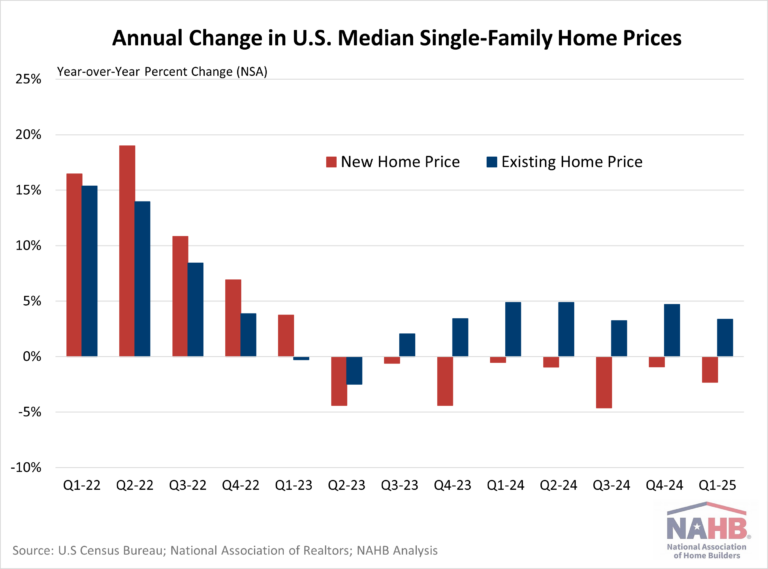

The median price for a new single-family home sold in the first quarter of 2025 was $416,900, a mere $14,600 above the existing home sale price of $402,300, according to U.S. Census Bureau and National Association of Realtors data (not seasonally adjusted – NSA).

Typically, new homes carry a price premium over existing homes. However, the median existing home price exceeded the new home price in the second quarter of 2024 and again in the third quarter of 2024. The first quarter of 2025’s $14,600 price difference is considerably modest by historical standards. Just over two years ago in Q4 2022, the price gap hit a peak with new homes selling for $64,200 more than existing homes. The average difference over the last five years was $26,700, while the decade (2010-2019) prior saw a much wider gap of $66,000.

Both new and existing homes saw dramatic increases in prices post-pandemic due to higher construction costs and limited supply. While overall home prices remain elevated compared to historical norms, new home prices have moderated due to builder business decisions, but existing home prices continue to increase because of lean supply.

The median price for a new single-family home sold in the first quarter of 2025 decreased 2.32% from the previous year. New home prices have continued to experience year-over-year declines for eight consecutive quarters.

Meanwhile, the median price for existing single-family homes increased 3.38% from one year ago. Existing home prices have continued to experience year-over-year increases for seven consecutive quarters.

There are several factors as to why new and existing homes are selling at similar price points. Tight inventory continues to push up prices for existing homes, as many homeowners who secured low mortgage rates during the pandemic are hesitant to sell due to current high interest rates.

Meanwhile, new home pricing is more volatile – prices change due to the types and locations of homes being built. Despite various challenges facing the industry, home builders are adapting to affordability challenges by building on smaller lots, constructing smaller homes, and offering incentives. Additionally, there has been a shift in home building toward the South, associated with less expensive homes because of policy effects.

The least expensive region for homes in the first quarter was the Midwest, with a median price of $367,500 for new homes and $297,800 for existing homes. The South followed closely, with a median new home price of $376,000 and an existing home price of $361,800.

New homes were most expensive in the Northeast with a median price of $784,900, while the West sold at $522,100. However, for existing homes, the West led as the most expensive region at $626,000, followed by the Northeast at $482,700.

The new home price premium was most pronounced in the Northeast, where new homes sold for $302,200 more than existing homes. In contrast, the South saw little difference with a modest $14,200— similar to the national trend. Uniquely, this pattern reversed in the West, where existing homes were $103,900 more than new homes.

Discover more from Eye On Housing

Subscribe to get the latest posts sent to your email.


This article was originally published by a eyeonhousing.org . Read the Original article here. .
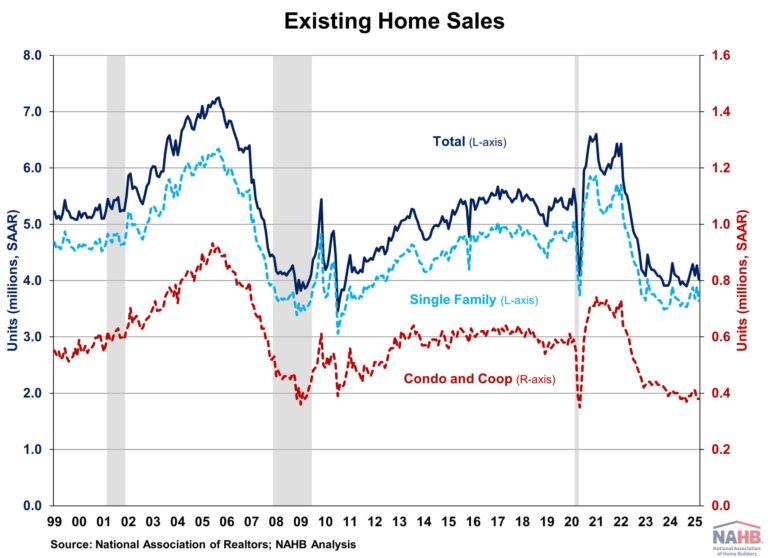

Existing home sales declined in March, according to the National Association of Realtors (NAR), as affordability challenges continued to weigh on the market. For the first time, the median home price surpassed $400,000 for the month of March, underscoring the ongoing pressure on prospective buyers. While mortgage rates have eased slightly, persistent economic uncertainty may continue to limit buyer activity in the near term.

While existing home inventory improves and the Fed continues lowering rates, the market faces headwinds as mortgage rates are expected to stay above 6% for longer due to an anticipated slower easing pace in 2025. These prolonged rates may continue to discourage homeowners from trading existing mortgages for new ones with higher rates, keeping supply tight and prices elevated. As such, sales are likely to remain limited in the coming months due to elevated mortgage rates and home prices.

Total existing home sales, including single-family homes, townhomes, condominiums, and co-ops, declined 5.9% to a seasonally adjusted annual rate of 4.02 million in March. On a year-over-year basis, sales were 2.4% lower than a year ago.

The share of first-time buyers rose to 32% in March, up from 31% in February and unchanged from March 2024.

The existing home inventory level was 1.33 million units in March, up 8.1% from February and 19.8% from a year ago. At the current sales rate, March unsold inventory sits at a 4.0-months’ supply, up from 3.5 months in February and 3.2 months in March 2024. This inventory level remains low compared to balanced market conditions (4.5 to 6 months’ supply) and illustrates the long-run need for more home construction.

Homes stayed on the market for an average of 36 days in March, down from 42 days in February but up from 33 days in March 2024.

The March all-cash sales share was 26% of transactions, down from 32% in February and 28% a year ago.

The March median sales price of all existing homes was $403,700, up 2.7% from last year. This marked the 21st consecutive month of year-over-year increases. The median condominium/co-op price in March was up 1.5% from a year ago at $363,000. This rate of price growth will slow as inventory increases.

In March, existing home sales declined across all four major U.S. regions. The West experienced the steepest drop, with sales falling 9.4%, followed by the South (-5.7%), the Midwest (-5.0%), and the Northeast (-2.0%). On a year-over-year basis, sales rose slightly in the West by 1.3%, declined in the South and Midwest by 4.2% and 3.1% respectively, and remained unchanged in the Northeast.

The Pending Home Sales Index (PHSI) is a forward-looking indicator based on signed contracts. The PHSI fell from 70.6 to an all-time low of 67.3 in February. This decline suggests elevated home prices and higher mortgage rates continue to constrain affordability. On a year-over-year basis, pending sales were 9.9% lower than a year ago, per National Association of Realtors data.

Discover more from Eye On Housing

Subscribe to get the latest posts sent to your email.


This article was originally published by a eyeonhousing.org . Read the Original article here. .
Pin It