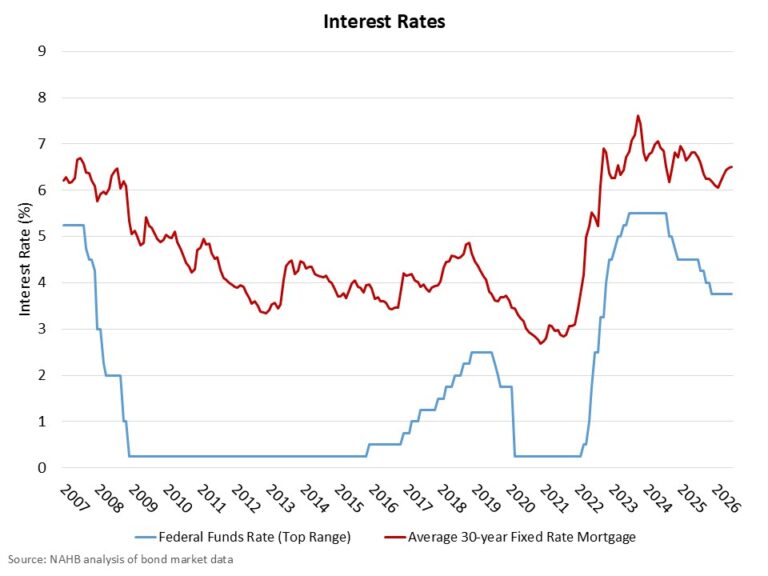
The Federal Reserve held the federal funds rate at a target range of 3.5% to 3.75% at the conclusion of its July policy meeting. There were three dissenting votes on the Federal Open Market Committee (FOMC), all of which supported raising the federal funds rate by 25 basis points. The July monetary policy hold marked the fifth consecutive hold, following 75 basis points of cuts at the end of 2025.
The central bank noted that “economic activity is expanding at a solid pace despite elevated uncertainty.” The Fed also stated that this uncertainty is due in part to the conflict in the Middle East. Additionally, Chairman Warsh noted at his press conference that the economy has shown “impressive resilience” in the face of these headline risks.
In a theme likely to receive growing attention in the quarters ahead, the Fed noted that productivity growth and capital investment are strong. Productivity growth, in particular, suggests future deflationary forces. The Fed also noted that the unemployment rate has experienced little change in recent data.
With respect to inflation, the Fed stated that “inflation remains elevated” relative to the central bank’s two percent target. Importantly, the Fed attributed these inflation challenges to “supply shocks,” including the energy sector.
If you squint a little, this can be seen as a dovish policy message because, while the Fed can affect aggregate demand by tightening monetary policy (as the bond market appears to expect), the central bank cannot effectively address supply shocks with policy. While this should not be interpreted as taking rate hikes off the table, it is an accurate statement of current macroeconomic conditions and many analysts’ views that the Fed cannot solve energy price increases due to war or one-off tariff effects with monetary policy. The same can be said about the impact of the housing deficit on the shelter component of overall inflation, which can only be addressed by other policies that bend the cost curve for housing supply.
From a policy perspective, the Fed noted very clearly, “The Committee will deliver price stability.” The Fed also explicitly emphasized the FOMC’s two percent inflation goal. Chairman Warsh reiterated this two percent goal clearly in his press conference. Moreover, the Fed Chairman noted that nominal long-term interest rates had moved higher since the last meeting, which he attributed to economic data rather than Fed forward guidance.
Indeed, the two-year Treasury rate is now 50 basis points higher than the top target rate for the federal funds rate, indicating that the bond market is expecting Fed tightening. However, one could also argue, as Chairman Warsh appeared to do so at his press conference, that the market has responded to the Fed’s current stance and goals and is delivering an environment in which market forces do the work of tighter policy. Chairman Warsh even suggested that despite the “no change” policy for the July meeting, other changes in market conditions indicate that the July meeting did not result in a policy “pause.”
There were important items not discussed in today’s statement, although they were referenced in today’s press conference. Chairman Warsh has established several task forces looking at Fed communications, forward guidance, data measurement (including how inflation is measured, a topic discussed at the Chairman’s press conference, suggesting new, preferred measures are coming), and other policy-related topics. We will learn more about those efforts down the road.
The Fed will also likely address the status of the central bank’s balance sheet, which can affect long-term interest rates, including mortgage rates, if balance sheet reduction were to be accelerated. These long-term rate changes, set by markets, are in the driver’s seat in the meantime.
This article was originally published by a eyeonhousing.org . Read the Original article here. .