Tag

Headwinds

Browsing


The latest residential housing market report, delayed by the federal government shutdown last fall, indicates that builders have faced significant headwinds in recent months. Elevated mortgage rates earlier in the year have restrained buyer demand and weighed on home building activity, alongside persistently high construction costs.

Overall housing starts declined 4.6 percent in October to a seasonally adjusted annual rate of 1.25 million units, according to the U.S. Department of Housing and Urban Development and the U.S. Census Bureau. This pace reflects the number of housing units builders would begin over the next 12 months if October’s activity were sustained.

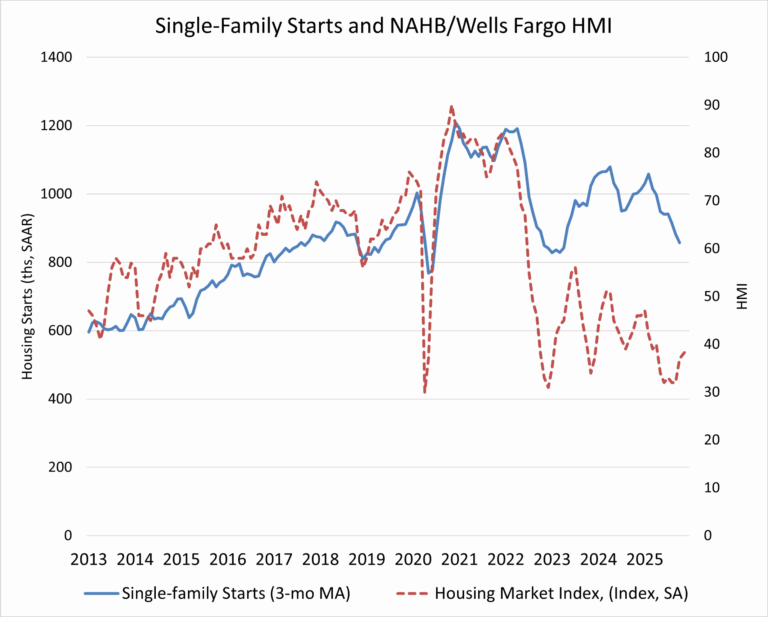
Within the total, single-family starts rose 5.4 percent to a seasonally adjusted annual rate of 874,000 units but remain 7.8 percent lower than a year earlier. On a year-to-date basis, single-family starts are down 7.0 percent. Given recent volatility, the three-month moving average provides a clearer signal, declining to 857,000 units.

In contrast, multifamily starts, which include apartment buildings and condominiums, fell sharply, down 22.0 percent to an annualized pace of 372,000 units. The three-month moving average for multifamily construction has trended lower to 424,000 units, and activity is 7.9 percent below year-ago levels.

Regionally and on a year-to-date basis, combined single-family and multifamily starts increased 9.1 percent in the Midwest and 8.5 percent in the Northeast, while declining 1.9 percent in the West and 4.1 percent in the South.

The total number of housing units under construction stood at 1.3 million in October, down 10.1 percent from a year earlier. Single-family homes under construction fell to 596,000 units, a 7.0 percent year-over-year decline and the lowest level since November 2020. Multifamily units under construction declined to 790,000, down from peaks above 1 million units in December 2023 and 4.0 percent lower than a year ago.

Completions of single-family homes remained relatively strong at an annual rate of about 1 million units, reflecting continued progress in finishing projects already underway and marking a 2.0 percent increase from a year earlier. Multifamily completions, however, dropped sharply, down 41.7 percent year over year to a 377,000-unit pace. On a year-to-date basis, total completions across both sectors are down 9.2 percent.

Overall building permits edged down 0.2 percent in October to a 1.41-million-unit annualized rate. Single-family permits declined 0.5 percent to 876,000 units and are 9.4 percent lower than a year ago, with year-to-date permits down 7.0 percent. Multifamily permits were essentially unchanged at a 536,000-unit pace compared to the previous month and are up 16.3 percent compared to October 2024. Regionally, year-to-date total permits increased 5.9 percent in the Midwest, while declining 3.3 percent in the West, 4.0 percent in the South, and 9.3 percent in the Northeast.


This article was originally published by a eyeonhousing.org . Read the Original article here. .


Market uncertainty exacerbated by the government shutdown along with economic uncertainty stemming from tariffs and rising construction costs kept builder confidence firmly in negative territory in November.

Builder confidence in the market for newly built single-family homes rose one point to 38 in November, according to the National Association of Home Builders (NAHB)/Wells Fargo Housing Market Index (HMI).

While lower mortgage rates are a positive development for affordability conditions, many buyers remain hesitant because of the recent record-long government shutdown and concerns over job security and inflation. We continue to see demand-side weakness as a softening labor market and stretched consumer finances are contributing to a difficult sales environment. After a decline for single-family housing starts in 2025, NAHB is forecasting a slight gain in 2026 as builders continue to report future sales conditions  in marginally positive territory.

In a further sign of ongoing challenges for the housing market, the latest HMI survey also revealed that 41% of builders reported cutting prices in November, a record high in the post-Covid period and the first time this measure has passed 40%. Meanwhile, the average price reduction was 6% in November, the same rate as the previous month. The use of sales incentives was 65% in November, tying the share in September and October.

Derived from a monthly survey that NAHB has been conducting for more than 40 years, the NAHB/Wells Fargo HMI gauges builder perceptions of current single-family home sales and sales expectations for the next six months as “good,” “fair” or “poor.” The survey also asks builders to rate traffic of prospective buyers as “high to very high,” “average” or “low to very low.” Scores for each component are then used to calculate a seasonally adjusted index where any number over 50 indicates that more builders view conditions as good than poor.

The HMI index gauging current sales conditions increased two points to 41, the index measuring future sales fell three points to 51 and the gauge charting traffic of prospective buyers posted a one-point gain to 26.

Looking at the three-month moving averages for regional HMI scores, the Northeast rose two points to 48, the Midwest fell one point to 41, the South increased three points to 34 and the West gained two points to 30. HMI tables can be found at nahb.org/hmi.


This article was originally published by a eyeonhousing.org . Read the Original article here. .

With inflation gradually easing and builders anticipating mortgage rates will moderate in coming months, builder sentiment moved higher for a second consecutive month despite challenging affordability conditions.

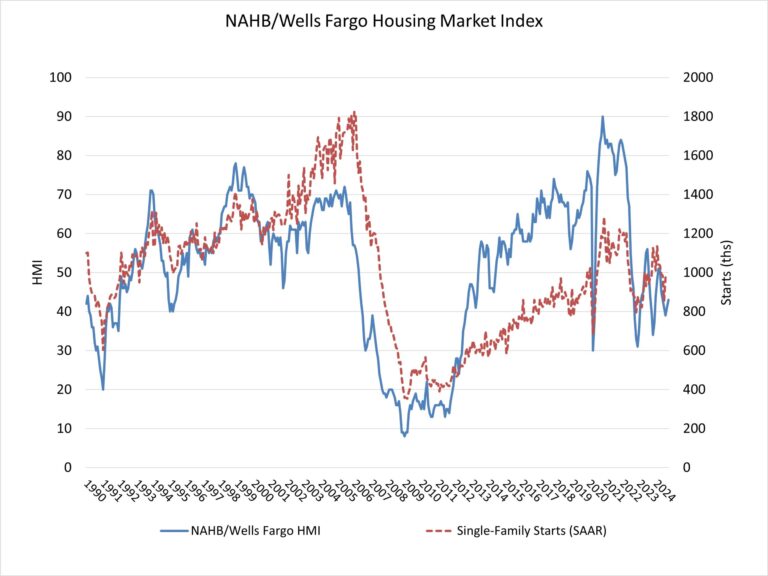
Builder confidence in the market for newly built single-family homes was 43 in October, up two points from a reading of 41 in September, according to the National Association of Home Builders (NAHB)/Wells Fargo Housing Market Index (HMI).

Despite the beginning of the Fed’s easing cycle, many prospective home buyers remain on the sideline waiting for lower interest rates. We are forecasting uneven declines for mortgage interest rates in the coming quarters, which will improve housing demand but place stress on building lot supplies due to tight lending conditions for development and construction loans. However, while housing affordability remains low, builders are feeling more optimistic about 2025 market conditions. A wildcard for the outlook remains the election.

The latest HMI survey also revealed that the share of builders cutting prices held steady at 32% in October, the same rate as last month. Meanwhile, the average price reduction returned to the long-term trend of 6% after dropping to 5% in September. The use of sales incentives was 62% in October, slightly up from 61% in September.

Derived from a monthly survey that NAHB has been conducting for more than 35 years, the NAHB/Wells Fargo HMI gauges builder perceptions of current single-family home sales and sales expectations for the next six months as “good,” “fair” or “poor.” The survey also asks builders to rate traffic of prospective buyers as “high to very high,” “average” or “low to very low.” Scores for each component are then used to calculate a seasonally adjusted index where any number over 50 indicates that more builders view conditions as good than poor.

All three HMI indices were up in October. The index charting current sales conditions rose two points to 47, the component measuring sales expectations in the next six months increased four points to 57 and the gauge charting traffic of prospective buyers posted a two-point gain to 29.

Looking at the three-month moving averages for regional HMI scores, the Northeast increased two points to 51, the Midwest moved two points higher to 41, the South held steady at 41 and the West increased three points to 41. The HMI tables can be found at nahb.org/hmi.

Discover more from Eye On Housing

Subscribe to get the latest posts sent to your email.


This article was originally published by a eyeonhousing.org . Read the Original article here. .
Pin It