Tag

Fourth

Browsing


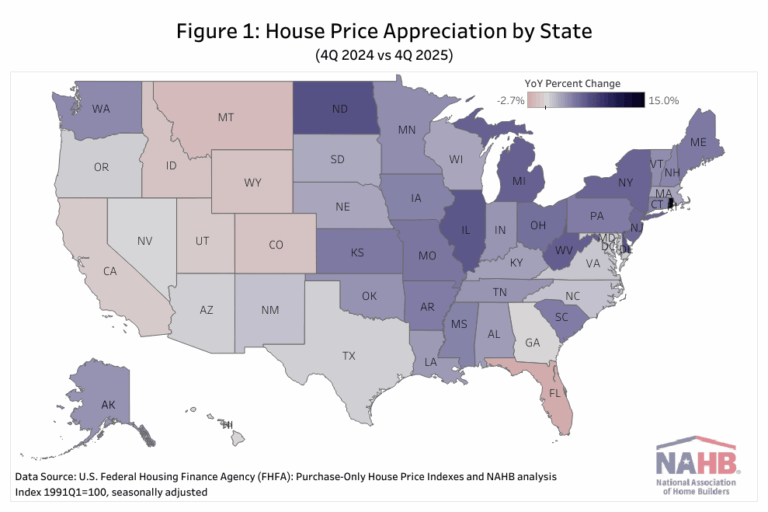
U.S. house prices continued to rise at the close of 2025, though the pace of growth has slowed compared with the rapid gains of previous years. Elevated mortgage rates, affordability challenges, and ongoing economic uncertainty have restrained buyer demand, resulting in wide variations in local housing markets. While some states and metropolitan areas continue to post solid price gains, others are experiencing flat or declining prices.

Nationally, according to the quarterly purchase-only House Price Index (HPI)1 released by the Federal Housing Finance Agency (FHFA), U.S. house prices rose 1.8% in the fourth quarter of 2025, compared to the same period in 2024. This represents the slowest year-over-year (YoY) appreciation since the second quarter of 2012, indicating a cooling in the housing market following more than a decade of robust price growth. On a quarterly basis, appreciation was modest, increasing 0.8% from the third quarter.

The FHFA’s purchase-only HPI tracks average price changes based on more than six million repeat sales transactions on the same single-family properties. It offers insights about house price changes not only at the national level but also across states and metropolitan areas.

At the state level, 43 states experienced positive YoY price growth between the fourth quarter of 2024 and the fourth quarter of 2025, with gains ranging from 0.1% to 6.4%. North Dakota led the nation with a 6.4% gain, followed by Delaware with a 6.3% gain and Illinois with a 6.1% gain. On the opposite end, nine states and the District of Columbia reported negative YoY house price appreciation. Florida posted the most significant price decline at 2.7%. Notably, 33 states exceeded or matched the national YoY growth rate of 1.8%. On a quarterly basis, home prices declined in five states compared to the third quarter of 2025, highlighting softening momentum in select regional markets.

At the metro level, the divergence is even more pronounced. Among the 100 largest U.S. metro areas tracked by FHFA, YoY house price appreciation ranged from a 9.1% decline to an 8.9% increase. Cape Coral-Fort Myers, FL recorded the steepest annual decline, while Allentown-Bethlehem-Easton, PA-NJ posted the strongest annual gains over the previous four quarters. In total, 34 out of the 100 largest metro areas experienced annual price declines in the fourth quarter, while 66 metro areas posted gains.  Many of the strongest performers were concentrated in the Midwest and Northeast, where inventory remains limited and price levels are comparatively affordable. In contrast, several Sun Belt and Mountain West metro areas that saw outsized appreciation earlier in 2021-2022 are now facing flatter or negative growth as affordability pressures weigh on demand.

Note:


This article was originally published by a eyeonhousing.org . Read the Original article here. .

Lending standards for most types of residential mortgages were essentially unchanged but overall demand was weaker in the fourth quarter of 2025, according to the recent release of the Senior Loan Officer Opinion Survey (SLOOS). However, for commercial real estate (CRE) loans, lending standards for multifamily were looser, while standards for construction & development were essentially unchanged. Demand for construction & development loans was stronger, while demand for multifamily loans was essentially unchanged for the quarter. 

After three consecutive 25 basis point cuts to finish 2025, the Federal Reserve decided to maintain its key short-term interest rate (i.e., Federal Funds) unchanged during its first meeting of 2026. Participants on the Federal Open Market Committee (FOMC) continue to assess how to weigh the components of its dual mandate, as inflation continues to be above the stated target of 2% (i.e., the case for higher rates) while the economy is experiencing further deceleration in job growth (i.e., the case for lower rates). Given the current macroeconomic landscape and a change in leadership at the Fed as Jerome Powell’s term as Chair ends in May, NAHB anticipates that any further rate cuts will occur in the latter half of this year.

Residential Mortgages

In the fourth quarter of 2025, three of seven residential mortgage loan categories; GSE-eligible, Qualified Mortgage (QM) non-jumbo non-GSE eligible, and Government, saw a positive net easing index for lending conditions with an additional two (non-QM non-jumbo and QM jumbo) recording a neutral reading (i.e., 0). Subprime and non-QM jumbo loans experienced tighter lending conditions, as evidenced by a negative value, -8.3 and -4.2 respectively.

All seven residential mortgage loan categories reported weaker demand in the fourth quarter of 2025, with the weakest demand coming from subprime loans. This category has experienced weaker demand for 22 consecutive quarters.

Commercial Real Estate (CRE) Loans

For the CRE loan categories, multifamily registered a net easing index of +5.5 for the fourth quarter of 2025, indicating looser credit conditions for the first time since Q1 2022. As a reminder, this was when the Federal Reserve began their aggressive rate hiking path, which saw the Federal Funds rate increase by 525 basis points over a year and a half period. For construction & development loans, the net easing index was -1.8, or essentially unchanged.

The net percentage of banks reporting stronger demand was 8.9% for construction & development loans, with a positive number indicating stronger demand. This is the first time construction & development has been positive since Q4 2021. For multifamily loans, demand was -1.9% in the fourth quarter of 2025, which is essentially unchanged according to the Fed’s classification scheme (i.e., between -5.0% and +5.0%).


This article was originally published by a eyeonhousing.org . Read the Original article here. .

In the third quarter of 2025, the NAHB/Westlake Royal Remodeling Market Index (RMI) posted a reading of 64, increasing four points compared to the previous quarter.

Most remodelers are finding reasonably strong market conditions, even with the normal seasonal slowdown during the holidays.  The major headwinds the industry is experiencing continue to be rising costs and potential customers hesitating due to policy and economic uncertainty.  Demand for remodeling is being supported by an aging housing stock, strong homeowner equity and increasing need for aging-in-place improvements.

The RMI is based on a survey that asks remodelers to rate various aspects of the residential remodeling market “good”, “fair” or “poor.”  Responses from each question are converted to an index that lies on a scale from 0 to 100. An index number above 50 indicates a higher proportion of respondents view conditions as good rather than poor.

Current Conditions

The Remodeling Market Index (RMI) is an average of two major component indices: the Current Conditions Index and the Future Indicators Index. 

The Current Conditions Index is an average of three subcomponents: the current market for large remodeling projects ($50,000 or more), moderately-sized projects ($20,000 to $49,999), and small projects (under $20,000).  In the fourth quarter of 2025, the Current Conditions Index averaged 71, increasing three points from the previous quarter.  All three components increased quarter-over-quarter and remained above the break-even point of 50.  Large remodeling projects saw the largest increase, rising five points to 69, followed by small remodeling projects adding two points to 73, and moderately-sized projects, inching up one point to 70.

Future Indicators

The Future Indicators Index is an average of two subcomponents: the current rate at which leads and inquiries are coming in, and the current backlog of remodeling projects. 

In the fourth quarter of 2025, the Future Indicators Index averaged 56, up four points from the previous quarter.  Both components increased quarter-over-quarter and are above the break-even point of 50.  The component measuring the current rate at which leads and inquiries are coming in rose five points to 54 while the component measuring backlog of remodeling jobs added two points to 58.

For the full set of RMI tables, including regional indices and a complete history for each RMI component, please visit NAHB’s RMI web page.


This article was originally published by a eyeonhousing.org . Read the Original article here. .

Following two straight quarters of deceleration, house price appreciation accelerated slightly in the fourth quarter of 2024 due to the persistent high mortgage rates and low inventory. Although inventories of existing homes have improved from a year ago, the current 3.5-month supply remains below the 4.5- to 6-month supply that considered a balanced housing market.

Nationally, according to the quarterly all-transactions House Price Index (HPI) released by the Federal Housing Finance Agency (FHFA), U.S. house prices rose 5.4% in the fourth quarter of 2024, compared to the fourth quarter of 2023. The year-over-year rate has decreased from a high of 20.6% in the second quarter of 2022, but is higher than the previous quarter’s rate of 5.2%.

The quarterly FHFA HPI not only reports house prices at the national level but also provides insights about house price fluctuations at the state and metro area levels. The FHFA HPI used in this article is the all-transactions index, measuring average price changes in repeat sales or refinancings on the same single-family properties.  

Between the fourth quarter of 2023 and the fourth quarter of 2024, 49 states and the District of Columbia had positive house price appreciation. Vermont topped the house price appreciation list with an 8.9% gain, followed by New Jersey and Connecticut both with 8.3% gains. At the other end, Louisiana had the lowest house price appreciation (+2.1%), while Hawaii was the only state to experience a price decline (-4.3%). Among all 50 states and the District of Columbia, 31 states reached or exceeded the national growth rate of 5.4%. Compared to the third quarter of 2024, 32 out of the 50 states had an acceleration in house price appreciation in the fourth quarter.

House price growth widely varied across U.S. metro areas year-over-year, ranging from -4.9% to +24.7%. In the fourth quarter of 2024, 18 metro areas, in reddish color on the map above, had negative house price appreciation, while the remaining 366 metro areas experienced positive price appreciation. Punta Gorda, FL had the largest decline in house prices, while Cumberland, MD-WV saw the highest increase over the previous four quarters.

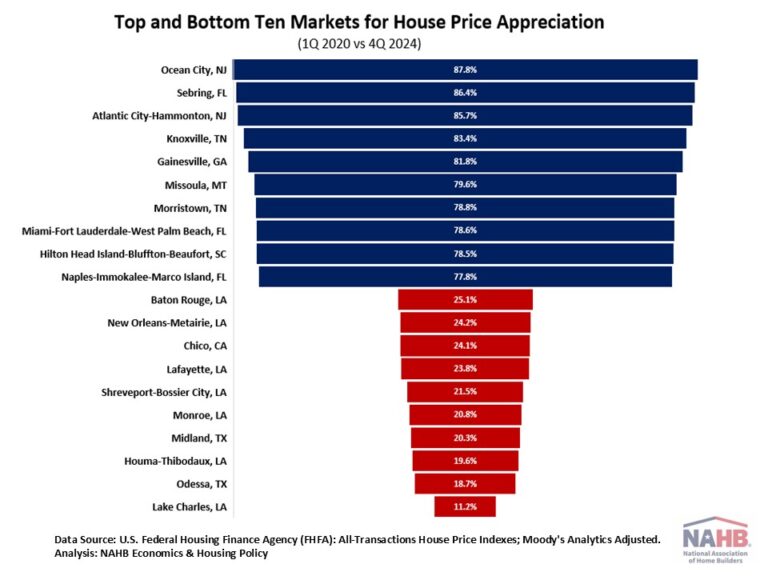
Additionally, house prices have increased dramatically since the COVID-19 pandemic. Nationally, house prices rose 53% between the first quarter of 2020 and the fourth quarter of 2024. More than half of metro areas saw house prices rise by more than the national price growth rate of 53%.

The table below shows the top and bottom ten markets for house price appreciation between the first quarter of 2020 and the fourth quarter of 2024. Among all the metro areas, house price appreciation ranged from 11.2% to 87.8%. Ocean City, NJ experienced the highest house price appreciation. Lake Charles, LA had the lowest appreciation for the third quarter in a row.

Discover more from Eye On Housing

Subscribe to get the latest posts sent to your email.


This article was originally published by a eyeonhousing.org . Read the Original article here. .


Confidence in the market for new multifamily housing reflected mixed results year-over-year in the fourth quarter, according to results from the Multifamily Market Survey (MMS) released today by the National Association of Home Builders (NAHB).  The MMS produces two separate indices.  While the Multifamily Production Index (MPI) increased seven points to 48 year-over-year, it is still below the break-even point of 50.  The Multifamily Occupancy Index (MOI) had a reading of 81, up four points year-over-year.

An MPI below 50 is consistent with the decline in multifamily starts that the sector experienced in both 2023 and 2024.  Multifamily developers are slightly less pessimistic than they were at this time last year, but supply-chain problems and high interest rates remain serious barriers to a stronger market.  NAHB forecasts multifamily construction will decline again in the first half of 2025 before stabilizing toward the end of the year, with the industry supported by a low national unemployment rate.

Reflected by the MOI reading of 81, occupancy rates for owners of rental properties have remained solid even as they are continuing to struggle with high operating costs.

Multifamily Production Index (MPI)

The MPI is a weighted average of four key market segments: three in the built-for-rent market (garden/low-rise, mid/high-rise, and subsidized) and the built-for-sale (or condominium) market.  The survey asks multifamily builders to rate the current conditions as “good”, “fair”, or “poor” for multifamily starts in markets where they are active.  The index and all its components are scaled so that a number above 50 indicates that more respondents report conditions as good rather than poor.

Three of the four components experienced year-over-year increases: the component measuring mid/high-rise units rose 13 points to 39, subsidized units increased 11 points to 52, and garden/low-rise units added one point 52.  The only component to experience a decline year-over-year was built-for-sale units, falling one point to 42.  However, only two MPI components (garden/low-rise and subsidized) were above the break-even point of 50.

Multifamily Occupancy Index (MOI)

The MOI is a weighted average of the three built-for-rent market segments (garden/low-rise, mid/high-rise and subsidized).  The survey asks multifamily builders to rate the current conditions for occupancy of existing rental apartments, in markets where they are active, as “good”, “fair”, or “poor”.  Similar in nature to the MPI, the index and all its components are scaled so that a number above 50 indicates more respondents report that occupancy is good than report it as poor. 

All three components for the MOI experienced year-over-year gains.  The component measuring mid/high-rise units rose 10 points to 74, subsidized units increased by three points to 91, and garden/low-rise units added one point to 81.  All three MOI components were above the break-even point of 50.

The MMS was re-designed last year to produce results that are easier to interpret and consistent with the proven format of other NAHB industry sentiment surveys.  Until there is enough data to seasonally adjust the series, changes in the MMS indices should only be evaluated on a year-over-year basis.

Please visit NAHB’s MMS web page for the full report.

Discover more from Eye On Housing

Subscribe to get the latest posts sent to your email.


This article was originally published by a eyeonhousing.org . Read the Original article here. .

The NAHB/Westlake Royal Remodeling Market Index (RMI) posted a reading of 68 for the fourth quarter of 2024, up five points compared to the previous quarter.

Remodelers are more optimistic about the market than they were earlier in the year, corroborated by NAHB’s recent analysis of home improvement loan applications.  Demand in many parts of the country was stronger than usual for the fall season, especially demand for larger projects, with leads coming in after the uncertainty about the November elections was removed.  Not only did the current conditions index for $50,000-plus projects show the greatest increase during the quarter, but the share of remodelers doing whole house remodeling reached a record high of 62%.  

The RMI is based on a survey that asks remodelers to rate various aspects of the residential remodeling market “good”, “fair” or “poor.”  Responses from each question are converted to an index that lies on a scale from 0 to 100. An index number above 50 indicates a higher proportion of respondents view conditions as good rather than poor.

Current Conditions

The Remodeling Market Index (RMI) is an average of two major component indices: the Current Conditions Index and the Future Indicators Index. 

The Current Conditions Index is an average of three subcomponents: the current market for large remodeling projects ($50,000 or more), moderately sized projects ($20,000 to $49,999), and small projects (under $20,000). In the fourth quarter of 2024, the Current Conditions Index averaged 75, increasing three points from the previous quarter.  All three components remained well above 50 in positive territory: large remodeling projects rose eight points to 75, moderate remodeling projects increased two points to 73, and small remodeling projects inched down one point to 76.

Future Indicators

The Future Indicators Index is an average of two subcomponents: the current rate at which leads and inquiries are coming in and the current backlog of remodeling projects. 

In the fourth quarter of 2024, the Future Indicators Index was 61, up six points from the previous quarter.  The component measuring the current rate at which leads and inquiries are coming jumped nine points to 62.  Meanwhile, the component measuring in the backlog of remodeling jobs rose two points to 59 quarter-over-quarter.

For the full set of RMI tables, including regional indices and a complete history for each RMI component, please visit NAHB’s RMI web page.

Discover more from Eye On Housing

Subscribe to get the latest posts sent to your email.


This article was originally published by a eyeonhousing.org . Read the Original article here. .
Pin It