This article was originally published by a www.houzz.com . Read the Original article here. .

This article was originally published by a www.houzz.com . Read the Original article here. .

Alison Felstead, owner and interior designer at Naibu Design, says, “When designing a living room, I’d recommend you select the sofa first as it is generally the largest piece of furniture in the room. It needs to be proportionate to the space it’s going into, and very comfortable. I will often choose an easy-to-clean fabric in a neutral color that’s simple to update with cushions.”
Giulianna del Popolo, principal designer at GDP Interior Design, adds, “I’d recommend specifying custom-made upholstery pieces from local makers. Not only does this support local manufacturing, but it’s generally easier to customize pieces to your clients’ needs, you can easily follow the progress of the manufacture, there’s often more flexibility with timing, and you won’t have the hassle — or cost — of relying on overseas shipping.
“If you consider the quality and life span of custom pieces, they are not necessarily more expensive than imported retail pieces. Superior frames and fill types guarantee a long-life product. If you choose a piece with clean lines and comfortable proportions, it can last your clients for years, with the option to update the look and feel with new upholstery or filling down the track.”
Should You Go the Custom Route in Your Projects?
This article was originally published by a www.houzz.com . Read the Original article here. .
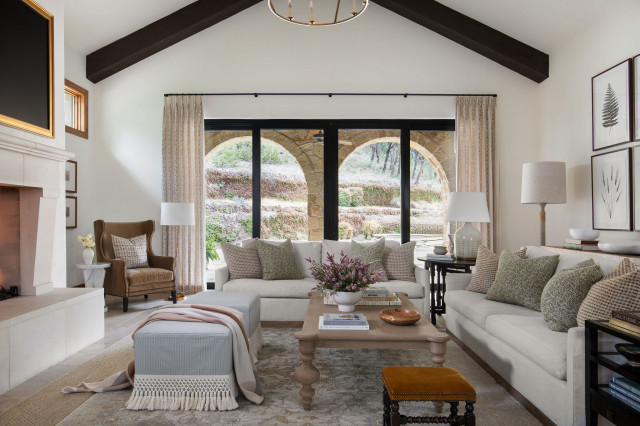
Alison Felstead, owner and interior designer at Naibu Design, says, “When designing a living room, I’d recommend you select the sofa first as it is generally the largest piece of furniture in the room. It needs to be proportionate to the space it’s going into, and very comfortable. I will often choose an easy-to-clean fabric in a neutral color that’s simple to update with cushions.”
Giulianna del Popolo, principal designer at GDP Interior Design, adds, “I’d recommend specifying custom-made upholstery pieces from local makers. Not only does this support local manufacturing, but it’s generally easier to customize pieces to your clients’ needs, you can easily follow the progress of the manufacture, there’s often more flexibility with timing, and you won’t have the hassle — or cost — of relying on overseas shipping.
“If you consider the quality and life span of custom pieces, they are not necessarily more expensive than imported retail pieces. Superior frames and fill types guarantee a long-life product. If you choose a piece with clean lines and comfortable proportions, it can last your clients for years, with the option to update the look and feel with new upholstery or filling down the track.”
Should You Go the Custom Route in Your Projects?
This article was originally published by a www.houzz.com . Read the Original article here. .

Alison Felstead, owner and interior designer at Naibu Design, says, “When designing a living room, I’d recommend you select the sofa first as it is generally the largest piece of furniture in the room. It needs to be proportionate to the space it’s going into, and very comfortable. I will often choose an easy-to-clean fabric in a neutral color that’s simple to update with cushions.”
Giulianna del Popolo, principal designer at GDP Interior Design, adds, “I’d recommend specifying custom-made upholstery pieces from local makers. Not only does this support local manufacturing, but it’s generally easier to customize pieces to your clients’ needs, you can easily follow the progress of the manufacture, there’s often more flexibility with timing, and you won’t have the hassle — or cost — of relying on overseas shipping.
“If you consider the quality and life span of custom pieces, they are not necessarily more expensive than imported retail pieces. Superior frames and fill types guarantee a long-life product. If you choose a piece with clean lines and comfortable proportions, it can last your clients for years, with the option to update the look and feel with new upholstery or filling down the track.”
Should You Go the Custom Route in Your Projects?
This article was originally published by a www.houzz.com . Read the Original article here. .
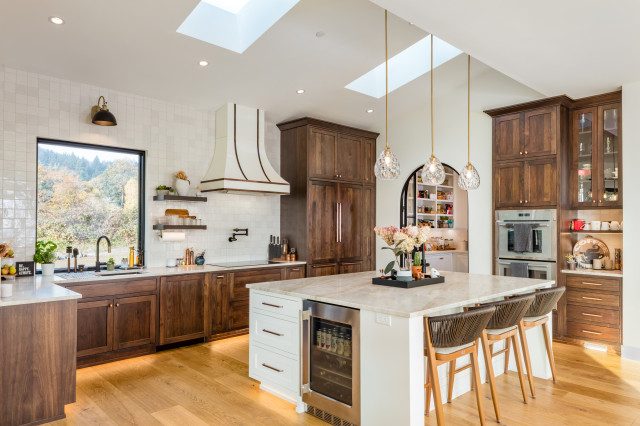
As kitchen islands increase in size, so do the possibilities for customization. So what should homeowners be including to make the most of this popular kitchen feature? We canvassed kitchen design professionals to find out.
This article was originally published by a www.houzz.com . Read the Original article here. .
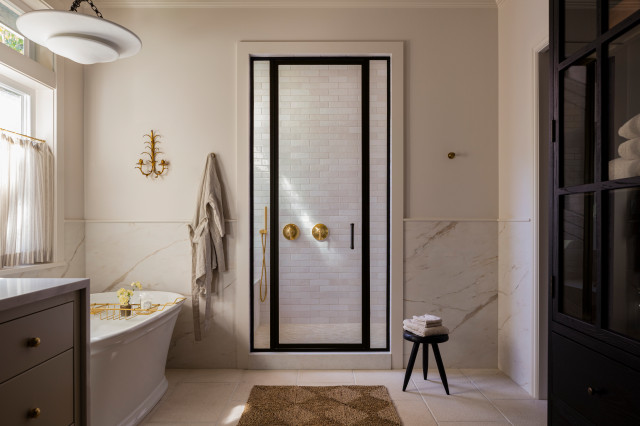
“They had a lot of projects they wanted to work on throughout the house, but their own bathroom was the most important one on their list,” Helgeson says. Accordingly, renovating this space served as phase one in their construction plan. The bathroom’s European-inspired blend of streamlined modern elements and more ornate traditional details established the couple’s style and set the tone for future projects in the home.
This article was originally published by a www.houzz.com . Read the Original article here. .
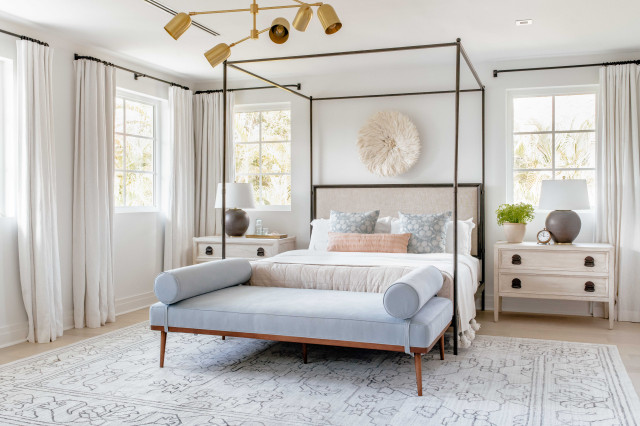
An upholstered headboard versus a hard, solid material will add function to your room. “I always recommend an upholstered headboard,” says designer Heather Hanley of The Tin Roof. “Not only is it an elegant look and timeless, but it’s functional for those of us that love to read in bed, watch TV or work in bed. I love to lean up against the headboard and spread out a project and work while sitting in bed. It’s cozy and seems somewhat like resting, even if it’s not.”
In this Tampa, Florida, bedroom by Debra Ackerbloom, a scalloped channel-tufted headboard elevates the serene style.
This article was originally published by a www.houzz.com . Read the Original article here. .

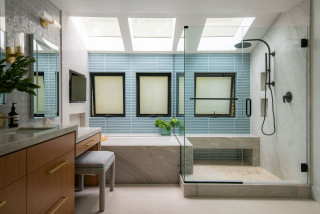
Spa-like features can transform a daily routine into a restorative ritual. Curbless showers, soaking tubs, heated floors and natural materials soothe the senses and create calm, comfortable spaces that rival a day at a luxury spa. Here, design and remodeling pros share the spa-inspired details they used to bring that relaxing vibe to four newly uploaded bathrooms on Houzz.
Designer: Maegan Ayukonchong of M. Swabb Interior Design
Location: Del Mar, California
Size: 234 square feet (22 square meters); 13 by 18 feet
Homeowners’ request. “We fully renovated this entire home, including a complete transformation of the primary bathroom,” says designer Maegan Ayukonchong. “During our discovery phase, the clients shared their vision for an organic spa-like retreat with a few playful design elements. They love taking thoughtful design risks while still maintaining a timeless aesthetic.”
Spa-like features and details. “A soaking tub was high on their wish list, and to elevate the experience even further they were set on incorporating a TV recessed into the slab wall — perfect for unwinding, watching their favorite shows, listening to music and creating a true moment of relaxation,” Ayukonchong says. “A double vanity was also essential, along with a rain shower head and a floating shower bench to bring a clean, elevated feel to the space. Every material was thoughtfully chosen — from the calming pebble stone shower floors to the tranquil rain shower head — to reinforce the serene, spa-inspired atmosphere.”
Other special features. “Throughout the space, we incorporated natural, calming materials to reinforce the serene aesthetic,” Ayukonchong says. “The slab we selected, White Pearl quartzite (for the countertop, tub surround and shower walls and bench) brings a beautiful sense of warmth and texture, while the pebble tile flooring in the shower adds subtle pattern and movement. The limestone bathroom floors elevate comfort even further — they’re fully heated. To introduce a touch of playfulness, we installed a stunning blue Deco tile on the vanity wall. For the vanity itself we chose a rifted white oak finish with clean slab-front doors to keep the lines minimal and modern.”
Designer tip. “Don’t be afraid to mix finishes and tiles,” Ayukonchong says. “You’ll notice on the plumbing fixtures in the shower we went with a matte black to tie in the window details. But on the vanity wall we opted for brass finishes on the wall-mounted faucets and the sconces.”
Ayukonchong uses Houzz Pro software to manage her projects. “The features we use the most are proposals, invoices and the purchase order and tracking features,” she says. “This is so key during the construction phase so we can keep up to date with the items paid, being ordered, tracked for delivery and to mark things that are on-site and ready for installation. Our clients benefit the most from their client dashboard, where they can access the documents shown as paid or pending approval — things like that are great to keep transparency throughout the project.”
See why you should hire a professional who uses Houzz Pro software
Designer: Rachel Brooks of Feinmann
Location: Lexington, Massachusetts
Size: 254 square feet (24 square feet)
Homeowners’ request. “The homeowners, now nearly empty nesters, were ready to move beyond their small, crowded primary bath and create a space they could truly enjoy,” says designer Rachel Brooks. “A freestanding tub was essential, and although the house is traditional, they were drawn to a clean, modern aesthetic that would still feel at home within the architecture.”
Spa-like features and details. “A must-have soaking tub anchors the space,” Brooks says. “Generous walnut cabinetry provides ample storage while adding warmth and richness. The double vanity, complete with his-and-hers sinks, enhances both functionality and comfort, making the bathroom as practical as it is luxurious.” The large walk-in shower features stone-look porcelain tile. The flooring is the same tile in a smaller format, installed in a herringbone pattern. The countertops are soapstone-look engineered quartz.
Other special features. “Natural materials, high-end finishes and thoughtful architectural details like exposed beams and transom windows create an atmosphere of tranquillity and understated elegance,” Brooks says. “Every element was chosen to balance beauty with functionality, resulting in a serene retreat tailored for relaxation and daily rejuvenation.”
Designer tip. “Previously, the bathroom had only a small window, limiting daylight,” Brooks says. “A large-paned window, skylight and transom window in the shower now flood the space with natural light, enhancing the bright and refreshing ambiance.”
Design-build firm Feinmann uses Houzz Pro software.
Cabinetry: Walnut hybrid veneer in Breakwater stain and matte finish, Greenfield Cabinetry; shower and floor tile: Mystic Pearl in polished finish, Elysium Tiles
Find a bathroom designer on Houzz
Designer: Linda Machmeier of Signature Homes of the Chippewa Valley
Location: Jim Falls, Wisconsin
Size: 223 square feet (21 square meters); 13½ by 16½ feet
Homeowners’ request. “[These homeowners wanted] a custom home with an efficient but dramatic primary en suite bath with an enclosed toilet area, ample storage and a heavy, well-made tub,” says designer Linda Machmeier.
Spa-like features and details. “Porcelain tile was installed on a hydronic heated floor for a soft, warm underfoot feel,” Machmeier says. “The shower walls and vanity backsplash tile unify the space and offer an organic yet dramatic feel. The zero-entry shower with wide opening and no door offers accessibility and age-in-place living. This was constructed so that a door could be added later if desired. A freestanding solid-surface tub (partially visible in the foreground) is insulated to keep water warm longer.”
Other special features. “The custom Thorcraft cabinetry is solid walnut with stainless steel legs, dual storage areas and a solid-surface quartz countertop,” Machmeier says. “Above the sink is a Robern Uplift modern medicine cabinet mirror providing storage, additional electrical and a no-fog feature. The mirror front rises vertically for ease of use and access.”
25 Home Design Trends Defining How We’ll Live in 2026
Designer: Jenny Keenan Design
Design-build firm: Buffington Homes
Location: Kiawah Island, South Carolina
Size: 247 square feet (23 square meters); 13 by 19 feet
Homeowners’ request. “The home is an oceanfront property that is surrounded by pine and oak trees,” says Joanna Buffington of design-build firm Buffington Homes. “The homeowners wanted a home that made you feel connected to the outdoors, among the tree canopies, and to enjoy the ocean from every room.”
Spa-like features and details. Large curbless shower with floating bench. Large soaking tub. White oak vanity. Dolomite marble tile flooring. The shower walls are porcelain slabs. “The homeowners wanted a clean palette that’s light and soothing — white stone, soft veining and natural wood accents,” Buffington says. “The finishes are intentionally quiet so the architecture and craftsmanship can be the focal point.”
Other special features. “The large windows were essential to bring in the natural light and to showcase views,” Buffington says. “When privacy is handled thoughtfully, expansive glass brings in natural light, connects you to the outdoors and instantly transforms a simple bathroom into a spa-like retreat.”
Design-build pro tip. “Do not be afraid of white walls with white tile and countertops,” Buffington says. “Layering white paint on the walls alongside white floors and white shower tile can actually make a space feel brighter, larger and more cohesive. The key is to mix in subtle textures and finishes so it makes the room feel intentional.”
Wall paint: White Dove, Benjamin Moore
More on Houzz
Read more stories
Browse photos for ideas
Find home professionals
This article was originally published by a www.houzz.com . Read the Original article here. .

The value of a single-family home is shaped by many factors, but its physical features remain among one of the most influential. Using the latest 2023 American Housing Survey (AHS), this study focuses on which home features genuinely boost single-family detached home values and by how much. Key findings show that the overall square footage of the home and the number of bathrooms stand out as especially strong value drivers, while other features such as the number of bedrooms and the presence of amenities also play a role.
In this first part of our two-part blog series, we focus on the physical features of single-family homes. The second part will explore how location and neighborhood quality further influence home values across the United States.
Home size is one of the strongest value drivers in today’s housing market, as shown in Figure 1. Compared with smaller homes under 1,000 sq. ft., homes between 1,000 and 2,000 sq. ft. are valued about 17% higher. Moving up to homes between 2,000-3,000 sq. ft. increases value by around 30%, while homes with 3,000 sq. ft. or more adds 55% more to the market value. These effects are measured after accounting for differences in region, age of structure, and other key features.
While both the number of bathrooms and bedrooms contribute to single-family home values, the number of bathrooms has a larger impact. Each additional full bathroom increases home value by approximately 32%, compared to about 5% for an additional bedroom, holding the square footage and other features constant. Even a half bathroom brings meaningful returns, adding an estimated 15%.
The age of the home is also a contributing factor to the final market value, even after accounting for other features and neighborhood conditions. Compared to homes built before 2010, homes built between 2010 and 2019 have 13% higher values, and homes built after 2020 are valued 19% higher. These premiums likely reflect improvements in energy efficiency, insulation, and modern building systems that are appealing to more buyers.
Other amenities also bring solid returns, like garages, fireplaces, and centralized air conditioning. Garages add around 10% to home value; Besides a protected parking space, garages offer the flexibility for additional storage or turning it into a workshop/hobby space. Having a fireplace can add value to a home, increasing its value by around 10%. It is appealing to some home buyers, as it not only provides a cozy ambiance, but also could reduce heating costs in some regions. Centralized AC adds about 7% to home value nationwide, but its impact varies across the divisions. In the South, including the South Atlantic, East South Central, and West South divisions, centralized AC adds 23%, 40%, and 48% more values, respectively.
Please click here to be redirected to the full special study.
This article was originally published by a eyeonhousing.org . Read the Original article here. .
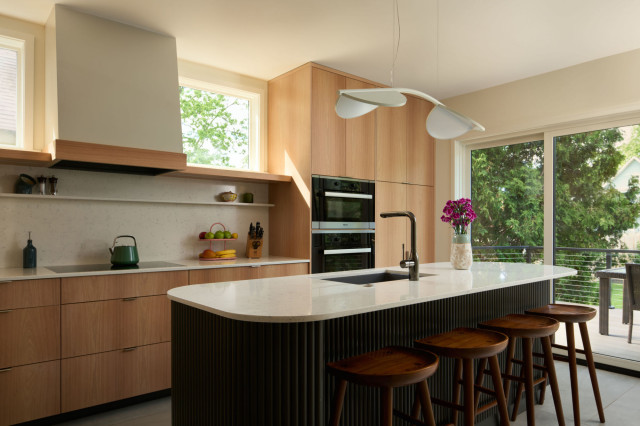
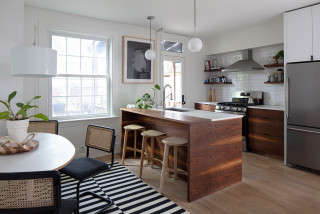
If your kitchen feels cramped, removing all or some of your upper cabinets might be the best option for you. This is a sure way to open up the visual space around the room, making the kitchen appear much larger than it is.
Plenty of light is important in a small space, and upper cabinets can sometimes cast a shadow over the countertops, making the workspace feel darker than necessary. So skipping those uppers can really open a space up. Running tile on the backsplash to the ceiling can also help visually heighten the look of the room.
If you’re worried about losing the storage from ditching upper cabinets, consider a hardworking island, if you have the space, or consult with a design pro to really maximize your lower cabinet storage with pullouts, drawers and other high-functioning components.
This article was originally published by a www.houzz.com . Read the Original article here. .

Alison Felstead, owner and interior designer at Naibu Design, says, “When designing a living room, I’d recommend you select the sofa first as it is generally the largest piece of furniture in the room. It needs to be proportionate to the space it’s going into, and very comfortable. I will often choose an easy-to-clean fabric in a neutral color that’s simple to update with cushions.”
Giulianna del Popolo, principal designer at GDP Interior Design, adds, “I’d recommend specifying custom-made upholstery pieces from local makers. Not only does this support local manufacturing, but it’s generally easier to customize pieces to your clients’ needs, you can easily follow the progress of the manufacture, there’s often more flexibility with timing, and you won’t have the hassle — or cost — of relying on overseas shipping.
“If you consider the quality and life span of custom pieces, they are not necessarily more expensive than imported retail pieces. Superior frames and fill types guarantee a long-life product. If you choose a piece with clean lines and comfortable proportions, it can last your clients for years, with the option to update the look and feel with new upholstery or filling down the track.”
Find an interior designer on Houzz