Tag

Fall

Browsing


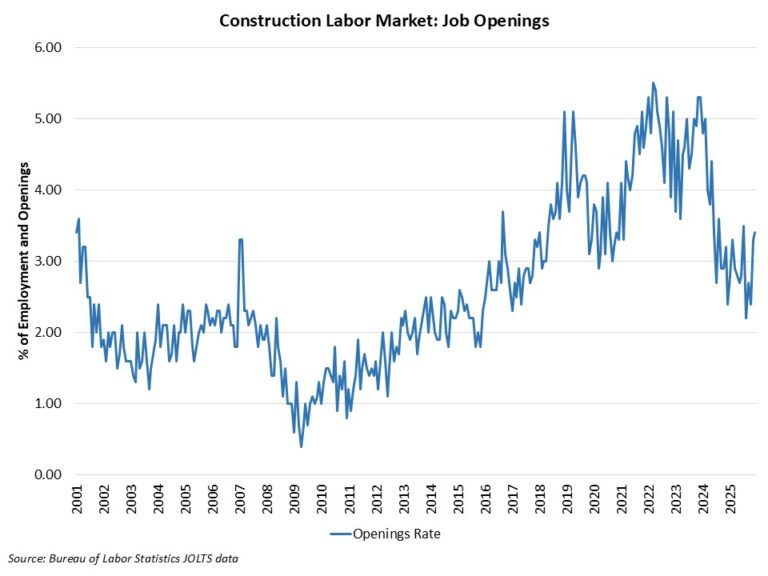
Running counter to the data for the full economy, the count of open, unfilled positions in the construction industry increased in December, per the delayed Bureau of Labor Statistics Job Openings and Labor Turnover Survey (JOLTS). The current level of open jobs is down measurably from two years ago due to declines in construction activity, particularly in housing.

The number of open jobs for the overall economy declined as the labor market weakened at the end of 2025, falling from 6.982 million in November to 6.542 million in December. The December reading was down from a year ago (7.508 million).

Previous NAHB analysis indicated that this number had to fall below eight million on a sustained basis for the Federal Reserve to move forward on interest rate reductions. With estimates remaining below eight million for national job openings, the Fed, in theory, should be able to cut further.

The number of open construction sector jobs increased from 284,000 in November to 292,000 in December. This total is higher compared to a year ago (205,000), although the reading is notably lower than two years ago. The chart below notes the declining trend that has been in place for unfilled construction jobs since the Fed raised the federal funds rate and home building weakened. While home building employment was declining during the second half of 2025, other subsectors of the construction industry have expanded (e.g. data centers).

The construction job openings rate increased to 3.4% in December, higher than the 3.2% rate estimated a year ago.

The layoff rate in construction declined to 1.5% in December. The quits increased to 1.5% for the month.


This article was originally published by a eyeonhousing.org . Read the Original article here. .

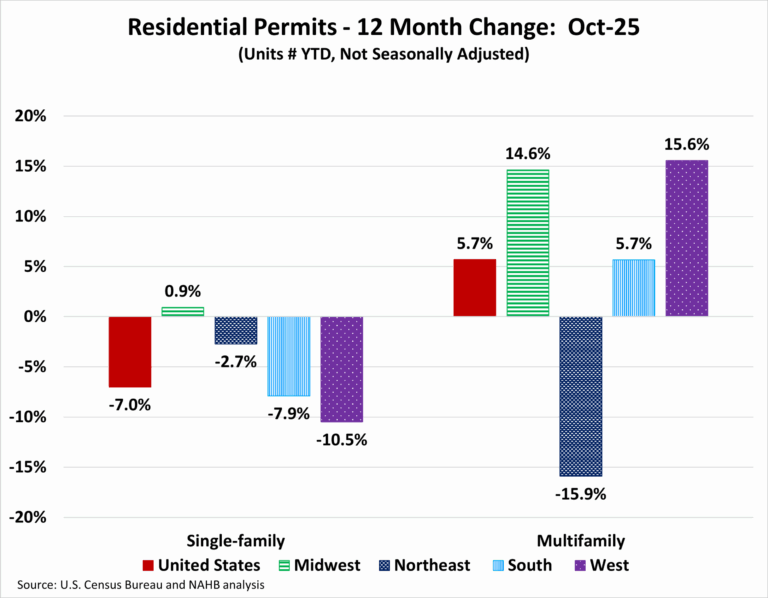
In October, single-family building permits weakened, reflecting continued caution among builders amid affordability constraints and financing challenges. In contrast, multifamily permit activity remained steady and continued to perform relatively well. Together, these trends suggest that while demand for new housing persists, builders are adjusting residential construction activity in response to evolving market conditions. Because permits typically precede construction starts, these patterns offer insight into the near-term outlook for residential building activity.

Over the first ten months of 2025, the number of single-family permits issued nationwide reached 787,122. On a year-over-year basis, this represents a 7.0 percent decline compared with the October 2024 year-to-date total of 846,446. Multifamily permitting activity was stronger, with 426,352 permits issued nationwide, marking a 5.7 percent increase from the same period last year.

Regionally, year-to-date single-family permitting increased in only one of the four regions through October. The Midwest posted a modest gain of 0.9 percent, while activity declined in the Northeast (down 2.7 percent), the South (down 7.9 percent), and the West (down 10.5 percent). Multifamily permits increased in three of the four regions, led by gains in the West (up 15.6 percent), followed by the Midwest (up 14.6 percent), and then the South (up 5.7 percent). The Northeast saw a sharp decline of 15.9 percent, driven largely by a 28.0 percent drop in the New York–Newark–Jersey City metropolitan area.

At the state level, 15 states recorded year-over-year increases in single-family permits between October 2025 year-to-date and October 2024 year-to-date, with gains ranging from 12.6 percent in New Hampshire to 0.8 percent in West Virginia. The remaining 35 states and the District of Columbia reported declines, led by Nevada, which posted the steepest drop at 22.4 percent.

The ten states issuing the highest number of single-family permits accounted for 62.0 percent of all single-family permits issued nationwide. Texas continued to lead the country, with 122,293 permits issued over the first ten months of 2025, although this represented a 10.3 percent decline compared with the same period last year. Florida, the second-highest state, saw permits fall by 9.8 percent, while North Carolina, ranked third, experienced a decline of 5.8 percent.

Between October 2025 year-to-date and October 2024 year-to-date, 29 states and the District of Columbia recorded increases in multifamily building permits, while 21 states experienced declines. Mississippi posted the largest percentage increase, with multifamily permits surging 142.6 percent, rising from 289 to 701 units. In contrast, Maryland recorded the steepest decline, with permits falling 44.5 percent, from 5,265 to 2,922 units.

The ten states issuing the highest number of multifamily permits accounted for 60.2 percent of all multifamily permits issued nationwide. Over the first ten months of 2025, Texas, which issued the most multifamily permits, recorded a modest increase of 2.9 percent. Florida, the second-highest state, posted a stronger gain of 27.8 percent, while California, ranking third, saw multifamily permits rise by 19.8 percent.

At the local level, the following are the ten metropolitan areas with the highest number of single-family permits issued.

Below are the ten local areas with the highest levels of multifamily permitting activity.


This article was originally published by a eyeonhousing.org . Read the Original article here. .


The market value of household real estate assets fell to $48.0 trillion in the third quarter of 2025, according to the most recent release of U.S. Federal Reserve Z.1 Financial Accounts. The third quarter value is 0.7% lower than the second quarter but is 1.5% higher than a year ago.

This measure of market value estimates the value of all owner-occupied real estate nationwide. The calculation combines both repeat-home sales data with estimates of additions to the housing stock, essential measuring both price changes and the change in quantity of housing assets. This approach explains why household real estate wealth can continue to rise even as other measures may show a slowing in home price growth.

Real estate secured liabilities of households’ balance sheets, i.e. mortgages, home equity loans, and HELOCs, increased 0.8% in the third quarter to $13.6 trillion. This level is 2.8% higher compared to the third quarter of 2024.

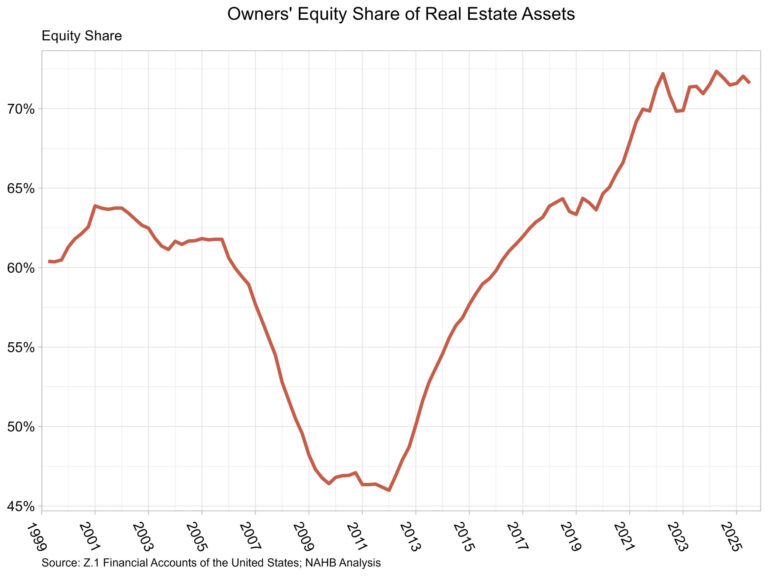
Owners’ equity share of real estate assets was 71.6% in the third quarter, slightly lower than the second quarter due to the decline in real estate asset values. The share in the third quarter of 2024 was 72.0% and has been above 70% for 15 consecutive quarters, the longest stretch since the 1950s. Owners’ equity in real estate was $34.4 trillion in the third quarter.


This article was originally published by a eyeonhousing.org . Read the Original article here. .


5. Cortney Bishop x Amadi

Charleston, South Carolina, designer Cortney Bishop has long partnered with Amadi Carpets to create luxurious custom rugs for clients. This fall, she brought that collaboration to a broader audience with her first official collection for the brand, unveiled at Verellen during High Point Market.

The line includes 14 hand-woven rug styles, including graphic geometric patterns inspired by vintage Swedish textiles and abstract interpretations of flora and fauna. The rugs are crafted in Afghanistan by Amadi’s artisans using hand-dyed wool and wool-silk blends and feature a warm, earthy palette of green, brown, golden and peach tones. Bishop poses here with the beautiful Tilde, a design reminiscent of a vintage Swedish flat-weave (röllakan) rug, beneath her feet.


This article was originally published by a www.houzz.com . Read the Original article here. .


5. Cortney Bishop x Amadi

Charleston, South Carolina, designer Cortney Bishop has long partnered with Amadi Carpets to create luxurious custom rugs for clients. This fall, she brought that collaboration to a broader audience with her first official collection for the brand, unveiled at Verellen during High Point Market.

The line includes 14 hand-woven rug styles, including graphic geometric patterns inspired by vintage Swedish textiles and abstract interpretations of flora and fauna. The rugs are crafted in Afghanistan by Amadi’s artisans using hand-dyed wool and wool-silk blends and feature a warm, earthy palette of green, brown, golden and peach tones. Bishop poses here with the beautiful Tilde, a design reminiscent of a vintage Swedish flat-weave (röllakan) rug, beneath her feet.


This article was originally published by a www.houzz.com . Read the Original article here. .


8. Jewel Box

Window boxes offer another opportunity to bring fall color up close. In this festive design by Garden Stories, a mix of brightly colored perennials, strappy grasses and interesting dried elements looks lovely from both inside and outside the house. Plants and dried ingredients include ‘Indian Summer’ rudbeckia (Rudbeckia hirta ‘Indian Summer’, zones 3 to 7), Japanese forest grass (Hakonechloa macra, zones 5 to 9), ‘Red Rooster’ leatherleaf sedge (Carex buchananii ‘Red Rooster’, zones 6 to 9), ‘Sombrero Hot Coral’ echinacea (Echinacea x hybrida ‘Sombrero Hot Coral’, zones 4 to 9), croton (Codiaeum variegatum, zones 9 to 12), sugar pine cones and miniature lotus pods.

Water requirement: Regular
Light requirement: Full sun


This article was originally published by a www.houzz.com . Read the Original article here. .


As fall settles in, our homes and gardens take on a new character — inviting us to enjoy them in fresh ways. A vibrant pot of chrysanthemums can brighten an overlooked part of your porch, while outdoor lighting or a patio heater can make it feel cozy to linger outside on fall evenings. With just a few thoughtful updates, you can extend the beauty and comfort of your outdoor spaces for the season. Read on for simple, high-impact ideas to make the most of your yard.

The Inspired GardenSave Photo
1. Refresh Container Gardens

Container gardens are an easy way to bring color and seasonal interest to your outdoor spaces. Rework summer containers with fall perennials that are just coming into their own, such as chrysanthemums (Chrysanthemum spp.,USDA zones 5 to 9; find your zone) coneflowers (Echinacea spp., zones 3 to 9), ‘Autumn Joy’ stonecrop (Sedum ‘Autumn Joy’, zones 3 to 8) and ornamental grasses. These hardy selections add color and texture, ensuring containers remain vibrant well into fall.

9 Ways to Refresh Your Summer Container Gardens for Fall

2. Plant a Fruit Tree

For a fall harvest you’ll enjoy for years to come, consider planting an apple, pear, pomegrante or persimmon tree. September and October are the best months to plant fruit trees in mild climates. (Cold-winter climates should wait until late winter or spring.) Soils are still warm, rain is more frequent and trees can settle in over the winter, establishing strong root systems that will fuel growth next spring.

Find a landscape contractor in your area

Andrea Swan – Swan ArchitectureSave Photo
3. Update Entry Lighting

As the days grow shorter, exterior lighting can transform your home’s entry from dark and shadowy to warm and welcoming. Focus on your front entrance, where the impact is greatest. Lighting options include wall-mounted sconces, pendant lights, recessed fixtures, pathway lighting or a layered combination of several sources. If your current lighting setup is effective, fall is a good time to replace bulbs, clean fixtures and ensure everything shines its brightest.

What to Know About Adding Outdoor Lighting

Groff Landscape Design, LLCSave Photo
4. Rethink Outdoor Dining

With a few additions for comfort, your patio or deck can be a welcoming spot for meals and fall gatherings. Layer warm textiles to make seating cozy and inviting, and add soft lighting with string lights or lanterns to create ambiance as dusk falls. Bring in seasonal table settings with gourds, branches and fall colors. If your outdoor table is on an exposed deck or patio, you may want to consider moving it under the covering of a porch or solid-roof shade structure to provide more shelter.

10 Ideas for Styling Your Patio for Outdoor Dining This Fall

Dennis Mayer – PhotographerSave Photo
5. Heat Your Deck or Patio

The addition of outdoor heaters can help extend your enjoyment of outdoor spaces as temperatures dip. Freestanding propane-fueled outdoor heaters (as pictured here) can provide an area of warmth 10 to 12 feet in diameter. You’ll need one heater for a small table or seating area and two to cover an eight-person table.

See why you should hire a professional who uses Houzz Pro software

6. Layer Cozy Throws and Textiles

If you’re not investing in outdoor heaters this season, bring out blankets and quilts for warmth. Tuck them into a basket near the door or drape them over chairs for family members and guests to enjoy. To further increase coziness in your outdoor seating area, consider adding a textured outdoor rug to define the space and create warmth underfoot.

New to home remodeling? Learn the basics

ROCHE+ROCHE Landscape ArchitectureSave Photo
7. Keep the Fun Going Outdoors

The end of summer doesn’t mean outdoor fun has to come to a halt. Even as temperatures cool, kids of all ages need space to stay active, explore and burn off energy. Encourage them to get outside by including play and sports equipment in the backyard. Install a swing set, rig up a badminton net or soccer goal and establish a new routine for after school.

Jeremy Allen Garden DesignSave Photo
8. Fill Bare Spots in Garden Beds

Adding a few fall-blooming flowers, ornamental grasses or shrubs with colorful foliage or berries can help add interest for the season. Nurseries should be well stocked this time of year with plenty of seasonal options to choose from.

Don’t have the time for planting? A top dressing of fresh mulch can make garden beds look tidy and insulate bulbs and shallow roots over the winter. Choose a quality bark mulch (avoiding ones with dyes) and spread on garden beds about 2 to 3 inches thick, keeping mulch away from the trunks of trees and large shrubs.

20 Favorite Flowers for the Fall Landscape

Shop for Outdoor Products

Item 1 of 5


This article was originally published by a
www.houzz.com . Read the Original article here. .


Pixa chair by Hugo Charlet

3. Uncurved Seating

Although chairs have been adopting comforting, wraparound shapes with domed curves for a few years, this fair saw the return of sharp, straight lines. That’s one of the things we noticed in creations by young designers, including Hugo Charlet, the young graduate selected by Paris Design Week Factory to showcase his designs for the first time.

The initiative chose to put the spotlight on his Pixa collection, a line of robust, rustic furniture designed for outdoor spaces. Their thick legs and oversized proportions are intriguing, but the manufacturing method also deserves attention. The collection is designed using a unique type of board made from pressure-treated pine for optimal resistance, making manufacturing as straightforward as possible while minimizing off-cuts and waste.


This article was originally published by a www.houzz.com . Read the Original article here. .


Housing permits continued a downhill trend for the fifth month in a row, pointing to a broader residential construction slowdown for 2025. This slowdown is attributed to factors like higher mortgage rates, tariff concerns, and challenges about future housing demand due to economic uncertainty.

Over the first five months of 2025, the total number of single-family permits issued year-to-date (YTD) nationwide reached 404,977. On a year-over-year (YoY) basis, this is a decline of 6.1% over the May 2024 level of 431,196. For multifamily, the total number of permits issued nationwide reached 195,561. This is essentially unchanged from the May 2024 level of 195,932.

Year-to-date ending in May, single-family permits were up in two out of the four regions. The Midwest and the Northeast posted small increases of 0.9% and 0.7% respectively. The South was down by 7.6% and the West was down by 7.4% in single-family permits during this time. For multifamily permits, three out of the four regions posted increases. The Midwest was up by 20.0%, the West was up by 5.2%, and the South was up by 3.5%, Meanwhile, the Northeast declined steeply by 31.2%, driven by the New York-Newark-Jersey City, NY-NJ MSA which declined by 42.0%.

Between May 2025 YTD and May 2024 YTD, 16 states posted an increase in single-family permits. The range of increases spanned 26.2% in Hawaii to 0.4% in Pennsylvania. The remaining 34 states and the District of Columbia reported declines in single-family permits with New Mexico reporting the steepest decline of 24.5%.

The ten states issuing the highest number of single-family permits combined accounted for 63.2% of the total single-family permits issued. Texas, the state with the highest number of single-family permits, issued 66,055 permits over the first five months of 2025; This is a decline of 8.7% compared to the same period last year. The second highest state, Florida, decreased by 12.2%, while the third highest, North Carolina, posted a decline of 3.9%.

Between May 2025 YTD and May 2024 YTD, 27 states recorded growth in multifamily permits, while 23 states and the District of Columbia recorded a decline. Iowa (+168.0%) led the way with a sharp rise in multifamily permits from 781 to 2,093, while Alabama had the biggest decline of 54.7% from 1,676 to 760.

The ten states issuing the highest number of multifamily permits combined accounted for 61.1% of the multifamily permits issued. Over the first five months of 2025, Florida, the state with the highest number of multifamily permits issued, experienced an increase of 14.5%. Texas, the second-highest state in multifamily permits, saw an increase of 12.7%. California, the third largest multifamily issuing state, increased by 1.1%.

At the local level, below are the top ten metro areas that issued the highest number of single-family permits.

For multifamily permits, below are the top ten local areas that issued the highest number of permits.

Discover more from Eye On Housing

Subscribe to get the latest posts sent to your email.


This article was originally published by a eyeonhousing.org . Read the Original article here. .


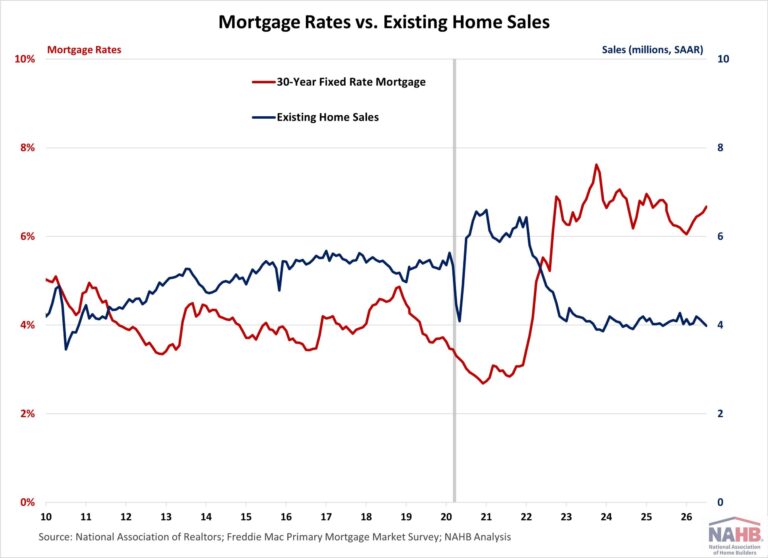
Despite the brief retreat in mortgage rates and increased supply, existing home sales dropped to 7-month low in April, according to the National Association of Realtors (NAR). This unexpected decline suggests buyers’ activity continues to be constrained by economic uncertainty and ongoing affordability challenges even with improved market conditions.

While existing home inventory improved , the market faces headwinds as mortgage rates are expected to stay above 6% for longer due to an anticipated slower easing pace in 2025. These prolonged higher rates may continue to discourage homeowners from trading existing mortgages for new ones with higher rates, keeping supply tight and prices elevated. As such, sales are likely to remain limited in the coming months due to elevated mortgage rates and home prices.

Total existing home sales, including single-family homes, townhomes, condominiums, and co-ops, fell 0.5% to a seasonally adjusted annual rate of 4.00 million in April. On a year-over-year basis, sales were 2.0% lower than a year ago.

The first-time buyer share was 34% in April, up from 32% in March and 33% from a year ago.

The existing home inventory level was 1.45 million units in April, up 9.0% from March, and up 20.8% from a year ago. At the current sales rate, April unsold inventory sits at a 4.4-months’ supply, up from 4.0-months in March and 3.5-months in April 2024. This inventory level remains low compared to balanced market conditions (4.5 to 6 months’ supply), but it increases growing competition for home builders.

Homes stayed on the market for an average of 29 days in April, down from 36 days in March but up from 26 days in April 2024.

The April all-cash sales share was 25% of transactions, down from 26% in March and 28% a year ago. All-cash buyers are less affected by changes in interest rates.

The April median sales price of all existing homes was $414,000, up 1.8% from last year. This marked an all-time high for the month and the 22nd consecutive month of year-over-year increases. The median condominium/co-op price in April was up 1.4% from a year ago at $370,100. This rate of price growth will slow as inventory increases. Existing home sales in April were mixed across the four major regions. Sales fell in the West (-3.9%) and Northeast (-2.0%), rose in the Midwest (2.1%), and remained unchanged in the South. On a year-over-year basis, sales were down in the Midwest (-1.0%), South (-3.2%) and West (-1.3%), while remaining flat in the Northeast.

The Pending Home Sales Index (PHSI) is a forward-looking indicator based on signed contracts. The PHSI jumped from 72.1 to 76.5 in March, the largest monthly increase since December 2023. This increase suggests homebuyers are highly sensitive to even small changes in mortgage rates. On a year-over-year basis, pending sales were 0.6% lower than a year ago, per National Association of Realtors data.

Discover more from Eye On Housing

Subscribe to get the latest posts sent to your email.


This article was originally published by a eyeonhousing.org . Read the Original article here. .

Pin It