Tag

Eye

Browsing


According to the U.S. Census Bureau’s latest estimates, the U.S. resident population grew by 1,781,060 to a total population of 341,784,857. The population grew at a rate of 0.5%, a sharp decline from the near 1.0% growth in 2024. The growth rate was the lowest since 2021 when it grew at 0.2%. The vintage population estimates are released annually and represent the change in the U.S. population between July 1st of 2024 and 2025.

The primary source of population growth continued to be net international migration. For 2025, the level of net international migration was less than half of its level in 2024, falling from 2.7 million to 1.3 million. Natural change, represented as births minus deaths, was up marginally from 514,277 to 518,858 in 2025. The decline in net international migration and stable natural change led to lower population growth nationally between 2024 and 2025.

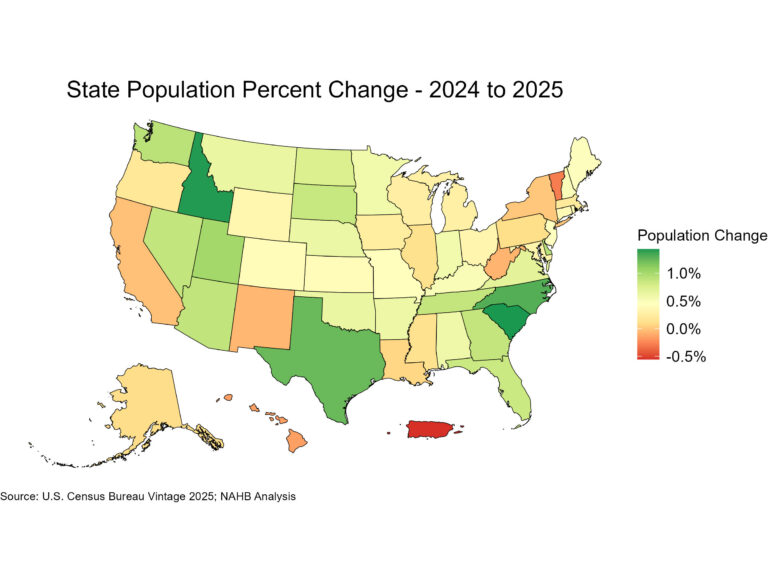
Each region in the U.S. experienced population growth over the period. The South led in population growth at 0.9%, followed by the Midwest at 0.4%. Meanwhile, the West grew 0.3%, while the Northeast grew the least at 0.2%.

At the state level, 45 States and the District of Columbia saw a population increase over the year. South Carolina had the highest population percentage growth, at 1.5%. This was followed by Idaho (1.4%) and North Carolina (1.3%). Numerically, Texas experienced the largest population increase, gaining 391,243. This was followed by Florida at 196,980 and North Carolina at 145,907.

Five states and Puerto Rico experienced population declines. The population of Puerto Rico fell by 0.6%, followed by Vermont at 0.3% and Hawaii at 0.1%. The other states that experienced population declines were West Virgina, New Mexico and California

California remained the most populous state with a population of 39,355,309. The next most populous state was Texas at 31,709,821. To round out the top five states by total population, the proceeding highest were Florida (23,462,518), New York (20,002,427), and Pennsylvania (13,059,432).


This article was originally published by a eyeonhousing.org . Read the Original article here. .


Every quarter, the National Association of Home Builders (NAHB) conducts a survey of professional remodelers. The first part of the survey collects the information required to produce the NAHB/Westlake Royal Remodeling Market Index (RMI). The survey collects information required to produce an overall reading which is calculated by averaging two indices: 1) the Current Conditions Index and 2) the Future Indicators Index. The Current Conditions Index is an average of three components: the current market for large remodeling projects ($50,000 or more), moderately-sized projects (at least $20,000 but less than $50,000) and small projects (under $20,000). The Future Indicators Index is an average of two components: the current rate at which leads and inquiries are coming in, and the current backlog of remodeling projects. Results for Q4 2025 were released earlier this month which can be accessed here.

In addition to the questions required for the RMI, the quarterly survey often also includes a set of “special” questions on a topic of current interest to the remodeling industry. For the fourth quarter 2025 RMI survey, NAHB asked remodelers how common 22 remodeling projects were for their company in 2025 on a scale of 1 to 5 where 1=not common at all and 5=very common. 

Bathroom remodeling was the most common project in 2025, with an average of 4.1 and 73% of remodelers rating it common to very common (4 or 5). Two other remodeling jobs received average ratings above 3.0: kitchen remodeling (3.9) and whole house remodeling (3.5). Over 50% of remodelers rated both projects as common to very common.  Historically, bathroom, kitchen, and whole house remodeling have been the three most common types of projects undertaken by NAHB remodelers.


This article was originally published by a eyeonhousing.org . Read the Original article here. .


Personal income rose 0.3% in November 2025, following a 0.1% increase in October, according to the latest data from the Bureau of Economic Analysis. Gains were largely driven by higher wages and dividend income. However, income growth has cooled noticeably from peaking at a monthly increase of 1.1% in July 2022 to 0.3% now.

Real disposable income, the amount remaining after adjusted for taxes and inflation, was up 0.1% in November, reversing a 0.1% decline in October. On a year-over-year basis, real (inflation-adjusted) disposable income rose 1%, down from a 7.2% year-over-year recent peak recorded in June 2023.

Consumer spending, meanwhile, remained robust but showed signs of softening. Personal consumption expenditures rose 0.5% in November. Real spending, adjusted to remove inflation, increased 0.3% in November, with expenditures on goods climbing 0.6% and spending on services up 0.2%.

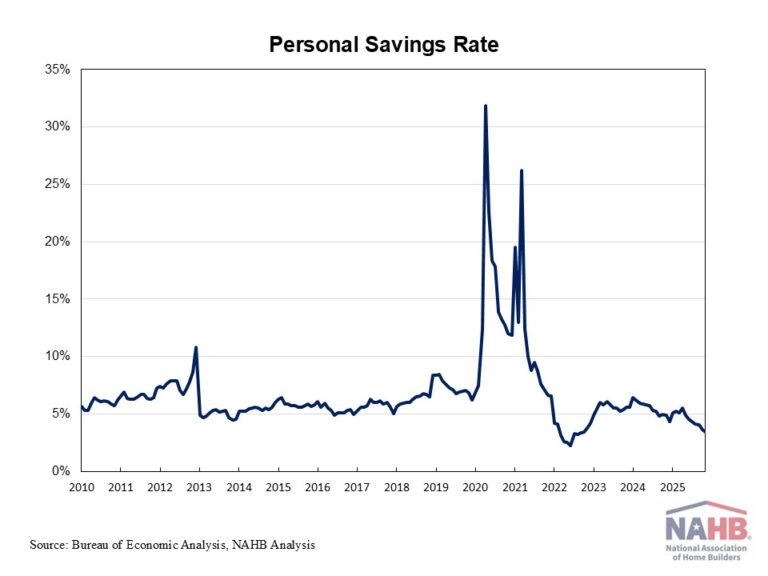
With spending growth outpacing income growth, the personal saving rate decreased to 3.5% in November, the lowest level since late 2022, when core CPI was around the peak. With inflation eroding compensation gains, households are dipping into savings to support spending, especially during the period when some payments were disrupted by the government shutdown. This trend will ultimately lead to a slowing of consumer spending.


This article was originally published by a eyeonhousing.org . Read the Original article here. .


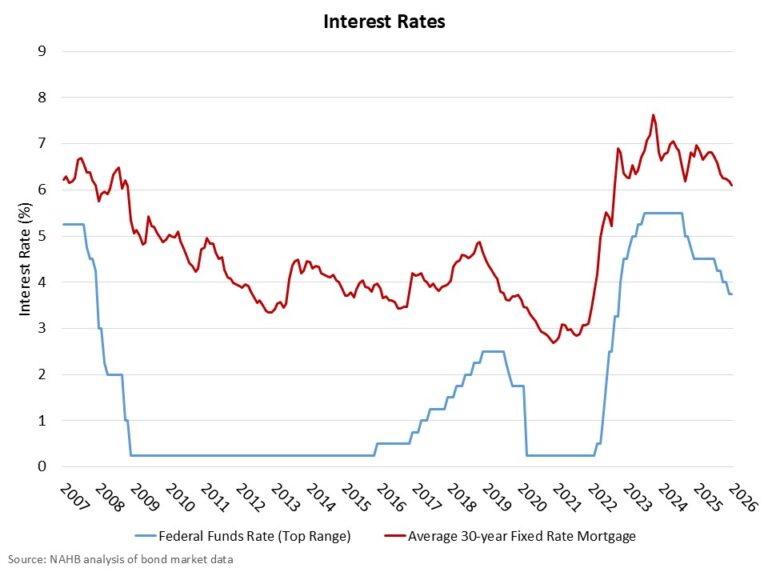
The Fed paused its easing cycle at the conclusion of the January meeting of the Federal Open Market Committee, the central bank’s monetary policy body. The Fed held the short-term federal funds rate at a top rate of 3.75%, the level set in December. This marked the first policy pause since the Fed resumed easing in September of last year.

The Fed characterized the economy as being in solid health. The January statement noted:

Available indicators suggest that economic activity has been expanding at a solid pace. Job gains have remained low, and the unemployment rate has shown some signs of stabilization. Inflation remains somewhat elevated.

The Fed’s statement noted the central bank will continue to consider risks associated with both sides of its dual mandate, to maintain maximum employment and stable prices. It is worth noting that the January statement did not include a reference to a concern of higher risk from a weakening labor market, as was specified in December. Thus, the January statement suggests the Fed sees balanced risks from inflation and current labor market conditions.

There was little forward guidance in today’s statement. There were two dissenting votes (Waller, a Fed Chair candidate, and Miran), who voted for a quarter point cut. Both economists have previously made the argument for more dovish monetary policy due to limited tariff effects and an improving productivity outlook that would mute future inflation pressure.

Chair Powell has two remaining meetings at the helm at the Fed. President Trump has promised an announcement soon regarding the next chair, whose candidates include Governor Waller, White House economist Kevin Hassett, prior Fed Governor Kevin Warsh and Rick Reider from Blackrock. Reider’s prospects appeared to have increased in recent weeks.

NAHB is forecasting two additional rate cuts for 2026, based on expectation of modest easing of inflation and a cooled labor market.  

While reductions for the federal funds rate do not have a direct effect on mortgage interest rates, which remain slightly above 6%, federal funds rate reductions do lower interest rates on builder and developer loans, helping the supply-side of the housing market. Supplying more housing and at lower cost is key to solving the ongoing housing affordability challenge. Lower financing costs are part of the overall solution.


This article was originally published by a eyeonhousing.org . Read the Original article here. .


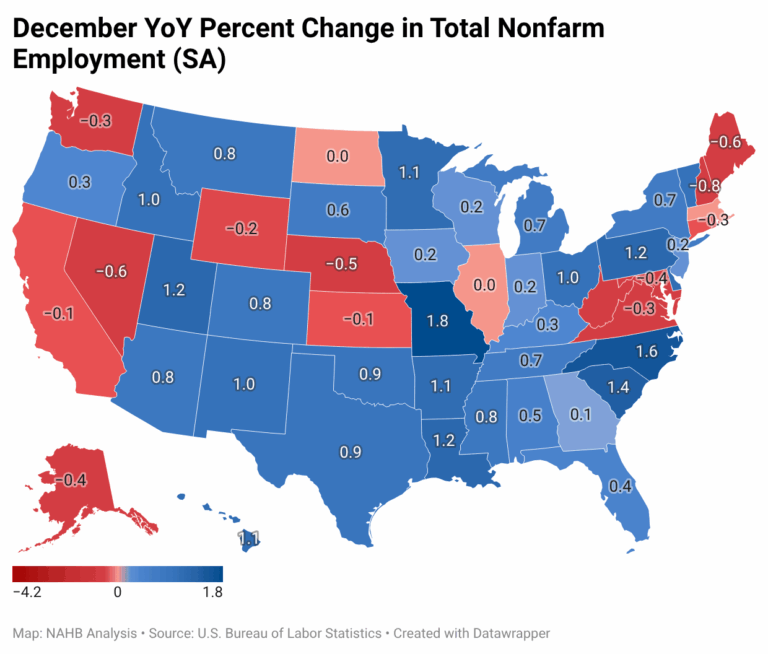
With few exceptions, year-over-year nonfarm employment levels were relatively stable across states at the end of 2025, ranging from a decline of 4.2 percent to a gain of 1.8 percent. Construction employment, however, showed considerably greater dispersion, with declines of up to 9.3 percent in some states and gains approaching 9.0 percent in others.

In December, nonfarm payroll employment increased in 22 states and the District of Columbia compared to November, while 27 states recorded declines; Minnesota reported no change. According to the Bureau of Labor Statistics, total U.S. nonfarm payroll employment rose by 50,000 in December, following substantial downward revisions to the prior two months. For all of 2025, monthly job growth averaged just 49,000, well below the 168,000 average monthly gain recorded in 2024.

On a month-over-month basis, employment gains were led by Texas (+19,700), followed by New York (+19,100) and Illinois (+11,800). In contrast, a total of 53,200 jobs were lost across 27 states, with Indiana posting the largest decline (–7,700). In percentage terms, Montana recorded the strongest increase (+0.4 percent), while Kansas experienced the largest decrease (–0.3 percent) between November and December.

On a year-over-year basis through December, total nonfarm employment increased by 584,000 jobs nationwide, representing a 0.4 percent gain relative to December 2024. Job gains ranged from 1,300 in Massachusetts to 132,500 in Texas. Sixteen states and the District of Columbia collectively lost 115,300 jobs over the past 12 months, with the District of Columbia experiencing the largest decline (–32,400). In percentage terms, job growth ranged from 0.1 percent in Georgia to 1.8 percent in Missouri. Among states with losses, declines ranged from 0.1 percent in California, Kansas, and Connecticut to 0.8 percent in New Hampshire; the District of Columbia, however, recorded a substantially larger decline of 4.2 percent.

Construction Employment

Construction employment —which includes both residential and non-residential construction— showed mixed results in December. Twenty states and the District of Columbia added construction jobs compared to November, while 26 states experienced declines; the remaining four states reported no change. Arizona posted the largest monthly gain, adding 3,900 jobs, while Minnesota recorded the largest loss (–9,900). Overall, the construction sector shed a net 11,000 jobs nationwide in December. In percentage terms, Montana recorded the strongest monthly increase (+3.0 percent), while Minnesota experienced the steepest decline (–6.6 percent).

Year-over-year, U.S. construction employment increased by 14,000 jobs, a 0.2 percent gain compared to December 2024. Texas led all states with an increase of 15,700 construction jobs, while California recorded the largest loss (–19,800). In percentage terms, Hawaii posted the strongest annual growth in construction employment (+8.7 percent), while Nevada experienced the largest decline (–9.3 percent).


This article was originally published by a eyeonhousing.org . Read the Original article here. .

After a rapid expansion of residential swimming pool and spa construction following the pandemic, permit levels in the latest monthly index for December fell to their lowest level since 2020.

The Pool Construction Permit Index, created by NAHB using proprietary data from Construction Monitor, can be used to track pool and spa construction projects nationwide. Perhaps intuitively, the raw data used to create the index has strong seasonality. Most permits are submitted during warmer months, like May and June, while there are typically few pool construction permits collected in November and December.

As of December 2025, pool construction permits were 34.3% lower than the January 2020 reading, our baseline for this index. The index was down 25.5% from the month prior and down 34.7% from one year ago.

As previously mentioned, the raw data displays strong seasonality across months. Due to this seasonality, it is difficult to determine the true trend of residential pool construction. To account for this, a seasonally adjusted index was created to account for the seasonal changes.

For the seasonally adjusted estimates, pool construction permits continued to peak in 2021 but have steadily declined to lower levels. The current December reading is 23.4% lower than our index base of January 2020 and down 26.8% from a month ago and 37.3% lower than last year. The seasonally adjusted data, shown in red below, allows for a clear visualization of how the Pool Construction Permit Index has changed over the past five years. December data was the lowest in the data series.

Geographic Analysis

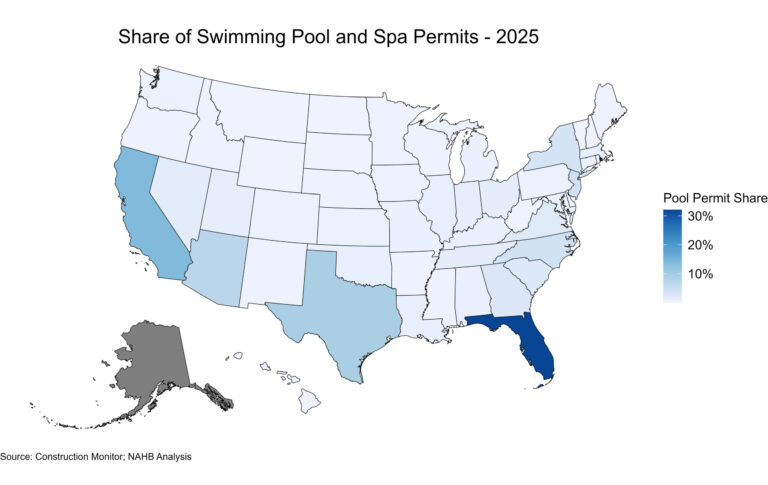
The index is dependent on where pool construction is most likely to take place. For 2025, almost 1/3rd of pool construction permits were in Florida. The next closest state was California with a 14% share of pool construction. New York and New Jersey were the only states in the Northeast to break the top ten in terms of pool permit shares in 2025.


This article was originally published by a eyeonhousing.org . Read the Original article here. .

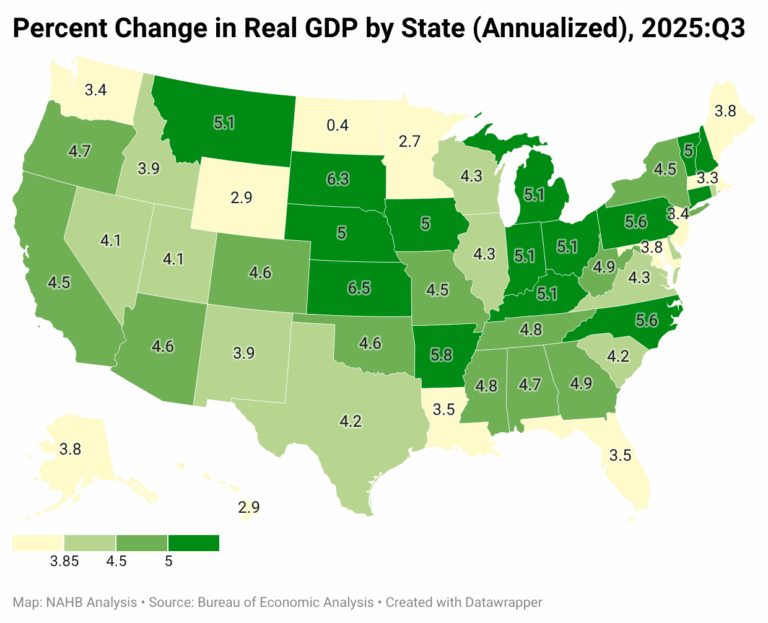
In the third quarter of 2025, the Bureau of Economic Analysis (BEA) reported that real gross domestic product (GDP) expanded nationally, with growth recorded across all states and the District of Columbia. The increase in GDP reflected broad-based economic momentum, supported by contributions from several major industries. At the state level, real GDP growth ranged from a 6.5 percent increase in Kansas to a 0.4 percent increase in North Dakota.

Nationally, real GDP, measured at a seasonally adjusted annual rate, increased 4.4 percent in the third quarter of 2025, led by growth in information; finance and insurance; and professional, scientific, and technical services.

Regionally, real GDP increased in all eight regions between the second and the third quarters of 2025. Growth was widespread, with regional gains ranging from a 4.2 percent increase in the New England region to a 4.8 percent increase in the Great Lakes region, underscoring broad economic strength across the country.

Service-providing sectors, including information, finance and insurance, and professional and business services, were key drivers of growth across many states. Agriculture and related industries played an especially important role in select states, including Kansas and South Dakota, which recorded the two highest growth rates in real GDP during the quarter. Manufacturing activity, particularly in durable goods, also contributed to higher output in several regions, including Arkansas and Connecticut, which posted the third- and fourth-largest increases in real GDP, respectively. While most states experienced strong expansion, a small number of states and the District of Columbia posted more modest gains, highlighting regional differences in economic performance.

At the industry level, information services, finance and insurance, and professional, scientific, and technical services were the most consistent contributors to GDP growth nationwide. However, several sectors weighed on growth in specific regions, including management of companies and enterprises; government and government enterprises; nondurable goods manufacturing; and construction, all of which contracted during the third quarter.

Overall, the third quarter state GDP data point to a broadly expanding U.S. economy, with growth evident across all states and supported by a diverse mix of industries. Although the drivers of growth varied by region, reflecting differences in industrial composition, the widespread gains in economic output underscore resilient economic activity at both the state and national levels and suggest continued momentum in overall GDP.


This article was originally published by a eyeonhousing.org . Read the Original article here. .

Nationally, house prices continued to rise at a modest pace in the third quarter of 2025, as mentioned in our previous quarterly house prices post. However, this national trend masks significant variation across local markets. While many metro areas continued to see house price appreciation, others experienced notable declines following several years of rapid growth.

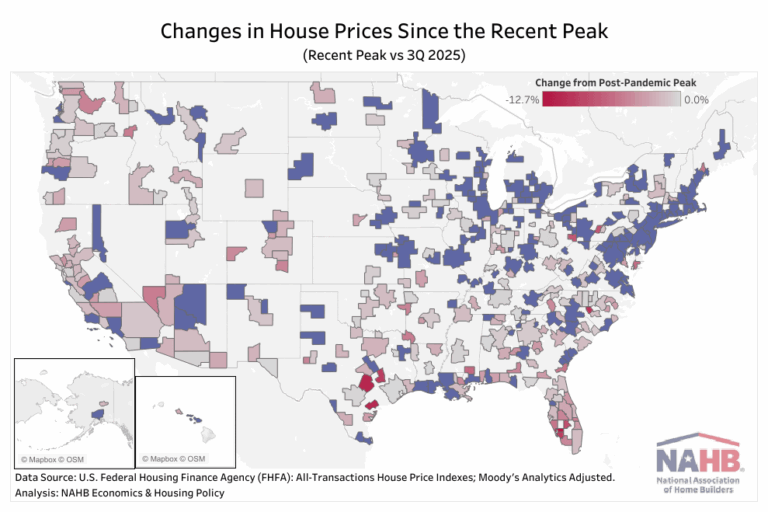
Since the onset of the COVID-19 pandemic, house prices have surged nationwide. Between the first quarter of 2020 and the third quarter of 2025, national house prices climbed 54.9%. Local markets saw broad gains as well, with cumulative appreciation ranging from 18.3% to 88.4%, and 159 metro areas reached their highest recorded house prices in the third quarter of 2025.

Yet despite these increases, more than half of metro areas have now experienced at least some decline from their recent price peak. These declines range from a slight 0.1% dip to a more substantial 12.7% decline, with most of the downward trends beginning in last 2024 or early 2025.

House price declines have been most widespread in the West and South, regions that saw some of the fastest appreciation during the pandemic boom.  Several markets stand out for their significant corrections:

Punta Gorda, FL has experienced the sharpest decline, with prices falling 12.7% since its peak in the fourth quarter of 2022.

Austin–Round Rock–San Marcos, TX, one of the nation’s hottest markets during the pandemic, has seen prices drop 11.3% since reaching a peak in the second quarter of 2022.

Victoria, TX reached its peak more recently in the fourth quarter of 2024 and has since seen prices decline 11.0% over the past three quarters.

In contrast, many metro areas in the Midwest and Northeast have avoided significant price declines. These regions continue to see slower but steady price growth, supported by persistent inventory shortages and solid demand. Their more moderate appreciation during the pandemic has also helped limit the risk of sharp price corrections. Here are some examples (listed in no particular order):

York–Hanover, PA recorded a 6.0% year-over-year increase in house prices in the third quarter of 2025, reflecting stable demand and limited housing supply.

Worcester, MA continues to experience price growth, slowing from the rapid 18.0% growth in the third quarter of 2021 to a still-solid 4.4% year-over-year gain in the third quarter of 2025.

Wausau, WI experienced a robust 9.5% year-over-year increase in home prices, standing out as one of the strongest and most resilient housing markets in the region.

Milwaukee-Waukesha, WI continue to see rising house prices, with growth easing from a peak of 16.7% growth in the second quarter of 2022 to a more sustainable 5.6% year-over-year increase in the third quarter of 2025.


This article was originally published by a eyeonhousing.org . Read the Original article here. .

Private residential construction spending was up 1.3% in October, rebounding from a 1.4% decline in September 2025. This modest gain was primarily driven by increased spending on home improvements. Despite this increase, total spending remained 1.3% lower than a year ago, as the housing sector continues to navigate the economic uncertainty stemming from ongoing tariff concerns and elevated mortgage rates.

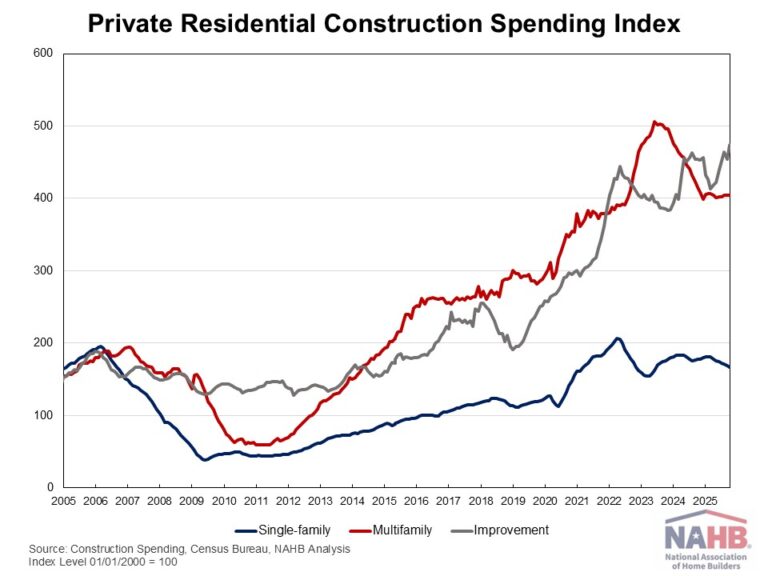
According to the latest U.S. Census construction spending data, single-family construction spending declined 1.3% in October, consistent with the soft builder confidence reflected in the NAHB/Wells Fargo Housing Market Index (HMI). Compared to a year ago, single-family construction spending decreased by 6.1%. Meanwhile, multifamily construction spending edged down 0.2% in October after four consecutive months of modest gains. Compared to a year earlier, multifamily spending was still down 2.8%. Improvement spending (remodeling) rose 4.5% for the month and was up 4.4% compared to a year ago.

The NAHB construction spending index is shown in the graph below. The index illustrates how   spending on single-family construction has slowed since early 2024 under the pressure of elevated interest rates and concerns over building material tariffs. Multifamily construction spending growth has also slowed down after the peak in July 2023, with the index largely plateauing since late 2024. In contrast, improvement spending has been on an upward trend since the beginning of 2025.

Spending on private nonresidential construction was down 2.6% over a year ago. The annual private nonresidential spending decrease was primarily driven by a $23 billion drop in manufacturing construction spending, followed by a $3.8 billion decrease in commercial construction spending.


This article was originally published by a eyeonhousing.org . Read the Original article here. .

In October, single-family building permits weakened, reflecting continued caution among builders amid affordability constraints and financing challenges. In contrast, multifamily permit activity remained steady and continued to perform relatively well. Together, these trends suggest that while demand for new housing persists, builders are adjusting residential construction activity in response to evolving market conditions. Because permits typically precede construction starts, these patterns offer insight into the near-term outlook for residential building activity.

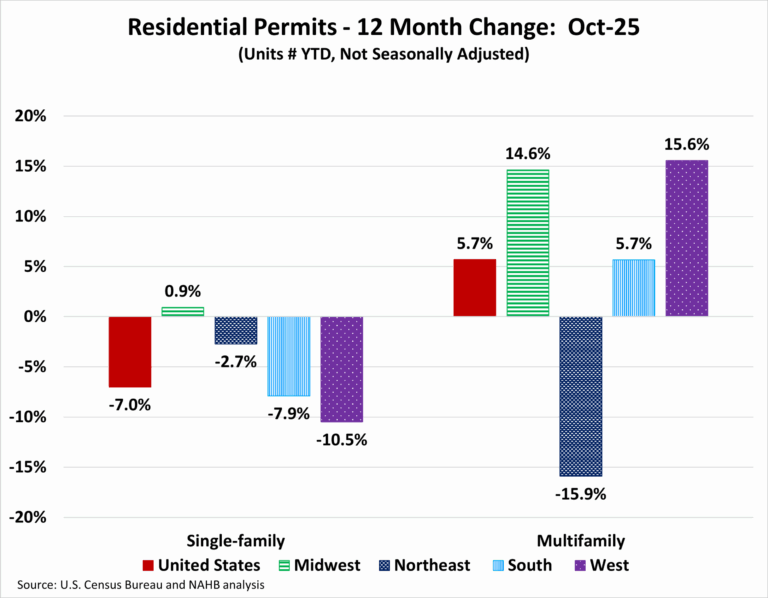
Over the first ten months of 2025, the number of single-family permits issued nationwide reached 787,122. On a year-over-year basis, this represents a 7.0 percent decline compared with the October 2024 year-to-date total of 846,446. Multifamily permitting activity was stronger, with 426,352 permits issued nationwide, marking a 5.7 percent increase from the same period last year.

Regionally, year-to-date single-family permitting increased in only one of the four regions through October. The Midwest posted a modest gain of 0.9 percent, while activity declined in the Northeast (down 2.7 percent), the South (down 7.9 percent), and the West (down 10.5 percent). Multifamily permits increased in three of the four regions, led by gains in the West (up 15.6 percent), followed by the Midwest (up 14.6 percent), and then the South (up 5.7 percent). The Northeast saw a sharp decline of 15.9 percent, driven largely by a 28.0 percent drop in the New York–Newark–Jersey City metropolitan area.

At the state level, 15 states recorded year-over-year increases in single-family permits between October 2025 year-to-date and October 2024 year-to-date, with gains ranging from 12.6 percent in New Hampshire to 0.8 percent in West Virginia. The remaining 35 states and the District of Columbia reported declines, led by Nevada, which posted the steepest drop at 22.4 percent.

The ten states issuing the highest number of single-family permits accounted for 62.0 percent of all single-family permits issued nationwide. Texas continued to lead the country, with 122,293 permits issued over the first ten months of 2025, although this represented a 10.3 percent decline compared with the same period last year. Florida, the second-highest state, saw permits fall by 9.8 percent, while North Carolina, ranked third, experienced a decline of 5.8 percent.

Between October 2025 year-to-date and October 2024 year-to-date, 29 states and the District of Columbia recorded increases in multifamily building permits, while 21 states experienced declines. Mississippi posted the largest percentage increase, with multifamily permits surging 142.6 percent, rising from 289 to 701 units. In contrast, Maryland recorded the steepest decline, with permits falling 44.5 percent, from 5,265 to 2,922 units.

The ten states issuing the highest number of multifamily permits accounted for 60.2 percent of all multifamily permits issued nationwide. Over the first ten months of 2025, Texas, which issued the most multifamily permits, recorded a modest increase of 2.9 percent. Florida, the second-highest state, posted a stronger gain of 27.8 percent, while California, ranking third, saw multifamily permits rise by 19.8 percent.

At the local level, the following are the ten metropolitan areas with the highest number of single-family permits issued.

Below are the ten local areas with the highest levels of multifamily permitting activity.


This article was originally published by a eyeonhousing.org . Read the Original article here. .
Pin It