Home building trends diverged across geographies in the second quarter of 2026. According to the Home Building Geography Index (HBGI), single-family construction declined in nearly all geographic categories, although the contraction eased in most markets from the first quarter. Multifamily construction expanded across six of the seven categories, with activity increasingly concentrated in large metro core and suburban counties.
Single-Family
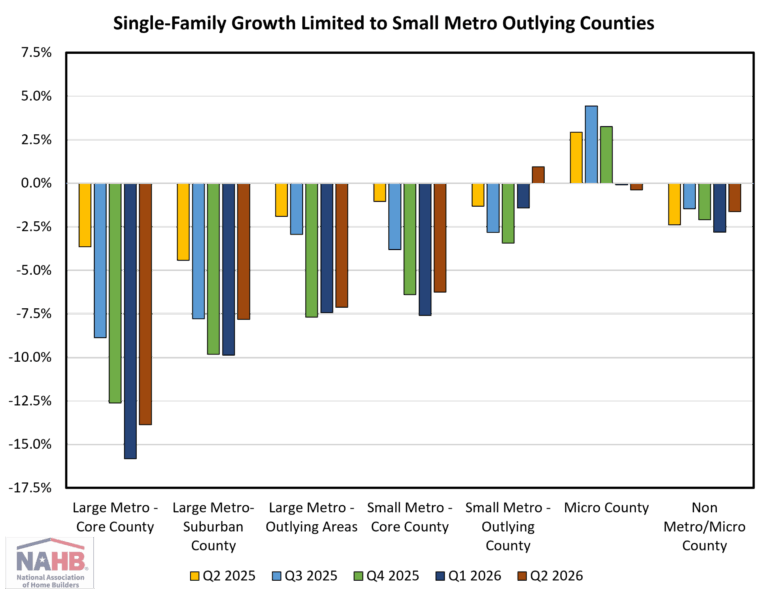
Single-family construction declined in six of the seven geographic categories in the second quarter. However, the downturn in single-family construction in the second quarter eased as these geographies contracted at a slower pace from the previous quarter.
Large metro core counties recorded the steepest decline, falling 13.9% and marking the fifth consecutive quarter of decline. This was an improvement from the 15.8% decline in the first quarter. Outlying counties in small metro areas were the only market to return to growth, increasing a modest 0.9% following four consecutive quarterly declines.
The geographic composition of single-family construction continued to shift toward smaller and less densely populated markets. Large metro core counties experienced the largest market share decline, falling 1.3 percentage points from a year earlier to reach another new low point at 14.6%. By contrast, small metro outlying counties posted the largest gain, increasing 0.8 percentage point to 10.9%.
Small metro core counties remained the largest single-family market, accounting for 29.4% of construction, followed by large metro suburban counties at 24.0%.
Multifamily
Multifamily construction expanded in all markets except large metro outlying counties. Large metro core counties increased 11.6%, recording three-quarters of consecutive growth. Compared to the previous quarter, the pace of increase has slowed but the market still recorded the strongest growth among all geographies.
Large metro suburban counties also followed a similar pattern, posting a 7.9% increase, although growth has slowed from the prior quarter. In contrast, large metro outlying counties declined 15.9% and were the only market that contracted for the multifamily sector.
Non-metro/micro counties posted the clearest acceleration, with growth rising to 10.3%, although these areas accounted for only 1.2% of multifamily construction.
Multifamily market share continued to shift toward large metropolitan areas. Large metro core counties gained 1.6 percentage points from a year earlier to reach 35.4%, while large metro suburban counties gained 0.5 percentage points to reach 27.3%. Together, these markets accounted for 62.7% of multifamily construction.
The second quarter of 2026 HBGI data along with an interactive HBGI map can be found at https://nahb.org/hbgi.
This article was originally published by a eyeonhousing.org . Read the Original article here. .